Everyone's pitching AI. Nobody's proving it works for YOUR business.
Vendors promise transformation but get vague on costs, timelines, and results.
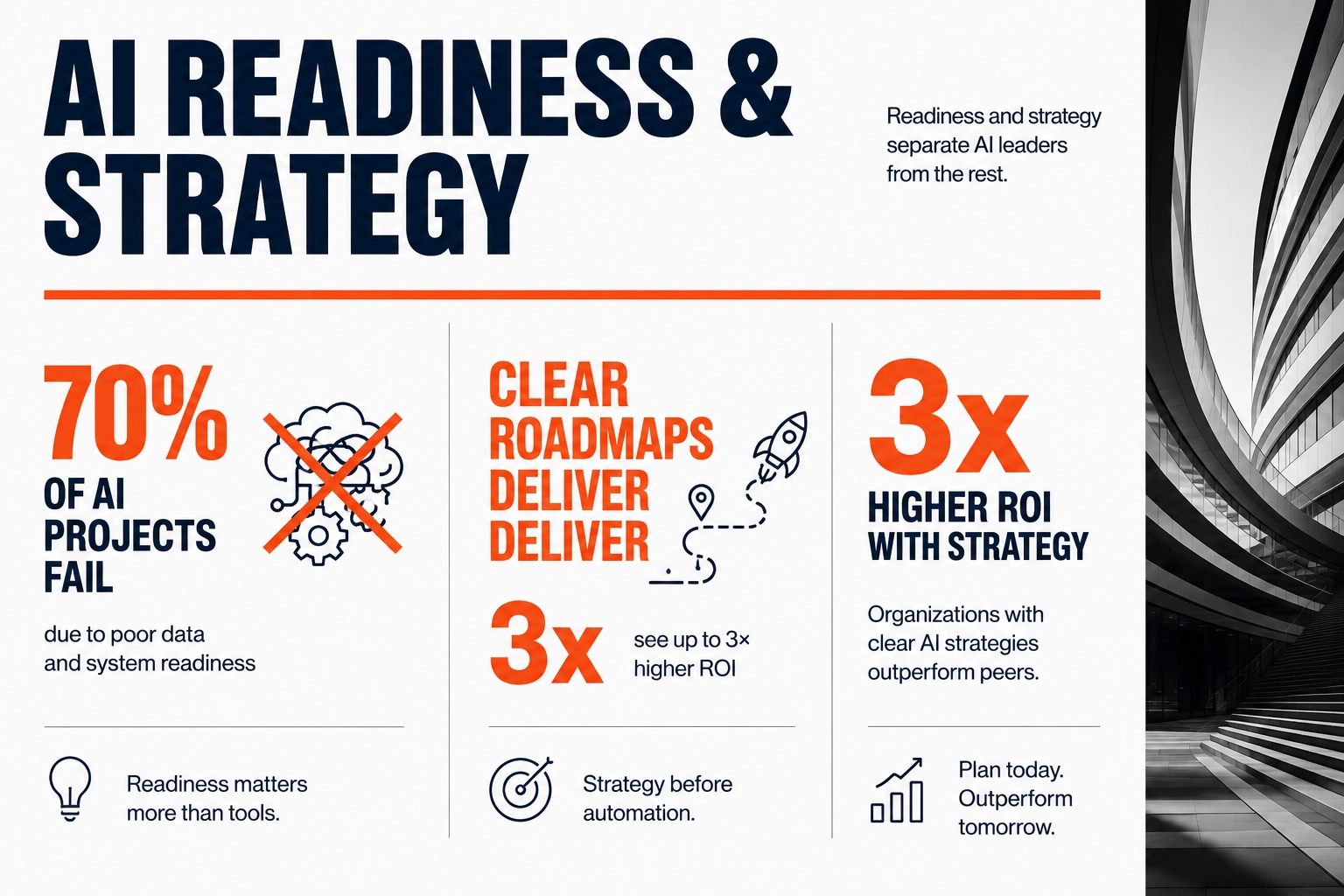
85% of AI projects fail—not because AI doesn't work, but because companies implement it wrong: wrong places, bad data, problems that don't need AI.
We assess where AI creates real value in your operations and where it wastes money. Our job is truth, not sales.
Companies assessing readiness first see 3x higher success rates and 60% lower costs.

Buying AI without a real need
Companies follow trends, not problems. The result is expensive tools that deliver little value.
Data not ready
AI only works with clean, reliable data. Messy systems lead to bad predictions and poor results.
No clear success goal
Without defined metrics, no one knows if AI is helping or wasting money.
The real cost
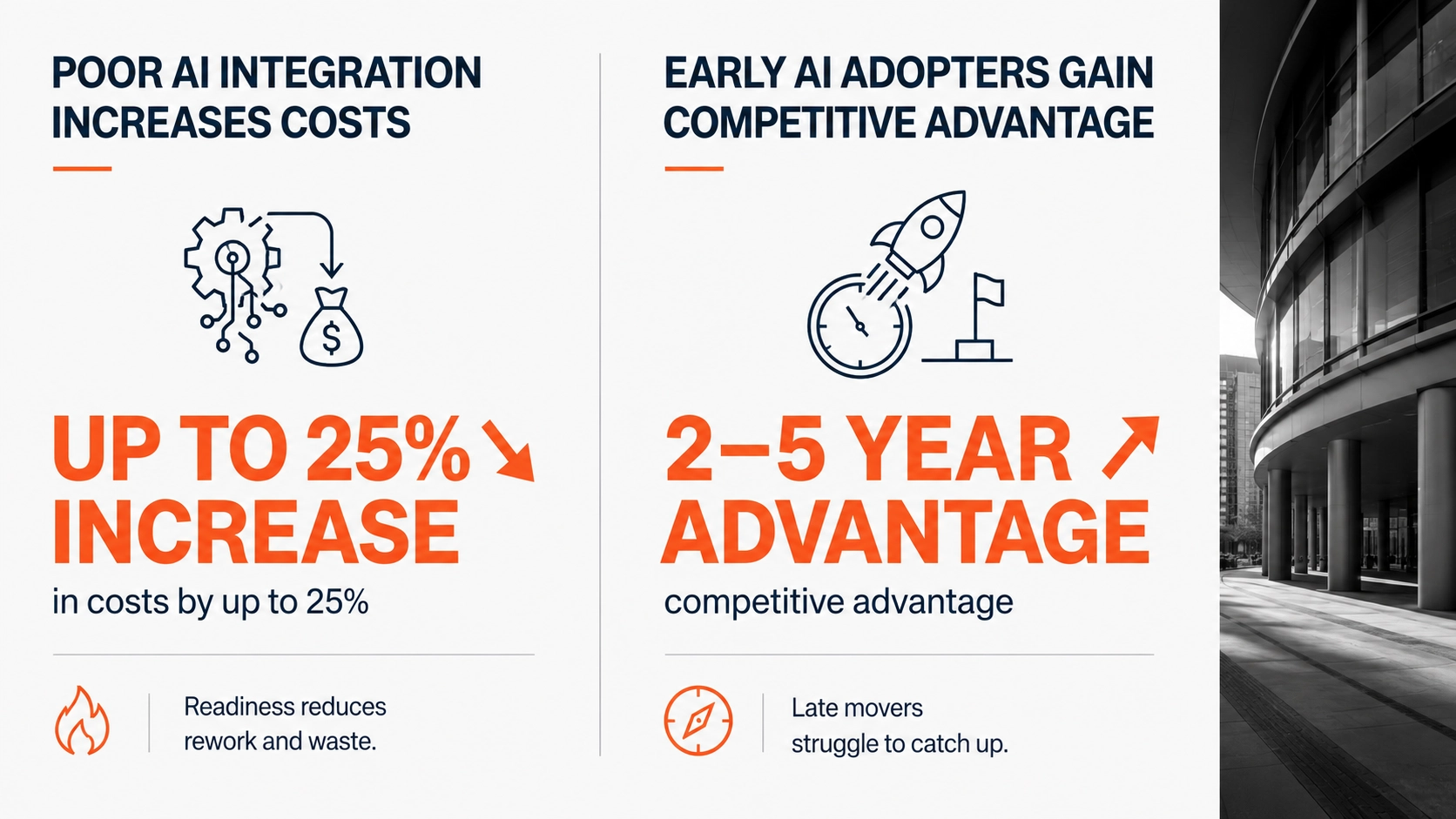
Large budgets lost, frustrated teams, and missed opportunities while competitors move ahead.
Do not buy AI because it sounds good.
Start with the problem, clean the data, define success, then act.
Smarter planning leads to real results.
Weeks 1 to 2 — Find real value
Pinpoint the processes actually costing money and where AI can realistically reduce time, errors, or workload.
Weeks 3 to 4 — Test your data
Check if your data is clean, connected, and usable. Identify gaps that would break any AI effort.
Weeks 5 to 6 — Decide what’s worth doing
Prioritize high-impact, low-complexity wins. Drop ideas that look exciting but add little value. Build a practical rollout plan.
Execution
Launch a small pilot to prove results, then expand what clearly saves time or money.
AI works when it solves real problems, not when it follows trends.
Find the bottlenecks. Fix what matters. Scale what proves value.


AI Readiness Package
Executive Summary
Data & Technology Strategy
18-Month Implementation Plan
Typical Results
Where AI Actually Creates Value
Customer Service Automation
Process Automation
Predictive Analytics
Personalization
Decision Support


Example of AI Readiness Assessment
Express Assessment
What happens next: If you implement AI with us, assessment cost is credited toward implementation.
Typical implementation costs:
Expected ROI:
The difference between AI success and AI waste? Assessment before implementation.
Companies rushing into AI without assessing readiness waste millions. Companies that assess first invest in AI that delivers measurable results.
We'll tell you honestly whether AI makes sense for you, where it creates value, and what it realistically takes to succeed.
Stop wondering about AI. Start knowing.

Then we tell you that honestly. About 40% of assessments conclude "not ready yet." Usually because data quality is too poor or no clear use cases with sufficient ROI. We'll tell you exactly what needs to happen before AI makes sense and how long that would take. Better to know now than waste $500K implementing AI that fails.
Depends on what we recommend. A single AI pilot project (like a chatbot or document automation) typically runs $50K-$150K. Multi-use case implementations range $200K-$800K. Enterprise-wide AI programs can be $1M+. The assessment gives you exact costs for your specific recommendations—no surprises.
Depends on your internal capabilities. If you have data scientists and ML engineers, you might implement some use cases yourself using our roadmap. Most clients don't have that expertise and partner with us for implementation. Either way, the assessment gives you a clear plan. If you implement yourself and hit roadblocks, we can help then.
Pilot projects typically show positive ROI within 6-12 months. For example, an AI chatbot handling 70% of routine inquiries pays for itself in under a year through reduced support costs. More complex AI initiatives (predictive maintenance, advanced analytics) take 12-18 months to full ROI but deliver much larger returns.
The assessment will show exactly where you stand versus competitors. Often "competitors using AI" means they have a basic chatbot—nothing game-changing. We'll identify where AI creates real competitive advantage for you and prioritize those use cases. It's better to implement AI right six months from now than implement it wrong today just to say you have it.