Ever watched a visitor land on your website, struggle to find what they need, and leave within seconds? You’re not alone. The reality is that most website search boxes fail users—and quietly cost businesses money every day.
Your customers are actively searching for products, answers, and solutions. If your search can’t understand intent or return relevant results, they leave and choose a competitor. It’s that simple.
That’s where intelligent website search comes in. And below, we show how it works and why it changes user behavior.


Let’s keep this simple.
AI-powered site search works like a smart assistant that understands what visitors mean, even when they misspell words, use different terms, or describe things imperfectly.
Here’s the key difference:
Traditional search: Visitor types “red sneakers” → No results, because the product is listed as “crimson athletic shoes”
AI-powered search: Visitor types “red sneakers” → Correct results, because the system understands intent and meaning
That’s the baseline benefit. But it goes further.
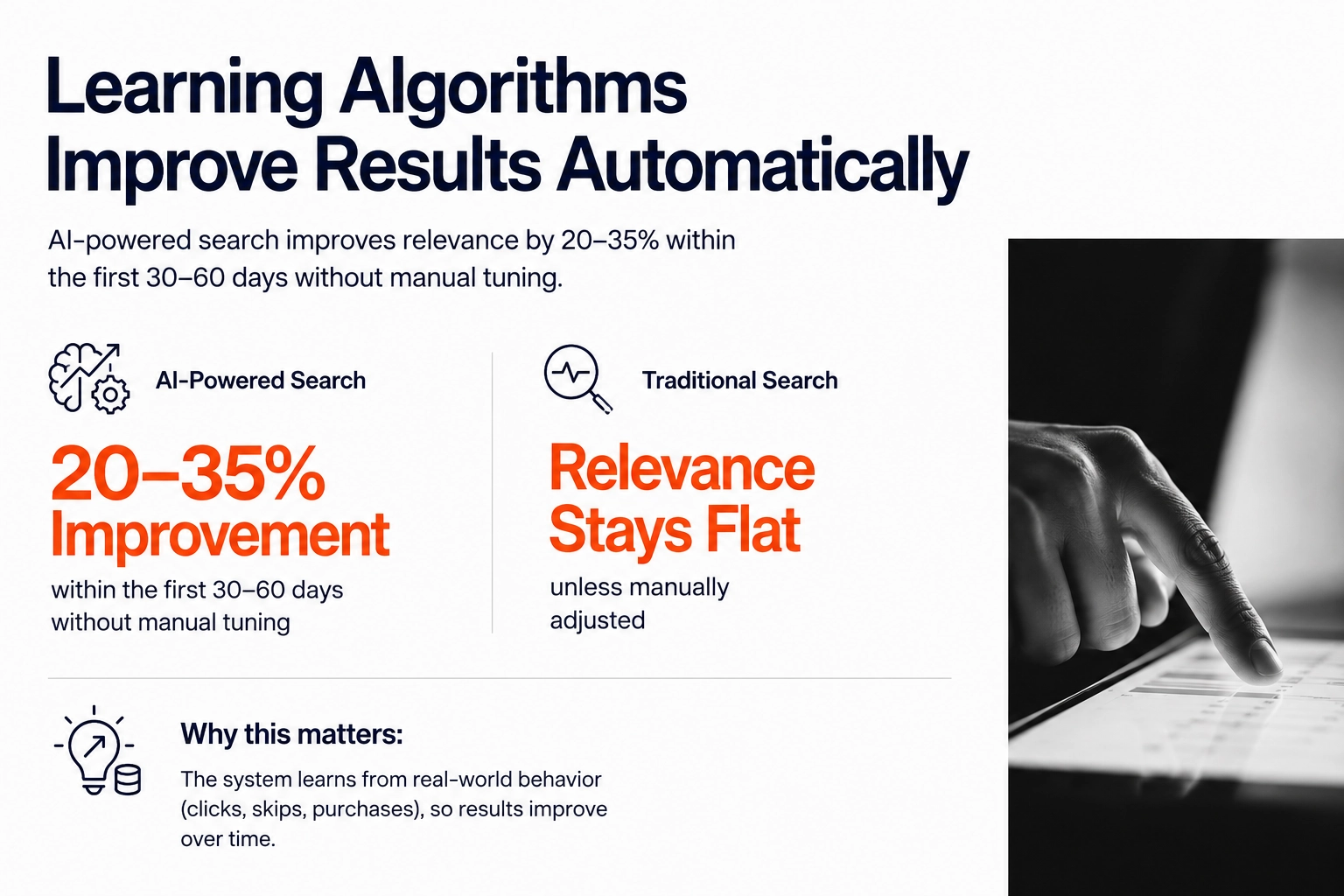
AI-powered search learns from behavior. Every search, click, and interaction helps it improve relevance over time, so results become more accurate the more your site is used.
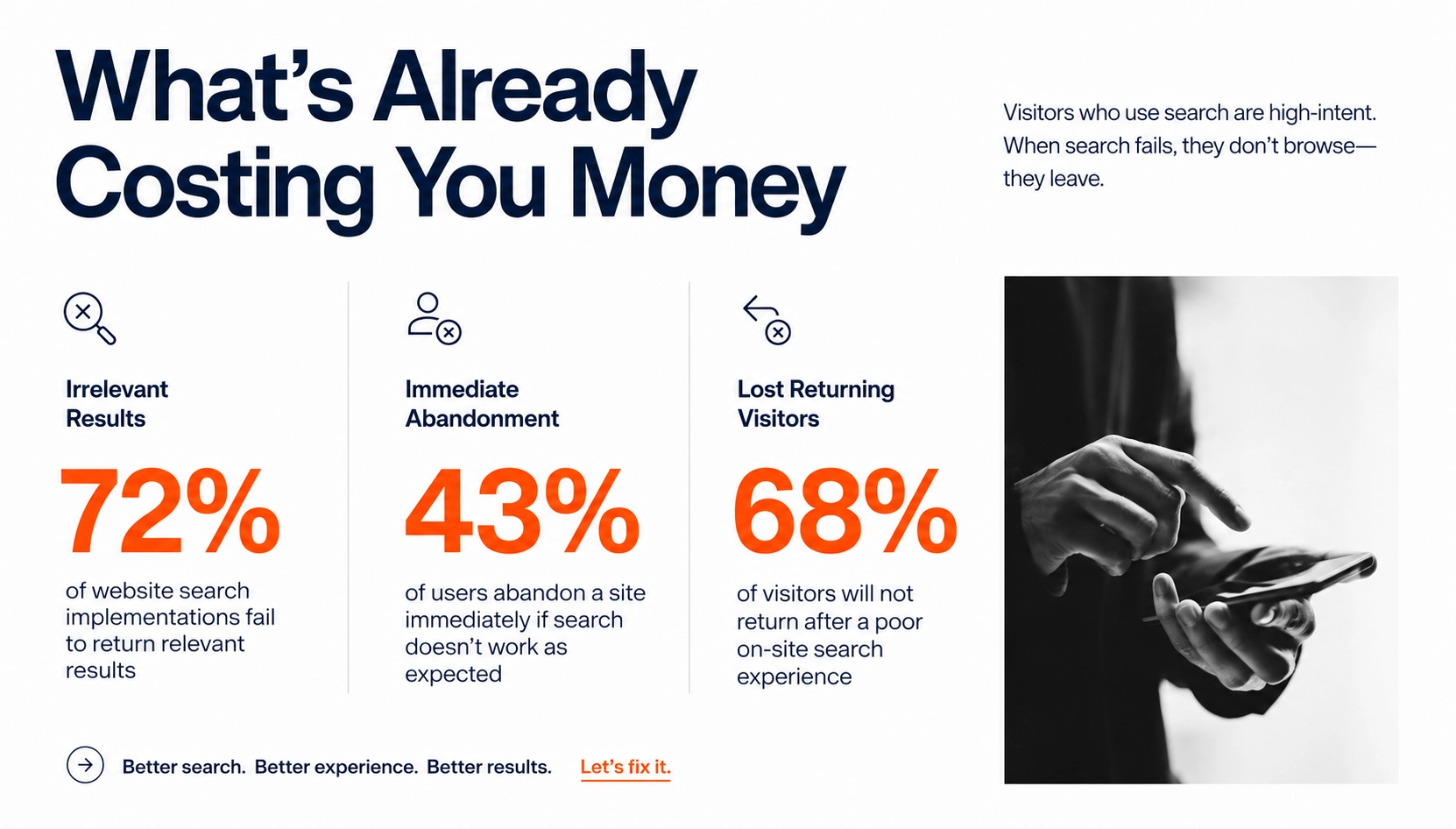
On most websites today, visitors search, press enter, and get irrelevant results—or none at all. When that happens, they leave. No second chance.
The data is clear:
So when search fails, you’re not just frustrating users—you’re losing high-intent customers and revenue.
AI-powered site search fixes this by turning search from a liability into a conversion engine.
No tech talk. Just the real deal.
AI-powered site search is like when Google understands your question—even when you phrase it badly. We bring that same experience inside your website.
Here’s what actually happens:
When someone searches, the system focuses on what they mean, not the exact wording.
Example: searching “gift for mom birthday” shows gift ideas, not party supplies or generic pages.
The search gets smarter from real clicks. If most people searching “phone cases” click iPhone cases, those rise to the top automatically.
Over time, results improve without manual updates.
Typos happen. The search still works.
“Labtop” → laptop. “Acommodation” → accommodation.
No dead ends. No frustration.
If a visitor searched for running shoes before, then later searches “shoes”, running shoes appear first.
The search remembers preferences and delivers more relevant results every time.
The outcome is simple: visitors find what they want faster, stay longer, and are far more likely to convert.

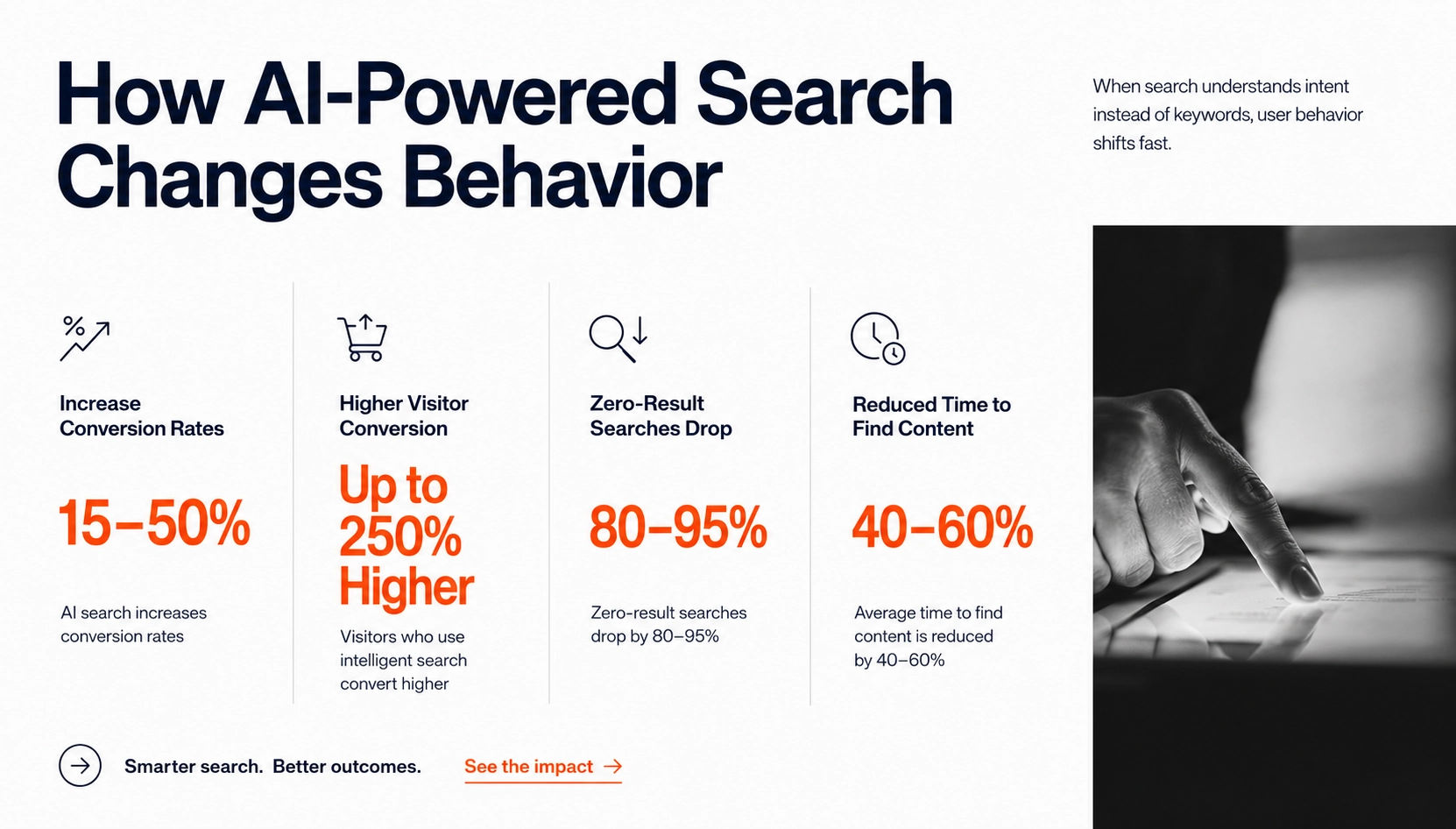
Let's talk numbers because that's what matters.
When you add AI-powered search to your website, here's what typically happens:
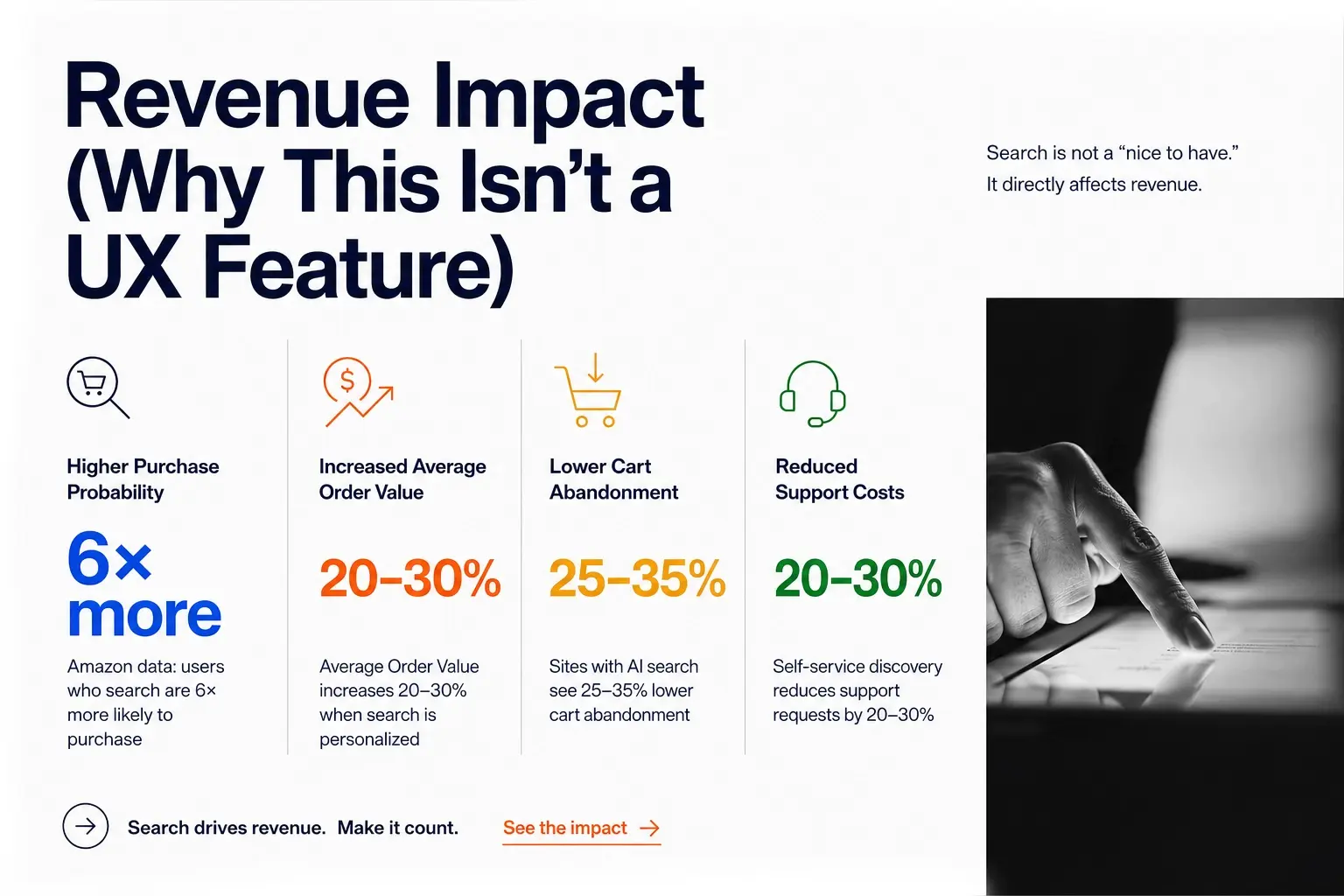
Real example: Amazon's conversion rate shoots up 6x when visitors use search (from 2% to 12%). That's massive.
Think about your own website for a second. What would happen to your revenue if conversion rates doubled? That's not fantasy—it's what good search actually delivers.
Here’s what you get with modern AI-powered site search, in plain, practical terms:
Autocomplete that actually helps
As visitors start typing, the search suggests useful, relevant options—just like Google. Type “blu” and see suggestions like “bluetooth speakers”, “blue jeans”, or “blueberry jam”, based on what exists on your site. This saves time and helps people find things faster.
Synonym recognition
Your customers don’t always use your wording. A smart search knows that “sofa” and “couch” mean the same thing, just like cell phone = mobile phone or sneakers = trainers. This prevents missed results and lost sales due to different word choices.
No more zero results
Few things frustrate visitors more than seeing “no results found.” AI-powered search almost eliminates this by finding the closest relevant matches, even when the exact term doesn’t exist.
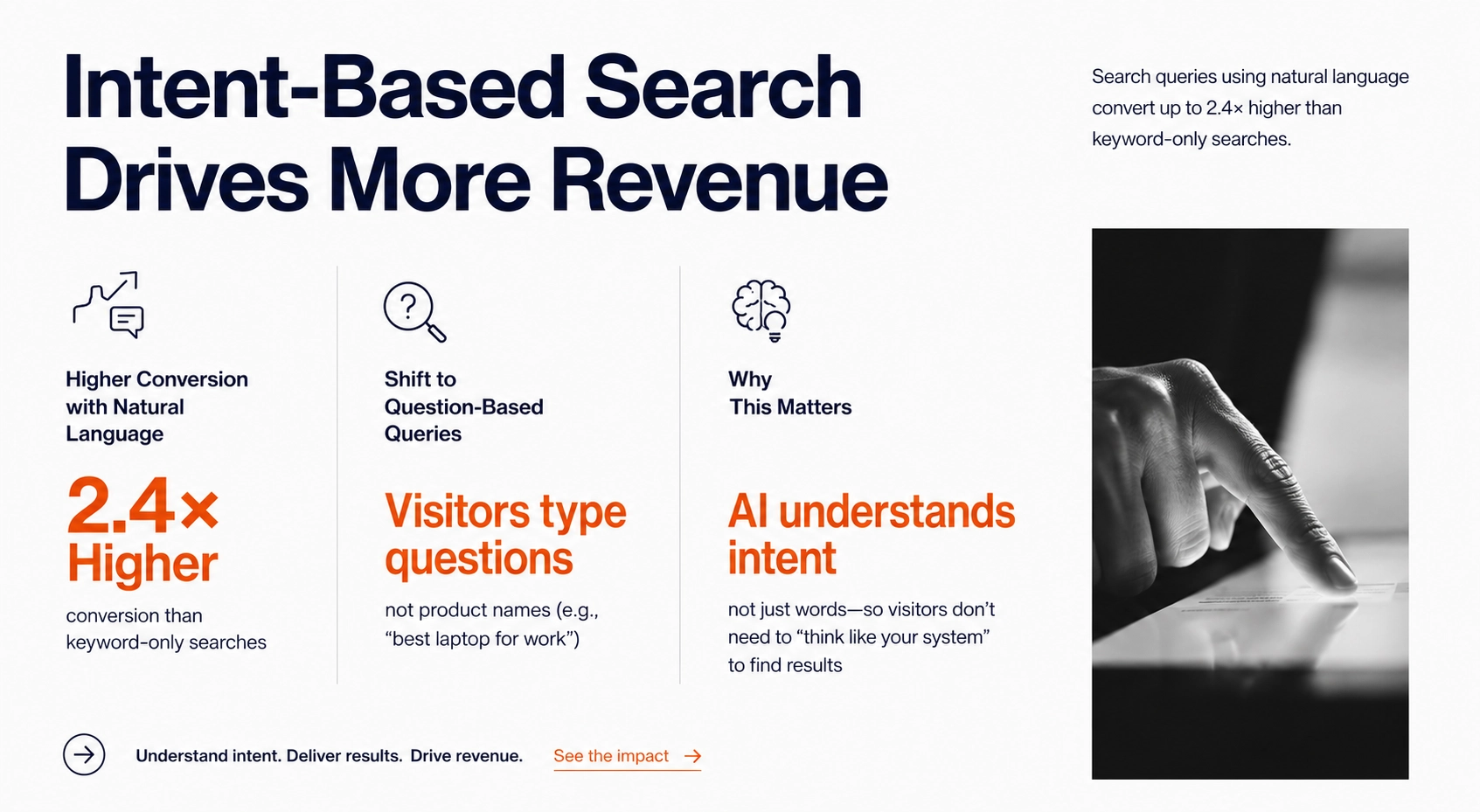
Understanding full questions
People search the way they talk. Queries like “comfortable shoes for standing all day at work” confuse traditional search. AI search understands the full meaning and returns results that actually make sense.
Smart filtering that adapts
Filters change based on what someone searches for. Look for “laptops” and you’ll see screen size, processor, and price. Search for “dresses” and filters shift to size, color, and occasion. The search adapts automatically to what visitors are trying to find.
The result is simple: less friction, faster discovery, and more conversions—without visitors having to fight your website.

Almost anyone with a website benefits—but some industries see especially strong impact:
Online Stores (E-commerce)
If you sell products online, this is a clear win. Customers are searching for specific items, and better search means faster discovery and more sales. Product suggestions during search also help increase average order value.
Content Websites & Blogs
With large libraries of articles or resources, search helps visitors find the right content quickly. This keeps users on your site longer, encourages exploration, and builds trust in your brand.
Education & Universities
Students and parents search for programs, admissions, courses, and campus details. AI-powered search delivers accurate answers faster, reducing confusion and supporting higher enrollment.
Healthcare Providers
Patients look for symptoms, doctors, services, and locations—and they need clarity fast. Intelligent search helps users find the right care without getting lost in complex terminology.
B2B & SaaS Companies
Buyers research deeply. If they can’t find case studies, pricing, or feature details, they leave. Smart search keeps prospects engaged, informed, and moving toward conversion.
You’re probably wondering: “This sounds complicated. How hard is it to set up?”
The short answer: it’s simpler than you think.
Easy implementation
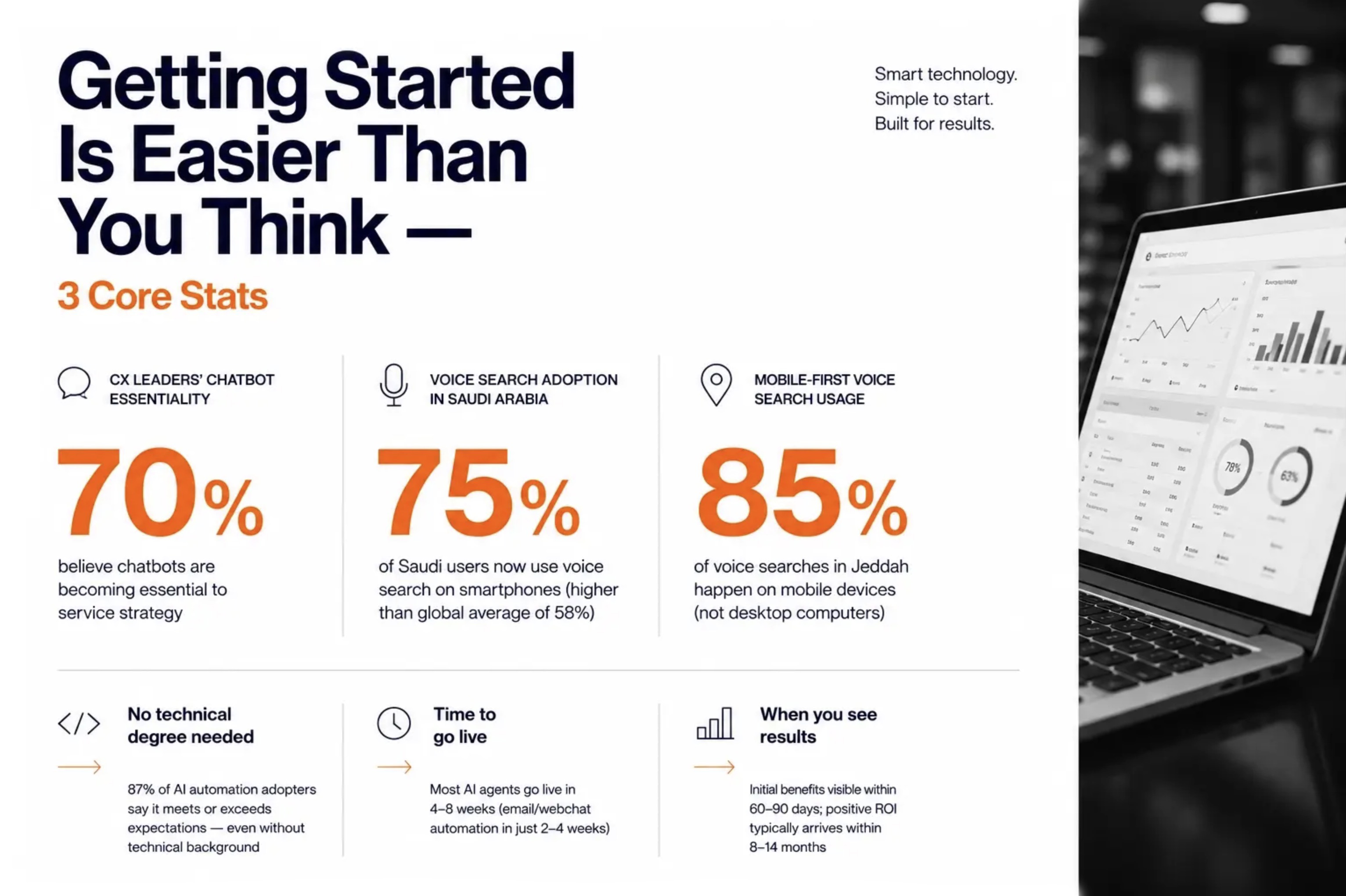
AI search works with the website you already have—WordPress, Shopify, Magento, custom-built sites, and more. There’s no need to rebuild or redesign anything. It plugs into your existing setup.
Fast setup time
This is not a months-long project. Most businesses go live within 2–4 weeks, including setup, testing, and launch.
No coding required
You don’t need a technical team. Management happens through a simple dashboard where you can see what people search for and make adjustments in just a few clicks.
Works on all devices
Whether visitors use a phone, tablet, or desktop, the search adapts automatically. Mobile search is just as smooth and effective as desktop.
In short: low friction, fast rollout, real results—without technical headaches.


Let's walk through what changes when you upgrade your search:
Before AI search:
After AI search:
See the difference? That's the whole point.
What you can track:
All this data helps you understand your customers better and make smarter business decisions.
You might hear the term semantic search—but it’s simpler than it sounds.
It just means the search understands meaning, not just exact words.
Example:
Traditional search looks only for exact phrases like “best phone under $500.”
Semantic search understands the intent—affordable, good-value, highly rated phones within budget—even if those exact words don’t appear.
It’s about context and what people actually want, not how perfectly they phrase it.
This matters a lot for e-commerce. If someone searches “running shoes for bad knees,” semantic search knows they’re really looking for:
All without the customer needing to know—or type—those technical terms.
The result: better matches, less frustration, and higher conversions.


Let’s be honest about the real headaches many websites face:
Problem #1: People can’t find your products
You may have exactly what visitors want—but your search doesn’t surface it.
Solution: AI search understands different ways people describe the same thing, matching intent, not just exact wording.
Problem #2: Too many irrelevant results
A simple search returns hundreds of random items. Visitors give up.
Solution: Smart ranking shows the most relevant results first, so people see what matters immediately.
Problem #3: Misspellings break everything
One typo and results disappear. Visitors assume you don’t have the product.
Solution: Automatic spell correction handles mistakes seamlessly, keeping search results accurate.
Problem #4: You don’t know what people want
You’re guessing what customers are looking for—and guessing wrong costs sales.
Solution: Search analytics reveal what users search for, what they find (or don’t), and what leads to purchases.
Problem #5: Mobile search is terrible
Search works on desktop but feels clunky on phones.
Solution: Responsive search design ensures fast, easy use on any device, with autocomplete and filters optimized for small screens.
These aren’t minor issues—they directly impact conversions, engagement, and revenue. AI-powered search fixes them at the source.
Don't just take our word for it. Here's what happens when businesses upgrade their site search:
E-commerce Store Example:
University Website Example:
Healthcare Provider Example:
These aren't special cases. This is what good search does.


No technical degree required. No massive time commitment. Here's how simple it actually is:
We look at your current website and search setup. This takes about 30 minutes.
Free trial or demo on your actual website. See real results with your real content.
If you like it (and you will), we handle the setup. You'll be live in a few weeks.
Watch the analytics roll in. See exactly how search is helping your business.
That's it. Four simple steps from start to success.
AI-powered site search uses artificial intelligence and machine learning to understand what visitors are really looking for on your website. Unlike basic search that just matches keywords, AI search understands context, handles misspellings, recognizes synonyms, and learns from user behavior to deliver more accurate results over time.
Regular search only finds exact keyword matches, which means it often misses what people actually want. Intelligent search understands the meaning behind search queries, recognizes different ways people describe things, fixes spelling mistakes automatically, and personalizes results based on individual behavior. It's like the difference between talking to a robot and talking to a helpful human.
Most businesses can have AI-powered search up and running within 2-4 weeks. The timeline depends on your website size and complexity, but the process is straightforward: setup and integration (week 1), indexing your content (week 1-2), configuration and testing (week 2-3), and going live (week 3-4). Many platforms offer quick-start options that can be live even faster.
Yes! Modern AI search solutions integrate with virtually all website platforms including WordPress, Shopify, Magento, Wix, Squarespace, and custom-built sites. You don't need to rebuild your website or change your existing structure. The search layer simply adds on top of what you already have.
Pricing varies based on your website size, traffic volume, and required features. Small to medium websites typically start around $50-200 per month, while larger enterprise solutions can range from $500-2000+ monthly. Most providers offer free trials so you can test the service before committing. The investment usually pays for itself quickly through increased conversions.