









































Your business runs on systems: ERP, CRM, HR, inventory, customer
support, supplier management. But these systems don't talk to
each other. Your team wastes hours every day jumping between
screens, searching for information, doing manual work.
We fix that with AI-powered business systems that connect
everything. Ask a question in plain language. Get instant answers.
Automate repetitive tasks. Scale without hiring more people.
This is how modern businesses work. And it's built specifically
for your operations - not a generic template.
Manama's position as Bahrain's financial and commercial hub drives demand for intelligent automation solutions that accelerate business operations while reducing costs. AI business automation Manama organizations implement today transforms manual processes into streamlined digital workflows that operate 24/7 with minimal human intervention. Companies across government, banking, logistics, and enterprise sectors recognize that competitive advantage increasingly depends on operational efficiency enabled through intelligent automation.
The evolution from traditional business process management to AI-powered automation represents a fundamental shift in organizational capability. Legacy systems require constant human oversight, produce errors from manual data entry, and scale linearly with headcount. Intelligent automation learns from patterns, makes decisions within defined parameters, and scales exponentially without proportional cost increases. This transformation allows Bahrain businesses to compete globally while managing local operations more effectively than ever before.

Public sector organizations in Bahrain face unique pressures to deliver citizen services efficiently while maintaining transparency, accountability, and compliance with regulatory frameworks. Government AI automation Bahrain initiatives address these challenges through intelligent document processing, automated approval workflows, citizen service chatbots, and predictive resource allocation.
Bahrain's Economic Vision 2030 emphasizes digital transformation across public sectors, creating urgency for automation initiatives that enhance service delivery. Traditional government processes involving multiple manual touchpoints, paper documents moving between departments, and sequential approvals create delays frustrating to citizens and employees alike. AI automation services eliminate these bottlenecks through intelligent routing, automated data extraction, and parallel processing that maintains proper governance and audit trails.
AI-powered chatbots handle routine citizen inquiries 24/7 in Arabic and English, answering questions about services, application status, required documents, and procedures. These virtual assistants resolve 60-70% of inquiries without human intervention, providing instant responses that would otherwise require phone calls or office visits during business hours.
Document digitization initiatives using optical character recognition and intelligent data extraction convert historical paper records into searchable digital repositories. Government employees quickly locate information that previously required physical archive searches, improving response times and reducing document loss risks. Business process automation ensures consistency across departments while maintaining security and access controls.
Predictive analytics help government agencies anticipate service demand, optimize resource allocation, and identify potential issues before they escalate. Public health departments predict disease outbreaks, traffic management systems anticipate congestion patterns, and social services identify families needing intervention


Enterprise organizations in Manama spanning banking, insurance, logistics, retail, and professional services implement intelligent automation Manama solutions addressing specific operational challenges. Accounts payable automation eliminates manual invoice processing, customer service automation handles routine inquiries, HR automation streamlines onboarding and benefits administration, and supply chain automation optimizes inventory and logistics.
The business case for intelligent automation becomes compelling when organizations calculate time currently spent on repetitive manual tasks across entire workforces. Finance teams processing hundreds of invoices monthly, HR departments managing employee lifecycle paperwork, customer service representatives answering the same questions repeatedly—all represent opportunities for automation that improves speed, accuracy, and employee satisfaction. Working with experienced custom development partners ensures automation aligns with actual workflows rather than forcing businesses into rigid templates.
Robotic process automation (RPA) handles repetitive computer-based tasks by mimicking human interactions with software applications. Data entry between systems, report generation, email processing, and form completion—tasks consuming hours of employee time daily—execute automatically through software robots working around the clock. RPA implementation delivers rapid returns with relatively simple deployment compared to system replacements.
Workflows connecting people, systems, and decisions across organizational boundaries represent automation's most impactful application. AI workflow Bahrain implementations use machine learning to optimize routing, predict bottlenecks, suggest improvements, and adapt processes based on outcomes.
Document-centric workflows involving contracts, proposals, reports, and forms benefit enormously from AI capabilities. Intelligent document processing extracts data regardless of format, classifies documents by type, validates information against business rules, and routes items for appropriate handling. Contract review workflows automatically identify non-standard clauses, calculate financial impacts, check counterparty risk, and highlight items requiring legal review. This intelligence accelerates throughput while improving risk management through workflow automation solutions.
Intelligent workflows continuously learn from outcomes and user behavior, progressively improving performance without manual reconfiguration. Machine learning models identify patterns in which requests get approved versus rejected, which exceptions prove valid, and which routing paths minimize processing time.
Bottleneck detection analyzes workflow throughput, identifies stages where work accumulates, and suggests remediation strategies. Perhaps certain approvers consistently delay processing, specific document types require clarification, or peak periods overwhelm capacity.


Smart process automation Manama implementations combine multiple AI technologies—machine learning, natural language processing, computer vision, and predictive analytics—creating systems with unprecedented capabilities. These advanced automations handle unstructured data, make contextual decisions, learn from experience, and collaborate naturally with human workers.
Invoice processing evolved from simple OCR data extraction to intelligent systems that handle any format, validate against purchase orders and contracts, resolve discrepancies, calculate payment terms, route for approval, schedule payments, and update financial systems. Exception handling that previously required hours of investigation happens automatically through intelligent matching algorithms and access to relevant business context through ERP integration capabilities.
Cognitive automation brings human-like capabilities to complex tasks involving judgment, pattern recognition, and contextual understanding. Loan application processing analyzes financial documents, assesses creditworthiness, identifies risk factors, recommends appropriate products, and generates approval recommendations.
Predictive automation anticipates needs and takes action proactively rather than waiting for requests. Supply chain systems predict demand surges and preemptively order inventory. Customer service platforms identify customers likely to churn and trigger retention campaigns. Maintenance systems predict equipment failures and schedule preventive service.
Enterprise AI Bahrain deployments require strategic planning addressing technology selection, process optimization, change management, and organizational alignment. Successful implementations don't simply automate existing inefficient processes—they rethink workflows to leverage automation capabilities while addressing root causes of inefficiency.
Technology selection balances capabilities, integration requirements, scalability, total cost, and vendor viability. The automation technology landscape includes specialized point solutions for specific use cases and comprehensive platforms supporting multiple automation types. Working with experienced digital transformation partners provides guidance navigating these complex decisions.
Employee concerns about automation replacing jobs must be addressed transparently through communication emphasizing augmentation rather than replacement. Most automation initiatives free workers from tedious manual tasks, allowing them to focus on work requiring human judgment, creativity, and relationship skills.
Training programs ensure employees understand how to work alongside automated systems, escalate issues appropriately, and leverage automation outputs in their decision-making. Hands-on experience during pilot phases builds confidence and generates feedback improving system design before broad deployment.


Bahrain's position as a regional financial hub creates opportunities for fintech AI automation Manama solutions transforming banking operations, customer service, risk management, and regulatory compliance. Banks and financial institutions face intense pressure to reduce costs, improve customer experience, detect fraud, and comply with evolving regulations.
Loan processing automation analyzes financial documents, employment verification, income statements, debt obligations, and collateral valuations to generate credit decisions in minutes rather than days. This automation improves customer satisfaction, increases throughput, and maintains consistent credit standards through AI-powered financial services.
Transaction monitoring systems analyze spending patterns, location data, merchant categories, and behavioral indicators to identify suspicious activity in real-time. Machine learning models trained on historical fraud cases recognize anomalies suggesting unauthorized transactions, account takeover, or money laundering. Legitimate transactions proceed instantly while suspicious activity triggers immediate investigation and preventive actions like temporary card blocks.
Successful AI business automation implementations follow structured methodologies minimizing risk while accelerating value realization. Discovery phases document current state processes, quantify improvement opportunities, identify automation candidates, and establish success metrics. This foundation ensures automation initiatives address real business needs rather than implementing technology for its own sake.
Iterative development deploys automation incrementally, incorporating feedback and monitoring performance continuously. Agile methodologies allow adjustments based on real-world usage rather than attempting to design perfect solutions upfront. Systems improve progressively as teams learn what works, users become comfortable with automation, and technology capabilities mature.
Comprehensive metrics track automation benefits across multiple dimensions—cost reduction, speed improvements, quality enhancement, and employee satisfaction. Time saved from eliminating manual tasks translates directly to cost savings calculated by multiplying hours saved by loaded labor costs. Processing time reductions improve customer satisfaction and enable businesses to handle volume growth without proportional staff increases.


A mid-size logistics company managing freight forwarding and customs clearance faced operational challenges with manual documentation, delayed customs processing, customer inquiry handling, and financial reconciliation. The company decided to implement comprehensive AI business automation addressing these pain points and positioning the organization for growth.
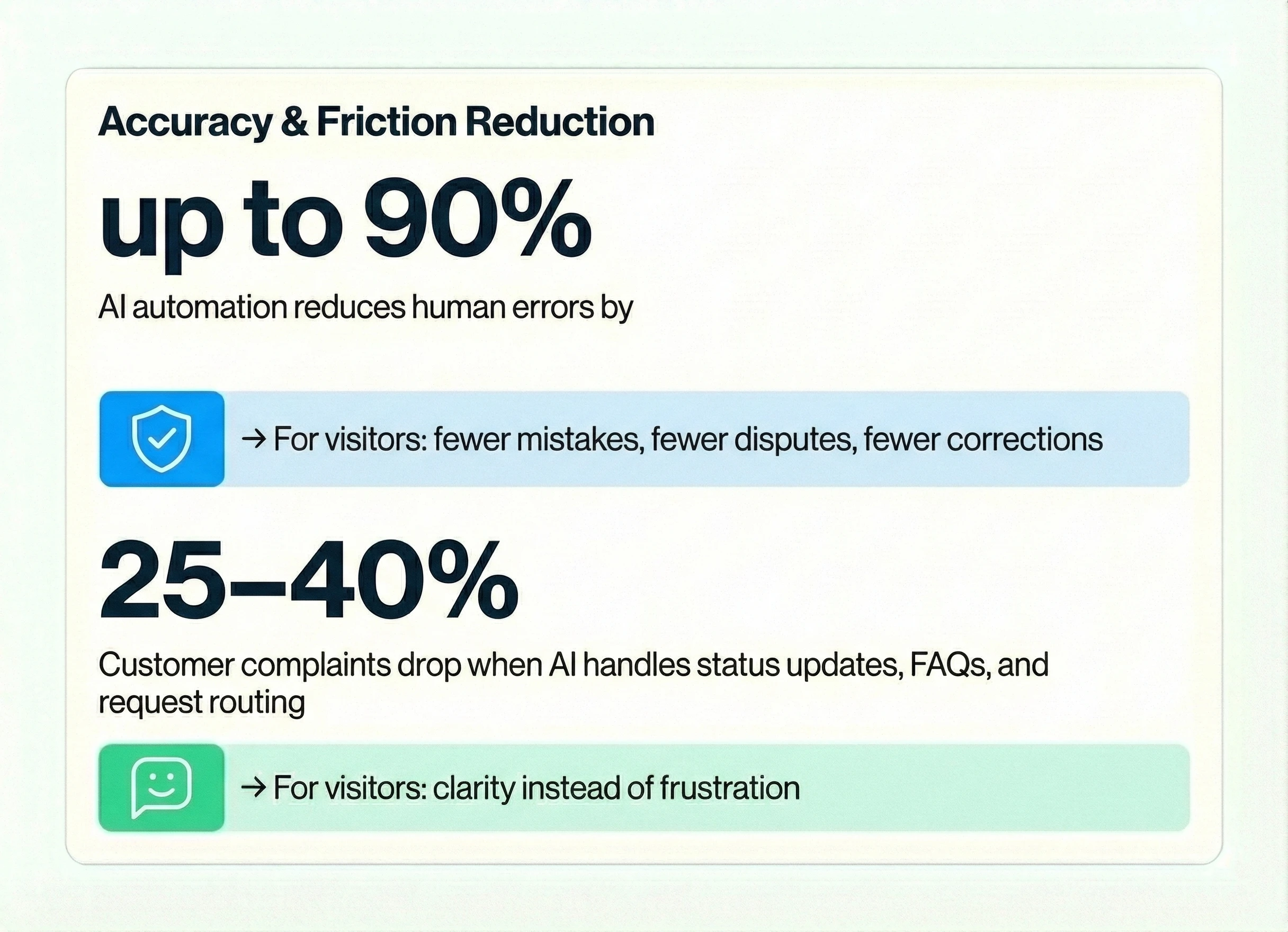
Customer service automation deployed AI chatbots handling shipment tracking inquiries, documentation requests, and general questions in Arabic and English 24/7. The system reduced inbound calls by 60% while improving response times from hours to seconds.
Twelve months post-implementation, the logistics company measured substantial operational and financial improvements. Overall operational costs decreased 28% through reduced manual labor, fewer errors requiring correction, and improved efficiency across all processes. Customer satisfaction scores increased 42% driven by faster processing, better communication, and fewer errors.
GO-Globe brings over 20 years of experience implementing intelligent business automation solutions across Bahrain and the broader Middle East. Our team combines technical expertise with deep understanding of regional business requirements, regulatory environments, and cultural considerations. We don't simply implement technology—we partner with organizations to transform operations and achieve strategic objectives.
From initial consultation through deployment, training, and ongoing optimization, GO-Globe ensures automation investments deliver promised returns. Our proven methodology balances best practices with customization addressing unique organizational needs. We work collaboratively with client teams, transferring knowledge and building internal capabilities rather than creating dependencies on external consultants.
Post-implementation support ensures systems continue performing optimally as businesses evolve, automation technologies advance, and new opportunities emerge. Regular reviews identify optimization possibilities, additional automation candidates, and emerging technologies that could benefit operations. Our relationship extends beyond project completion to long-term partnership supporting continuous improvement and growth.

High-value automation candidates share specific characteristics: high volume, repetitive patterns, rule-based decisions, clear inputs and outputs, and significant time consumption. Invoice processing, customer service inquiries, data entry, document processing, approval workflows, and report generation typically offer strong returns. Processes requiring complex judgment, handling exceptional cases, or involving frequent changes may not justify automation costs. Start with processes causing obvious pain points and demonstrating clear measurement of success before expanding to more complex automation opportunities.
Implementation timelines vary based on process complexity and organizational readiness. Simple automation projects like chatbots or document processing complete in 6-12 weeks. Comprehensive process automation spanning multiple departments and systems requires 4-6 months. Enterprise-wide automation initiatives may span 12-18 months with phased deployments. Pilot projects demonstrating value in 6-8 weeks build momentum for larger initiatives. Proper planning, clear requirements, and executive sponsorship significantly accelerate implementations while poor preparation causes delays and cost overruns.
Typical automation projects deliver 200-400% ROI within 18-24 months through labor cost reduction, error elimination, speed improvements, and capacity increases. Simple automations like invoice processing show returns within 6-9 months. Complex enterprise automations require 12-18 months but deliver sustained benefits for years. Beyond direct financial returns, automation improves customer satisfaction, employee engagement, and competitive positioning. Organizations should establish comprehensive metrics capturing all value dimensions rather than focusing solely on labor cost savings which often understate total benefits.
Well-designed automation eliminates tedious manual work, allowing employees to focus on activities requiring human judgment, creativity, and interpersonal skills. Most organizations redeploy workers to higher-value roles rather than reducing headcount. Clear communication about automation goals, retraining programs, and involvement in implementation planning reduce anxiety and build enthusiasm. Employees generally appreciate automation that removes frustrating aspects of their jobs. Organizations successful with automation emphasize augmentation—humans and AI working together—rather than simple replacement of human workers.
Modern automation platforms integrate with virtually any business system through APIs, database connections, or user interface automation. Standard integrations connect to popular ERP, CRM, accounting, and industry-specific applications. Custom integration development addresses unique requirements for legacy systems or specialized software. The goal is creating seamless workflows across your existing technology landscape rather than requiring expensive system replacements. Integration capabilities should be evaluated carefully during automation platform selection to ensure compatibility with your specific environment and requirements.