Every day, hundreds or thousands of people visit your website. They browse products, read content, add items to carts, and then most of them leave forever without taking action. No purchase. No sign-up. No contact. No relationship. Just gone.
This represents massive lost opportunity. You invested time and money driving traffic to your website through search optimization, paid advertising, social media, content creation, and countless other efforts. All that work gets visitors to your site, but then most leave without converting. The traffic acquisition cost remains the same whether visitors convert or not, which means every unconverted visitor directly impacts your profitability.
The problem is that visitors need gentle nudges at key moments to take action. Someone about to abandon their shopping cart might complete the purchase with a small discount offer. A first-time visitor might subscribe to your email list if offered valuable content. A returning customer might book a consultation if reminded of your services. Someone hesitating might commit if social proof shows others making the same decision.
Smart pop-ups provide these timely interventions. Unlike annoying pop-ups that interrupt immediately with irrelevant messages, smart pop-ups use behavioral triggers and personalization to engage visitors at precisely the right moment with messages specifically relevant to their situation. They feel helpful rather than intrusive. They increase conversions significantly while maintaining positive user experience.
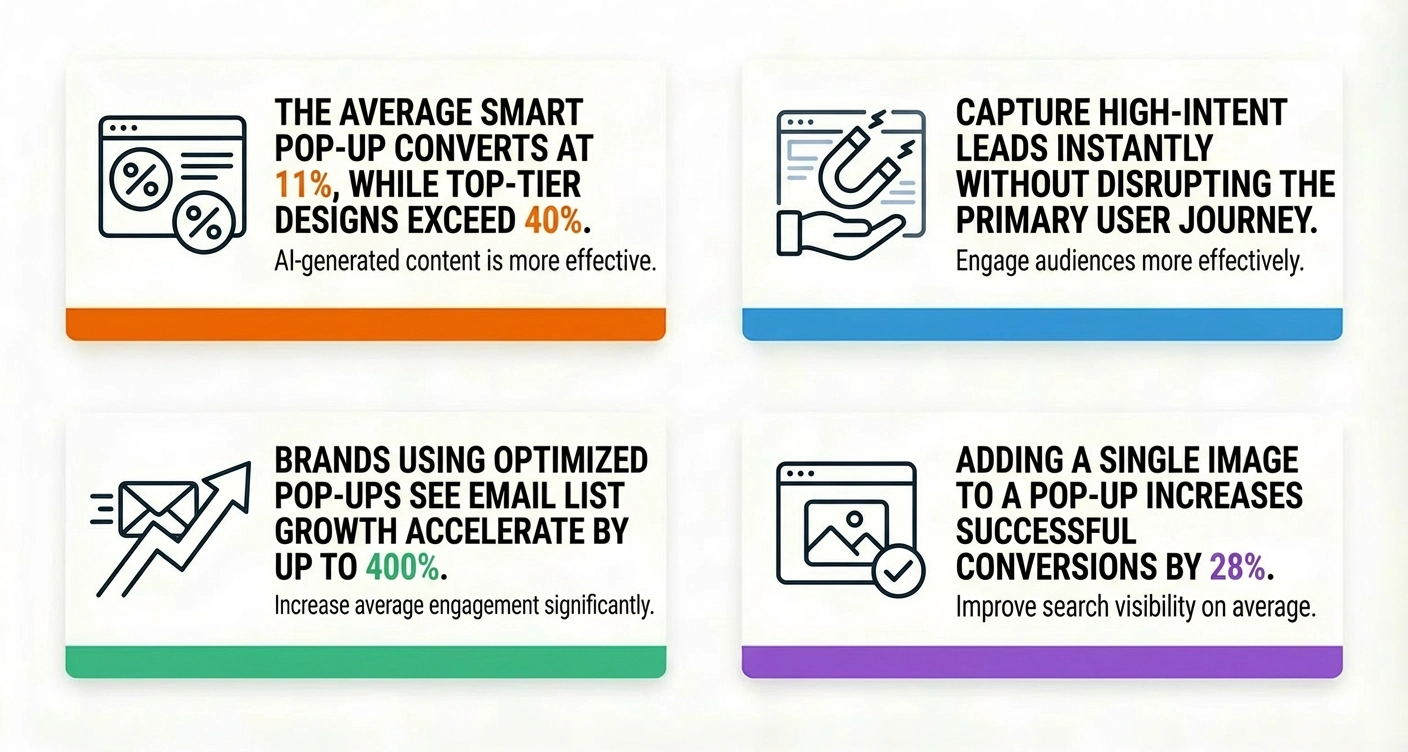
Businesses using well-designed smart pop-ups typically see 2 to 5 percent conversion rates on the pop-ups themselves, which translates to substantial revenue increases when applied to meaningful traffic volumes. The technology has matured dramatically. Modern smart pop-ups are sophisticated tools that serious businesses use to maximize the value of website traffic they've worked hard to attract.

Smart pop-ups are targeted messages that appear on your website based on specific visitor behaviors, characteristics, or timing. Unlike traditional pop-ups that show the same message to everyone immediately upon arrival, smart pop-ups adapt to each visitor's situation.
Here's how they work. The system monitors visitor behavior in real time. This includes which pages they view, how long they spend on each page, whether they're scrolling or engaged with content, whether they've added items to a shopping cart, whether their mouse moves toward closing the browser, whether they're new or returning visitors, where they came from before reaching your site, and what device they're using.
Based on these signals, the system determines the optimal moment and message for each visitor. Someone about to leave might see an exit-intent pop-up offering a compelling reason to stay. A first-time visitor might see a welcome message after engaging with content for 30 seconds. Someone who abandoned a cart might see a limited-time discount. A mobile visitor might see a click-to-call button. A visitor from a specific marketing campaign might see messaging aligned with that campaign.
The pop-ups themselves can take various forms including modal overlays that appear in the center of the screen, slide-ins that appear from the side or bottom, banner bars across the top or bottom, full-screen takeovers for major announcements, and embedded forms that expand on the page. Design and messaging are fully customizable to match your brand and campaign objectives.
Smart pop-ups also respect visitor experience. They can be configured to appear only once per visitor, to not show again if dismissed, to avoid appearing too frequently, and to never interfere with critical actions like completing checkout. The goal is conversion without annoyance.

Let's explore the specific problems that smart pop-ups solve and the value they deliver.
You Recover Lost Revenue from Cart Abandonment
Shopping cart abandonment averages 70 percent across e-commerce. For every ten people who add products to their cart, seven leave without purchasing. This represents enormous lost revenue. For a business with 100,000 SAR in monthly cart value, 70,000 SAR walks away every month.
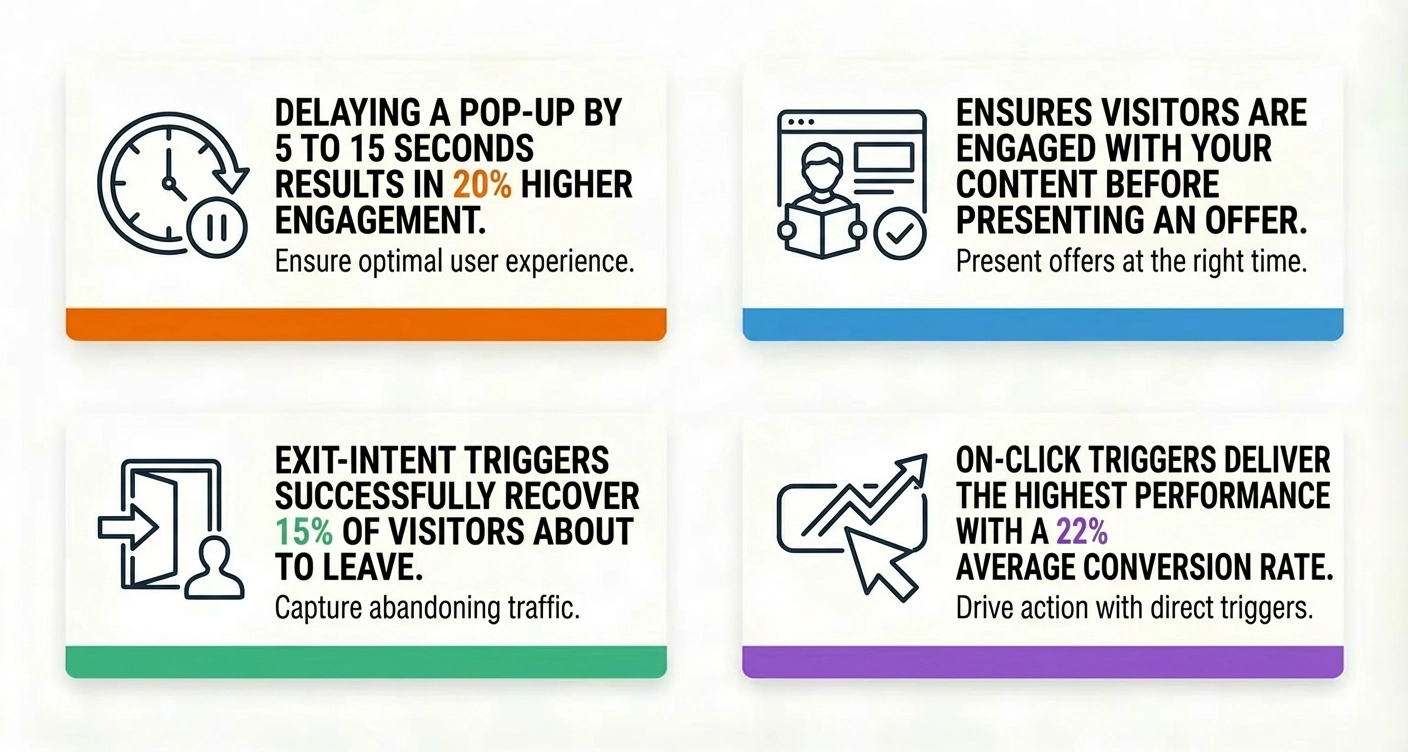
Exit-intent pop-ups can recover 10 to 30 percent of these abandoning visitors. When someone's mouse moves toward closing the browser or navigating away, the system detects this exit intent and triggers a pop-up with a compelling offer. This might be a discount code, free shipping, payment plan information, trust signals addressing common objections, or a reminder of items in their cart.
Even recovering just 10 percent of abandoned carts transforms economics dramatically. That same business with 70,000 SAR in monthly cart abandonment could recover 7,000 SAR monthly, or 84,000 SAR annually, from one well-designed exit-intent campaign. The investment in smart pop-up technology pays for itself many times over from this use case alone.
You Build Your Email List Automatically
Email marketing consistently delivers the highest ROI of any digital marketing channel, but only if you have email subscribers. Traditional signup forms on websites convert at low single-digit rates. Most visitors never even see them.
Smart pop-ups dramatically increase email list growth. Timed pop-ups that appear after visitors engage with content for 30 or 60 seconds convert 3 to 10 percent of visitors into subscribers. That's often 5 to 10 times higher than static signup forms.
For a business receiving 10,000 monthly website visitors, even a conservative 3 percent conversion rate yields 300 new subscribers monthly or 3,600 annually. Each subscriber has lifetime value through future marketing campaigns. If subscribers generate average revenue of just 100 SAR each over their lifetime, those 3,600 subscribers represent 360,000 SAR in future revenue opportunity from a single year of pop-up email collection.
You Increase Conversions on Specific Goals
Whether your goal is sales, bookings, demo requests, downloads, registrations, or any other conversion, smart pop-ups increase completion rates. They do this by capturing attention at key moments, highlighting value propositions clearly, reducing friction through simplified forms, addressing objections proactively, creating urgency through limited-time offers, and providing social proof that builds confidence.
Different pop-up types work for different goals. E-commerce sites use discount and free shipping offers. SaaS companies offer free trials or demos. Content sites promote premium memberships. Service businesses encourage consultation bookings. Educational institutions push application submissions.
The cumulative effect across multiple conversion goals can be substantial. A business might see 15 percent more product sales, 25 percent more email signups, 30 percent more webinar registrations, and 20 percent more consultation requests all from strategic pop-up deployment across different visitor segments.
You Personalize Messaging Without Manual Effort
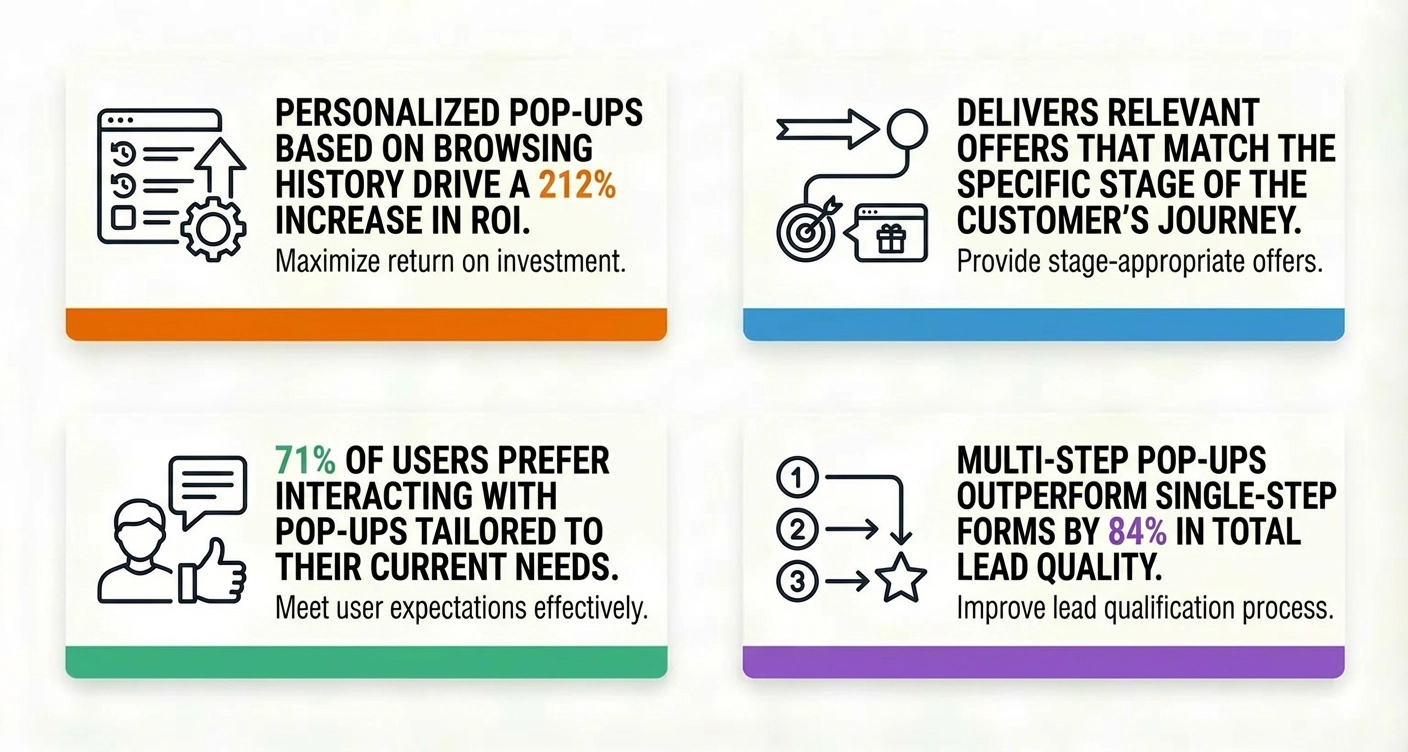
Different visitors respond to different messages. New visitors need education about your offerings. Returning visitors want quick access to what they came for. Cart abandoners need persuasion to complete purchase. High-value customers deserve premium treatment. Visitors from specific campaigns expect messaging aligned with the ad they clicked.
Smart pop-ups enable this personalization automatically. The system shows different messages to different visitor segments based on their characteristics and behaviors. This personalization significantly increases relevance and conversion rates compared to generic one-size-fits-all messaging.
Manual personalization at this scale would be impossible. Smart pop-ups make it automatic and effortless.
You Promote Important Announcements Effectively
Sometimes you need to communicate critical information to visitors like major sales or promotions, new product launches, shipping delays or policy changes, upcoming events or webinars, seasonal hours or closures, or important news about your business.
Smart pop-ups ensure these announcements actually get seen. Unlike burying information in website content that many visitors never read, pop-ups capture attention and deliver the message clearly. You can configure them to appear site-wide or on specific pages, to specific visitor segments, for limited time periods aligned with the announcement timeframe.
This visibility ensures important messages reach your audience instead of being overlooked.
You Reduce Immediate Exits
Many visitors leave websites within seconds of arrival, a phenomenon called bounce rate. High bounce rates waste traffic acquisition costs and indicate poor visitor engagement.
Smart entry pop-ups and welcome mats can reduce bounce rate by immediately engaging visitors. A compelling offer presented right away gives visitors a reason to stay and explore. Even if they don't convert immediately, the initial engagement increases time on site and pages viewed, which improves overall conversion probability.
You Test and Optimize Continuously
Smart pop-up platforms include A/B testing capabilities. You can test different headlines, offers, images, timing, trigger conditions, and designs to determine what converts best. Over time, continuous testing and optimization compound effectiveness.
A campaign that initially converts at 3 percent might reach 5 percent or even 7 percent through systematic optimization. These incremental improvements multiply the value generated from your website traffic.
We've implemented smart pop-up systems for e-commerce, SaaS, professional services, educational institutions, and media companies. Here's what our comprehensive solution includes.
Behavioral Targeting and Triggers
Our system monitors dozens of visitor behaviors and triggers pop-ups based on intelligent rules. This includes exit intent detection that shows pop-ups when visitors are about to leave, time on site triggers that engage visitors after specific durations, scroll depth triggers that activate when visitors scroll to certain page positions, page targeting that shows specific messages on specific pages, referral source targeting that adapts messaging based on where visitors came from, device targeting that optimizes for mobile or desktop, returning visitor detection that shows different messages to repeat visitors, cart value triggers that activate for high-value carts, and inactivity detection that engages visitors who've stopped interacting.
This sophisticated targeting ensures visitors see relevant messages at optimal moments.
Advanced Segmentation
You can create unlimited visitor segments and show different pop-ups to each. Segment by new versus returning visitors, visitors from specific marketing campaigns, visitors who viewed particular products or content, visitors from specific geographic locations, visitors using specific devices, visitors with specific cart values, visitors who've previously dismissed certain pop-ups, and virtually any other criterion you can imagine.
Segmentation dramatically increases relevance and conversion rates.
Multiple Pop-up Types
Our solution supports all major pop-up formats. Modal overlays appear centered on the screen with background dimming for maximum attention. Slide-ins appear from corners with less interruption. Banner bars across top or bottom provide persistent visibility. Full-screen takeovers work for major announcements. Embedded forms expand on the page without overlaying content. Timed delays control when pop-ups appear.
You choose the format that best suits each campaign objective.
Professional Design Templates
We provide dozens of professionally designed templates optimized for conversion. These cover email collection, discount offers, product announcements, content downloads, event registrations, free trials, webinar signups, and more. All templates are mobile-responsive, customizable with your branding, optimized for fast loading, and tested for high conversion rates.
You can also create completely custom designs if standard templates don't meet your needs.
Smart Frequency Controls
Nobody wants to annoy visitors with excessive pop-ups. Our system includes sophisticated frequency controls that ensure visitors don't see pop-ups too often. You can set rules like show only once per visit, don't show again for X days if dismissed, don't show again for X days if user converted, limit to X pop-ups per visit across all campaigns, and prioritize certain campaigns over others.
These controls maintain positive user experience while maximizing conversion opportunity.
A/B Testing and Optimization
Built-in A/B testing allows you to test variations of everything including headlines and copy, images and graphics, offers and incentives, call-to-action buttons, timing and triggers, design and layout. The system tracks performance of each variation and identifies winners. Over time, systematic testing improves campaign performance continuously.
You make optimization decisions based on actual data rather than guesswork.
Detailed Analytics
Comprehensive analytics show exactly how pop-ups perform. Track impressions and view rates, conversion rates by pop-up and segment, revenue generated from each campaign, comparison against goals and benchmarks, visitor behavior patterns, timing and trigger effectiveness, and device-specific performance.
These insights inform strategy and prove return on investment.
Integration with Marketing Tools
Smart pop-ups integrate seamlessly with your existing marketing stack. This includes email marketing platforms so collected emails flow automatically into your lists, CRM systems to capture leads properly, analytics platforms like Google Analytics to track conversions, e-commerce platforms to apply discounts and track sales, marketing automation tools to trigger follow-up campaigns, and advertising platforms to track conversion attribution.
Integration ensures pop-ups work as part of your complete marketing ecosystem rather than in isolation.
Compliance and Privacy
Our solution includes features to maintain compliance with data protection regulations. This covers GDPR consent options for EU visitors, cookie consent integration, clear privacy policy links, data collection transparency, and subscriber management for email collection.
You capture leads and conversions while respecting visitor privacy and regulatory requirements.


SaaS companies deploy free trial offers to visitors engaging with pricing pages, demo booking prompts for visitors researching features, content downloads in exchange for email addresses, webinar registration pop-ups for educational events, upgrade offers to existing free users, win-back campaigns for churned customers, and onboarding assistance for new trial users.
Service businesses use consultation booking prompts for visitors viewing services, contact form simplification that reduces friction, testimonial showcases that build credibility, case study downloads for research-stage prospects, limited appointment slots to create urgency, location-based offers for local service areas, and qualification questions to prioritize high-value leads.
Content websites and media companies employ article recommendation pop-ups that reduce bounce rate, premium membership offers to engaged readers, newsletter signups for regular visitors, comment encouragement to increase engagement, social follow prompts to build community, content upgrade downloads that capture emails, and native advertising that generates revenue.
Educational institutions promote application deadline reminders, virtual tour bookings, program information downloads, financial aid information requests, campus visit scheduling, alumni engagement campaigns, and event registrations for prospective students.
We begin by understanding your business model, conversion goals, target audience, current website performance, and existing marketing campaigns. We identify optimal pop-up opportunities where interventions will drive maximum value. We define success metrics and establish baseline performance for comparison.
Technical Integration (Week 1)
Our team installs the pop-up platform on your website. This typically requires adding a single tracking code. We integrate with your email platform, CRM, analytics, and other relevant tools. We ensure everything loads quickly and works correctly across all devices and browsers.
Campaign Design and Development (Week 2)
We design pop-up campaigns aligned with your goals and brand. This includes writing compelling copy, selecting or creating visual designs, configuring targeting rules and triggers, setting up conversion tracking, and building out all variations for A/B testing.
Testing and Quality Assurance (Week 2)
Before launching, we thoroughly test every campaign. We verify pop-ups appear correctly, triggers fire at appropriate moments, forms submit properly, integrations work seamlessly, mobile display functions perfectly, and frequency controls operate correctly. We test across multiple browsers, devices, and scenarios.
Launch and Monitoring (Week 3)
Campaigns go live according to the strategic plan. We monitor performance closely during the initial launch period. We watch for any technical issues, unexpected behaviors, or opportunities for quick wins. Early data informs immediate refinements.
Optimization and Expansion (Ongoing)
After launch, we continuously optimize performance through systematic A/B testing, analysis of visitor behavior patterns, refinement of targeting rules, development of new campaign variations, and expansion to additional visitor segments. Performance improves over time through continuous iteration.

The exact results depend on your industry, traffic volume, conversion goals, and how well campaigns are optimized. Well-executed pop-up strategies consistently deliver strong positive returns.
Stop accepting that most website visitors leave without converting. Stop losing revenue from cart abandonment. Stop building email lists at painfully slow rates. Stop missing opportunities to engage visitors at key moments.
Smart pop-ups give you the tools to capture visitor attention strategically, deliver relevant messages at optimal moments, increase conversions across all goals, build valuable customer relationships, and maximize return on traffic acquisition investment.
Every day without smart pop-ups means lost conversions and lost revenue. The businesses winning in your market use every advantage to maximize their website's effectiveness. Smart pop-ups are proven, measurable, and consistently deliver strong returns.
Badly designed pop-ups that appear immediately with irrelevant messages do annoy visitors. Smart pop-ups use behavioral triggers and personalization to engage visitors at relevant moments with appropriate messages. When done well, they feel helpful rather than intrusive. Additionally, frequency controls ensure individual visitors don't see excessive pop-ups.
Basic implementation takes 2 to 3 weeks from project start. This includes strategy, integration, campaign design, testing, and launch. More complex implementations with numerous campaigns and custom designs may take slightly longer.
Yes. We train your team on platform usage. You can create new campaigns, adjust existing ones, run tests, and analyze results independently. We remain available for support and consultation.
This varies significantly by industry and campaign type. Email collection pop-ups typically convert 3 to 10 percent of visitors who see them. Exit-intent offers recover 10 to 30 percent of abandoning visitors. Well-optimized campaigns consistently exceed baseline website conversion rates by meaningful margins.
No, when implemented correctly. Search engines understand and accept pop-ups as long as they don't hide main content, don't interfere with mobile usability, and follow best practices. Our implementation ensures SEO compatibility.