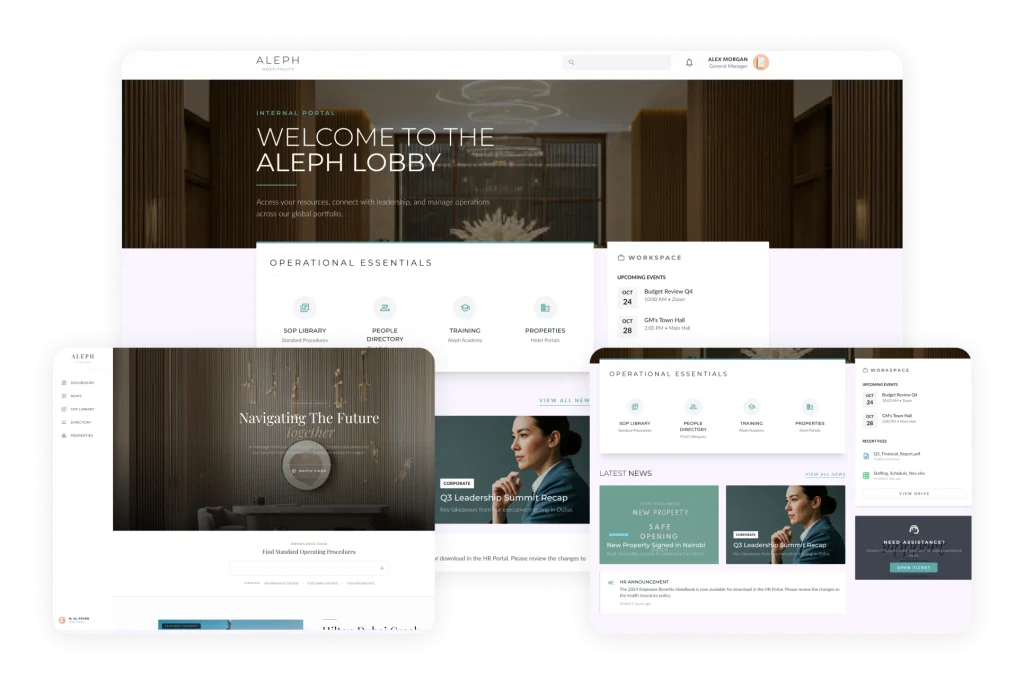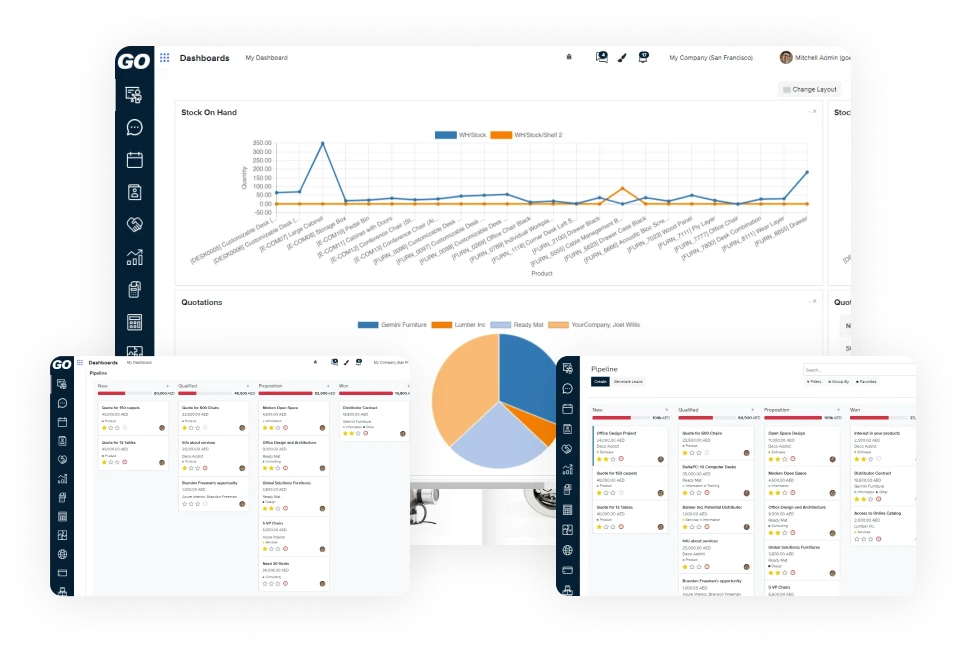









































London workplaces are evolving into intelligent environments where employees access everything through a single, adaptive interface. An AI employee hub London platform serves as the digital headquarters for your workforce, consolidating communication tools, company resources, project workspaces, and personalized information streams into one cohesive experience.
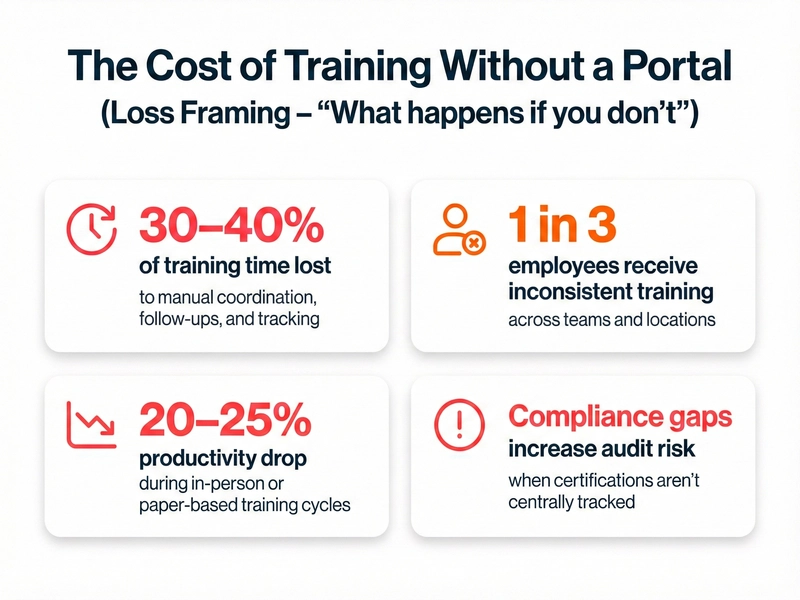

Traditional company intranets became digital dumping grounds where information goes to be forgotten. Employees stop checking them because navigation is confusing, content is outdated, and finding anything requires knowing exactly where to look.
Search functionality on older platforms rarely delivers useful results. An intelligent employee portal London system understands your role, location, and context to return the specific policy version relevant to you, along with necessary forms and workflows.
Mobile experiences on legacy intranets range from nonexistent to barely functional. Platforms that only function on desktop computers create accessibility problems, causing people to maintain personal copies of information that fragment the single source of truth.
GO-Globe designs intelligent employee portal London solutions that function as living workspaces rather than static repositories. Our methodology starts with understanding your employee journey—from recruitment through onboarding, daily work, professional development, and eventual transition.
Content architecture follows task completion patterns rather than organizational hierarchies. User interfaces prioritize efficiency over reflecting internal department structures. Integration with existing business systems creates a unified workspace where employees accomplish tasks without application switching.
The intelligence layer learns from collective behavior across your workforce, identifying gaps in navigation or content discoverability and flagging areas for improvement.

Employee portals handle extensive personal information—employment records, performance reviews, salary details, health information, and behavioral data. A gdpr ai intranet UK platform must protect this sensitive content through comprehensive measures that satisfy regulatory requirements while maintaining usability.
Data minimization principles guide what information the portal collects and retains. Collect analytics necessary for improving user experience and identifying security anomalies, but avoid surveillance features that erode trust.
Access controls implement least privilege principles where individuals can only view information necessary for their roles. The portal enforces these boundaries consistently across all integrated systems.
Right to be forgotten requirements create particular challenges because employment records have legitimate retention periods. A compliant ai intranet London system must distinguish between personal data that can be deleted immediately and information that must be retained for legal or regulatory reasons.
An ai knowledge base UK transforms how organizations capture, organize, and distribute institutional knowledge. Rather than relying on individual experts for recurring questions, the system documents answers once and makes them discoverable when others have similar needs.
Natural language processing allows employees to ask questions conversationally rather than browsing category trees. The system understands variations in phrasing, so different wordings all return relevant results.
The knowledge base learns continuously from employee interactions. When someone reads an article but immediately searches for related information, the system recognizes the initial content didn't fully address their needs.
Content gaps become visible through search analytics showing what employees are looking for but not finding. This data-driven approach ensures resources are developed based on actual demand rather than assumptions.

Personalization transforms a smart employee hub London platform from a generic corporate site into each employee's customized workspace. The system adapts to individual roles, preferences, and behavior patterns to surface relevant information while filtering out noise.
Onboarding pathways adjust based on role, department, and experience level. A junior employee receives detailed guidance about company culture and benefits, while a senior hire sees abbreviated orientation focused on company-specific processes.
Project-based personalization adjusts the hub as employees move between initiatives. When someone joins a new project team, the portal automatically displays relevant documents and introduces team members. This dynamic adaptation prevents interface clutter.
Learning recommendations use AI to suggest professional development resources based on career trajectories, skill gaps, and content consumed by peers in similar roles.
An ai internal portal UK serves as the communication backbone for organizations where employees work across locations, time zones, and schedules. Announcements reach targeted audiences rather than blasting everyone with irrelevant information.
Social features foster informal connections that build organizational culture. Employee directories show expertise areas, current projects, and organizational relationships that help people identify who to approach for specific questions.
Discussion forums organized by topic create spaces for asynchronous conversation that email cannot match. Questions and answers remain accessible long after initial posting, building a searchable archive of organizational knowledge.
A compliant ai intranet London implementation balances accessibility with appropriate security controls. Role-based access control provides the foundation, but intelligent systems apply contextual factors beyond static permissions.
Multi-factor authentication adds verification beyond passwords. Risk-based authentication escalates requirements when suspicious patterns emerge—logins from unusual locations or access attempts outside normal working hours.
Deploying an AI employee hub London platform requires methodical planning that balances ambition with pragmatic execution. Start with discovery workshops involving representatives from different departments, roles, and seniority levels.
Content migration from existing systems demands careful curation. Audit existing content to identify what should move to the new platform, what needs updating, and what can be archived or deleted.
Integration planning identifies which business systems need connections to the employee hub and what data should flow between them.
Establish metrics that reflect whether your intelligent employee portal London investment achieves intended outcomes. Active user counts show adoption, but engagement depth matters more—are employees completing substantive tasks within the hub?
Information accessibility improvements appear in reduced time spent searching for documents or waiting for answers. Track help desk tickets related to policy questions reductions indicate the portal successfully provides self-service answers.
Collaboration metrics reveal whether the platform strengthens connections. Document co-editing frequency, discussion forum participation, and cross-departmental project formation show people working together more effectively.
London organizations competing for talent and market position cannot afford the productivity drain caused by fragmented information systems. An AI employee hub London solution creates the digital foundation where your workforce operates efficiently, collaborates effectively, and stays engaged.
Whether you need a gdpr ai intranet UK that prioritizes privacy, a comprehensive smart employee hub London, or an ai knowledge base UK that scales expertise, modern platforms deliver capabilities that were aspirational just years ago.
Contact us for a compliant ai intranet London assessment tailored to your organization. We'll evaluate your current employee experience, identify improvement opportunities, and design a hub strategy that aligns with your culture, workflows, and business objectives.



An AI employee hub centralizes tools, resources, communication, and knowledge into one intelligent workspace for employees.
It ensures employees access role-based information, documents, and collaboration tools from anywhere through a single platform.
Unlike static intranets, AI hubs offer personalization, smart search, automation, and real-time content relevance.
Yes, GDPR-compliant AI intranets apply data minimization, access controls, audit logs, and privacy-by-design principles.
It captures organizational knowledge and allows employees to find answers using natural language search.
Yes, it integrates with HR, ERP, document management, and collaboration tools via secure connections.