Government agencies and public sector organizations face unique challenges that private businesses don't encounter. You must serve every citizen regardless of their technical ability or access to technology. You operate under strict regulations, compliance requirements, and public scrutiny. You manage sensitive data that demands the highest security standards. Your budget comes from taxpayers who expect value, efficiency, and accountability. You need to coordinate across multiple departments, locations, and jurisdictions while maintaining consistency and transparency.


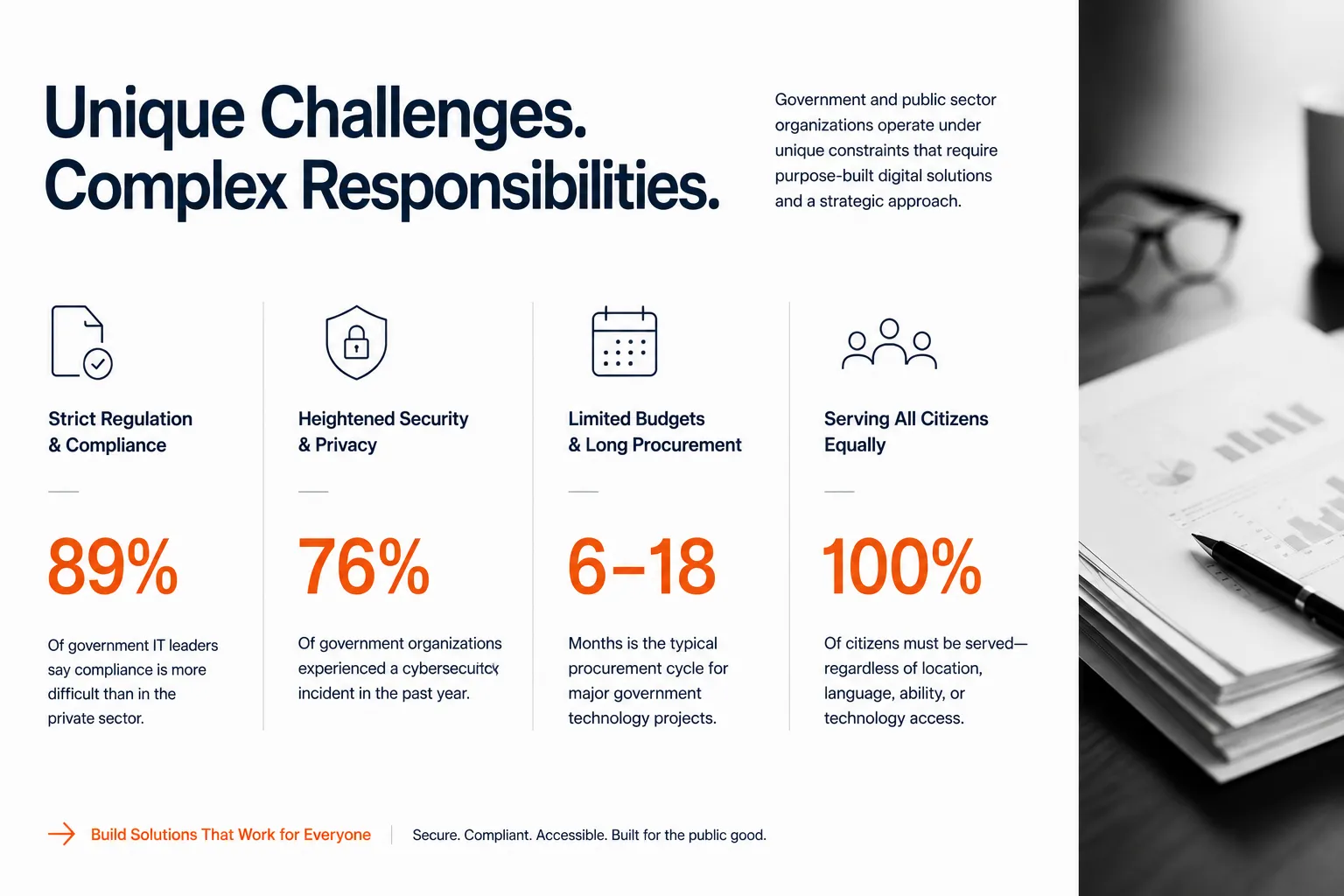
Government agencies face obstacles that make digital transformation more complex than in the private sector.
Strict Regulatory and Compliance Requirements
Every government system must comply with laws, regulations, and policies covering data privacy, accessibility, security, procurement, and public records. These requirements aren't optional or negotiable. Violations can result in legal liability, loss of funding, political consequences, and damaged public trust. Commercial software often doesn't meet these specialized requirements, forcing agencies to build custom solutions or extensively modify existing systems. The complexity multiplies when serving multiple jurisdictions with different regulations.
Heightened Security and Privacy Concerns
Government agencies handle extremely sensitive information including personal identification data, financial records, health information, law enforcement records, and classified materials. This data represents high-value targets for criminals, foreign adversaries, and malicious actors. Security breaches don't just harm individuals; they can compromise national security, enable identity theft at scale, or undermine public confidence in government institutions. Security requirements far exceed typical business standards, requiring specialized expertise, rigorous testing, and ongoing vigilance.
Limited Budgets and Long Procurement Cycles
Public sector budgets face intense scrutiny and constraints. Every expenditure must be justified to taxpayers and oversight bodies. Procurement processes involve extensive requirements documentation, competitive bidding, contract negotiations, and approval workflows that can take months or years. This makes agile adaptation difficult and creates pressure to get solutions right the first time. Budget cycles may not align with technology lifecycles, forcing agencies to plan years ahead or miss opportunities for modernization.
Need to Serve All Citizens Equitably
Private businesses can choose their customers and optimize for profitable segments. Government must serve everyone regardless of age, technical literacy, language, disability, income level, or geographic location. This requires accessibility features for people with disabilities, multilingual support, mobile optimization for those without computers, offline options for areas with poor connectivity, and assistance programs for digitally excluded populations. Solutions must work for the least technically capable citizen, not just the average user.
Let's examine the specific benefits that well-designed digital solutions deliver to public sector organizations.
Dramatically Improve Citizen Experience
Modern digital services transform how citizens interact with government. Online portals let people access services 24/7 from home or work without taking time off, traveling to offices, or waiting in lines. Clear interfaces guide users through processes step by step, eliminating confusion about requirements or procedures. Automated status updates keep citizens informed about their requests without phone calls or emails. Mobile optimization lets people use smartphones, expanding access for those without computers. Self-service options give citizens control and convenience for routine transactions. Integration across departments creates seamless experiences instead of forcing citizens to interact separately with each agency.
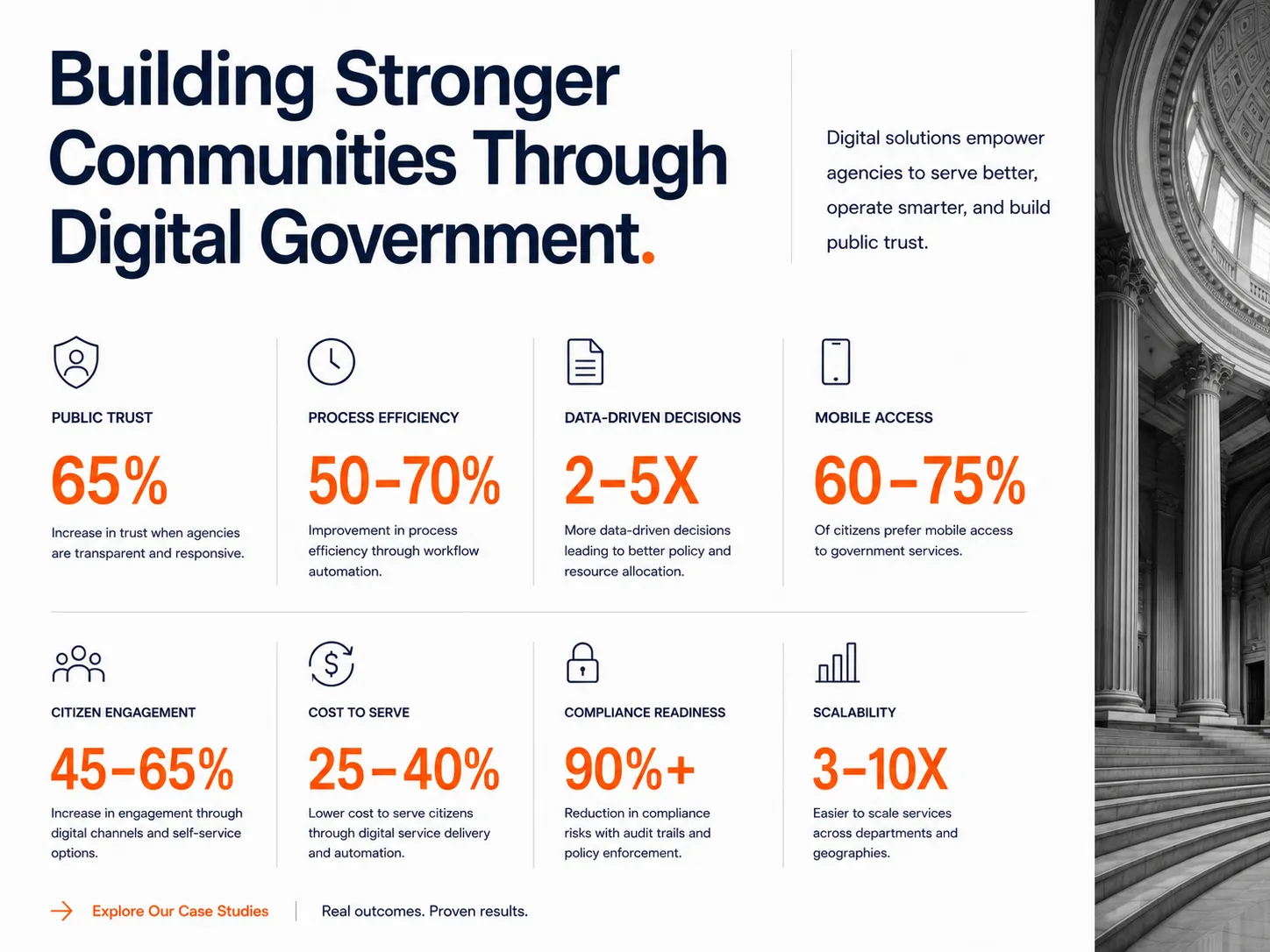
The cumulative impact on citizen satisfaction is substantial. Surveys consistently show that citizens prefer digital government services when they're designed well. Satisfaction scores increase. Complaints decrease. Positive word-of-mouth builds as citizens share good experiences. This improved experience doesn't just make people happier; it builds trust in government institutions and increases civic engagement.
Increase Operational Efficiency
Digital automation eliminates countless hours of manual work. Forms that staff once typed from paper applications now populate automatically. Documents that required physical filing and retrieval become instantly searchable in databases. Processes that needed multiple people passing papers can route automatically based on rules. Reports that took days to compile generate in minutes. Payments that required checks and processing happen electronically.
These efficiency gains compound across an organization. When one department automates intake, downstream departments receive better data faster. When systems integrate, staff don't re-enter information or reconcile discrepancies between databases. When workflows optimize, bottlenecks disappear. The time savings add up to thousands of staff hours annually that can be redirected to higher-value work that requires human expertise, judgment, and citizen interaction.
Reduce Costs Over Time
While digital transformation requires upfront investment, it typically reduces ongoing costs substantially. Less staff time on manual processing means lower labor costs or ability to serve more citizens with existing staff. Reduced paper consumption, printing, mailing, and physical storage saves money. Fewer errors mean less time correcting mistakes and fewer costs from incorrect payments or decisions. Better data leads to better decisions that avoid expensive problems. Self-service options reduce the volume of calls and office visits that require staff time.
Many government agencies report that digital solutions pay for themselves within a few years through these cost reductions. The savings continue indefinitely while the technology investment is one-time (plus ongoing maintenance costs that are typically much lower than the efficiency savings).

We've built digital systems for government agencies at municipal, regional, and national levels. Here's what our comprehensive government solutions include.
Citizen Service Portals
We create secure online portals where citizens access government services conveniently. These portals provide account management for viewing personal information and history, online applications for permits, licenses, benefits, and registrations, document submission uploading supporting materials securely, payment processing for fees and taxes, status tracking seeing real-time progress of requests, communication tools for messaging with agencies, appointment scheduling booking times for in-person services, service directories finding the right department or program, and personalized dashboards showing relevant information for each citizen.
The portals use single sign-on so citizens create one account for all government services instead of separate logins for each department. They include robust identity verification to prevent fraud while maintaining security. They work seamlessly across desktop, tablet, and mobile devices. They support multiple languages for diverse populations. They meet accessibility standards so everyone can use them regardless of disability.
Transparency and Open Data Platforms
We help agencies meet transparency mandates and exceed citizen expectations through specialized platforms including public dashboards displaying budgets, spending, and metrics in clear visualizations, open data portals publishing datasets citizens can download and analyze, performance tracking showing progress toward goals and service levels, meeting management publishing agendas, minutes, and recordings, public records requests handling freedom of information requests efficiently, GIS mapping showing geographic data for planning and services, budget visualization explaining how funds are allocated and spent, project tracking displaying status of infrastructure and initiatives, and reporting tools generating public reports automatically.
E-Government and Digital Service Delivery
We build comprehensive e-government platforms that transform how agencies deliver services including online voting and election management for authorized use cases, tax filing and payment systems, benefit application and distribution, vital records requests for birth certificates and marriage licenses, vehicle registration and driver licenses, business registration and reporting, property record access and transactions, public comment and engagement on proposed policies, grant application and management, and licensing for professions and activities.
Each service connects to appropriate backend systems, maintains security and compliance requirements, provides accessibility for all citizens, includes audit trails for accountability, and integrates with related services to avoid duplication. The platforms use progressive enhancement so simpler transactions can be fully automated while complex cases get routed to staff who can apply judgment.
Government projects require specialized approaches that account for unique requirements, stakeholder complexity, and risk sensitivity.
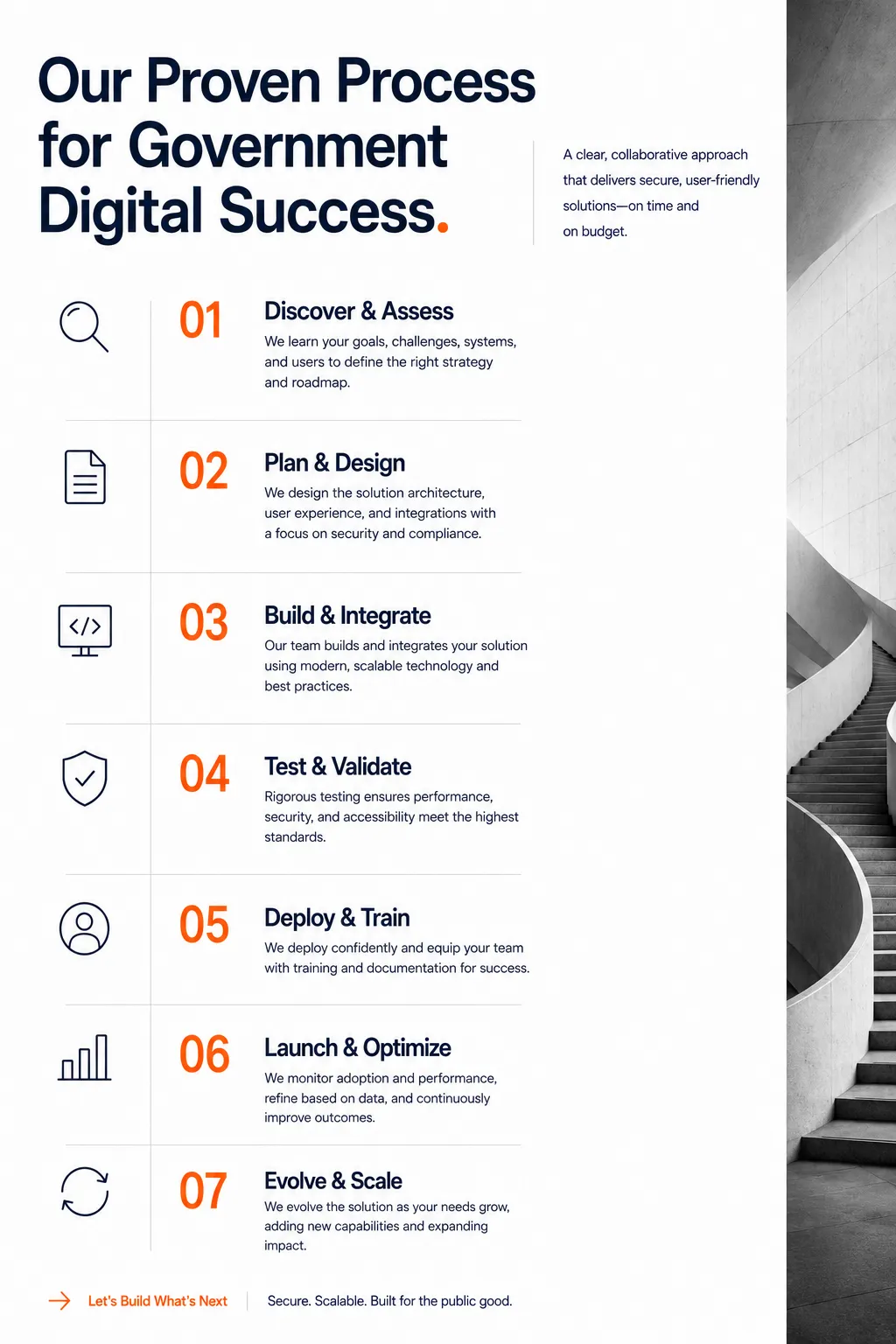
Requirements Gathering and Stakeholder Engagement (Weeks 1-4)
We begin every government project with extensive discovery including interviews with agency leadership, staff, and key stakeholders, observation of current processes and citizen interactions, review of existing systems and documentation, analysis of regulatory and compliance requirements, assessment of security and accessibility needs, identification of integration requirements with other systems, and understanding of political and organizational dynamics.
User-Centered Design and Prototyping (Weeks 5-8)
We design solutions with input from the people who will actually use them including citizens who will access services, frontline staff who will use systems daily, managers who will supervise operations, IT staff who will maintain systems, accessibility advocates ensuring inclusion, and oversight bodies monitoring compliance.
We create prototypes and conduct usability testing with representative users to validate designs before development begins. This user-centered approach prevents building systems that technically work but fail to meet real-world needs.
Secure Development and Compliance (Weeks 9-20)
Our development process follows government security and compliance standards including secure coding practices preventing vulnerabilities, regular security testing and code reviews, privacy controls protecting sensitive data, accessibility compliance meeting WCAG standards, performance testing ensuring reliability under load, documentation for maintenance and compliance, and integration testing with existing systems.
Testing, Training, and Deployment (Weeks 21-24)
Before launch, we conduct comprehensive testing including functionality verification against requirements, security penetration testing, accessibility compliance validation, performance and load testing, user acceptance testing with real users, integration testing with connected systems, and disaster recovery testing.
We provide thorough training for all users through hands-on workshops, documentation and reference materials, train-the-trainer programs for agencies to sustain training, and ongoing support during launch and beyond.

Municipal Governments
Cities use our solutions for online permit applications and payments, business license management, property tax payment systems, utility billing and payment, citizen request tracking for repairs and services, recreation program registration, public meeting management, code enforcement tracking, GIS mapping for planning, and budget transparency dashboards.
State and Regional Agencies
State agencies implement our systems for professional licensing and renewals, benefit application and distribution, regulatory compliance tracking, environmental permitting, vehicle and driver services, tax collection and refund processing, public records management, grant administration, and inter-agency data sharing.
Federal and National Government
Federal agencies deploy our solutions for citizen service centers providing multi-agency access, regulatory compliance reporting, inspection management, open data platforms, public engagement on rulemaking, grant management, national databases, interoperability platforms, and secure information sharing across jurisdictions.
Public Safety and Emergency Services
Emergency management agencies use our systems for emergency notifications to citizens, incident coordination across agencies, resource management during disasters, public safety records management, volunteer coordination, and recovery assistance administration.
Public Health and Social Services
Health and social service agencies implement systems for benefit application and eligibility determination, case management for clients, appointment scheduling, health inspections and licensing, vital records access, disease surveillance and reporting, and program evaluation tracking.
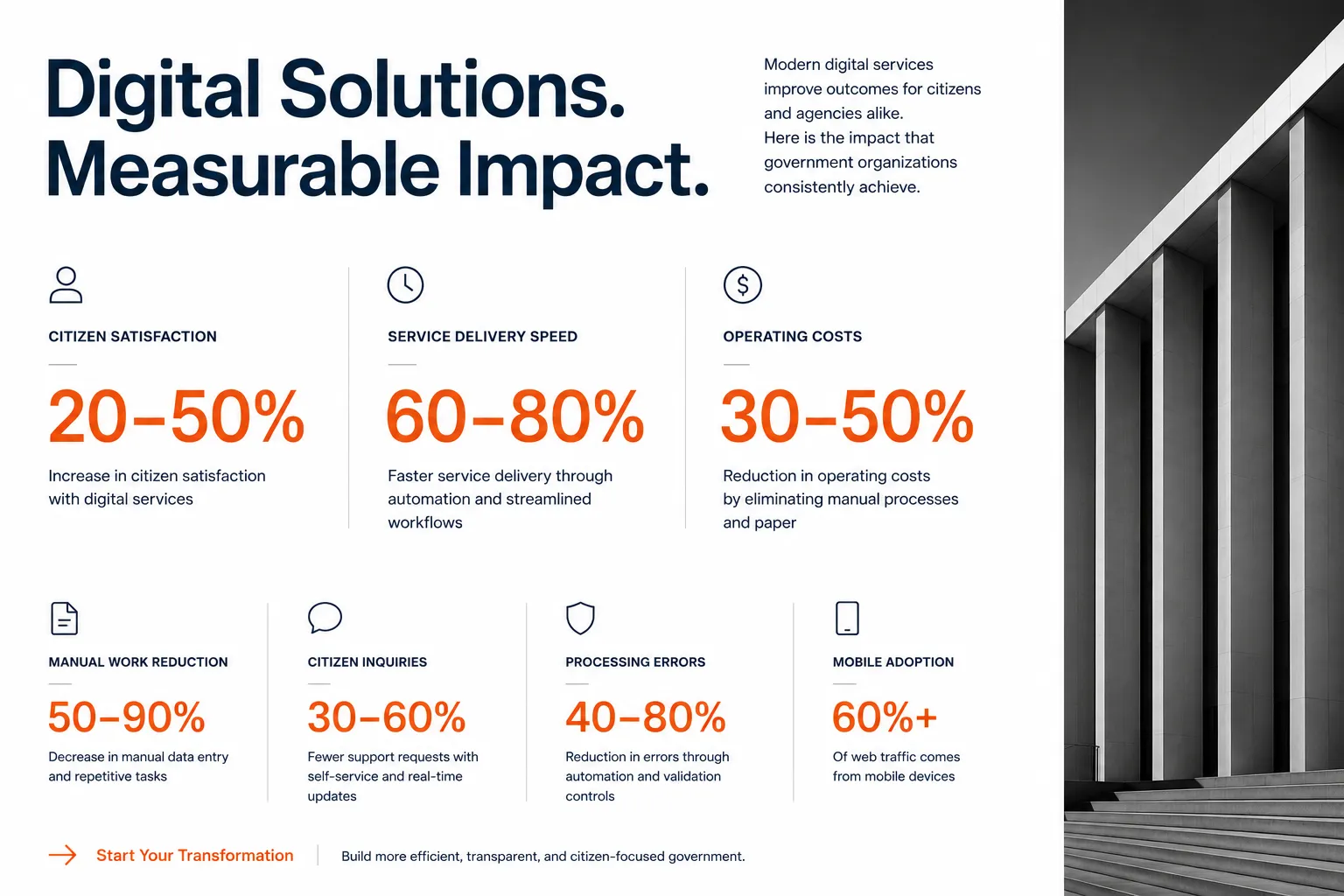
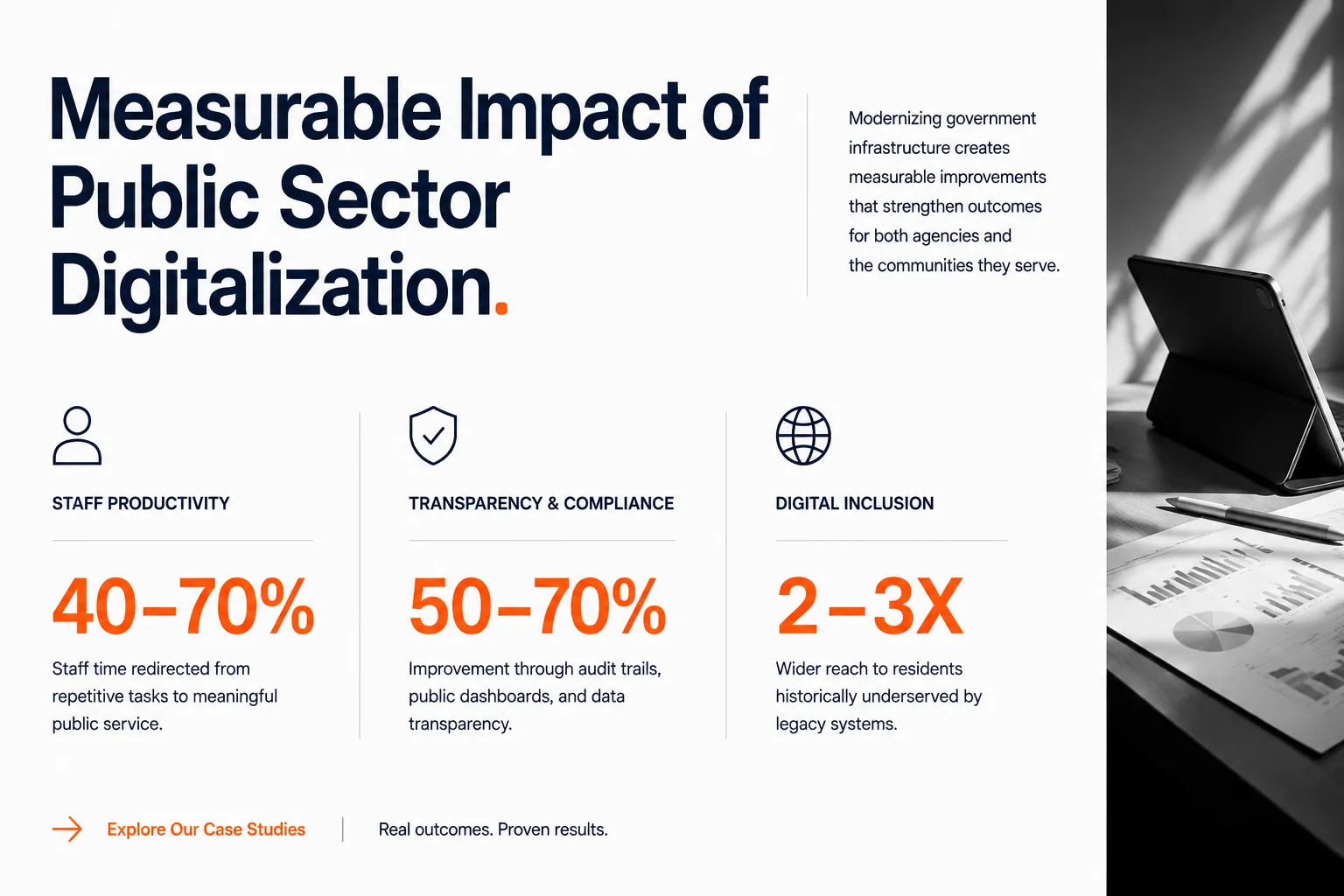
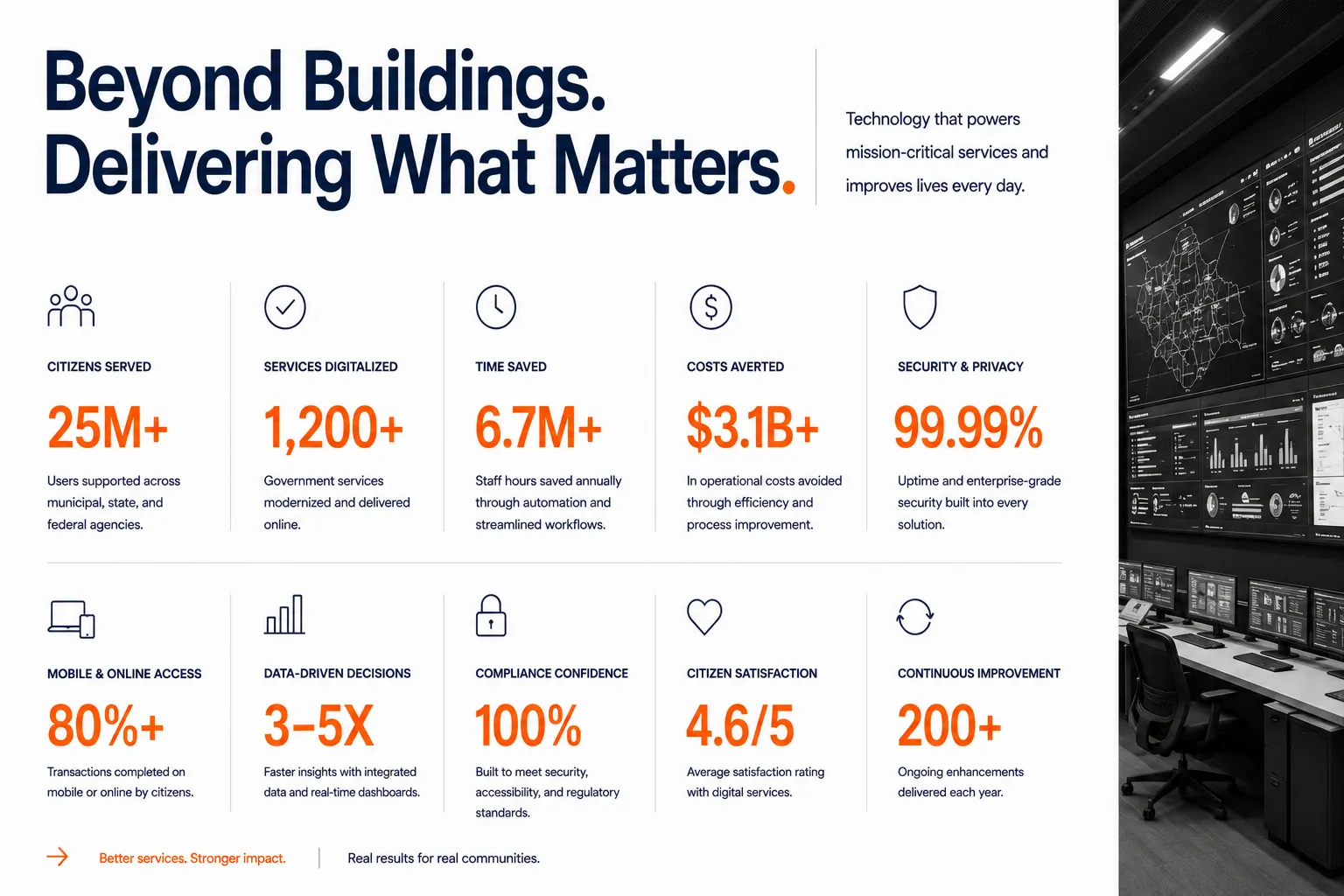
Agencies implementing modern digital solutions typically see citizen satisfaction scores increase 40-60% as services become more accessible and convenient. Service delivery times decrease 60-80% through automation and streamlined workflows. Operating costs decrease 30-50% from efficiency gains and reduced manual processing. Staff satisfaction improves as they focus on meaningful work rather than paperwork. Transparency metrics improve as citizens gain visibility into government operations. Accessibility improves as digital services reach previously underserved populations. Compliance improves through systematic controls and audit trails.
The investment in digital transformation pays returns for years through ongoing efficiency, better service, and improved outcomes.

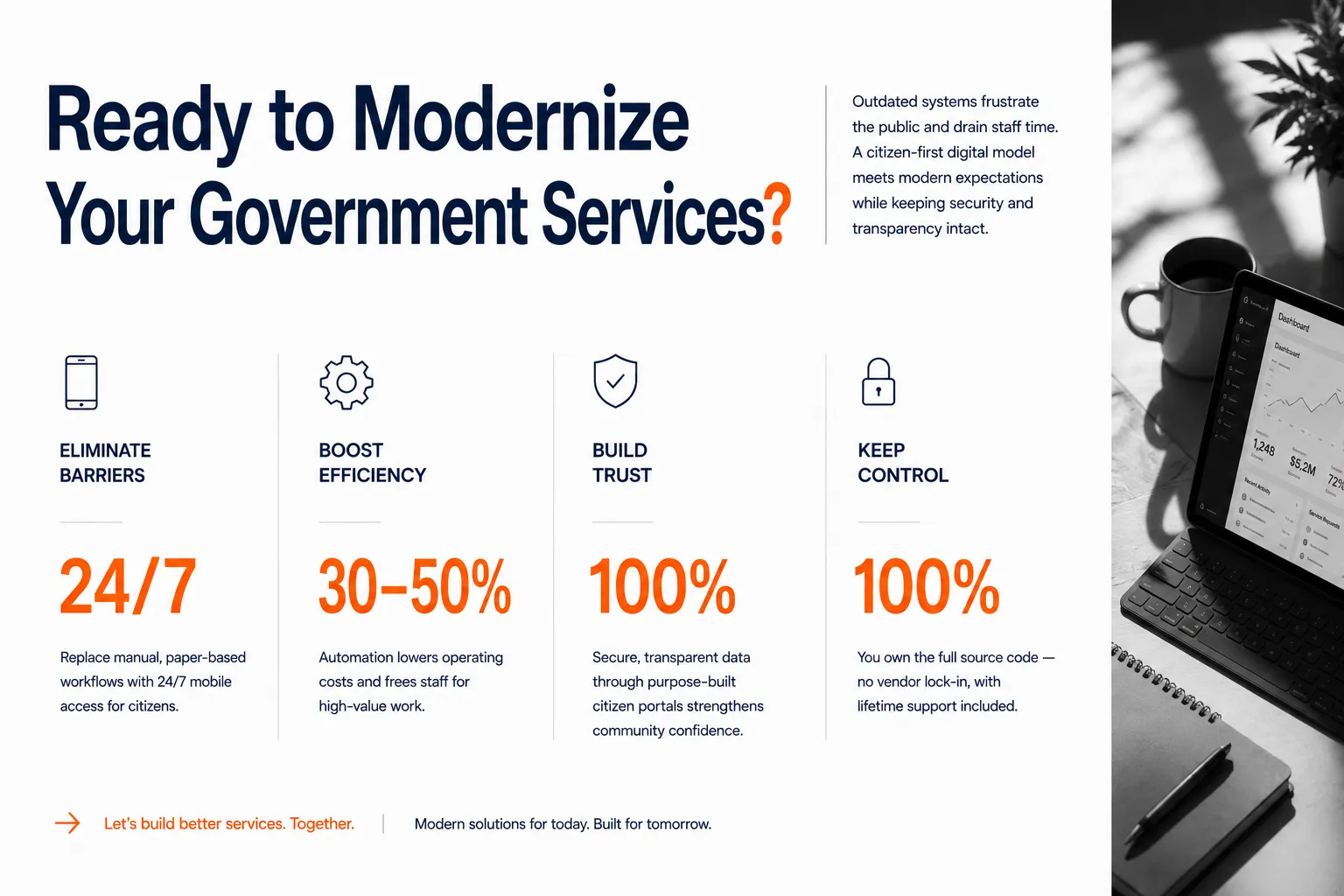
Stop frustrating citizens with outdated processes. Stop wasting staff time on manual paperwork. Stop limiting transparency due to technical constraints. Stop excluding citizens who need digital access. Stop falling behind citizen expectations shaped by modern services elsewhere.
Modern digital solutions help government agencies serve citizens better while operating more efficiently. Citizens get convenient access to services they need. Staff focus on work that requires human expertise. Costs decrease through automation and efficiency. Transparency increases, building public trust. Accessibility improves, ensuring equitable service delivery.
Every day without modernization means continuing frustration for citizens, wasted time for staff, and missed opportunities to improve government effectiveness.
We implement comprehensive security controls including encryption for data in transit and at rest, multi-factor authentication, role-based access controls, intrusion detection and prevention, regular security audits and testing, secure coding practices, compliance with government security standards, incident response planning, and physical security for systems. We have extensive experience with classified and sensitive systems.
Yes. Integration with legacy systems is a core competency. We connect new digital services to existing databases, enterprise systems, and specialized applications through APIs, data exchange protocols, and custom integration layers. We preserve your existing investments while adding modern capabilities.
Compliance is built into our process from the beginning. We identify applicable regulations during requirements gathering, design systems to meet compliance requirements, document compliance for audits, build in controls and audit trails, test for compliance before deployment, and provide ongoing compliance support.
All our government solutions meet or exceed WCAG accessibility standards. We design for screen readers, keyboard navigation, appropriate color contrast, text alternatives for images, and other accessibility features. We test with users who have disabilities to ensure solutions work in practice, not just in theory.
Timelines vary based on project scope and complexity. Simple citizen portals might deploy in 3-4 months. Complex multi-agency systems might require 12-18 months. We provide realistic timelines during planning and manage projects to stay on schedule.