Remember when you had to type long descriptions to find things online? Those days are over. Visual search in 2026 has completely changed how we shop and discover products. Instead of struggling with words, you just point your camera at something. Within seconds, you get your answer.
This isn't future technology anymore. Over 20 billion visual search queries happen every month through Google Lens alone. Businesses that focus on gaining an early advantage on emerging visual search trends by creating image-optimized, high-quality content during this rising phase can build strong user engagement signals and secure lasting visibility before the space becomes saturated. That's right—20 billion! Millions of people use image recognition search daily to find clothes they spot on strangers, identify plants in their backyard, or locate that perfect chair they saw at a coffee shop. Your camera has become your new search bar, and AI technology trends continue to make it smarter every day.
Contents
- 1 How Does This Actually Work in Practice?
- 2 What Can I Realistically Search For?
- 3 Privacy Concerns: What Happens to My Photos?
- 4 Does Visual Search Work Offline?
- 5 How Accurate Is Image Recognition Search Really?
- 6 GO-Globe's Visual Search Solutions for Businesses
- 7 Can You Search Your Own Photo Library?
- 8 Fake Results and Sponsored Content Issues
- 9 Integration With Existing Tools
- 10 Cost and Global Availability
- 11 Who's Actually Using Visual Search?
- 12 Ready to Transform How You Search?
- 13 Frequently Asked Questions About Visual Search
How Does This Actually Work in Practice?
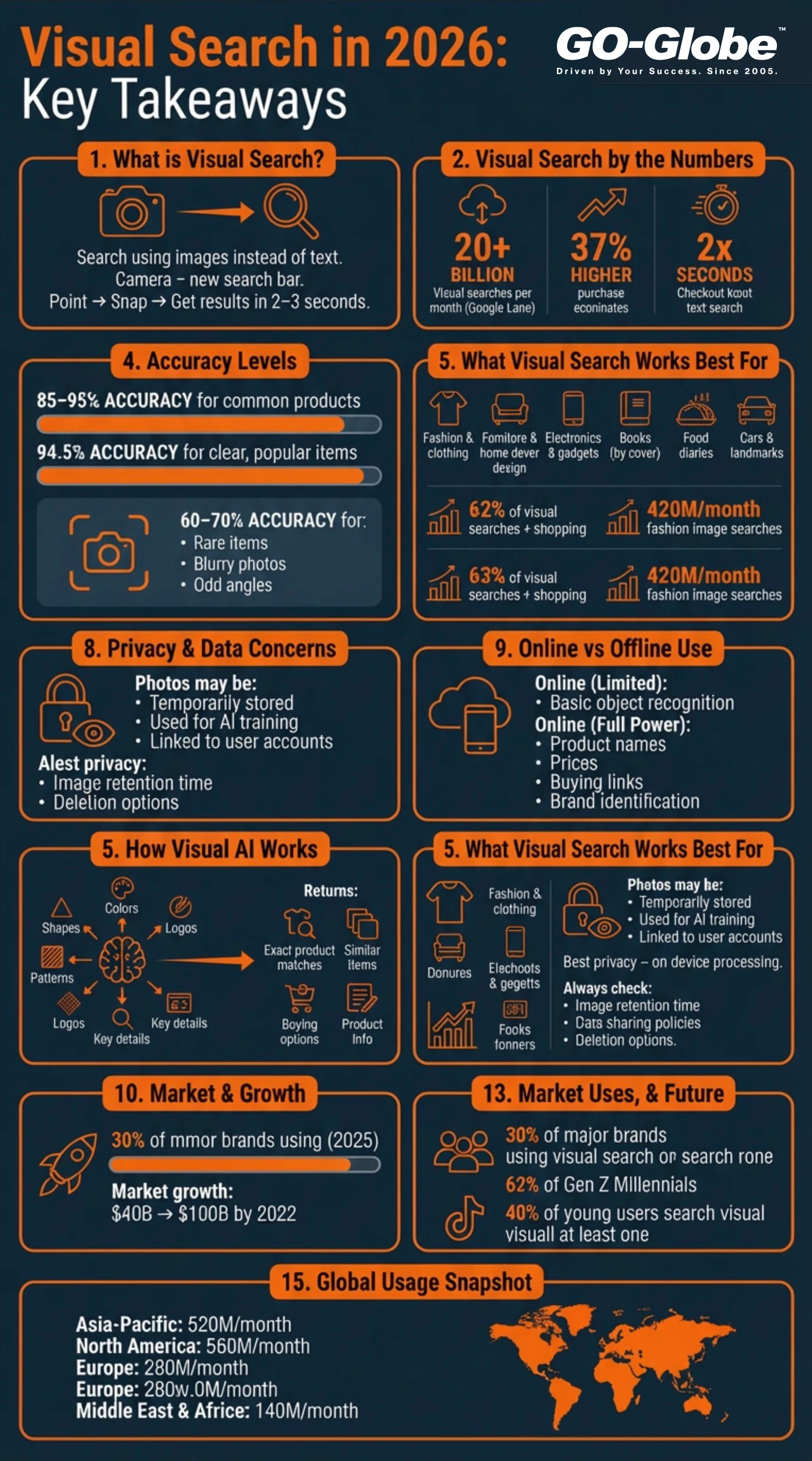
Let's talk about the real experience. When you use visual product discovery today, the process is super quick. You open your camera app or a visual search tool. Point it at any object. Snap a photo. Done. Within 2 to 3 seconds, you get results.
The Technology Behind Visual AI
The visual AI technology examines your photo carefully. It looks at shapes, colors, patterns, brand logos, and special details. Then it compares these features to billions of images stored online. You get matches showing where to buy that item. You also see similar products or detailed information about what you photographed.
Most modern phones handle this in under three seconds. The technology works for handbags, rare birds, buildings, plants, or even homework problems. According to recent data, camera-based search accuracy has jumped to over 94.5% for common products. That's way better than the 88% accuracy we saw just two years ago in 2022.
Why Visual Search Converts Better
Here's something cool: people who search visually are 37% more likely to buy something. They also reach checkout twice as fast compared to typing their search. That's a huge difference! The visual format helps shoppers feel confident about exactly what they're buying.
What Can I Realistically Search For?
This question matters because "find anything" sounds too good to be true. Here's the honest truth. Camera-based search works really well for manufactured products, common objects, landmarks, plants, animals, and text. It struggles with abstract ideas, heavily customized items, or things without clear features.
Products That Work Best
You can successfully search for:
- Clothing and fashion items
- Furniture pieces
- Electronics and gadgets
- Books by their covers
- Artwork and paintings
- Home decorations
- Car models
- Food dishes at restaurants
- Branded products
For personalized home decor and custom photo displays, users can explore Wall Pics to turn their favorite images into high-quality wall art.
Current statistics show that 62% of total visual searches happen for shopping and retail purposes. Fashion searches alone generate 420 million image queries every month. That's massive! The technology recognizes patterns really well. If something has been photographed and posted online before, your chances of finding it are high.
Items That Are Harder to Find
But here's the catch. That completely custom handmade necklace from a small local artist? That probably won't show up in results. The technology needs reference points. If an item exists mainly offline or hasn't been documented online much, reverse image search can't magically create information about it.
The best results come from popular products that many people have photographed. Rare or one-of-a-kind items are much harder to identify. Understanding this helps you use these tools more effectively.
Privacy Concerns: What Happens to My Photos?
You should definitely ask this question. Every photo you upload gets processed somewhere. Most big companies say they keep your images temporarily for processing. Then they delete them. But "say" is the important word here.
How Different Services Handle Your Data
Different services handle privacy very differently. Some keep your search history connected to your account forever. Others process images right on your phone when possible. They only send the important data points to their computers, not your actual photo. A few companies keep everything permanently to train their AI automation systems.
Before using any image recognition search service, read their privacy policy. Look for these specific details:
- How long do they keep your images?
- Do they use your photos to train their AI?
- Do they share your data with other companies?
- Can you delete your search history?
Protecting Your Privacy
The safest options do all processing on your device. But this sometimes means slower results or lower accuracy. Your photos contain personal information about where you've been, what you own, and what interests you. Companies really want this data.
According to privacy experts, always know what you're agreeing to before you start snapping pictures for searches. Read those terms carefully!
Does Visual Search Work Offline?
Short answer: kind of. Some apps download basic recognition tools to your phone. This lets you identify simple objects without the internet. But real visual product discovery needs an active internet connection to search through huge online databases.
What Works Without Internet
Think about it this way. Your phone can recognize you're looking at a chair without the internet using basic AI. But to tell you it's an "Eames Lounge Chair" worth $5,000 and show you where to buy it? That needs online access. Basic identification happens locally on your phone. The detailed search absolutely requires connectivity.
Tips for Travelers
If you travel a lot, plan ahead. Download apps that work offline before trips to places with bad cell signals. Some services let you take photos offline. Then they automatically search for answers once you reconnect to wifi. This compromise works well for most people who occasionally need visual search without immediate internet access.
How Accurate Is Image Recognition Search Really?
Let's talk about real numbers that matter. Current visual search technology gets things right about 85-95% of the time for common consumer products with clear photos. That accuracy drops to 60-70% for rare items, blurry pictures, or objects photographed from weird angles.
Recent Accuracy Improvements
Recent industry reports show that visual recognition algorithms now achieve 94.5% accuracy. That's a huge jump! This improvement has helped retailers reduce product return rates by 23% on average. When customers see exactly what they're buying through accurate visual search, they make better decisions.
What Affects Accuracy
Lighting matters enormously. A bright, well-lit photo of a dress gives you excellent results. That same dress photographed in dim lighting with lots of shadows might return completely wrong matches. Background mess also confuses the systems. A clean image with your target object centered in the frame works best every time.
Brand logos help a ton. If you're searching for Nike shoes, that swoosh logo helps the visual AI narrow things down immediately. Plain items without distinctive features don't work as well. A basic white t-shirt might match thousands of products online. That makes exact identification basically impossible.
Pro Tips for Better Results
Here's a helpful tip from experts: take multiple photos from different angles. This gives the system more information to work with. Better photos equal better results every single time. The average visual search takes only 18 seconds from photo to finding the product. That's incredibly fast!
GO-Globe's Visual Search Solutions for Businesses
Companies like GO-Globe understand that businesses need reliable visual search solutions built into their websites and apps. Whether you run an e-commerce platform or help customers find products, adding camera-based search capabilities keeps you competitive in 2026.
Market Growth and Opportunities
Industry forecasts show that 30% of major online brands will use visual search by the end of this year. By 2032, the global visual search market will grow to over $150 billion. That's growing at about 17-18% each year! Smart businesses are getting ahead of this trend now.
Implementation Benefits
The setup process usually connects your website to established visual search providers through simple code integration. This lets your customers take photos of products and find them directly in your catalog. Sales go up when mobile shopping becomes this easy. Instead of typing "blue floral summer dress size medium," customers snap a photo and land right on your product page.
Retailers using visual search see a 16% increase in customer engagement and a 9% bigger average purchase amount. Those numbers add up fast! This technology isn't just for giant companies anymore. Small and medium businesses can add it too through custom e-commerce solutions. The cost has come down significantly, and setup is much easier than before.
Can You Search Your Own Photo Library?
Yes, and this feature has become incredibly useful! Visual search in 2026 works both directions. You can search the internet with your photos. Or you can search your own massive photo collection using another picture as reference.
Personal Photo Organization
Imagine having 15,000 photos on your phone. You want to find that specific picture from your beach vacation two years ago where everyone wore matching blue shirts. Instead of scrolling endlessly through thousands of images, you show the app another photo with similar colors, people, or beach settings. The reverse image search technology finds matches within your personal library in seconds.
Available Tools and Features
Apple Photos, Google Photos, and similar apps now do this automatically. Third-party apps make it even more powerful. They let you search across different devices and all your cloud storage services at once. This transforms messy, disorganized photo collections into searchable, organized libraries.
You can find all photos of a specific person, all photos from a certain place, all photos with similar colors or moods. It's like having a super smart filing system for your memories. No more endless scrolling to find that one special picture!
Fake Results and Sponsored Content Issues
Here's something tricky you need to know. When you use visual product discovery to shop, you often see results that companies paid to show you. That "perfect match" at the top? It might actually be a paid advertisement, not the closest visual match to what you photographed.
Identifying Sponsored Results
Good, honest platforms clearly mark sponsored results with labels. Others blur the lines on purpose. They make it really confusing to tell real matches from paid ads. Always check multiple sources when shopping with visual search. Compare prices across different sites. Read actual customer reviews. Make sure you're getting the actual product you photographed, not just something similar.
Smart Shopping Strategies
Some visual AI tools have started adding verification badges. These show "exact match" versus "similar items." Look for these helpful indicators. They tell you whether the computer found precisely what you photographed or just something that looks kind of close.
Don't assume the first result is automatically the best one. Scroll down through results. Check different options. Companies pay serious money to appear first in visual search results. Sometimes the third or fourth result is actually better or cheaper!
Integration With Existing Tools
Most visual search happens through dedicated apps right now. But integration is getting much better and easier. Camera apps on newer phones from the last 2-3 years include built-in visual search. They partner with Google Lens, Pinterest Lens, or similar services. You don't always need a separate download anymore.
Browser and Mobile Integration
Browser extensions let you right-click any image you see online and instantly search for it. This works great for finding original sources of images, locating better quality versions, or finding shopping alternatives. The technology fits smoothly into what you already do online through mobile app development and existing workflows.
The Future: Smart Glasses
Smart glasses represent the exciting next step. Instead of pulling out your phone, you'll just look at objects through your glasses. You'll get instant information appearing right in your field of view. Several major tech companies are testing this technology right now. Broader commercial availability is expected within the next two years.
The overall goal? Making visual search as natural and easy as asking a simple question. Point, look, or snap. Get your answer immediately without interrupting your day.
Cost and Global Availability
Basic visual search costs absolutely nothing for regular people. Google Lens, Pinterest Lens, and similar tools are completely free to use. You don't pay with money. But you do pay with your personal information and attention to ads. That's the trade-off.
Pricing Models
Premium services charge around $5-15 per month. You get unlimited searches, no annoying ads, much faster processing, and special features for business use. Companies adding camera-based search to their own websites pay based on how many people use it. Usually $0.001-0.01 per search depending on total volume.
Also check Custom AI vs Off-the-Shelf: The Decision Framework for 2026
Regional Availability
Where you live in the world matters quite a bit. Visual search works best in North America, Europe, and big cities across Asia. Those regions have the most comprehensive product databases online. Rural areas or developing countries might see fewer, less accurate results. Simply because fewer products from those places get photographed and indexed online.
Language also matters for accuracy. The technology performs better when product descriptions match your phone's language settings. If you're searching in English but products are described in another language, results won't be as good.
Usage Statistics by Region
Current data shows North America processes about 560 million visual searches monthly. Asia-Pacific handles 620 million searches. Europe sees 280 million. The Middle East and Africa combined see about 140 million monthly searches. These numbers keep growing every month!
Who's Actually Using Visual Search?
The statistics about who uses this technology are really interesting. Younger people absolutely love visual search. About 62% of Gen Z and Millennials prefer visual search over any other new technology. They want to search with images, not words.
Demographic Trends
Here's a surprising fact: almost 40% of young people now use TikTok or Instagram for searches instead of Google. They prefer the completely visual nature of these results. When looking for product recommendations, step-by-step instructions, or travel ideas, they want to see videos and photos, not text links.
The demographic aged 18 to 24 uses Google Lens the most. But it's not just young people. Over 36% of all online shoppers have used visual search at least once. More than half of all shoppers say visual information is more important than text when making buying decisions online.
Conversion Impact
People who search visually convert to actual purchases 37% more often than people using text search. That's a huge difference! The visual format helps people feel more confident about what they're buying. Retail mobile apps that integrate visual search see significantly higher customer satisfaction rates.
Ready to Transform How You Search?
Visual search in 2026 isn't perfect yet. But it's definitely powerful enough to change your daily shopping and discovery habits. Instead of bookmarking items, taking screenshots, or hoping you remember where you saw something cool, you can capture and find it instantly.
The technology will only improve as image recognition search becomes even more sophisticated. Industry experts predict massive growth. The visual search market is expected to grow from $40 billion this year to over $150 billion by 2032. That's incredible growth driven by how much people love this technology!
Start experimenting with visual AI today. Download a visual search app right now. Try photographing random products around your home. See what results pop up. Test it next time you're in stores before buying something. Compare prices online instantly by snapping a photo in the store. The more you use these tools, the more clever ways you'll discover to save time and money.
You might find that an expensive couch costs way less online. You might finally identify that mystery plant you've wondered about for months. You might discover exactly where to buy those amazing shoes you saw someone wearing on the street. The possibilities grow literally every day as more products get added to visual search databases.
Want to add visual search capabilities to your business website or app? Contact GO-Globe today to discuss integration options that perfectly match your specific needs and budget. Stay ahead of your competition in 2026!
Frequently Asked Questions About Visual Search
Can visual search identify people's faces?
No, most consumer visual search tools deliberately block face recognition for important privacy reasons. You can search for objects, products, landmarks, and places. But you cannot and should not identify unknown strangers in your photos. This protects everyone's privacy.
Does visual search work for artwork and paintings?
Yes, really well! Museums and art apps use visual search to provide detailed information about paintings, sculptures, and historical artifacts. Point your camera at artwork in a museum to instantly learn about the artist, the time period, historical significance, and related pieces. Over 90% accuracy for famous artworks!
How do I get better, more accurate results from my visual searches?
Take clear, bright, well-lit photos with minimal background clutter and distractions. Center your target object right in the middle of the frame. Make sure to capture any brand logos or distinctive features clearly. Avoid blurry, dark, or messy images for best accuracy. Take photos from multiple angles for even better results!
Can companies track me through visual search?
Potentially yes, if you're logged into an account while searching. That company can definitely see and store your complete visual search history. Use private browsing mode or search while logged out for more anonymous, private searching. Read privacy policies carefully before uploading personal photos.
Will visual search completely replace traditional text-based search engines?
No, they work together and complement each other perfectly. Visual search is absolutely fantastic when you can see something but don't know what to call it or how to describe it in words. Text search remains much better for abstract concepts, specific detailed questions, and in-depth research topics.
Does visual search work on all smartphones?
Most smartphones from the last 3-4 years fully support visual search technology. Older phones from before 2020 might not have enough processing power or the right camera capabilities. Check your phone's app store to see if major visual search apps work on your specific device.
How fast is visual search compared to typing?
Visual searches average only 18 seconds from taking a photo to finding the exact product. That's way faster than typing descriptions, scrolling through search results, and clicking multiple links. People using visual search reach checkout twice as fast as people typing their searches!
What makes visual search different from regular image search?
Regular image search uses text keywords to find pictures. Visual search uses the actual picture itself as the search query. You're searching with images, not words about images. It's like showing someone what you want instead of trying to describe it. Much more accurate and faster!