Contents
- 1 The Problem Nobody Saw Coming
- 2 What Sovereign AI Actually Means
- 3 The GCC Reality
- 4 The Three Levels of Control
- 5 Real Scenarios in the GCC
- 6 The Technology Behind It
- 7 The Business Case
- 8 Common Misconceptions
- 9 The Vendor Lock-In Question
- 10 Starting Your Sovereign AI Journey
- 11 The Regional Advantage
- 12 What Happens If You Wait
- 13 The Future is Local
- 14 Making the Decision
- 15 Getting Expert Help
The Problem Nobody Saw Coming
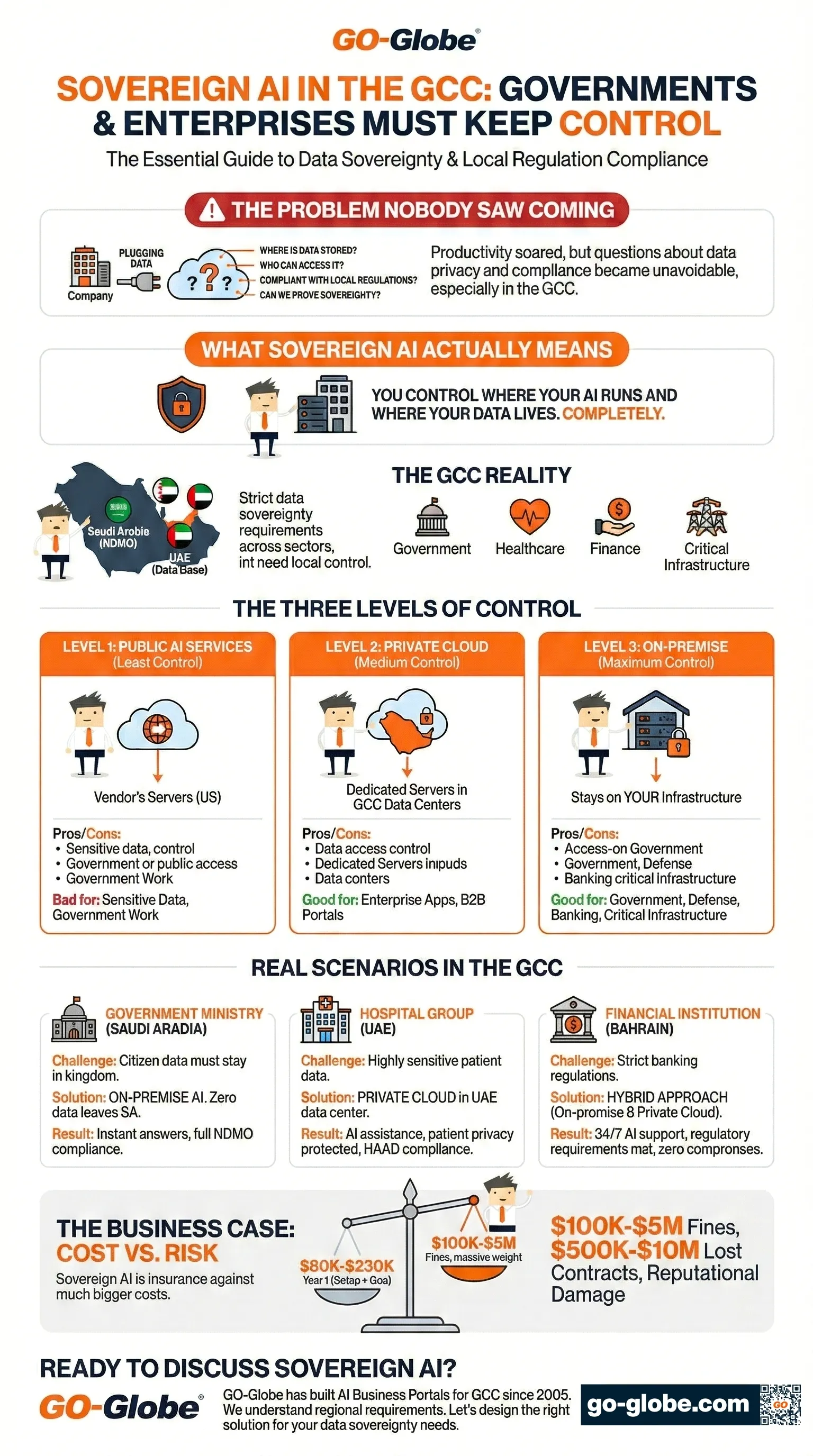
Three years ago, companies rushed to adopt AI. They plugged their data into ChatGPT, Claude, and other public AI services. They got amazing results. Productivity soared.
Then the questions started coming:
"Where is our data stored?"
"Who can access it?"
"What happens to sensitive information we send to these AIs?"
"Are we compliant with local regulations?"
"Can we prove data sovereignty to auditors?"
For many companies, especially in the GCC, the answers were uncomfortable.
What Sovereign AI Actually Means
Sovereign AI is simple: you control where your AI runs and where your data lives.
Not "we trust the vendor's privacy policy."
Not "they say it's secure."
Not "probably it's fine."
You control it. Completely.
This matters more in the GCC than almost anywhere else in the world. Here's why.
The GCC Reality
Governments across Saudi Arabia, UAE, Bahrain, Qatar, and Kuwait are taking data sovereignty seriously:
Saudi Arabia's NDMO (National Data Management Office) requires certain data to stay within the kingdom.
UAE's data protection laws mandate specific handling of personal and sensitive information.
Financial sector regulations across the GCC require strict data controls.
Healthcare data must meet local privacy requirements.
Government contracts often require on-premise or private cloud deployments.
If you're working with governments, healthcare, banking, or critical infrastructure, you can't just use public AI services. You need sovereign AI.
The Three Levels of Control
There are three ways to deploy AI. Each gives you different levels of control:
Level 1: Public AI Services (Least Control)
What it is: Using ChatGPT, Claude, or other public APIs
Where your data goes: Vendor's servers (usually US)
Who controls it: The vendor
Pros: Easy to start, cheap initially
Cons: No data sovereignty, limited customization, compliance risks
Good for: Non-sensitive tasks, personal use
Bad for: Government work, healthcare, financial services, anything with sensitive data
Level 2: Private Cloud (Medium Control)
What it is: Dedicated AI running in GCC data centers
Where your data goes: Your dedicated servers in UAE/Saudi/Bahrain data centers
Who controls it: You do, but infrastructure is managed
Pros: Regional data hosting, scalable, compliant with most regulations
Cons: Still involves third-party data centers
Good for: Most enterprise applications, B2B portals, customer data
Bad for: Highest-security government work, extremely sensitive data
Level 3: On-Premise (Maximum Control)
What it is: AI running on your own servers in your own building
Where your data goes: Nowhere - stays on your infrastructure
Who controls it: Completely you
Pros: Total sovereignty, maximum security, complete audit trail
Cons: Requires more infrastructure, higher initial setup
Good for: Government systems, defense, banking, critical infrastructure
Bad for: Small companies without IT infrastructure
Real Scenarios in the GCC
Let's look at actual situations where sovereign AI matters:
Government Ministry in Saudi Arabia
Challenge: Need AI to help citizens search through regulations and services, but data cannot leave the kingdom.
Solution: On-premise AI installation. All citizen queries stay within ministry servers. Full compliance with NDMO requirements.
Result: Citizens get instant answers. Zero data leaves Saudi Arabia. Complete audit trail for regulators.
Hospital Group in UAE
Challenge: Want AI to help doctors access patient records and medical knowledge, but healthcare data is highly sensitive.
Solution: Private cloud in UAE data center with strict access controls. Patient data never mixes with any other systems.
Result: Doctors get AI assistance. Patients' privacy protected. HAAD compliance maintained.
Financial Institution in Bahrain
Challenge: Need AI for customer service portal, but banking data has strict requirements.
Solution: Hybrid approach - on-premise for sensitive transactions, private cloud for general queries.
Result: Customers get 24/7 AI support. Regulatory requirements met. Zero compromises on security.
Industrial Corporation
Challenge: Multiple factories, suppliers, clients across GCC. Need AI portals but want data control.
Solution: Private cloud with regional deployment. Each country's data stays in that country's data center.
Result: One system serving all locations. Each region's data stays local. Meets local regulations everywhere.
The Technology Behind It
"How does sovereign AI actually work?"
Modern AI can be deployed three ways:
Option 1: Local AI models
Open-source models like Llama, Mistral, or Falcon run entirely on your infrastructure. No external dependencies.
Option 2: Private AI instances
Commercial AI services (like Claude, GPT-4) deployed in your private environment. You get the power of advanced AI with your control.
Option 3: Hybrid systems
Less sensitive tasks use cloud AI. Critical operations use on-premise. Best of both worlds.
All three can connect to your existing systems: ERP, CRM, databases, document management. The AI reads your data securely without sending it anywhere.
The Business Case
"Sovereign AI sounds expensive."
Let's look at real costs vs. risks:
Cost of Sovereign AI:
- Infrastructure setup: $50K-150K (one-time)
- Annual operation: $30K-80K
- Total Year 1: $80K-230K
Cost of NOT Having Sovereign AI:
- Regulatory fine for data breach: $100K-$5M
- Lost government contracts (non-compliant): $500K-$10M
- Reputational damage: Impossible to measure
- Emergency migration later: 2-3x the cost
The math is clear. Sovereign AI isn't an expense. It's insurance against much bigger costs.
Common Misconceptions
"Sovereign AI is slower"
Not true. With proper setup, performance is identical or better because the AI is closer to your data.
"It's too complicated"
The deployment is complex. Using it is simple. End users don't see any difference.
"You need a huge IT team"
You need partners who know what they're doing. But once set up, it runs like any other system.
"It's only for governments"
Healthcare, banking, legal, any business with sensitive data benefits. In the GCC, that's most serious enterprises.
The Vendor Lock-In Question
Here's something critical: with sovereign AI, you avoid vendor lock-in.
With public AI services: If OpenAI changes pricing or terms, you're stuck. If they have an outage, you're down. If they discontinue a service, you scramble.
With sovereign AI: You can switch AI models. Change providers. Even run multiple AIs. Your infrastructure. Your choice.
This matters in the GCC where government and enterprise contracts span 5-10 years. You need stability and control.
Starting Your Sovereign AI Journey
You don't have to do everything at once. Here's a smart progression:
Phase 1: Assessment
- Identify which data is sensitive
- Map regulatory requirements
- Determine control needs
Phase 2: Pilot
- Start with one use case
- Test with non-sensitive data
- Prove the technology works
Phase 3: Deploy
- Roll out to sensitive applications
- Train users
- Establish monitoring
Phase 4: Expand
- Add more use cases
- Scale infrastructure
- Optimize performance
Timeline: 3-6 months from assessment to full production.
The Regional Advantage
The GCC is in a unique position. Data centers in Dubai, Riyadh, Manama. Regulations that favor local control. Governments pushing for digital sovereignty.
Companies that build sovereign AI now have an advantage:
Win government contracts that require data sovereignty
Enter regulated industries with confidence
Build trust with customers concerned about privacy
Stay ahead of coming regulations
What Happens If You Wait
Regulations are getting stricter, not looser. In 2-3 years:
- More data will be required to stay local
- Penalties for non-compliance will increase
- Government contracts will mandate sovereign AI
- Customers will expect data sovereignty
Companies that move early will have the advantage. Those that wait will be forced to migrate under pressure, which is always more expensive and risky.
The Future is Local
The global trend is toward data sovereignty. Europe has GDPR. China has strict data controls. The US is considering new regulations.
The GCC is ahead of this curve. Governments here understand that data is strategic. They're building frameworks that favor sovereign solutions.
This isn't going away. It's the future.
Making the Decision
Ask yourself these questions:
- Do we handle sensitive customer data?
- Do we work with government entities?
- Are we in a regulated industry?
- Could a data breach damage our reputation?
- Do we want to avoid vendor lock-in?
If you answered yes to any of these, you need to think seriously about sovereign AI.
Getting Expert Help
Sovereign AI isn't a DIY project. You need partners who:
- Understand GCC regulations
- Have deployed in your industry
- Can work with your existing systems
- Provide ongoing support
- Keep up with changing requirements
The technology is complex, but the outcome is simple: AI that works for you while keeping you in control.
Ready to Discuss Sovereign AI for Your Organization?
GO-Globe has built AI Business Portals for governments and enterprises across the GCC since 2005. We understand regional requirements, work with local data centers, and deliver solutions that keep you in control.
Whether you need on-premise deployment for maximum security or private cloud for scalability, we'll design the right solution for your specific needs.
Let's talk about your data sovereignty requirements and show you exactly how sovereign AI can work in your environment.