Contents
China's Smartphone Market in 2036
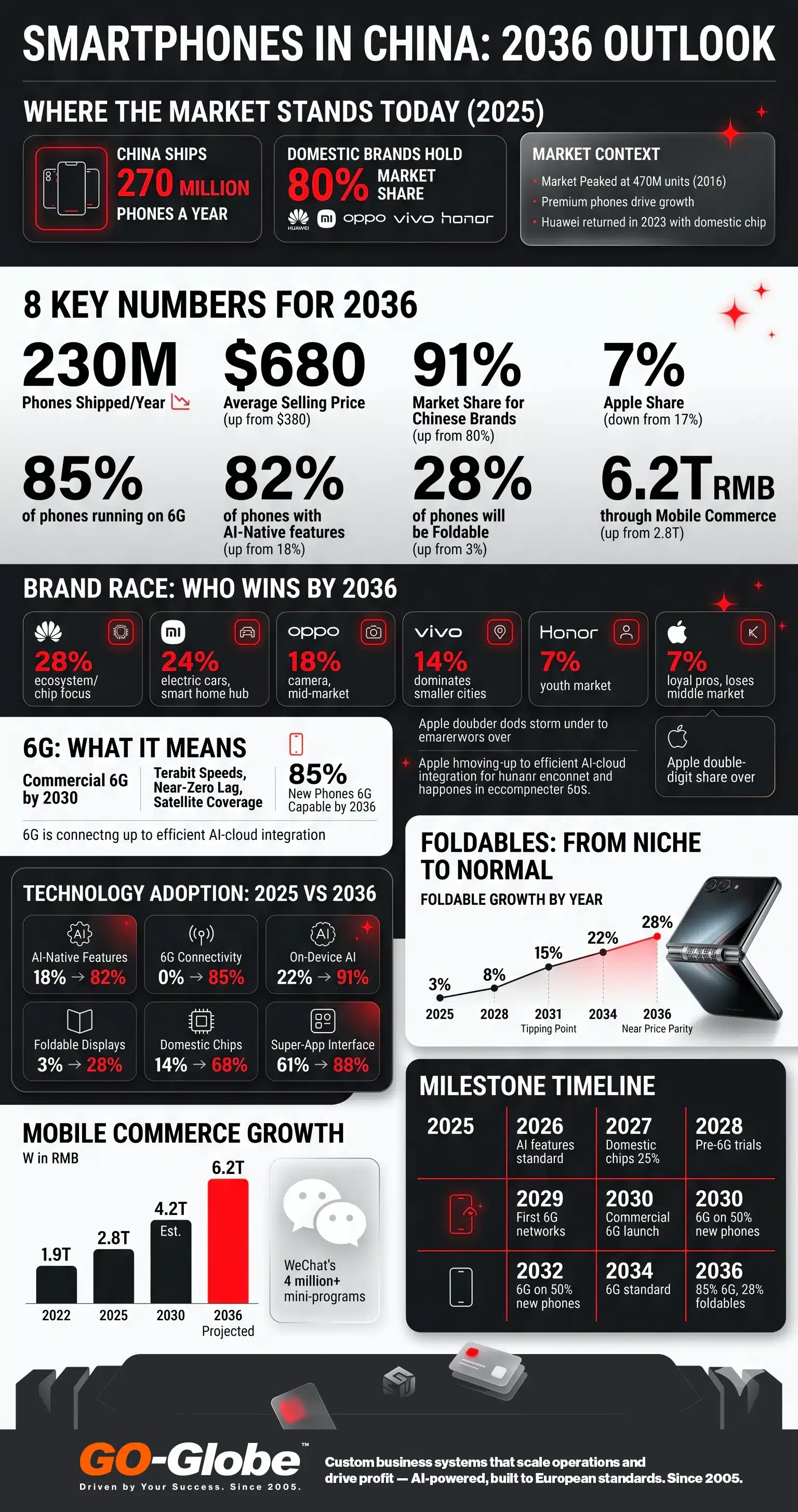
China has the world's largest smartphone market. In 2024, it shipped 270 million devices. That is more than the US and Europe combined.
But the next 10 years will change almost everything. The brands, the technology, and how people use their phones will all look different by 2036.
This report walks through what the data shows. It covers 6G, AI-native devices, the brand race, foldables, and mobile commerce. At the end, it explains what these shifts mean for companies doing business in China or entering the market.
The Numbers at a Glance
These are the eight numbers that define the shift from 2025 to 2036.
| Metric | 2025 | 2036 Projected | Change |
| Annual shipments | 270M | 230M | Down 15% |
| Average selling price | $380 | $680 | Up 79% |
| Domestic brand share | 80% | 91% | Up 11 pts |
| Apple market share | 17% | 7% | Down 10 pts |
| 6G device penetration | 0% | 85% | New |
| AI-native device features | 18% | 82% | Up 64 pts |
| Foldable / flexible share | 3% | 28% | Up 25 pts |
| Mobile commerce (RMB) | 2.8 trillion | 6.2 trillion | Up 121% |
Sources: IDC, Canalys, GSMA Intelligence, MIIT projections, GO-Globe analysis.
The Brand Race
Five years ago, Apple was the most wanted phone in China. That has changed.
Huawei came back strong in 2023. Its Mate 60 Pro used a chip made entirely in China. That was significant. It showed China could build advanced chips without US suppliers.
By 2036, domestic brands will hold about 91% of the market. That is up from 80% today. Apple will not disappear. But it will drop from 17% share to around 7%. Its loyal base will stay. The aspirational middle market will not.
| Brand | 2025 Share | 2036 Projected | Primary Advantage |
| Huawei | 22% | 28% | Domestic chip + HarmonyOS |
| Xiaomi | 14% | 24% | IoT + EV + services platform |
| OPPO / OnePlus | 17% | 18% | Camera innovation, mid-market |
| vivo | 16% | 14% | Tier 3 and 4 city depth |
| Honor | 11% | 7% | Youth market, value-price |
| Apple | 17% | 7% | Global services, professionals |
| Other | 3% | 2% | Niche and export-only |
Huawei will be the biggest story. Vertical integration of chip, OS, and hardware gives it compounding advantages. Competitors cannot close that gap fast.
Xiaomi is not just a phone company. Its SU7 electric car, smart home devices, and HyperOS platform make your phone the hub of a larger ecosystem. By 2036, buying a Xiaomi phone means joining a connected world of products.
Apple holds a profitable niche. But the days of double-digit share in China are likely over.
6G: What It Is and When It Arrives
China plans to launch 6G commercially by 2030. This is credible. China deployed 5G faster than any country on earth. It built more 5G towers in 18 months than the rest of the world combined.
6G will bring three big changes to smartphones:
- Much faster speeds. We are talking terabit-level bandwidth. Downloads that take seconds today will take milliseconds.
- Near-zero lag. Real-time interaction becomes truly real-time. Holographic calls become practical.
- Better coverage. Satellite and ground networks will merge. Remote and rural areas in China will be fully connected.
By 2036, 85% of new phones sold in China will be 6G capable. That is up from zero today.
The bigger impact is what 6G enables on the side. On-device AI and cloud AI can work together without users noticing. The phone thinks faster because the network does not slow it down.
| For enterprise teams Companies building employee portals and customer apps for China need to plan for 6G user expectations. Response times that feel fast today will feel slow in a 6G context. Build for speed now. It will matter sooner than you think. |
AI Phones vs Smart Phones
There is a real difference between AI-enabled and AI-native. It matters.
AI-enabled: your phone has AI features added on top. Better photos. Smarter autocorrect. A voice assistant you use sometimes.
AI-native: AI is how you use the phone. You do not tap menus. You tell the phone what you want. It works across all your apps. It remembers context from earlier in the day.
Technology Adoption: 2025 vs 2036
| Technology | 2025 | 2036 Projected | Change |
| AI-native device features | 18% | 82% | +64 pts |
| 6G connectivity | 0% | 85% | New |
| On-device AI processing | 22% | 91% | +69 pts |
| Foldable / flexible display | 3% | 28% | +25 pts |
| Domestic chip (non-TSMC) | 14% | 68% | +54 pts |
| Super-app as primary UX | 61% | 88% | +27 pts |
Chinese manufacturers are ahead on this shift. Huawei, Xiaomi, and OPPO are all building intent-based interfaces. The phone understands what you mean, not just what you say.
By 2036, 82% of Chinese smartphones will have AI-native features. That is up from 18% today. The shift is already happening. By 2036, it will be the expectation, not the exception.
| What this means for your apps Enterprise software built on tap-and-navigate interfaces will feel dated in this environment. Systems need to expose AI-accessible APIs. If an employee can ask their phone to 'approve the supplier invoice from last Tuesday,' your system needs to support that interaction. |
Foldables Go Mainstream
China leads the world in foldable phones. Huawei, Xiaomi, OPPO, and vivo all make competitive foldable devices. China already accounts for over 60% of global foldable shipments.
Right now, foldables cost more than regular phones. They add about $300 to $500 to the price. That keeps most buyers away.
But manufacturing costs are dropping fast. The key technology is flexible OLED displays. Two Chinese companies, BOE and China Star, are the main global suppliers. They are getting better and cheaper every year.
Around 2029 to 2031, the price gap will close to about $150. At that point, foldables move from aspirational to mainstream.
Foldable Growth Trajectory
| Year | Foldable Share | Premium Price Gap | Status |
| 2025 | 3% | $300 to $500 | Early adopter |
| 2028 | 8% | $200 to $350 | Growing |
| 2031 | 15% | $100 to $150 | Tipping point |
| 2034 | 22% | Under $100 | Mainstream |
| 2036 | 28% | Near parity | Standard tier |
By 2036, foldable and flexible devices will make up about 28% of Chinese smartphone shipments. That is up from 3% today.
And the form will keep changing. Rollable displays are in prototype stage now. Screens that extend sideways from a compact body are coming. Stretchable displays, which curve around surfaces, are in labs in Shenzhen. The smartphone of 2036 may look very different from any device available today.
Mobile Commerce: The Super-App Economy
China's mobile commerce market is the most advanced in the world. In 2025, about 2.8 trillion RMB flows through mobile platforms every year.
By 2036, that number is projected to reach 6.2 trillion RMB. That is more than double in 10 years.
Mobile Commerce Growth (RMB Trillion)
| 2022 | 2025 | 2030 Est. | 2036 Projected |
| 1.9T RMB | 2.8T RMB | 4.2T RMB | 6.2T RMB |
Most of this flows through super apps. WeChat. Alipay. Douyin. These are not just apps. They are digital environments. Users shop, pay, book travel, talk to government services, and do banking all inside one platform.
WeChat alone hosts over 4 million mini-programs today. These are small apps that live inside the big app. By 2036, this model will be stronger, not weaker. AI will make super apps smarter and faster. The gap between them and standalone apps will grow.
If your business is not inside these ecosystems, you are not really participating in the Chinese market.
Key Milestones: 2025 to 2036
| Year | What Happens |
| 2025 | 5G mainstream at 65% of new devices. Huawei re-enters premium tier. Foldables in early adopter stage. Apple under share pressure. |
| 2026 | AI features become a standard selling point. On-device AI chips in all flagship phones. Xiaomi EV ecosystem integrates with HyperOS. |
| 2027 | Domestic chip share crosses 25%. Foldables drop below $1,000 for first time. Douyin becomes a serious commerce platform at scale. |
| 2028 | Pre-6G trials begin in major cities. AI agents inside super apps handle routine transactions. Foldable share reaches 8%. |
| 2029 | 6G standards finalised. First 6G test networks go live in Beijing and Shanghai. Rollable phones enter consumer market. |
| 2030 | Commercial 6G launch (China target). AI-native OS becomes default on flagship phones. Domestic chip share crosses 45%. |
| 2032 | 6G reaches 50% of new phone shipments. Foldable cost gap drops under $100. Super-app AI agents manage entire user workflows. |
| 2034 | 6G standard across all new phones. Foldables at 22% share. AI-native becomes the norm, not the premium option. |
| 2036 | 85% 6G penetration. 91% domestic brand share. Foldables at 28%. Mobile commerce reaches 6.2 trillion RMB. |
What This Means for Your Business
The smartphone shifts above are not just consumer stories. They define the environment your employees work in, the devices your customers use, and the technical standards your systems must meet.
Here are the most direct implications.
If you operate in China
Enterprise software built for Western markets usually fails three tests in China:
- No WeChat or Alipay login integration. Users need a separate login they will not bother with.
- Not optimised for HarmonyOS or Chinese Android. Things break. Performance drops.
- No AI agent API. AI assistants on Chinese phones cannot access your systems. Your software becomes invisible.
These are not minor issues. They reduce adoption, slow down teams, and cut you off from how Chinese users actually work.
If you are entering the GCC-China corridor
Chinese manufacturers expanding to UAE, Saudi Arabia, and Bahrain face a specific challenge. Their systems work in China. They do not work for GCC clients and partners.
A China-to-GCC digital infrastructure usually needs:
- Bilingual portals in Arabic and Mandarin, not just English.
- Dual payment setup: WeChat Pay and Alipay for the China team, local GCC gateways for clients.
- Supplier and customer portals that meet both China data regulations and GCC compliance rules.
- Workflow automation that connects Chinese manufacturing operations with GCC distribution and sales.
| GO-Globe works on this exact problem We build enterprise digital infrastructure for companies operating across the GCC and Asia. Our Shanghai office focuses on the China-GCC corridor. If your digital systems are not ready for this market, we can assess the gaps in a free consultation. Visit go-globe.com or email [email protected]. |
Frequently Asked Questions
Will Apple recover its China share by 2036?
Unlikely. The decline is structural, not cyclical. Domestic brands have matched Apple's build quality. Huawei's chip progress removes a key dependency. Apple will keep a profitable niche around 7% share. Reclaiming double digits would need a significant shift in China's technology environment.
When will 6G actually launch in China?
China's Ministry of Industry and Information Technology has set 2030 as the commercial launch target. Given China's 5G track record, this is credible. Consumer 6G phones would become mainstream from 2031 onward. Near-ubiquitous 6G in urban areas is realistic by 2036.
Are foldables really going mainstream or staying niche?
In China specifically, they are on a genuine mainstream path. The key driver is cost. Once the price premium drops below $150, foldables move fast. BOE and China Star are the world's main flexible OLED suppliers. Their cost curves point to that threshold arriving around 2030 to 2031.
What is the difference between AI-native and AI-enabled?
AI-enabled adds AI features to a conventional OS. The interaction model stays the same. AI-native means AI is the primary interface layer. The device understands intent, maintains context, and acts across apps. Most Chinese flagships will be AI-native by 2036.
Does the Chinese smartphone market matter to GCC businesses?
Yes, in two ways. First, Chinese brands are expanding into GCC markets. Xiaomi, OPPO, and vivo already have strong Middle East presence. Second, Chinese companies entering GCC need digital infrastructure that works for both markets. That is a growing opportunity for anyone who can bridge the two.