Resistance to change is silently killing more companies than bad products, bad markets, or bad luck. Here's what the research says — and what you can do about it.
Contents
- 1 Picture This…
- 2 What Is Resistance to Change — And Why Does It Happen?
- 3 The Numbers Don't Lie: What Resistance to Change Actually Costs
- 4 Why This Matters — Even If You're 15 Years Old
- 5 Why Is Change So Hard? (And How to Fix It)
- 6 What 2026 and Beyond Looks Like
- 7 5 Quick Wins: Do These This Week
- 8 The Wheel Is Right in Front of You
- 9 Frequently Asked Questions
Picture This…
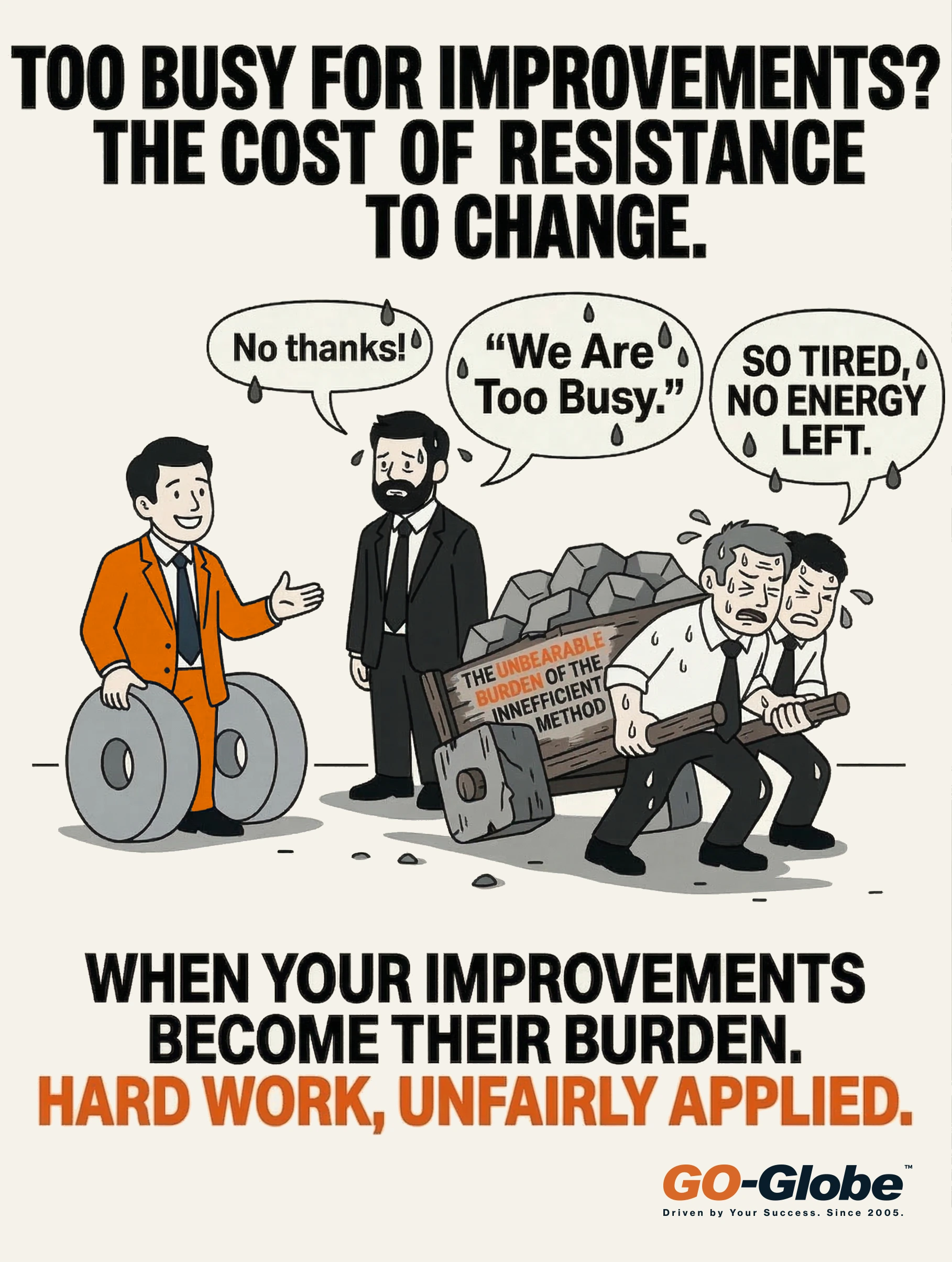
Imagine two workers pushing a heavy cart — no wheels, just brute force, sweating and struggling. A third person walks up holding two big stone wheels. "Want to try these?" they ask. One worker waves them off: "No thanks!" The other says: "We're too busy."
Sounds ridiculous, right? Nobody would actually do that.
Wrong. This happens every single day in thousands of businesses around the world. Maybe even in one near you.
The 'cart without wheels' is the old way of doing things. The wheels? That's automation, AI, better processes — the tools that could save your team hours every week. And yet, companies say no.
This article is about resistance to change — what it is, why it happens, what it costs, and how smart businesses (and smart people like you) can beat it.
| Key Insight: Research from McKinsey shows that up to 70% of all business change programs fail — and the #1 reason isn't technology or money. It's people resisting change. (McKinsey & Company, 2023) |
What Is Resistance to Change — And Why Does It Happen?
Resistance to change (also called change aversion) is when people or organizations actively avoid doing things differently — even when the new way is clearly better.
It's not always obvious. Sometimes it looks like:
- Saying "we've always done it this way"
- Agreeing in meetings but never actually changing anything
- Creating reasons why a new idea "won't work here"
- Getting so busy with daily tasks that no one ever improves the process
A Quick Timeline of Resistance to Change
This isn't a new problem. Here's how it's played out across history:
| Era | The "Wheel" Offered | The Resistance | What Happened |
|---|---|---|---|
| 1450s | The Printing Press | Scribes feared job loss | Books spread — scribes adapted or disappeared |
| 1800s | Steam Engines | Horse carriage industry lobbied against them | Railways transformed the world |
| 1990s | The Internet | "Nobody will buy online" (Blockbuster, 1998) | Amazon is now worth $1.8 trillion |
| 2010s | Cloud Computing | "We can't trust the cloud" | 99% of Fortune 500 now use cloud |
| 2020s | AI & Automation | "AI will never replace real people" | Still unfolding — the window is open NOW |
Every single time, the companies that embraced change early won. The ones that resisted? Most of them no longer exist.
The Numbers Don't Lie: What Resistance to Change Actually Costs
 Let's talk data. This is where it gets real.
The Global Cost of Staying Stuck
| What Was Measured | The Shocking Number | Source |
|---|---|---|
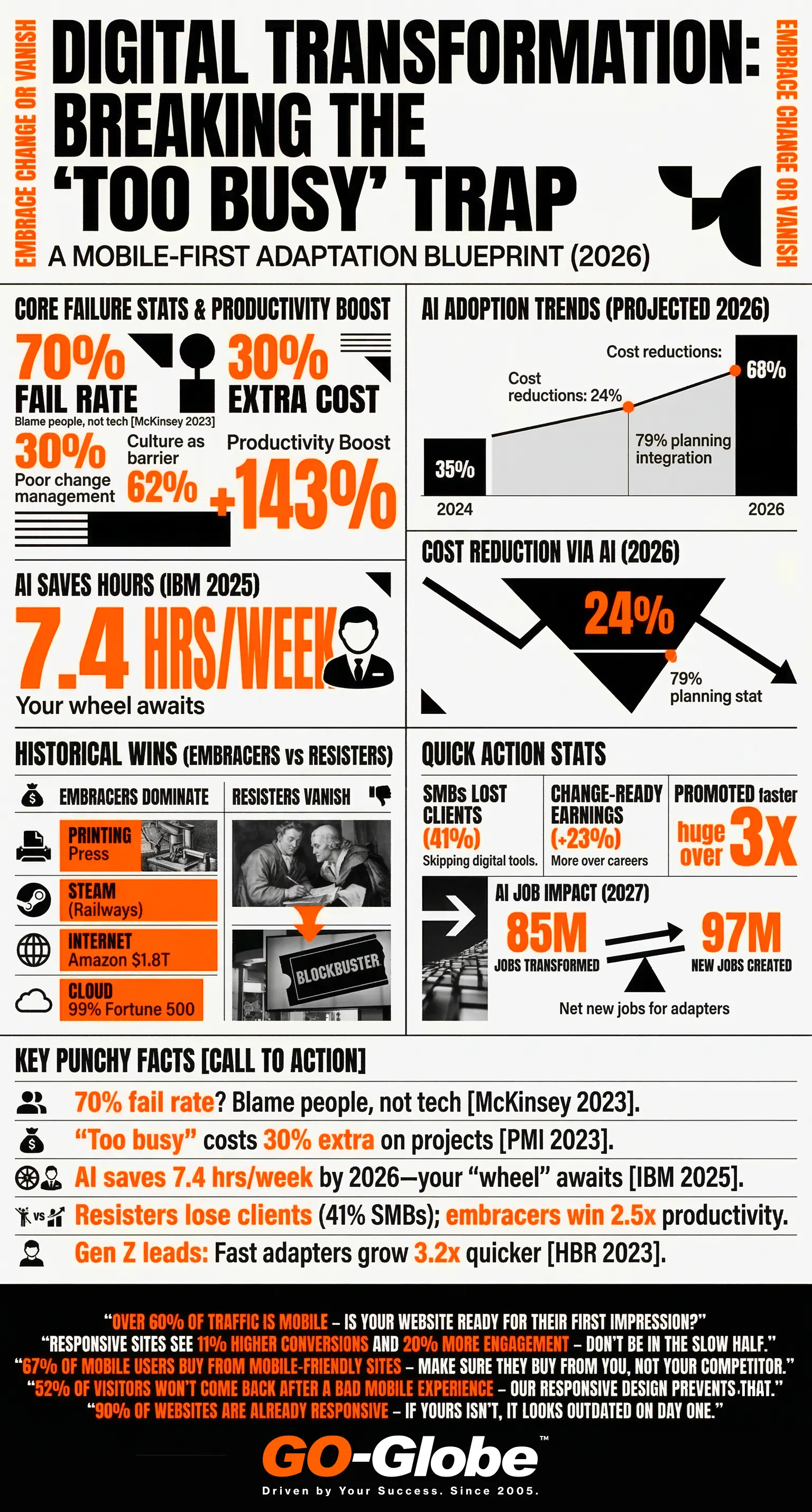
| % of digital transformations that fail | 70% | McKinsey, 2023 |
| Top reason they fail | Employee resistance | Prosci, 2023 |
| Extra cost when change is poorly managed | +30% over budget | PMI, 2023 |
| Productivity boost from embracing change well | Up to 143% | Gallup, 2022 |
| Companies that say culture is biggest barrier to change | 62% | Deloitte, 2024 |
| SMBs that lost clients after refusing to adopt digital tools | 41% | Salesforce State of SMB, 2023 |
Think about that last one. 4 out of 10 small businesses lost real customers — not because their product was bad, but because they refused to update the way they worked.
The "Wheel" in 2026: AI & Automation
Right now, the biggest "wheel" being offered to businesses is AI-powered automation. And just like every time in history, many companies are saying: "We're too busy."
| AI Adoption Trend | 2024 | 2025 (est.) | 2026 (proj.) |
|---|---|---|---|
| Businesses using AI tools | 35% | 52% | 68% |
| Avg. hours saved per employee/week via automation | 3.2 hrs | 5.1 hrs | 7.4 hrs |
| Cost reduction from process automation | 12% | 18% | 24% |
| Companies actively planning AI integration | 48% | 61% | 79% |
Sources: ; IBM Institute for Business Value 2025; McKinsey Global Survey 2024.
| The Bottom Line: Companies that adopt AI and digital automation today are projected to be 2.5x more productive than their competitors by 2028. The gap is growing every month you wait. |
Why This Matters — Even If You're 15 Years Old
OK, you might be thinking: "I'm a student, not a CEO. Why does this matter to me?"
Great question. Here's the thing — you will face this problem your entire life. Whether you're running a business, managing a team, or just trying to improve how you study.
Scenario 1: The Study Group That Refused to Change
Imagine your study group spends 3 hours making color-coded paper notes every week. Your friend says: "Let's try Notion — it's free, and we can all edit at the same time." But two people say: "We're used to paper. It's fine."
Sound familiar? That's resistance to change. And it's costing the group time, results, and energy.
Scenario 2: The Business Owner Who Said No
A restaurant owner in Dubai refused to go on Talabat or Careem food delivery in 2019 because "people will always come in person." Then COVID hit. The restaurants on delivery apps survived. Many who refused... closed.
The Personal Impact of Being Change-Ready
Here's what the research shows about people (not just companies) who embrace change:
- Earn 23% more over their career than those who resist learning new skills (World Economic Forum, 2024)
- Are 3x more likely to be promoted into leadership roles
- Report higher job satisfaction because they feel in control, not threatened
- Build future-proof skills that don't get automated away
| Try This Today: Think of one thing in your life — your study method, a hobby, how you manage time — that you've been doing the same way for years. Ask yourself: is there a better way? Just try it for one week. |
Why Is Change So Hard? (And How to Fix It)
Let's be fair. Change is uncomfortable. There are real reasons people resist it — and understanding them is the first step to fixing them.
| Why People Resist | What It Feels Like | The Solution |
|---|---|---|
| Fear of failure | "What if the new way doesn't work?" | Start small. Pilot test before full rollout. |
| Loss of control | "I won't know what I'm doing anymore" | Involve people in planning the change. |
| Too comfortable | "Things are fine the way they are" | Show the cost of NOT changing with data. |
| Too busy | "I don't have time to learn something new" | Automate the lowest-value tasks first to free up time. |
| No clear benefit | "What's in it for me?" | Connect the change to personal wins (less stress, more money, easier job). |
| Bad past experiences | "The last new system was a nightmare" | Acknowledge past failures and show what's different this time. |
The ADKAR Model: A Simple Change Blueprint
The world's most used change management framework is called ADKAR (Prosci). Here's what it means in plain English:
- Awareness — Help people understand WHY change is needed
- Desire — Give them a reason to WANT to change
- Knowledge — Teach them HOW to change
- Ability — Give them time and tools to actually practice
- Reinforcement — Celebrate wins and make the new way the default
Use this for school group projects. Use it when convincing your parents to try something new. Use it in your future career. It works everywhere.
What 2026 and Beyond Looks Like
The pace of change is speeding up — not slowing down. Here's what's coming:
Trend 1: AI Will Be Expected, Not Optional
By 2027, the World Economic Forum predicts that 85 million jobs will be transformed by automation. But here's the good news — 97 million new jobs will emerge. The people who thrive will be those who learned to work with AI, not against it.
Trend 2: Change Speed Is a Competitive Advantage
In a study of 1,500 companies, Harvard Business Review found that the fastest-adapting companies grew 3.2x faster than slow-adapting competitors over 5 years. Speed of change is now a superpower.
Trend 3: Gen Z Will Lead the Change Era
That's you. Gen Z grew up with technology. You're comfortable with digital tools, remote work, and rapid updates. This is your moment. The businesses that will win in the next 10 years are being built by people your age who aren't afraid of the wheel.
| Share This Article: Know someone stuck pushing the cart without wheels? Share this with them. You might just change their business — or their life. |
5 Quick Wins: Do These This Week
- Audit one process: Pick the most time-consuming task your team does manually. Ask: could this be automated? Even partially?
- Share the data: Find one statistic from this article and share it in your next team meeting. Data beats opinion in every room.
- Try the ADKAR check: Before your next change initiative, run through Awareness → Desire → Knowledge → Ability → Reinforcement. Skip none.
- Talk to your team: Ask two people: "What's one thing that slows you down every week?" Their answers are your roadmap.
- Start a 30-day pilot: Don't roll out a new system company-wide. Test it with 2-3 people for 30 days. Let the results speak.
The Wheel Is Right in Front of You
The two men in the cartoon aren't bad people. They're not stupid. They're just stuck in a pattern that feels safe — even when it's holding them back.
But you? You now know the data. You know the history. You know the cost.
So the question isn't whether to change. The question is: how fast?
| Ready to Put the Wheels on Your Business? GO-Globe has helped 800+ businesses across 28 countries modernize their operations, automate their processes, and build AI-powered digital solutions that actually grow revenue. Since 2005, we've been the wheel — so you don't have to push the cart alone. |
Sources & References
- McKinsey & Company (2023). Successful transformations. mckinsey.com/capabilities/transformation
- Prosci (2023). Best Practices in Change Management, 12th Edition. prosci.com
- Gallup (2022). State of the Global Workplace Report. gallup.com
- Deloitte (2024). Global Human Capital Trends. deloitte.com
- World Economic Forum (2024). The Future of Jobs Report. weforum.org
- Gartner (2024). Top Strategic Technology Trends. gartner.com
- Harvard Business Review (2023). The Fastest Companies Adapt Best. hbr.org
- Salesforce (2023). State of the SMB Report. salesforce.com
- IBM Institute for Business Value (2025). CEO Study: Own Your Impact. ibm.com/thought-leadership
Frequently Asked Questions
What is resistance to change in business?
It's when a company or team avoids adopting new tools, processes, or ideas — even when those changes would clearly make things better. It can be active (saying 'no') or passive (agreeing in meetings, then doing nothing).
Why do businesses resist change so much?
The most common reasons are fear of failure, comfort with the current way, lack of time to learn something new, and bad experiences with past changes. It's human nature — but it can be overcome.
What is the most effective way to manage change?
Start with WHY — help people understand the reason for the change before you ask them to make it. Use the ADKAR model: Awareness, Desire, Knowledge, Ability, Reinforcement. Involve people early and celebrate quick wins.
What is the cost of resistance to change in 2026?
McKinsey estimates that poor change management adds 30% to project costs on average. Companies that fail to digitally transform are losing customers, market share, and talent — often without realizing it until it's too late.
How can a small business overcome resistance to change?
Start small. Pick ONE process that's slowing you down and automate or improve just that. Use the time saved to tackle the next one. Show the team the results with real numbers. Build confidence through small wins before tackling big changes.
What role does AI play in business change management in 2026?
AI is both the change being resisted AND the tool that helps manage change. AI can analyze workflows, identify bottlenecks, personalize training, and even predict which employees are likely to resist — all before a change program launches.
Is resistance to change always bad?
Not always. Healthy skepticism can catch bad ideas before they're implemented. The problem is blanket resistance — saying no to everything new without evaluating it. The goal is thoughtful evaluation, not automatic rejection.