The Middle East online shopping market is witnessing rapid expansion, with 72% of consumers making their first online purchase within the past two years. As e-commerce adoption rises, businesses and consumers alike are embracing digital transactions. Understanding Middle East trends in online shopping is crucial for retailers, brands, and consumers looking to navigate this evolving landscape.
Contents
Growth of Online Shopping in the Middle East
The e-commerce industry in the Middle East has experienced significant growth due to increased internet penetration, digital payment adoption, and the demand for convenience. The UAE’s e-commerce industry alone is estimated to reach $10 billion in value. Reports indicate that five out of ten UAE consumers shop online regularly, highlighting the region’s growing preference for digital commerce.
Key Statistics
- 72% of Middle East online consumers made their first online purchase within the last two years.
- 63% of Middle East consumers are willing to pay for same-day delivery.
- 53% still prefer in-store shopping due to the ability to see, touch, and try products.
- 40% of consumers express concerns about online shopping security.
Updated Data 2026
- The Middle East and Africa e-commerce market was valued at $176.68 billion in 2026, growing at a CAGR of 13.85% (Mordor Intelligence, 2026). Mordor Intelligence
- The UAE e-commerce market reached $12.30 billion in 2026 — the largest single market in the GCC (Mordor Intelligence, Jan 2026). Mordor Intelligence
- Saudi Arabia's e-commerce market is estimated at $16.3 billion in 2025, growing at a 12.3% CAGR — making it the region's largest by GMV. P&S Intelligence
- Smartphones processed 78.7% of all UAE e-commerce orders in 2025 — the fastest-growing channel in the market. Titan Digital UAE
- The BNPL market in the Middle East reached $5.79 billion in 2025, growing at 19.4% year-on-year. Tabby and Tamara are the dominant regional platforms. Apaya
- E-commerce GMV in MENA expanded 30% in 2024, with cross-border commerce reshaping regional trade flows as businesses leverage UAE free zones for multi-market operations. Apaya
- 78% of consumers in the MENA region discover new brands via social media — outperforming global averages — with Instagram, TikTok, and Snapchat leading product discovery. Namaa
- Local e-commerce platforms Noon and Namshi capture 60% market share in fashion and electronics in the UAE through Arabic-first interfaces and same-day delivery (IMARC Group, Feb 2026). OpenPR
- Mobile ordering now accounts for around 70% of food delivery transactions across MENA, with the UAE's online food delivery market valued at $2.5 billion in 2024 and projected to reach $3.9 billion by 2030. Arabian Business
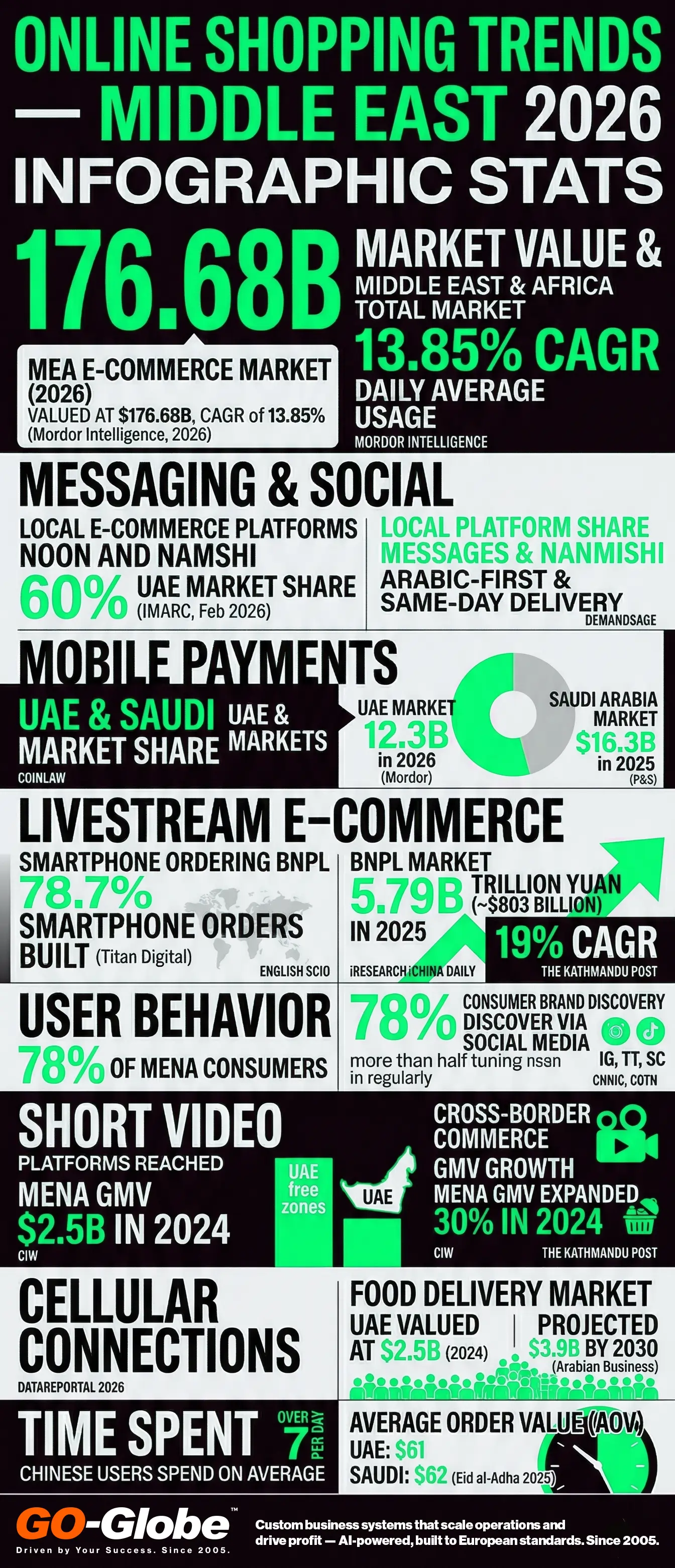
Infographic by GO Gulf Web Design
Consumer Behavior and Preferences
Consumer behavior in the Middle East reflects a mix of traditional and digital preferences. While online shopping is growing, a significant portion of consumers still opt for cash on delivery over digital payments.
Payment Methods
- 85% of online consumers prefer cash on delivery, while only 15% use credit or debit cards.
- Competitive pricing (60%) and convenience (56%) drive consumers toward online shopping.
- The ability to compare products online is a significant factor for 42% of consumers.
Mobile E-Commerce in the Middle East
Mobile commerce is an integral part of the e-commerce landscape. The UAE ranks second globally, behind China, in mobile e-commerce adoption. Nearly 60% of UAE consumers have made purchases via smartphones in the past year.
Social Media Influence on E-Commerce
Social media plays a vital role in driving e-commerce growth:
- 75% of Middle East consumers believe social media interactions influence their purchasing decisions, compared to 62% globally.
Cross-Border Shopping Trends
Cross-border shopping is a significant aspect of Middle East online shopping trends. A large number of consumers prefer purchasing international products due to better deals and availability.
Key Findings:
- 31% of online shoppers spend 11-50% of their budget on cross-border purchases.
- 12% allocate 51-100% of their online shopping budget to international orders.
- The top reasons for cross-border shopping include free shipping (49%), secure payment methods (49%), and product availability (39%).
- Concerns include high shipping costs (49%), fraud risks (47%), and discrepancies in product descriptions (42%).
Future of Online Shopping in the Middle East
As digital transformation continues, Middle East trends indicate sustained growth in e-commerce adoption. Businesses need to enhance online security, improve user experience, and offer flexible payment options to cater to evolving consumer needs.
Conclusion
Middle East online shopping is on an upward trajectory, driven by increased consumer confidence, mobile commerce, and competitive pricing. Understanding online shopping information and adapting to regional preferences is crucial for businesses looking to thrive in this expanding market.