Growth sounds exciting until the spreadsheets start multiplying. One team tracks sales in one platform, finance lives in another, inventory sits somewhere else, and customer data hides in inboxes. That setup works for a while. Then it doesn’t. Expansion tends to expose every weak process a company hoped no one would notice.
An integrated ERP system changes that picture fast. It connects core operations into one environment so teams stop chasing information and start using it. When a business wants to open new markets, add products, hire staff, or improve margins, speed matters. Clean systems matter more.
Contents
- 1 Growth Slows Down When Systems Don’t Talk
- 2 Real-Time Visibility Creates Faster Decisions
- 3 Finance Becomes a Growth Engine
- 4 Better Operations Mean Happier Customers
- 5 Expansion Into New Markets Gets Easier
- 6 Teams Work Faster With Less Friction
- 7 ERP Is Not Just for Giant Enterprises
- 8 Choosing the Right System Matters
- 9 Fast Growth Needs Strong Foundations
Growth Slows Down When Systems Don’t Talk
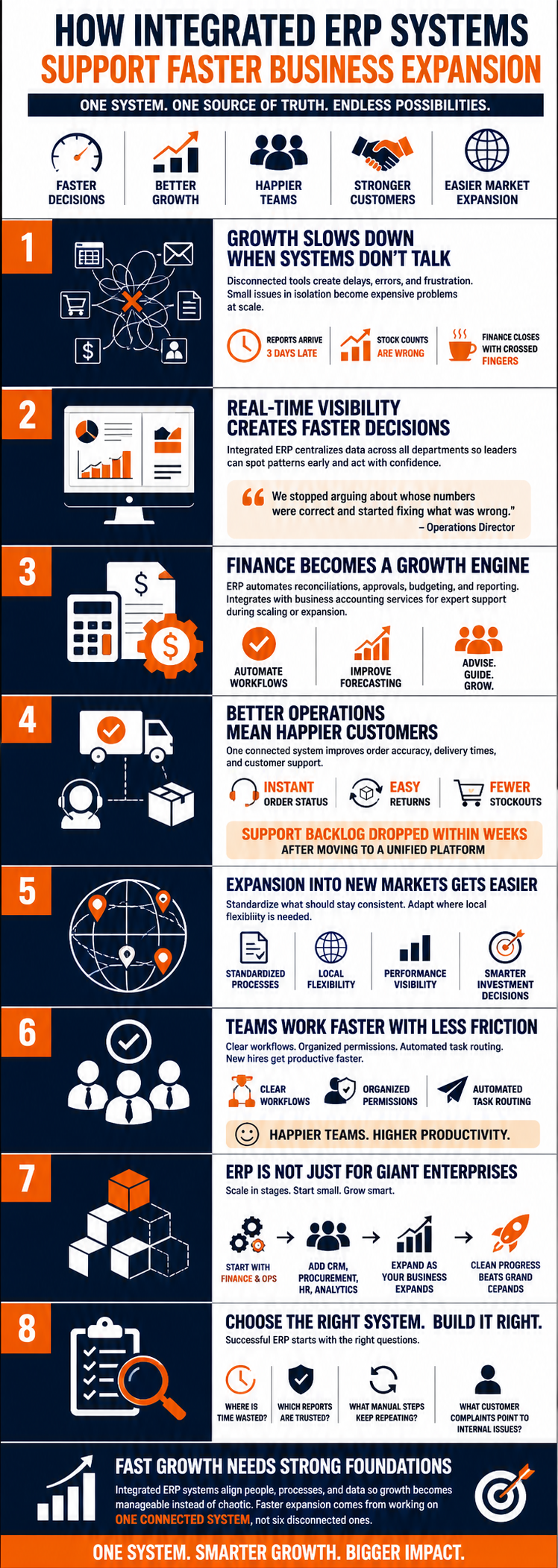
Many companies assume growth problems come from demand. Often, the real issue is internal friction. Orders need manual approval. Reports arrive three days late. Stock counts are wrong. Finance closes the month with crossed fingers and strong coffee.
Disconnected tools create delays that feel small in isolation. Together, they become expensive. A sales team can close deals all week, but if fulfillment can’t see inventory in real time, customers feel the pain immediately.
This is where integrated ERP platforms earn their keep. They give departments a shared source of truth. No guessing. No version 12_final_FINAL spreadsheet drama.
Real-Time Visibility Creates Faster Decisions
Expansion requires decisions made at the right moment, not two weeks later. Should pricing change? Is one region outperforming another? Which products deserve more attention? Without reliable data, leaders end up managing by instinct. Instinct has its place, but it shouldn’t run payroll.
Integrated ERP systems centralize reporting across sales, operations, procurement, HR, and finance. That means leadership teams can spot patterns early and act while the window is still open.
One operations director described it bluntly after a rollout: “We stopped arguing about whose numbers were correct and started fixing what was wrong.” That shift matters. Meetings get shorter. Decisions get sharper.
Finance Becomes a Growth Engine
Finance teams often carry the burden of messy expansion. New suppliers, more invoices, tax complexity, multiple currencies, tighter forecasting. Without the right systems, they spend valuable time cleaning data instead of guiding strategy.
ERP platforms automate reconciliations, approvals, budgeting workflows, and reporting. They also integrate smoothly with business accounting services when external expertise is needed during scaling phases or regional expansion.
That support changes the role of finance. Instead of acting like historians explaining last month, teams become advisors shaping next quarter.
Better Operations Mean Happier Customers
Customers don’t care whether systems are modern. They care whether orders arrive on time, invoices are accurate, and support teams know what’s happening.
An integrated ERP system improves the customer experience indirectly but powerfully. Sales can view order status instantly. Service teams can track returns without sending five emails. Procurement can prevent stockouts before they hit popular products.
The last time a retail group migrated from disconnected software to a unified platform, their support backlog dropped within weeks because staff finally had access to the same information. No magic trick. Just fewer blind spots.
Growth often depends on reputation. Reputation depends on consistency.
Expansion Into New Markets Gets Easier
Entering a new city or country sounds glamorous in boardroom slides. In reality, it means tax rules, vendor onboarding, compliance processes, localized pricing, and staffing changes. Plenty of moving parts.
ERP systems help standardize what should stay consistent while allowing regional flexibility where needed. That balance is hard to achieve manually. Templates for procurement, approvals, reporting structures, and inventory logic save time every single launch cycle.
Companies also gain clearer visibility into which markets deserve further investment opportunities based on actual performance data rather than optimistic guesses. That alone can prevent expensive detours.
Teams Work Faster With Less Friction
Growth adds headcount. Headcount adds communication risk. If new employees need six logins and tribal knowledge just to process a simple request, scaling gets messy fast.
Integrated ERP systems reduce that friction. Workflows become clear. Permissions stay organized. Tasks move automatically to the right people. New hires learn processes faster because the process exists in one place.
And morale improves. Quietly. Nobody celebrates fewer duplicate entries at the holiday party, but everyone appreciates not doing them.
ERP Is Not Just for Giant Enterprises
A common mistake is waiting too long. Some companies treat ERP as a “someday” project for massive corporations with endless budgets and dedicated transformation committees. That thinking causes pain.
Modern ERP solutions can scale in stages. Start with finance and operations. Add CRM, procurement, HR, or analytics later. Smart implementation beats oversized ambition every time.
The better approach is practical. Fix the bottlenecks hurting growth now, then expand the platform as the business expands. Clean progress beats grand chaos.
Choosing the Right System Matters
Not every ERP project succeeds. Some fail because leaders buy software before mapping workflows. Others fail because teams ignore adoption and training. Technology alone doesn’t solve disorder.
The strongest implementations begin with honest questions. Where is time wasted? Which reports are trusted? What manual steps keep repeating? Which customer complaints point to internal issues?
When those answers shape the rollout, ERP becomes more than software. It becomes infrastructure for growth.
Fast Growth Needs Strong Foundations
Expansion rewards companies that move quickly, but it punishes those built on patchwork systems. Revenue can rise while margins shrink. Orders can increase while service quality drops. Headcount can grow while accountability disappears.
Integrated ERP systems help prevent that trap. They align people, processes, and data so growth becomes manageable instead of chaotic. Faster expansion rarely comes from working harder. More often, it comes from finally working on one connected system instead of six disconnected ones.