Search is changing quickly. People still use Google to find websites, products, and services, but they are also using AI tools such as ChatGPT, Gemini, and Perplexity to get direct answers, compare options, and find recommendations.
This has created an important question for businesses and marketers: geo vs seo and which strategy should you focus on?
SEO helps websites appear in traditional search results. GEO, or Generative Engine Optimization, focuses on improving a brand’s visibility in AI-generated answers. The two strategies work differently, but they also share many of the same foundations.
Understanding geo vs seo is not about choosing one and ignoring the other. It is about understanding how people search today and creating content that can work across both traditional search engines and AI-powered search.
Contents
- 1 What Is GEO vs SEO?
- 2 Why Is GEO vs SEO Important?
- 3 How Does SEO Work?
- 4 How Does GEO Work?
- 5 GEO vs SEO: What Is the Biggest Difference?
- 6 Does SEO Help GEO?
- 7 How to Optimize Content for GEO and SEO
- 8 Build Topical Authority
- 9 Make Your Brand Easy to Understand
- 10 Add First-Hand Experience
- 11 GEO vs SEO for Local Businesses
- 12 GEO vs SEO for E-Commerce
- 13 Common Mistakes to Avoid
- 14 GEO vs SEO: Which One Should You Focus On?
- 15 How to Measure GEO and SEO
- 16 Conclusion
- 17 FAQs About GEO vs SEO
What Is GEO vs SEO?
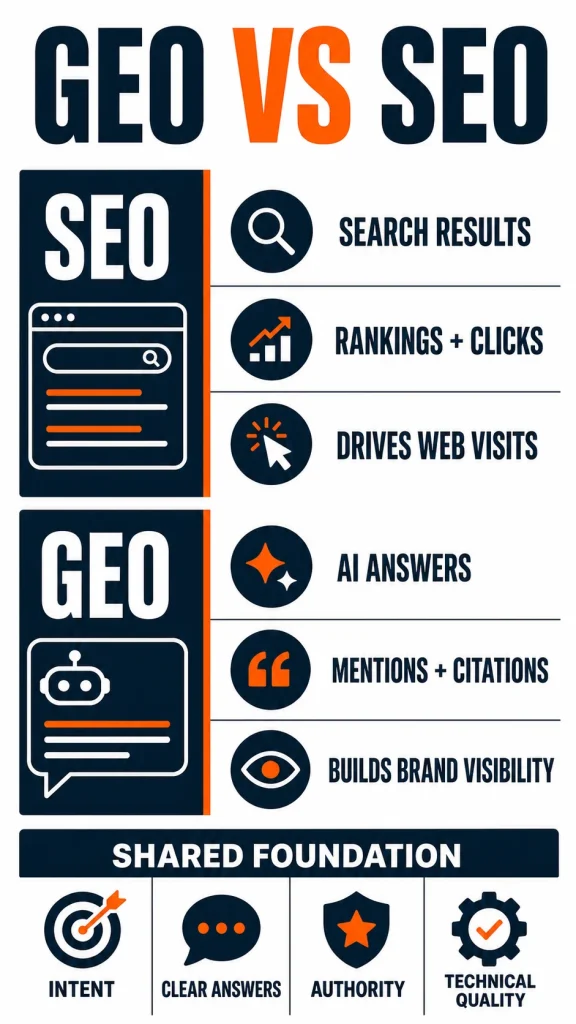
The easiest way to understand geo vs seo is to look at where each strategy wants your business to appear.
Search Engine Optimization, or SEO, focuses on improving a website’s visibility in traditional search engines such as Google and Bing. It covers keyword research, search intent, technical SEO, content, internal links, backlinks, website performance, and user experience.
Generative Engine Optimization, or GEO, focuses on improving a brand’s chances of appearing in AI-generated responses. Instead of focusing only on ranking a webpage, GEO considers whether AI systems can understand your business, content, expertise, and relevance to a particular question.
A simple comparison looks like this:
| SEO | GEO |
| Focuses on search engine results | Focuses on AI-generated answers |
| Targets search queries | Targets questions and prompts |
| Measures rankings and clicks | Measures mentions and citations |
| Drives users to webpages | Can create direct brand visibility |
| Focuses strongly on search optimization | Focuses strongly on useful and trusted information |
For example, someone may search Google for:
“Best software development companies in Malaysia”
SEO helps a company compete for that search.
Another person might ask an AI tool:
“Which software development companies in Malaysia are suitable for enterprise projects?”
GEO focuses on making the company’s information clear, relevant, and trustworthy enough to potentially appear in that answer.
That is the basic difference in geo vs seo.
People aslo search for: What is Answer engine optimization in 2026
Why Is GEO vs SEO Important?
For years, businesses focused heavily on Google rankings. Getting a page onto the first page could bring valuable traffic, leads, and sales.
That still matters.
However, people now have another way to find information. They can ask AI tools to explain a topic, compare companies, recommend products, or solve a problem.
This has made geo vs seo an important discussion for businesses that depend on online visibility.
Consider someone looking for an SEO agency. They could search:
“SEO agency in Dubai”
They may then visit several websites and compare them.
But they could also ask:
“What are the best SEO agencies in Dubai for a B2B technology company?”
The second question is more conversational. The user expects the AI system to understand their situation and provide a useful answer.
This means businesses need to think beyond rankings.
A strong Google ranking is still valuable. But being visible when people ask AI systems for recommendations is becoming another part of the customer journey.
People also search for: If your business serves a specific area, local SEO can help you reach customers searching for services near them.
How Does SEO Work?
To understand geo vs seo properly, it helps to understand what SEO is designed to achieve.
SEO helps search engines discover, understand, and rank your website for relevant searches.
A complete SEO strategy usually covers several areas.
Keyword Research
Keyword research helps you understand what your audience searches for.
For example, a software development company might target terms such as:
- Custom software development
- Software development company
- Enterprise software development
- Software development company Malaysia
- Software development company Singapore
The goal is not to repeat these phrases throughout a page.
The goal is to understand the topic and the reason behind the search.
On-Page SEO
On-page SEO improves the information and structure of individual pages.
This includes:
- Page titles
- Headings
- Meta descriptions
- Relevant keywords
- Internal links
- Content structure
- Image optimization
- Search intent
A good page should make it easy for both users and search engines to understand what the page is about.
Technical SEO
Technical SEO helps search engines access and understand your website.
Important areas include:
- Website speed
- Mobile usability
- Crawlability
- Indexing
- Canonical tags
- XML sitemaps
- URL structure
- HTTPS
- Core Web Vitals
Authority and Backlinks
Backlinks can also help build website authority.
When relevant and trustworthy websites link to or mention your content, it can provide additional signals about your website and expertise.
These elements remain important in the geo vs seo discussion because GEO does not make traditional SEO irrelevant.
How Does GEO Work?
GEO takes a different approach.
Instead of asking only, “How do I rank this page?” marketers also ask:
“How can my brand become a useful source when AI answers this question?”
This is one of the clearest differences between geo vs seo.
AI systems need information they can understand and use when generating responses. Your website should therefore clearly explain important information about your business.
For example, a software development company should explain:
- What services it offers
- Which industries it serves
- Where it operates
- Which technologies it uses
- What problems it solves
- What experience it has
- What makes its services different
A detailed service page gives users more information and gives search systems more context.
GEO Is More Than Keywords
One common misunderstanding about geo vs seo is that GEO simply means adding more keywords.
It does not.
Repeating a phrase such as “software development company Malaysia” dozens of times will not automatically make an AI system recommend your company.
GEO is more concerned with the overall quality and clarity of your information.
Important areas include:
- Useful and accurate content
- Topical depth
- Brand authority
- Expert knowledge
- First-hand experience
- Clear answers
- Consistent business information
- Relevant third-party mentions
The goal is to make your business easier to understand and trust.
If you sell products online, e-commerce SEO can help your product and category pages reach shoppers at the right stage of the buying journey.
GEO vs SEO: What Is the Biggest Difference?
The biggest difference in geo vs seo is how visibility is delivered.
SEO generally aims to get a webpage into search results.
GEO aims to improve the chance that a business or its information is included in an AI-generated answer.
For SEO, you might track:
- Keyword rankings
- Organic clicks
- Impressions
- Organic traffic
- CTR
- Leads
- Conversions
For GEO, you may look at:
- AI brand mentions
- Citations
- Recommendations
- Referral traffic
- Branded searches
- Visibility for important prompts
Imagine a web development company.
With SEO, success might mean ranking in the top three results for “web development company Singapore.”
With GEO, success might mean the company is mentioned when someone asks an AI tool to recommend web development companies in Singapore.
This difference is central to understanding geo vs seo.
Does SEO Help GEO?
Yes, but SEO alone does not guarantee AI visibility.
Many SEO fundamentals are useful for GEO because both search engines and AI systems need clear, accessible, and useful information.
A technically strong website provides a good foundation. Clear headings make content easier to understand. Internal links show relationships between topics. Detailed content provides more context.
For example, imagine a website has several useful pages about ERP software.
Those pages cover:
- ERP implementation
- ERP pricing
- ERP integrations
- ERP security
- ERP features
- ERP for SMEs
- ERP for manufacturing
This creates a much stronger topical picture than one short page targeting “ERP software.”
This is where geo vs seo begins to overlap. A strong SEO content strategy can also create a useful foundation for GEO.
How to Optimize Content for GEO and SEO
You do not need to create completely separate content for both strategies.
A well-planned page can support both.
1. Start With Search Intent
Before creating content, understand what the user actually wants.
Ask yourself:
- What problem are they trying to solve?
- Are they researching or ready to buy?
- What question are they asking?
- What information will they need next?
For example, someone searching “CRM software” may want a definition.
Someone searching “CRM software for real estate” may be looking for recommendations. Someone searching “CRM software pricing” may already be comparing solutions. Understanding these differences makes content more useful and supports both sides of geo vs seo.
Good web design makes it easier for visitors to find information, understand your offer, and take action.
2. Answer the Main Question Early
Do not make readers go through a long introduction before they get the answer.
If someone asks:
Does GEO replace SEO?
Answer directly:
No. GEO does not replace SEO. SEO focuses on traditional search visibility, while GEO focuses on visibility in AI-generated answers.
Then explain the reasons behind the answer.
This makes the content easier to scan and understand.
3. Cover Related Questions
A strong article should answer the questions that naturally follow the main topic.
For geo vs seo, these may include:
- What is GEO?
- What is SEO?
- How are they different?
- Does SEO help GEO?
- Is GEO replacing SEO?
- How do you measure GEO?
- How can a business improve AI visibility?
- Should businesses use both?
Answering related questions creates a more complete resource without making the content complicated.
Build Topical Authority
Topical authority matters in both traditional search and AI search.
Instead of publishing random articles around unrelated keywords, build content around subjects your business actually knows.
For example, an SEO company could create content around:
- Technical SEO
- Local SEO
- E-commerce SEO
- Enterprise SEO
- SEO audits
- Keyword research
- Link building
- Content optimization
- SEO reporting
These pages can link to each other naturally.
The result is a website with a clear topic structure.
This is useful in geo vs seo because search engines and AI systems can gain a better understanding of your expertise when your website covers a subject from several relevant angles.
The key is quality.
Do not create dozens of pages that say almost the same thing. Each page should have a clear purpose and answer a different user need.
Make Your Brand Easy to Understand
Brand clarity is another important part of geo vs seo.
Your website should make it easy to understand:
- Who your company is
- What services you provide
- Where you operate
- Which industries you serve
- What expertise you have
Keep important information consistent across your website and relevant external platforms.
For example:
| Business Information | Keep Consistent? |
| Company name | Yes |
| Services | Yes |
| Locations | Yes |
| Business description | Yes |
| Contact information | Yes |
| Industry expertise | Yes |
Clear and consistent information creates a stronger digital identity.
Add First-Hand Experience
Generic content is everywhere.
If you want your content to stand out, include information that comes from real experience.
For example, instead of simply saying that SEO audits are important, explain the problems you commonly find during audits.
These might include:
- Orphan pages
- Weak internal linking
- Duplicate metadata
- Indexing problems
- Incorrect canonical tags
- Thin service pages
- Poor search intent alignment
You can also include case studies, original research, project examples, expert opinions, and lessons learned.
First-hand experience makes content more useful and gives your website something that generic content cannot easily provide. This is an important part of a strong geo vs seo strategy.
Before focusing on AI search, make sure your website has a strong website SEO foundation that search engines can crawl and understand.
GEO vs SEO for Local Businesses
Local businesses can benefit from both strategies.
For example, a restaurant may optimize its website for:
“Italian restaurant in Karachi”
That is a traditional SEO opportunity.
A customer might also ask an AI tool:
“Where can I find a good Italian restaurant in Karachi for a family dinner?”
Now the business needs clear and accurate information about its location, opening hours, cuisine, menu, reviews, and services.
The same principle applies to:
- Lawyers
- Dentists
- Hotels
- Contractors
- Marketing agencies
- Web development companies
- Clinics
- Restaurants
Local businesses should therefore treat geo vs seo as complementary strategies rather than competing ones.
GEO vs SEO for E-Commerce
E-commerce businesses can also benefit from understanding geo vs seo.
SEO can help a product page rank for a search such as:
“wireless headphones under $100”
But an AI user might ask:
“What are the best wireless headphones under $100 for working from home?”
The second question requires more context.
The customer may care about:
- Battery life
- Comfort
- Microphone quality
- Noise cancellation
- Compatibility
- Price
A detailed product page gives users more information and provides search systems with clearer context.
Common Mistakes to Avoid
A weak geo vs seo strategy often comes from focusing too much on shortcuts.
Keyword Stuffing
Repeating the same keyword again and again can make content difficult to read.
Use keywords naturally and cover related concepts instead.
Thin Content
Publishing many pages with almost identical information does not automatically create authority.
Each page should solve a specific problem or answer a specific question.
Ignoring Search Intent
A page can target the right keyword and still fail if it does not give users what they actually need.
Publishing Generic AI Content
AI can help with research and drafting, but content still needs original insights, useful examples, experience, and accurate information.
Ignoring Brand Authority
Your website should not be the only place where your business appears online. Relevant third-party mentions can help strengthen your wider digital presence.
Expecting Guaranteed AI Mentions
No legitimate GEO strategy can guarantee that ChatGPT, Gemini, or another AI system will mention your business.
The goal is to improve your overall visibility and credibility.
GEO vs SEO: Which One Should You Focus On?
There is no universal winner in geo vs seo.
Your focus depends on your business goals.
| Goal | Main Focus |
| Improve Google rankings | SEO |
| Increase organic traffic | SEO |
| Generate search leads | SEO |
| Improve AI visibility | GEO |
| Increase AI brand mentions | GEO |
| Build long-term visibility | SEO + GEO |
| Prepare for AI search | SEO + GEO |
| Build stronger online authority | SEO + GEO |
For most businesses, combining both is the most practical approach.
Build a strong SEO foundation first. Then make your content more useful for AI-driven discovery by adding deeper information, clear answers, original expertise, strong brand signals, and credible external mentions.
How to Measure GEO and SEO
Measurement is an important part of geo vs seo.
For SEO, monitor:
- Rankings
- Impressions
- Clicks
- Organic traffic
- CTR
- Leads
- Conversions
For GEO, monitor:
- AI brand mentions
- AI citations
- Recommendations
- Referral traffic
- Branded searches
- Visibility across target prompts
Create a list of questions that matter to your business and test them regularly across relevant AI platforms.
For example:
“Best SEO agencies in Malaysia”
“SEO agency for B2B companies in Malaysia”
“How much does SEO cost in Malaysia?”
Record whether your brand appears and how it is described.
This gives you a practical way to monitor geo vs seo performance over time.
Conclusion
The geo vs seo discussion reflects a major change in how people discover information.
SEO helps businesses gain visibility in traditional search engines. GEO focuses on becoming more visible within AI-generated answers.
The two strategies are different, but they overlap in important areas. Both benefit from useful content, strong technical foundations, topical authority, clear information, and trust.
The best approach is not to choose one and ignore the other.
Build content that genuinely helps people. Answer real questions. Demonstrate expertise. Make your business easy to understand. Keep your information accurate and consistent.
As search continues to evolve, businesses that understand geo vs seo and build for both traditional and AI-powered discovery will have more opportunities to stay visible and reach the right audience.
GO-Globe also provides AI search optimization in New York City for organizations strengthening their presence in AI search.
FAQs About GEO vs SEO
What is the difference between GEO and SEO?
GEO focuses on visibility in AI-generated answers, while SEO focuses mainly on visibility in traditional search engine results.
Does GEO replace SEO?
No. GEO does not replace SEO. Traditional search remains important, while GEO helps businesses prepare for AI-powered search.
Does SEO help GEO?
Yes. Strong technical SEO, useful content, internal linking, topical authority, and clear website structure can support GEO.
Is GEO the same as AEO?
No. AEO focuses on optimizing content for direct answers, while GEO has a broader focus on visibility within generative AI systems.
How can I improve GEO visibility?
Create useful content, answer important questions directly, build topical authority, demonstrate expertise, keep business information consistent, and earn relevant third-party mentions.
Should I use GEO and SEO together?
Yes. For most businesses, combining both provides a stronger strategy than relying on either one alone.