In the vibrant and competitive market of Dubai, where technological innovation is embraced, the integration of Artificial Intelligence (AI) into AI-enhanced e-commerce platforms is becoming a game-changer for online retailers. AI is reshaping the landscape of online retail by enhancing customer experiences, streamlining operations, and providing businesses with valuable insights. This article explores the transformative impact of AI on e-commerce platforms, aiming to boost online retail in Dubai.
Personalized Shopping Experiences
Dynamic Product Recommendations
AI algorithms analyze customer behavior, preferences, and purchase history to provide dynamic and personalized product recommendations. This AI-Enhanced e-Commerce the shopping experience, guiding customers towards products that align with their tastes and needs.
Tailored Promotions and Offers
By leveraging AI, e-commerce platforms in Dubai can implement behavioral targeting. This involves customizing content, promotions, and advertisements based on individual user behavior, increasing the likelihood of conversions.
Customer-Centric Navigation and Personalized Content
User-Friendly Interface Design
E-commerce platforms in Dubai should invest in user-friendly interfaces that adapt to individual preferences. Intuitive navigation menus and interfaces that learn from user interactions contribute to a seamless and personalized browsing experience.
Adaptive Search and Filters
Implementing AI-driven search functionalities allows e-commerce platforms to understand user intent better. Adaptive filters and search suggestions make the shopping process more efficient, helping customers find products that match their criteria effortlessly.
Tailored Content Delivery
Personalized content extends to the entire shopping journey. E-commerce platforms can curate content such as blog posts, articles, and product descriptions based on individual interests, ensuring that customers in Dubai receive relevant information that complements their preferences.
Integrating AI-powered chatbots as virtual shopping assistants enhances customer support. Chatbots can answer queries, provide product information, and assist with the purchase process, contributing to a seamless and efficient customer experience.
Voice Commerce
The rise of voice-activated devices enables e-commerce platforms to embrace voice commerce. AI-driven voice assistants allow users in Dubai to make purchases, track orders, and engage in hands-free shopping experiences using natural language commands.
Inventory Management and Predictive Analytics
Optimizing Stock Levels
AI algorithms can predict demand patterns, helping e-commerce platforms in Dubai optimize stock levels. This prevents overstocking or stockouts, improving inventory management efficiency and reducing operational costs.
Demand Forecasting
Utilizing predictive analytics, AI analyses historical data and market trends to forecast future demand. E-commerce businesses can make informed decisions on product procurement, pricing strategies, and marketing campaigns.
Personalized Loyalty Programs
Tailored Loyalty Rewards
Loyalty programs can be enhanced through personalization. AI analyses individual purchasing patterns to offer tailored loyalty rewards, discounts, or exclusive perks that resonate with the specific preferences and behaviors of customers in Dubai.
Customized Communication
E-commerce platforms can personalize communication regarding loyalty programs. Whether through emails, notifications, or in-app messages, tailored communication ensures that customers receive information about rewards and promotions that are relevant to them.
Fraud Detection and Data Security
AI-Powered Fraud Prevention
In Dubai's online retail landscape, ensuring transaction security is paramount. AI-enhanced e-commerce platforms employ advanced fraud detection algorithms to identify and prevent fraudulent activities, safeguarding both businesses and customers.
Biometric Authentication
AI facilitates the implementation of biometric authentication methods, such as fingerprint or facial recognition, enhancing the security of transactions. This seamless authentication process provides a secure and convenient shopping experience.
Transparent Data Practices
Building trust is fundamental in personalization. E-commerce platforms must be transparent about data practices, assuring customers in Dubai that their personal information is handled securely and ethically.
Opt-In Personalization
Allowing users to opt-in for personalized experiences demonstrates respect for their privacy. E-commerce platforms should provide clear choices and preferences for users to control the level of personalization they wish to experience.
Integrating visual search using AI enables customers to search for products using images. E-commerce platforms in Dubai can leverage this technology, allowing users to find items by simply uploading pictures, enhancing the search experience.
AR for Virtual Try-Ons
AI-enhanced e-commerce platforms can implement augmented reality for virtual try-ons. Customers in Dubai can visualize how products will look on them before making a purchase, reducing the likelihood of returns and increasing customer satisfaction.
Data-Driven Insights for Business Growth
Customer Behavior Analysis
AI analytics provide e-commerce businesses in Dubai with deep insights into customer behavior. Understanding browsing patterns, preferences, and buying habits enables businesses to tailor marketing strategies and enhance customer engagement.
Performance Optimization
AI algorithms analyze website performance data, helping businesses optimize their e-commerce platforms for speed, responsiveness, and user experience. This ensures that the platform meets the evolving expectations of online shoppers in Dubai.
Individualized Product Pages
Each customer's journey is unique, and e-commerce platforms can reflect this by creating individualized product pages. Highlighting features, benefits, and reviews that align with a customer's preferences enhances their overall engagement with the platform,
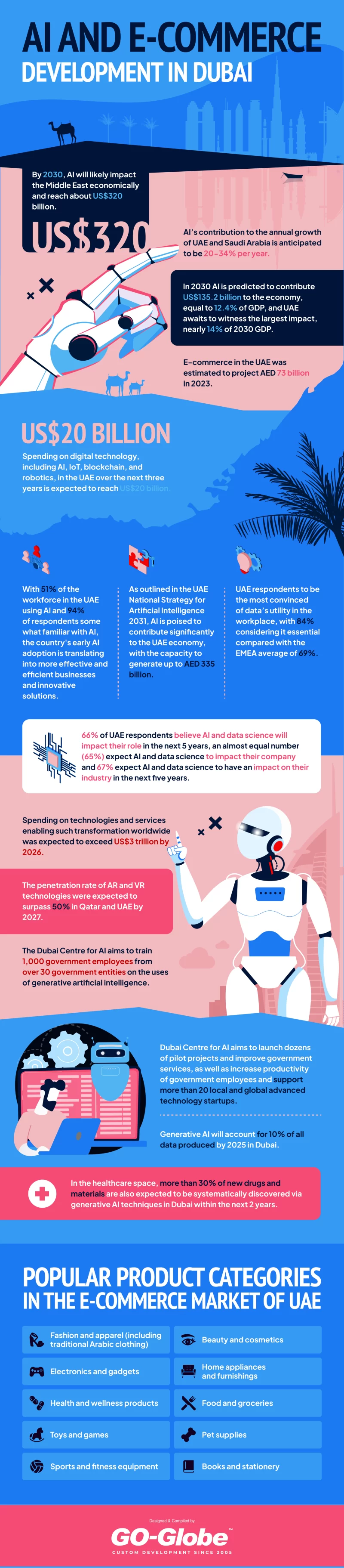
AI and E-Commerce Development in Dubai: Facts, Figures and Latest Statistics- Infographics
By 2030, AI will likely impact the Middle East economically and reach about US$320 billion.
AI’s contribution to the annual growth of UAE and Saudi Arabia is anticipated to be 20-34% per year.
In 2030 AI is predicted to contribute US$135.2 billion to the economy, equal to 12.4% of GDP, and UAE awaits to witness the largest impact, nearly 14% of 2030 GDP.
E-commerce in the UAE was estimated to project AED 73 billion in 2023.
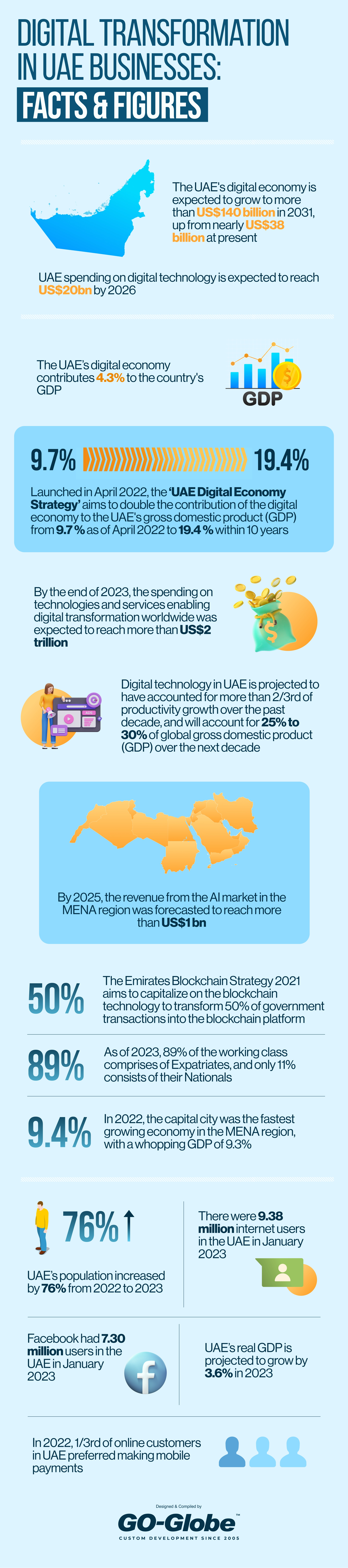
Spending on digital technology, including AI, IoT, blockchain, and robotics, in the UAE over the next three years is expected to reach US$20 billion.
With 51% of the workforce in the UAE using AI and 94% of respondents somewhat familiar with AI, the country's early AI adoption is translating into more effective and efficient businesses and innovative solutions.
As outlined in the UAE National Strategy for Artificial Intelligence 2031, AI is poised to contribute significantly to the UAE economy, with the capacity to generate up to AED 335 billion.
UAE respondents to be the most convinced of data’s utility in the workplace, with 84% considering it essential compared with the EMEA average of 69%.
66% of UAE respondents believe AI and data science will impact their role in the next 5 years, an almost equal number (65%) expect AI and data science to impact their company and 67% expect AI and data science to have an impact on their industry in the next five years.
. Spending on technologies and services enabling such transformation worldwide was expected to exceed US$3 trillion by 2026.
The penetration rate of AR and VR technologies were expected to surpass 50% in Qatar and UAE by 2027.
The Dubai Centre for AI aims to train 1,000 government employees from over 30 government entities on the uses of generative artificial intelligence.
Dubai Centre for AI aims to launch dozens of pilot projects and improve government services, as well as increase productivity of government employees and support more than 20 local and global advanced technology startups.
Generative AI will account for 10% of all data produced by 2025 in Dubai.
In the healthcare space, more than 30% of new drugs and materials are also expected to be systematically discovered via generative AI techniques in Dubai within the next 2 years.
Popular product categories in the E-Commerce Market of UAE
Fashion and apparel (including traditional Arabic clothing)
Beauty and cosmetics
Electronics and gadgets
Home appliances and furnishings
Health and wellness products
Food and groceries
Toys and games
Pet supplies
Sports and fitness equipment
Books and stationery
Conclusion
In conclusion, the integration of AI into e-commerce platforms is revolutionizing online retail in Dubai. From providing personalized shopping experiences to enhancing security, streamlining operations, and offering data-driven insights, AI is a catalyst for business growth and customer satisfaction. E-commerce businesses that embrace these AI-enhanced capabilities are well-positioned to thrive in the dynamic and tech-savvy market of Dubai.
Frequently Asked Questions (FAQs)
Q1: How does AI enhance the shopping experience on e-commerce platforms in Dubai?
A: AI enhances the shopping experience by providing personalized recommendations based on customer behavior and preferences. Virtual shopping assistants powered by AI, such as chatbots, contribute to efficient customer support, making the overall shopping journey more seamless and enjoyable.
Q2: Can AI help in preventing fraud on e-commerce platforms in Dubai?
A: Yes, AI plays a crucial role in preventing fraud on e-commerce platforms. Advanced fraud detection algorithms analyze transactions in real-time, identifying suspicious activities and securing online transactions. Additionally, the implementation of biometric authentication methods adds an extra layer of security.
Q3: How does AI contribute to inventory management?
A: AI optimizes inventory management by predicting demand patterns and providing accurate demand forecasting. This helps e-commerce businesses in Dubai maintain optimal stock levels, reducing the risk of overstocking or stock outs and improving operational efficiency.
Q4: What is the significance of visual search and augmented reality (AR) in Dubai's e-commerce landscape?
A: Visual search powered by AI allows customers to search for products using images, enhancing the search experience. Additionally, augmented reality (AR) facilitates virtual try-ons, enabling customers in Dubai to visualize how products will look before making a purchase, reducing the likelihood of returns.
Q5: How does AI-driven data analytics contribute to business growth for e-commerce platforms in Dubai?
A: AI-driven data analytics offer insights into customer behavior, preferences, and buying habits. This valuable information helps e-commerce businesses in Dubai tailor marketing strategies, optimize website performance, and make informed decisions for sustained business growth.
Q6: Can e-commerce platforms leverage voice commerce in Dubai?
A: Yes, e-commerce platforms in Dubai can leverage voice commerce, allowing users to make purchases, track orders, and engage in hands-free shopping experiences using voice-activated devices. Conversational AI enhances user interactions, making the shopping process more convenient.
Q7: How does AI contribute to the security of transactions on e-commerce platforms in Dubai?
A: AI contributes to transaction security by powering advanced fraud prevention measures and implementing biometric authentication methods. This ensures secure and trustworthy transactions, safeguarding both businesses and customers in Dubai's online retail landscape.
Q8: What role does AI play in providing data-driven insights for e-commerce businesses in Dubai?
A: AI plays a pivotal role in providing data-driven insights by analyzing customer data, website performance, and market trends. This information helps e-commerce businesses in Dubai make informed decisions, tailor their strategies, and stay competitive in the evolving online retail market.
Introduction to Digital Marketing in Sharjah
In the dynamic business landscape of Sharjah, staying ahead in the digital realm requires a strategic blend of cutting-edge technology and impactful digital marketing strategies. Sharjah businesses must leverage evolving technology and innovative web design to remain competitive. This article explores key digital marketing strategies for Sharjah businesses, focusing on SEO, responsive web design, and other essential tactics that can drive success.
Responsive Web Design for Sharjah Businesses
Mobile-Friendly Interfaces | Key for Sharjah's Digital Landscape
Recognizing the ubiquity of mobile device usage in Sharjah, businesses must prioritize mobile-friendly interfaces. Whether accessing websites on smartphones or tablets, users should experience seamless navigation and readability. Consider the touch screen nature of mobile devices. Responsive web design incorporates elements like appropriately sized buttons and touch-friendly menus, ensuring a smooth and intuitive user experience for those in Sharjah navigating websites on touch-enabled devices.
Cross-Browser Compatibility for Sharjah-Based Websites
Given the diverse preferences in internet browsers, cross-browser compatibility is vital. Businesses in Sharjah need to ensure their websites function optimally across various browsers, including popular choices like Chrome, Safari, Firefox, and Internet Explorer. Maintaining a consistent experience across different browsers reinforces the professional image of a business. Users in Sharjah should have the same seamless interaction, regardless of their choice of web browser.
Fast Loading Times for Sharjah Businesses
Users in Sharjah, like elsewhere, expect fast loading times. Optimizing website elements, compressing images, and leveraging browser caching are essential strategies to ensure swift access to information, contributing to a positive user experience. Streamlining the website by minimizing unnecessary elements further aids in reducing loading times. A responsive web design for Sharjah businesses focuses on delivering relevant content efficiently without overwhelming users with excessive graphics or data.
SEO Best Practices for Sharjah Digital Marketing
Search Engine Optimization (SEO) is integral to digital visibility. Google's mobile-first indexing means that mobile-friendly websites are prioritized in search results. Responsive web design directly contributes to improved SEO and ensures Sharjah businesses are easily discoverable online. Responsive websites often lead to better user engagement, another factor considered by search engines in rankings. Engaged users are more likely to spend time on a website, reducing bounce rates and signaling to search engines that the content is relevant.
Adaptable Images and Media in Sharjah's Responsive Web Design
Including scalable images and videos enhances visual appeal across devices. Responsive web design in Sharjah involves using images and media that adapt to different screen sizes, maintaining quality without compromising loading times. Implementing media queries is a key technique for responsive design. An edit image tool can also help optimize visuals for better performance and consistency. These queries enable the website to detect the characteristics of the device accessing it and adjust the layout and styling accordingly, ensuring a visually pleasing presentation.
User-Centric Navigation
User-centric navigation is fundamental to responsive design. Intuitive menus that adapt to smaller screens and hierarchical structures contribute to an efficient browsing experience for users in Sharjah, helping them find information effortlessly. Responsive design ensures that Call-to-Action (CTA) elements remain clear and accessible. Whether it's making a purchase, contacting the business, or subscribing, users in Sharjah should encounter easy-to-spot and responsive CTA buttons.
Social Media Engagement: Boosting Digital Marketing for Sharjah Businesses
Tailor Content to Local Preferences in Sharjah
Understanding the cultural nuances of the Sharjah community is crucial. Tailor your social media content to align with local values, traditions, and preferences. This cultural sensitivity enhances engagement by resonating with the audience on a personal level. Given the diverse linguistic landscape of Sharjah, embrace multilingual communication. Ensure that your social media posts are accessible to a wide audience by incorporating Arabic and other relevant languages in your content.
Visual Storytelling for Sharjah-Based Digital Marketing
Use visual storytelling to showcase local experiences and attractions. Whether it's highlighting the beauty of Sharjah's landscapes or featuring behind-the-scenes glimpses of your business, compelling imagery captures attention and enhances engagement. Encourage your audience to contribute by sharing their experiences with your products or services. User-generated content not only fosters community involvement but also serves as authentic testimonials, building trust among potential customers.
Interactive Content
Engage your audience through polls and surveys on social media. Seek their opinions on relevant topics or involve them in decision-making processes. This interactive approach not only boosts engagement but also provides valuable insights. Hosting live Q&A sessions to interact directly with your audience is critical to your success. Answering questions in real-time fosters a sense of transparency and accessibility, strengthening the connection between your business and the Sharjah community.
Local Events and Collaborations
Keep your audience informed about local events, festivals, and community initiatives. Actively promoting and participating in such events demonstrates your business's commitment to the local community, enhancing your brand image. Partnering with local influencers can significantly amplify your social media reach. Identify influencers aligned with your brand values and engage them in collaborations to reach a wider audience in Sharjah.
Timely and Consistent Posting
Be aware of the optimal times to post on social media platforms to maximize visibility. Consider factors such as the local time zone and the times when your target audience in Sharjah is most active on social media. Furthermore, maintaining a consistent brand image across all social media channels is critical. From visual elements to messaging, consistency builds brand recognition and reinforces your business identity in the minds of your Sharjah audience.
Engage in Conversations
Actively respond to comments and messages on your social media posts. Prompt and thoughtful responses show that your business values customer interaction, leading to increased engagement and positive brand perception. Include clear and compelling calls-to-action (CTAs) in your posts to encourage user engagement. Whether it's inviting comments, sharing content, or participating in a poll, well-crafted CTAs guide your audience towards interactive actions.
Infographics and Multimedia
Interactive content, such as infographics and multimedia presentations, captivates the audience. Sharjah businesses can leverage visually engaging content to communicate complex information, making it more digestible and shareable across digital platforms.
Seamless User Journeys in E-Commerce for Sharjah Businesses
Ensuring intuitive navigation is crucial for e-commerce integration. Users in Sharjah should seamlessly navigate through product categories, search functionalities, and the checkout process, fostering a positive and efficient user experience. Streamlining checkout processes is essential. Businesses in Sharjah can reduce cart abandonment rates by implementing straightforward and secure checkout procedures, allowing customers to complete transactions with ease.
Mobile Commerce for Sharjah's E-Commerce Growth
Given the prevalence of mobile device usage in Sharjah, businesses must prioritize mobile commerce. E-commerce platforms should be optimized for mobile interfaces, providing users with a seamless shopping experience on their smartphones or tablets. Integrating diverse mobile payment options is key. From digital wallets to mobile banking solutions, providing a range of payment methods accommodates the preferences of on-the-go shoppers in Sharjah, contributing to increased conversion rates.
AI-Powered Product Recommendations
Leveraging AI algorithms for product recommendations enhances personalization. Businesses in Sharjah can implement algorithms that analyze user behavior, suggesting relevant products and increasing the likelihood of cross-selling and upselling. Tailoring product suggestions based on individual customer profiles contributes to a more personalized shopping experience. AI-driven recommendations can consider previous purchases, browsing history, and preferences, making each user's journey unique.
Secure Payment Gateways
Ensuring the security of online transactions is paramount. E-commerce integration in Sharjah must include robust encryption protocols, protecting sensitive customer information and building trust in the security of payment gateways. Maintaining transparency in transaction processes instils confidence. Clearly communicating payment procedures, including any additional fees or charges, ensures that customers in Sharjah are well-informed and fosters trust in the e-commerce platform.
AI in Inventory Management
Utilizing AI for inventory management enhances operational efficiency. Predictive analytics can forecast demand patterns, preventing overstocking or stockouts. Businesses in Sharjah can optimize stock levels, reducing costs and improving overall inventory management. Implementing real-time updates on product availability is crucial. Users in Sharjah should have accurate information on stock levels, preventing disappointment and ensuring a positive shopping experience through the e-commerce platform.
Personalization is key in email marketing. Sharjah businesses can craft personalized email campaigns based on customer preferences, previous interactions, and purchase history, fostering a stronger connection with their audience.
Automated Email Workflows
Implementing automated email workflows streamlines communication. Sharjah businesses can use automation for onboarding sequences, customer feedback, and post-purchase follow-ups, ensuring timely and relevant interactions with their customer base.
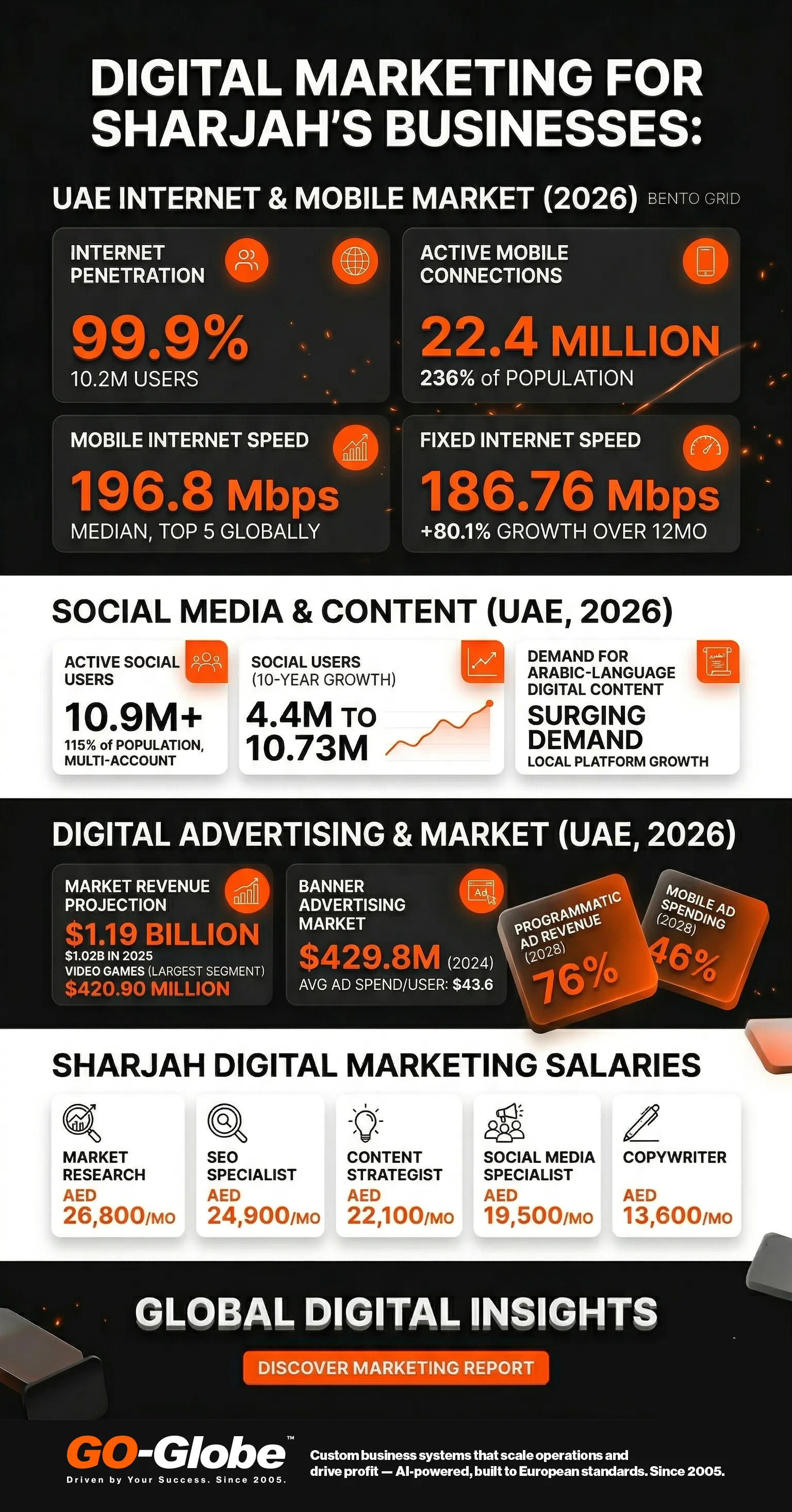
Digital Marketing for Sharjah's Businesses: Facts, Figures and Latest Statistics
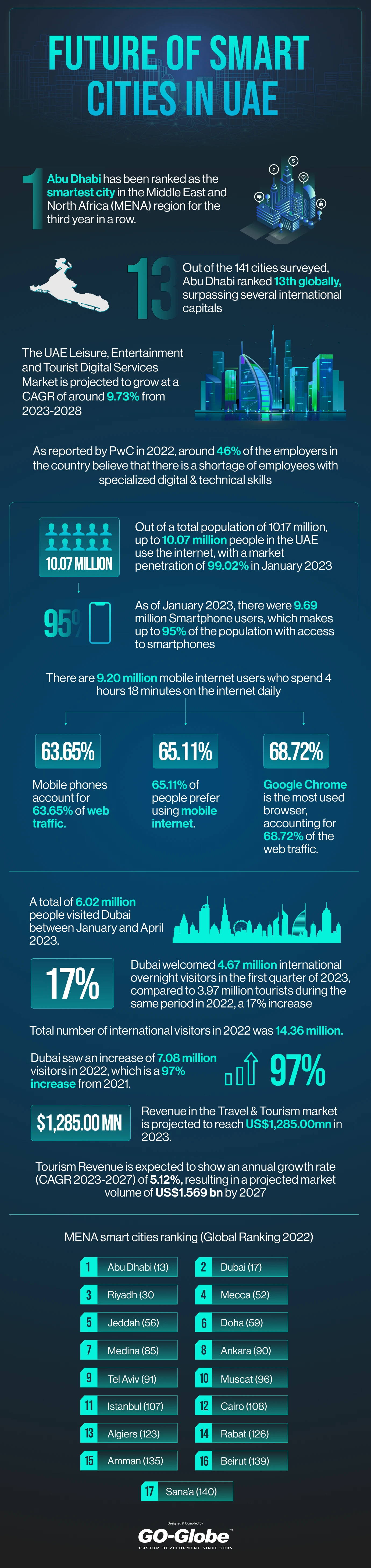
The UAE had 10.2 million internet users in January 2026 — internet penetration now stands at 99.9%.
The UAE has 10.9 million active social media users in 2026 — 115% of total population, accounting for multi-account usage.
22.4 million active mobile connections in the UAE in early 2026 — 236% of total population.
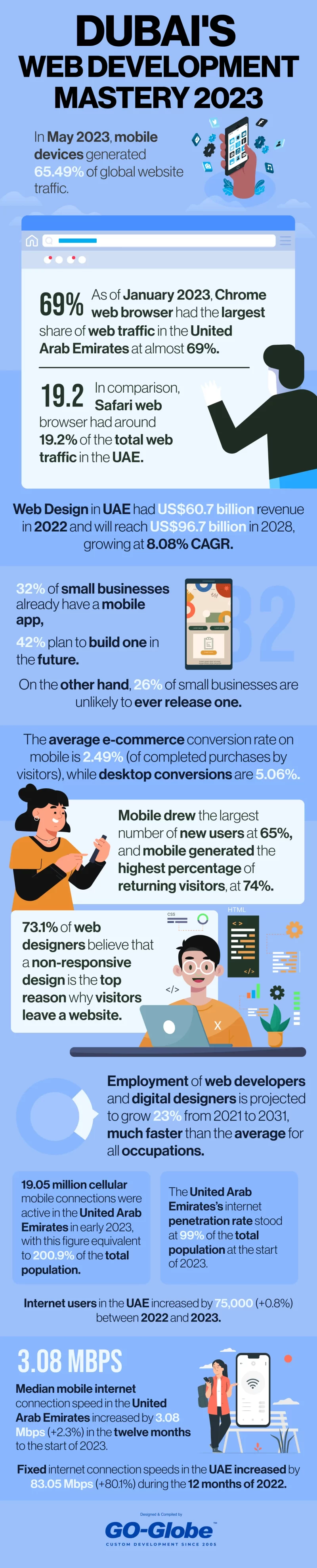
Internet users in the UAE increased by 75,000 (+0.8%) between 2022 and 2023.
UAE’s Social media users have also increased from 4.40 Million to 10.73 million in 10 years.
UAE digital media market revenue reached $1.02 billion in 2025 and is projected to grow to $1.19 billion in 2026.
Median mobile internet speed in UAE: 196.8 Mbps in 2025 — ranked among the top 5 globally for mobile network speed.
Median fixed internet connection speed in UAE: 186.76 Mbps.
The median mobile internet connection speed in the United Arab Emirates increased by 3.08 Mbps (+2.3%) in the 12 months to the start of 2023.
The fixed internet connection speeds in the UAE increased by 83.05 Mbps (+80.1%) during the same period.
Among the various segments within this market, Video Games is expected to be the largest, with a projected market volume of US$420.90 million in the same year.
The United Arab Emirates has witnessed a surge in demand for Arabic-language digital content, leading to the growth of local digital media platforms.
UAE digital advertising spend reached $1.38 billion in 2025, growing 22% year-on-year.
The largest market in UAE is Banner Advertising with a market volume of US$429.8m in 2024.
The average ad spending per user in the Banner Advertising market in UAE is projected to amount to US$43.6 in 2024.
In the Digital Advertising market, 46% of total ad spending in UAE will be generated through mobile in 2028.
In the Digital Advertising market, 76% of the Digital Advertising revenue will be generated through programmatic advertising in 2028.
The market share of Google amounts to an estimated 17% of the Digital Advertising market in UAE and the selected region in 2022.
What Works For Sharjah Businesses in 2026 That Did Not Existed 2 Years Ago
Google Business Profile (formerly Google My Business) now shows AI-generated summaries for local businesses in search results. If your profile is incomplete, Google fills the gaps with guesswork. Businesses in Sharjah with complete, keyword-rich profiles — including products, services, posts, and photos are getting 3x more calls and direction requests than those with bare-minimum listings.
WhatsApp Click-to-Chat ads have become the most cost-effective lead generation tool for Sharjah SMEs in 2025. The UAE has one of the highest WhatsApp penetration rates in the world — 85% of smartphone users. Running Instagram or Facebook ads that open a WhatsApp conversation directly cuts the friction between seeing an ad and talking to your business.
Conclusion
The digital marketing landscape for Sharjah businesses requires a strategic blend of evolving technology and innovative web design. From responsive web design to SEO, social media engagement, interactive content, and e-commerce integration, businesses in Sharjah can leverage these strategies to successfully navigate the dynamic digital landscape. By embracing the latest trends and technologies, Sharjah businesses can not only connect with their audience effectively but also establish a robust and enduring online presence.
Q1: Why is digital marketing important for businesses in Sharjah?
A: Digital marketing is essential for businesses in Sharjah to establish a strong online presence, connect with the target audience, and stay competitive in the digital landscape. It allows businesses to reach a wider audience, build brand awareness, and drive customer engagement.
Q2: How can businesses in Sharjah benefit from localized SEO strategies?
A: Localized SEO strategies help businesses in Sharjah appear in relevant local search results. By tailoring content, keywords, and meta tags to local preferences, businesses can enhance their visibility and attract customers specifically interested in their products or services in Sharjah.
Q3: What role does social media engagement play in digital marketing for Sharjah businesses?
A: Social media engagement is crucial for Sharjah businesses to connect with the local community. It helps build brand loyalty, share relevant content, and create a dialogue with customers. Effective social media strategies enhance visibility and foster a strong online presence.
Q4: How can businesses in Sharjah optimize their websites for mobile devices?
A: Optimizing websites for mobile devices involves creating responsive designs that adapt to different screen sizes. This ensures a seamless and user-friendly experience for customers in Sharjah accessing the website on smartphones or tablets.
Q5: What are the benefits of AI-powered product recommendations in e-commerce for Sharjah businesses?
A: AI-powered product recommendations enhance the e-commerce experience for Sharjah businesses by providing personalized suggestions based on user behavior. This increases the likelihood of cross-selling and upselling, leading to higher customer satisfaction and improved sales.
Q6: How can businesses in Sharjah ensure the security of online transactions in e-commerce integration?
A: Ensuring the security of online transactions involves implementing advanced encryption protocols and maintaining transparent communication about payment processes. These measures build trust among customers in Sharjah, assuring them of the safety of their sensitive information.
Q7: Why is personalized content important in digital marketing for Sharjah businesses?
A: Personalized content in digital marketing allows businesses to tailor their messaging to individual preferences and demographics. This approach resonates more with the audience in Sharjah, increasing engagement and fostering a stronger connection between the business and its customers.
Q8: How can businesses leverage AI in inventory management for e-commerce in Sharjah?
A: AI in inventory management for e-commerce enables businesses in Sharjah to predict demand patterns, prevent overstocking or stockouts, and optimize stock levels. Real-time updates on product availability ensure accurate information for customers, improving overall inventory efficiency.
Introduction
Blockchain integration technology is reshaping the digital frontier in the heart of Dubai's bustling financial landscape. This article explores the transformative impact of blockchain and web development, highlighting its benefits, challenges, and opportunities. From blockchain solutions in UAE to smart contracts development UAE, businesses are leveraging this technology to drive innovation. Finance platforms and services should consult with a lawyer specializing in blockchain to implement safeguards. As a still-unproven technology, misbehaving AI can open organizations to civil and criminal liability. A blockchain lawyer can advise on systems to protect financial assets.
Understanding Blockchain
Decentralization and Transparency
At the heart of Dubai's blockchain movement lies the concept of decentralization, fostering trust and transparency in various sectors. Explore how this groundbreaking technology is redefining traditional models by distributing power and ensuring immutable, transparent records. For businesses considering blockchain development integration Dubai , decentralization offers a robust framework for secure transactions. This is especially relevant for blockchain and web development , where decentralized systems enhance security and efficiency.
Smart Contracts
Dive into the realm of smart contracts, self-executing contracts with coded terms. In Dubai, these contracts automate processes, eliminate intermediaries, and instill unprecedented efficiency in transactions across diverse industries. Companies focusing on smart contracts development UAE are seeing significant improvements in operational efficiency. Smart contracts are also a key component of blockchain and web development , enabling seamless automation of tasks like payments, agreements, and compliance checks.
Blockchain integration assists in regulatory compliance reporting. Web applications can utilize blockchain to create transparent and immutable records, ensuring that financial transactions comply with regulatory requirements in Dubai's financial sector. Organizations seeking blockchain development consultancy in Abu Dhabi often prioritize compliance as a key benefit. For businesses focused on blockchain and web development , compliance becomes easier due to blockchain’s inherent transparency.
Auditable Records
Blockchain's tamper-resistant nature provides auditable records of financial transactions. Web development incorporating blockchain ensures that financial institutions in Dubai can maintain transparent and auditable records for compliance purposes. This is particularly valuable for companies working on blockchain fraud reduction in UAE properties and blockchain and web development projects.
Blockchain integration in blockchain and web development facilitates swift cross-border payments. The decentralized nature of blockchain eliminates the need for multiple intermediaries, reducing the time and costs associated with international money transfers. This is a key advantage for businesses leveraging blockchain integration services .
Lower Transaction Costs
By leveraging blockchain, web applications can offer lower transaction costs for cross-border payments. This is particularly beneficial for businesses in Dubai's financial sector engaged in international trade and investment. UAE blockchain development initiatives are increasingly focusing on reducing transaction costs through blockchain and web development .
Enhanced Security
Tamper-Resistant Data Storage
Blockchain ensures tamper-resistant data storage. In web development for Dubai's financial sector, this feature enhances the security of sensitive financial data, protecting it from unauthorized access or manipulation.
Mitigating Cybersecurity Risks
By incorporating blockchain, web applications can mitigate cybersecurity risks. The decentralized and cryptographic nature of blockchain technology enhances the resilience of financial platforms against cyber threats. This aligns with the goals of blockchain mentoring Dubai programs and supports blockchain and web development efforts.
Challenges for Blockchain Integration in Dubai
Regulatory Compliance
Navigating regulatory frameworks is a challenge in blockchain integration. Discover the strategies employed in Dubai to ensure compliance with financial regulations while harnessing the innovative potential of blockchain. Blockchain development consultancy Abu Dhabi firms often specialize in addressing these challenges. For blockchain and web development , compliance remains a top priority.
Integration with Legacy Systems
Integrating blockchain with existing systems poses challenges. Explore how Dubai is overcoming these hurdles, ensuring a smooth transition towards a blockchain-driven future without disrupting established operational processes. This is a focus area for blockchain integration framework projects and blockchain and web development initiatives.
Decentralized Ledger
Delve into the fundamentals of blockchain—a decentralized ledger that underpins trust in financial transactions. Explore how this innovative technology ensures transparency, security, and immutability, laying the foundation for the financial revolution in Dubai.
Smart Contracts
Uncover the power of smart contracts, self-executing contracts with the terms of the agreement directly written into code. In Dubai's financial sector, smart contracts streamline processes, automate transactions, and eliminate the need for intermediaries, fostering efficiency and cost-effectiveness.
Future Trends in Blockchain Integration
Decentralized Finance (DeFi)
Decentralized Finance (DeFi) is set to revolutionize traditional financial services by leveraging blockchain's decentralized nature. This trend includes decentralized lending, borrowing, and trading platforms that operate without traditional intermediaries, providing financial services to a broader global audience. Dubai crypto trends highlight the growing adoption of DeFi, which is closely tied to advancements in blockchain and web development .
Non-Fungible Tokens (NFTs)
Interoperability is a crucial trend in blockchain integration, aiming to enable different blockchain networks to communicate and transact seamlessly. This development addresses the current challenge of isolated blockchain ecosystems. Seamless blockchain integration is becoming a priority for many organizations, including those focused on blockchain and web development .
Interoperability
Interoperability is a crucial trend in blockchain integration, aiming to enable different blockchain networks to communicate and transact seamlessly. This development addresses the current challenge of isolated blockchain ecosystems. Interoperability fosters a more connected and collaborative blockchain landscape. It allows for the transfer of assets and information across different blockchain networks, enhancing efficiency and expanding the possibilities for cross-industry collaborations.
Central Bank Digital Currencies (CBDCs)
Central Bank Digital Currencies (CBDCs) involve the issuance of national currencies on blockchain technology. Several countries are exploring or piloting CBDCs as a way to modernize their monetary systems and enhance financial transparency. The integration of CBDCs on the blockchain brings benefits such as faster and more secure transactions, reduced fraud, and improved traceability of money flow. It represents a significant shift in how nations manage and distribute their currencies.
Sustainable and Green Blockchain
Acknowledging environmental concerns related to energy consumption in blockchain networks, a trend towards sustainable and green blockchain solutions is emerging. Efforts are being made to reduce the carbon footprint of blockchain technologies. Sustainable blockchain practices involve the use of eco-friendly consensus mechanisms and energy-efficient algorithms. This trend aims to make blockchain technology more environmentally friendly, addressing criticisms related to its ecological impact.
Integration with Internet of Things (IoT)
The integration of blockchain with the Internet of Things (IoT) is becoming a prominent trend. This involves securing and streamlining data exchanges between IoT devices using blockchain, enhancing security and transparency in the process. Blockchain's decentralized and tamper-resistant nature enhances the security and reliability of data generated by IoT devices. This integration is poised to revolutionize various industries, from supply chain management to healthcare, by ensuring the integrity of IoT-generated data.
Blockchain Integration in Dubai: Facts, Figures and Latest Statistics
Dubai's Blockchain Strategy targets making Dubai the first city fully powered by blockchain, built on three pillars: government efficiency, industry creation, and international leadership.UAE Government
UAE crypto market revenue is projected to reach $395.9 million by end of 2025, with user penetration approaching 33.48% by 2026 — one of the highest rates globally.FiscalNote
The UAE attracted over $30 billion in crypto inflows over the last 12 months, with retail transaction growth exceeding 80% and 1 in 4 adults holding digital assets.FiscalNote
The UAE blockchain market is estimated at $8.9 billion in 2025 and is projected to grow at 35% CAGR to reach $72.6 billion by 2032, driven by government digitization and financial services adoption.P&S Intelligence
The Emirates Blockchain Strategy 2021 is progressing toward its target of digitizing 50% of government transactions by 2031, with government and public services expected to post the highest CAGR of 35.2% in blockchain adoption.P&S Intelligence
The global blockchain market is projected to surpass $100 billion by 2026 and approach $400 billion by 2028, with long-term forecasts pointing toward $1.4 trillion by 2030.CoinLedger
The global blockchain market is projected to grow from $32.99 billion in 2025 to $393.45 billion by 2030 at a 64.2% CAGR (MarketsandMarkets, 2025).MarketsandMarkets
The UAE Central Bank announced its intention to issue the retail Digital Dirham CBDC in Q4 2025, as part of the Financial Infrastructure Transformation Programme which was 85% complete as of early 2025.Global Government Fintech
In November 2025, the UAE completed its first government transaction using the Digital Dirham, marking a milestone in its live deployment. By 2026, all licensed financial institutions are required to support the Digital Dirham.Great Inspire
Dubai accounts for 45% of the UAE blockchain market in 2025, serving as the country's primary innovation center — home to VARA, the Global Blockchain Council, and world-class free zone infrastructure.P&S Intelligence
Dubai Land Department launched a real estate tokenization pilot in March 2025, and in July 2025 signed an agreement with Crypto.com to explore blockchain-based property transactions and crypto payments for real estate.START
Over 1,000 crypto-related businesses are now operating in Dubai, making it one of the world's most crypto-friendly jurisdictions.Ugsdxb
Blockchain Applications Across Industries
Finance
Blockchain in Banking
Blockchain is transforming traditional banking by streamlining cross-border payments, reducing transaction costs, and enhancing security. Smart contracts on blockchain facilitate automated and transparent financial agreements, simplifying complex processes.
Cryptocurrency Exchanges
The very foundation of blockchain lies in cryptocurrency, and blockchain applications in cryptocurrency exchanges ensure secure and transparent transactions. Blockchain's decentralized ledger eliminates the need for intermediaries, enhancing the efficiency of cryptocurrency trading.
Healthcare
Electronic Health Records (EHRs)
Blockchain ensures the security and integrity of electronic health records. Patients' sensitive information is stored in an encrypted and decentralized manner, allowing for secure data sharing among healthcare providers while maintaining patient privacy.
Drug Traceability
Blockchain is employed to track the entire supply chain of pharmaceuticals, ensuring the authenticity and integrity of drugs. This application enhances transparency, reduces the risk of counterfeit medications, and improves overall patient safety.
Supply Chain
Product Traceability
Blockchain in supply chain management allows for real-time tracking of products from manufacturer to retailer. This transparency ensures authenticity, reduces fraud, and enables quick responses to issues such as product recalls.
Streamlining Logistics
Smart contracts on blockchain automate and streamline logistics processes. They enable real-time updates on shipments, automate payments, and improve the efficiency of the entire supply chain ecosystem.
Real Estate
Property Transactions
Blockchain is revolutionizing property transactions by providing a decentralized and tamper-resistant record of ownership. Smart contracts facilitate secure and transparent real estate transactions, reducing the need for intermediaries and paperwork.
Land Registry
Blockchain's decentralized ledger ensures the accuracy of land registry records. This reduces the risk of fraud, improves the efficiency of land transactions, and provides a transparent history of ownership.
Smart Contracts and Dispute Resolution
Smart Contracts in Legal Agreements
Blockchain-based smart contracts automate and enforce legal agreements, reducing the need for intermediaries. These self-executing contracts enhance transparency, reduce costs, and minimise the risk of contractual disputes.
Decentralized Dispute Resolution
Blockchain can facilitate decentralized and tamper-resistant systems for dispute resolution. This ensures a fair and transparent process, minimizing the need for lengthy legal proceedings.
Education
Credential Verification
Blockchain ensures the security and authenticity of academic credentials. By storing educational records on a decentralized ledger, individuals can easily verify their qualifications, reducing the risk of credential fraud.
Streamlining Certification Processes
Blockchain applications in education streamline certification processes. Smart contracts can automate the verification and issuance of certificates, making the process more efficient and reducing administrative burdens.
Read More: Dubai's Web Design Innovators: Crafting Websites That Sell
Conclusion
Blockchain integration in web development is poised to transform Dubai's financial landscape. From enabling seamless cryptocurrency transactions to automating financial agreements with smart contracts, the applications of blockchain are diverse and impactful. By embracing this technology, web development for Dubai's financial sector can unlock new levels of efficiency, transparency, and security, positioning the city as a global financial hub at the forefront of technological innovation.
FAQs
Q1: How does blockchain enhance the security of financial transactions in Dubai?
A: Blockchain enhances security through its decentralized and tamper-proof ledger, providing a transparent and secure record of financial transactions in Dubai.
Q2: What role do smart contracts play in Dubai's financial sector?
A: Smart contracts automate financial processes in Dubai, eliminating the need for intermediaries, reducing costs, and increasing efficiency in the financial sector.
Q3: How does blockchain facilitate cross-border transactions in Dubai?
A: Blockchain's decentralized nature facilitates swift and cost-effective cross-border transactions in Dubai by eliminating intermediaries and streamlining the process.
Q4: What challenges does Dubai face in integrating blockchain into its financial sector?
A; Dubai faces challenges in regulatory compliance and integrating blockchain with legacy systems. Strategies are implemented to ensure compliance and seamless integration.
Q5: How does blockchain improve identity verification in Dubai's financial operations?
A: Blockchain ensures secure and verifiable identity management in Dubai's financial sector, reducing fraud and enhancing customer trust through tamper-proof record-keeping.
Q6: What future trends can we expect in blockchain integration for Dubai's financial web development?
A: Future trends in Dubai include the adoption of Central Bank Digital Currencies (CBDCs) and further advancements in smart contract capabilities, shaping the future of financial web development.
For startups in Abu Dhabi, your website is much more than just a digital brochure—it’s your storefront, customer service desk, and marketing hub all rolled into one. As the business environment in Abu Dhabi continues to grow and evolve, having a solid web plan strategy is key to gaining a competitive edge. However, it’s not enough to have any website; your site needs to be tailored to meet both local needs and global standards.
A strong online presence is essential for startup branding in Abu Dhabi, especially in today’s digital-first world. But what makes a website truly effective? It’s not just about attractive visuals—it’s about functionality, user experience, and ensuring that the design aligns with the company’s values and target audience. This article explores the most important web design elements for startups in Abu Dhabi, including how to reflect cultural identity, why mobile-first design is non-negotiable, and tips for optimizing your site’s user experience.
With the help of GO-Globe, a leading provider of custom web design in Abu Dhabi, startups can unlock their websites' potential by following industry best practices while staying true to their local context.
Reflecting Cultural Identity
In a city like Abu Dhabi, where rich cultural heritage meets modern innovation, web structure must strike a balance between tradition and progress. Understanding the local culture and consumer behavior is crucial for any startup aiming to build a genuine connection with its audience.
Embrace Local Aesthetics
One of the key ways to make your website stand out is by embracing local aesthetics. This goes beyond just using local imagery. It involves creating a visual style that resonates with Abu Dhabi’s residents while staying modern and relevant. The color palette, typography, and imagery on your website should align with local customs, while still maintaining a professional and contemporary feel. For instance, earthy tones like sand and gold can convey a connection to the UAE’s landscape and heritage, while sleek, modern fonts keep the layout clean and easy to read.
Additionally, incorporating local landmarks or traditional motifs subtly into your web design can help create an emotional bond with users. However, it’s important to avoid clichés and instead focus on elements that genuinely reflect the spirit of Abu Dhabi—whether that’s the city’s bustling markets, its dynamic business environment, or its cutting-edge technology scene.
Multilingual Support
Abu Dhabi is home to people from various cultural backgrounds. As a startup in the UAE, catering to this diversity is crucial for your website's success. Offering multilingual support is no longer an option—it’s a must. A well-implemented Arabic and English version of your website ensures that you don’t alienate a large portion of your audience.
Beyond just translating content, it’s about designing the website to work in different languages. This means considering right-to-left text flow for Arabic, adapting the layout to accommodate longer words, and being mindful of cultural differences in color psychology. GO-Globe offers multilingual web design services that can help your website speak to both local and international audiences.
Mobile-First Design
With mobile usage surpassing desktop browsing in Abu Dhabi, creating your website for mobile is no longer a trend but a necessity. Whether it’s browsing on a smartphone or tablet, users expect a seamless experience on their mobile devices. A mobile-first approach ensures that your site performs well on all screen sizes, offering an intuitive experience across devices.
Responsive Design
Responsive design is the foundation of any mobile-first strategy. This approach allows your website to adjust automatically to different screen sizes and orientations. Whether someone is accessing your site on a phone, tablet, or desktop, responsive structure ensures they have an optimal viewing experience without the need to zoom or scroll excessively.
For startups, this can lead to a higher conversion rate, as users are more likely to engage with a website that functions well on their preferred device. It’s also important for SEO purposes—Google rewards mobile-friendly sites with better rankings, so by optimizing your website for mobile, you're also boosting your search engine visibility.
Fast Load Times
In the fast-paced digital world, users have little patience for slow-loading websites. A delay of even a few seconds can lead to a significant increase in bounce rates and a drop in conversion rates. For startups in Abu Dhabi, where competition is fierce, having a fast-loading website can give you a distinct advantage.
To improve your site’s speed, focus on optimizing images, reducing unnecessary plugins, and leveraging browser caching. These simple optimizations will ensure that your site not only loads quickly on mobile but also provides a better user experience overall. This can significantly impact your SEO ranking, as Google considers load time as a critical ranking factor.
User-Centric Navigation
A key factor in ensuring the success of any website, especially for startups, is its user-centric navigation. When potential customers visit a site, they expect an intuitive and straightforward way to find what they're looking for. This doesn't just help with user experience but also boosts SEO performance by reducing bounce rates.
Clear Navigation Menus
An easy-to-use navigation menu is essential for a positive website experience. For startups in Abu Dhabi, it's important to structure the menu in a way that makes sense for your audience. Categorize the content based on what is most relevant to the user. For example, if you offer services and products, ensure that these sections are clearly visible. By using clear labeling and a logical flow, users will quickly understand where to find the information they need. This contributes to both an improved user experience and a higher conversion rate.
Strategic Call-to-Action (CTA) Buttons
Effective call-to-action (CTA) buttons can significantly drive user engagement and conversions. These buttons should be placed strategically throughout the website, guiding users toward actions like making a purchase, signing up for a newsletter, or contacting your team. Action-oriented text such as “Get Started” or “Learn More” encourages users to take the next step. The visual prominence of these buttons, combined with their strategic positioning, ensures that they are noticed without overwhelming the user.
Security Measures
Website security should be a top priority for startups, particularly when handling sensitive data. For businesses in Abu Dhabi, where users are increasingly concerned about privacy, implementing strong security measures is a sign of professionalism and trustworthiness.
SSL Certification
SSL (Secure Sockets Layer) certification is crucial for securing your website’s data transmissions. This certification encrypts sensitive information, such as login credentials and payment details, ensuring that hackers cannot intercept them. It also boosts trust with your customers, as websites with SSL certificates show a padlock icon in the browser’s address bar. For startups, incorporating SSL certification not only protects users but also positively impacts SEO rankings, as search engines like Google prioritize secure websites.
Transparent Privacy Policies
Having a clear privacy policy is essential for building trust with your users. With concerns about data misuse on the rise, transparent privacy policies ensure that your users understand how their information will be handled. This includes detailing how data is collected, used, and stored. Startups in Abu Dhabi should make this policy easily accessible, typically linked in the website footer. Transparency in data usage not only builds trust but also ensures compliance with international privacy regulations, such as GDPR.
Future Trends for Design Essentials for Startups in Abu Dhabi
Startups in Abu Dhabi must adapt to emerging trends in web design to remain competitive. As the demand for sophisticated online experiences grows, embracing future trends not only enhances the user experience but also strengthens brand visibility and credibility. Below, we explore some key design essentials that will shape the future of startups in the region.
Engaging Visual Content
When it comes to creating a lasting impression on your website visitors, engaging visual content is essential. This category includes high-quality images and videos, which are integral to any successful digital presence. In Abu Dhabi, where diverse audiences converge, showcasing your brand through carefully chosen visual content helps to communicate your message more clearly.
High-Quality Imagery
Images are the first thing visitors notice on your website, making them a vital element of your overall design strategy. Whether you're showcasing products, services, or brand culture, high-quality, relevant imagery helps establish trust with your audience. For startups in Abu Dhabi, using culturally appropriate and professional images can make your brand appear more authentic and credible. Avoid stock images that feel generic; instead, opt for unique, high-resolution images that reflect your company’s personality.
Investing in quality imagery doesn’t just enhance aesthetics—it also boosts your SEO performance. Search engines favor pages with optimized, high-quality visuals, meaning that a visually rich website can improve your chances of ranking higher in search results.
Video Content
Video is one of the most powerful tools to engage your website visitors. It allows startups to tell their story, explain products, or highlight services in a way that static images cannot. Videos capture attention quickly and can make a deeper impact on users, encouraging them to stay longer on your website.
Consider adding explainer videos, customer testimonials, or behind-the-scenes footage to help your audience connect with your brand. In Abu Dhabi, where consumers are tech-savvy, a well-produced video that showcases your business can create a sense of trust and connection.
Immersive User Experiences
An immersive user experience ensures that visitors don’t just visit your website but are actively engaged. With so many options available, startups in Abu Dhabi must create a compelling experience to keep users interested. Interactive design features, like Augmented Reality (AR) or Virtual Reality (VR), can elevate a simple website into an engaging experience.
Augmented Reality (AR) Integration
Augmented Reality (AR) is increasingly being used in web design to provide users with a more interactive and immersive experience. For example, in retail and e-commerce, AR can allow potential customers to visualize how products will look in their space before purchasing. This feature has proven particularly successful in industries like interior design and fashion, where the customer experience can greatly benefit from AR integration.
For startups in Abu Dhabi, using AR can make your website stand out in a crowded market, offering a modern, engaging feature that not only attracts visitors but also builds trust with tech-savvy customers.
Virtual Reality (VR)
Virtual Reality (VR) is taking user experiences to the next level by offering a fully immersive digital experience. With VR, businesses in real estate or tourism, for example, can offer virtual tours of properties or destinations, making it easier for users to explore without leaving their homes.
While VR is still an emerging trend, it’s becoming increasingly accessible for web designers Abu Dhabi. For startups, incorporating VR into your website can create a unique, memorable experience that will captivate visitors and set you apart from your competitors.
Voice Search Optimization
Voice search is rapidly becoming a preferred method of interaction, especially with the rise of smart devices and virtual assistants like Siri, Alexa, and Google Assistant. For startups in Abu Dhabi, optimizing your website for voice search is no longer optional—it’s essential. Voice search improves accessibility, offering users a more convenient and efficient way to find information without typing.
A conversational User Interface (UI) allows users to engage with your website through natural, spoken language. This interface mimics the way we communicate with other people, making it more intuitive and user-friendly. For startups in Abu Dhabi, implementing conversational UI design means providing your customers with seamless interaction through voice-activated search or chatbots.
Integrating a conversational UI into your website enhances user experience, improving engagement and customer satisfaction. Whether it's through customer support bots, order tracking, or general queries, conversational UIs enable visitors to find what they need quickly, making your website more accessible to a wider audience.
Natural Language Processing (NLP)
Natural Language Processing (NLP) enables your website to understand and process spoken or typed user queries in a more human-like manner. With NLP, your website can better interpret and respond to the questions users pose, offering more accurate and contextually relevant results.
Incorporating NLP into your web design Abu Dhabi can improve the effectiveness of voice search, making interactions more natural and personalized. As voice search grows in popularity, startups in Abu Dhabi must adapt to these technologies, ensuring that their websites remain user-friendly and optimized for voice-driven queries.
Minimalistic and Functional Design
Minimalism in web design focuses on simplicity and clarity, creating a clean and distraction-free environment for users. This approach emphasizes functionality, ensuring that visitors can quickly find what they need without feeling overwhelmed by unnecessary elements. For startups in Abu Dhabi, adopting a minimalist design can make your website more user-friendly while improving load times and overall performance.
Simplified UI Elements
In minimalist web design Abu Dhabi, less is more. By simplifying UI elements, you create a clear structure that enhances navigation. For instance, limiting the number of colors, fonts, and graphics can make your website more visually appealing and easier to navigate. This simplicity allows users to focus on the content without being distracted by extraneous design elements. Startups in Abu Dhabi can use this approach to deliver a straightforward, efficient user experience that drives conversions.
Simplified UI elements also improve website performance. By reducing the number of visual components, websites load faster, which is crucial for retaining visitors. Faster load times are also a ranking factor for search engines, making minimalist design not only user-friendly but also SEO-friendly.
Functional Animation
While minimalism favors simplicity, functional animation adds subtle interactivity without overwhelming the user. Examples include hover effects, button animations, and smooth transitions that guide users through your website. These animations enhance the user experience by making the website feel more dynamic and engaging.
For startups in Abu Dhabi, functional animations can help highlight important content or lead users to specific actions, such as making a purchase or filling out a contact form. When done right, functional animations contribute to a smoother and more enjoyable browsing experience.
Personalization Through AI
Personalization is no longer just a luxury but an expectation from modern consumers. With the help of AI, startups can deliver personalized experiences that speak directly to the individual preferences of users. This tailored approach not only enhances user satisfaction but also increases conversion rates by aligning product offerings with customer needs.
AI-Driven Personalization
AI-driven personalization allows businesses to analyze user behavior and create customized experiences for each visitor. Through data collection, AI can track user interactions, preferences, and browsing patterns, allowing you to provide tailored recommendations, dynamic content, and targeted offers. For startups in Abu Dhabi, this means you can show the most relevant products or services to a customer based on their previous interactions or searches on your website.
For instance, an e-commerce site could recommend products based on items the user has previously viewed or purchased, or a service-based website could offer customized content related to user interests. By presenting a personalized experience, your website can create a deeper connection with the user, increasing the likelihood of conversion.
Personalization doesn’t stop at products—it can also extend to content and marketing campaigns. Whether it’s through personalized emails, product recommendations, or dynamic website content, AI helps startups in Abu Dhabi provide a unique experience for each visitor, improving engagement and customer loyalty.
Predictive Analytics
Predictive analytics is a powerful AI tool that takes personalization a step further by anticipating user behavior based on historical data. This technology analyzes past interactions and user data to forecast what customers might want in the future, allowing startups to be proactive in their approach.
For example, if a customer has shown interest in a specific category of products or services, predictive analytics can forecast the likelihood of them purchasing similar items in the future. With this knowledge, startups can push targeted promotions or new product offerings that match the customer's needs, improving both user experience and conversion rates.
Incorporating predictive analytics also helps startups optimize their marketing efforts. By understanding customer behavior and preferences, you can focus your resources on high-potential leads, ensuring that your marketing campaigns are reaching the right audience at the right time.
Blockchain-Powered Security
As online threats continue to grow, the security of user data becomes a critical concern for businesses. Blockchain technology offers a unique and highly secure solution for protecting sensitive information, such as financial transactions or personal data.
By using blockchain, startups can ensure that transactions are transparent, secure, and immutable, making it nearly impossible for malicious actors to tamper with data. For businesses handling customer payments, subscription services, or confidential data, blockchain-powered security provides peace of mind and builds trust with users.
For startups in Abu Dhabi, blockchain not only offers enhanced security but also provides a competitive edge. As customers become more aware of online security risks, choosing blockchain solutions will show that your business values data protection, leading to higher customer confidence.
Design Essentials in Abu Dhabi: Future Facts, Figures, and Predictions
Website Design Impact on Engagement and Revenue: Website design will likely improve time on-site by an impressive 95% and year-on-year online revenue by 250% by 2055, thanks to more advanced, AI-driven personalized designs and immersive user experiences that keep visitors engaged for longer periods.
Website Saturation: By 2055, the number of websites is expected to surpass 10 billion globally. As more businesses and individuals create their online presence, competition for visibility will intensify, making high-quality, user-centric web design in Abu Dhabi more crucial than ever.
Cost of Developing Websites in Abu Dhabi: The cost of developing a basic informational website in Abu Dhabi may rise to around 20,000 AED to 30,000 AED by 2055, reflecting the advancement in technology and design complexity, including immersive interfaces and AI-powered functionalities.
Cost of Developing E-commerce Websites: E-commerce website development in Abu Dhabi is expected to range from 50,000 AED to 100,000 AED by 2055 due to more sophisticated features like AR/VR shopping experiences, AI-based recommendation systems, and blockchain for secure transactions.
Customized Website in Abu Dhabi: The price for custom website development in Abu Dhabi may increase significantly, ranging from 75,000 AED to 150,000 AED or more by 2055. Customization will likely involve more immersive structure elements, AI-driven personalization, and cross-platform integration.
Mobile Device Traffic: By 2055, mobile devices will likely account for 85-90% of global website traffic, driven by the dominance of mobile-first web techniques and the widespread use of mobile devices for daily internet access, including 5G/6G networks enabling faster connections.
Investments in Startup Incubators and Accelerators: Abu Dhabi’s investments in startup incubators and accelerators will continue to grow, potentially exceeding $1 billion by 2055. The region will likely remain a hub for tech-driven startups, especially those focused on AI, web development, and blockchain technologies.
Small Business Mobile Apps: By 2055, approximately 80% of small businesses will likely have a mobile app, with the other 20% relying on optimized PWAs (Progressive Web Apps). The ability to create apps will become more accessible due to lower development costs and advanced app-building platforms.
Mobile vs. Desktop Conversion Rates: The e-commerce conversion rate on mobile devices is expected to rise to 5-7% by 2055 as mobile browsing becomes more integrated into daily life and optimized for faster, smoother transactions, while desktop conversions could hover around 8-10%.
New Users and Returning Visitors on Mobile: Mobile will continue to draw the largest number of new users, with an estimated 80% of new users accessing websites via mobile by 2055. Additionally, mobile will generate the highest percentage of returning visitors, possibly reaching 90%, due to the improved mobile user experience and the increasing reliance on smartphones.
Internet Penetration in the UAE: By 2055, nearly 100% of the UAE population will be internet users, as technological advancements in connectivity and internet access reach even the most remote areas. The country’s dedication to smart city initiatives and digital infrastructure will ensure full online accessibility.
Mobile Internet Usage: By 2055, mobile internet usage will likely reach 100% penetration in the UAE, with most people spending an average of 6-8 hours per day on mobile internet. The increased adoption of 5G/6G networks and the growing reliance on mobile-first applications will further drive this shift, making mobile internet the dominant method for accessing online content and services.
UAE Internet Usage Statistics: By 2055, it’s expected that nearly all of the UAE’s population (99.9%) will be active internet users. With nearly universal internet adoption, digital services will be more integrated into everyday life, from work to leisure, and UAE residents will use the internet for everything from e-commerce to virtual entertainment, education, and more.
Smartphone Internet Users: The number of smartphone internet users in the UAE will likely increase to 99% by 2055, with mobile phones becoming an essential part of the digital ecosystem. People will likely rely on their smartphones not just for communication but for a wide range of services including e-commerce, financial transactions, health monitoring, and entertainment.
Mobile Internet Usage Growth: By 2055, around 95-100% of mobile internet users in the UAE will spend an average of 5-6 hours daily on the internet. With advances in mobile technologies, including augmented reality (AR) and virtual reality (VR), mobile internet usage will expand to cover a broader range of activities beyond typical browsing and social media, such as immersive shopping experiences and remote work environments.
UAE Broadband Internet Speed: Broadband speeds in the UAE will likely reach speeds of 1,000 Mbps or more by 2055 as 6G networks become widespread. With faster speeds, there will be an even greater emphasis on data-heavy applications like high-definition streaming, cloud-based applications, and real-time communication technologies, enhancing overall user experience.
Conclusion
Building a strong online presence for startups in Abu Dhabi requires a strategic and culturally sensitive approach to web design. By reflecting the local identity, prioritizing mobile-first design, ensuring user-centric navigation, and incorporating security measures, startups can create a website that resonates with the diverse audience in Abu Dhabi. Engaging visual content, local testimonials, and personalized touches further contribute to a compelling online presence, setting the stage for success in the dynamic digital landscape of Abu Dhabi.
FAQs
How does responsive design benefit startups in Abu Dhabi?
Responsive layout benefits startups in Abu Dhabi by ensuring seamless functionality across various devices, catering to a broader audience and positively impacting search engine rankings.
Why is brand-consistent imagery crucial for startups in Abu Dhabi?
Brand-consistent imagery fosters brand identity establishes credibility, and creates a visually compelling narrative, contributing to a strong and memorable online presence for startups in Abu Dhabi.
What is the significance of strategic Calls-to-Action (CTAs) in web design for startups in Abu Dhabi?
Strategic CTAs guide visitors through the conversion funnel, prompting them to take desired actions and contributing to the overall success of startups in Abu Dhabi by increasing user engagement and conversion rates.
How do user-friendly forms enhance the user experience for startups in Abu Dhabi?
User-friendly forms enhance the user experience by providing a seamless interaction, encouraging engagement, and offering startups valuable insights through user feedback.
Why is loading speed crucial for the success of startups in Abu Dhabi?
Loading speed is crucial for the success of startups in Abu Dhabi as it impacts user experience, with faster loading times contributing to a more seamless and enjoyable interaction, positively influencing user satisfaction and retention.
How does reliable hosting contribute to a dependable online presence for startups in Abu Dhabi?
Reliable hosting contributes to a dependable online presence by ensuring faster loading times, minimal downtime, and more stable website performance for startups in Abu Dhabi.
Why are SSL certificates and data encryption essential security measures for startups in Abu Dhabi?
A: SSL certificates and data encryption are essential security measures for startups in Abu Dhabi as they safeguard user information, build trust, and enhance the overall credibility of the website.
In the bustling emirate of Sharjah, the digital realm is undergoing a transformative visual evolution thanks to the impactful contributions of GO-Globe, a leading web design company. This article explores the innovative web design trends set in motion by GO-Globe, shaping Sharjah's online landscape and elevating the digital experiences of businesses and users alike.
GO-Globe's Influence on Innovative Web Design Trends in Sharjah
Dynamic User-Centric Interfaces
GO-Globe's influence on Sharjah's web design scene is prominently marked by the adoption of dynamic user-centric interfaces. Websites crafted by GO-Globe prioritize user engagement through interactive elements, micro-animations, and intuitive navigation. This trend enhances the overall user experience, making websites more appealing and user-friendly.
Vibrant Color Palettes
The impact of GO-Globe on Sharjah's visual landscape is evident in the vibrant color palettes embraced by modern websites. Bold and lively colors are strategically employed, adding a visual richness that aligns with Sharjah's cultural vibrancy. This trend not only captures attention but also reflects the dynamic spirit of the emirate.
Storytelling Through Multimedia
Web design trends in Sharjah, influenced by GO-Globe, have seen a surge in storytelling through multimedia. Incorporating videos, animations, and immersive graphics, websites tell engaging narratives that go beyond text. This approach enhances brand storytelling and captivates audiences in a more profound and visually stimulating manner.
Mobile-First Responsive Design
GO-Globe's impact on Sharjah's web design landscape includes a significant emphasis on mobile-first responsive design. Recognizing the prevalence of mobile users, websites are optimized for various devices, ensuring a seamless and visually pleasing experience regardless of the screen size. This trend aligns with the mobile-centric habits of Sharjah's tech-savvy population.
Innovative Navigation Menus
Navigation menus undergo innovation in Sharjah's web design, inspired by GO-Globe's creative approach. Unconventional menu designs, such as hidden navigation, mega-menus, or sticky menus, redefine user journeys. This trend not only adds an element of surprise but also enhances the overall aesthetic and functionality of websites.
Integration of Arabic Typography
GO-Globe's influence is seen in the intentional integration of Arabic typography, preserving Sharjah's cultural identity in web design. Websites showcase fonts that resonate with the Arabic aesthetic, ensuring that content is not only visually appealing but also culturally relevant. This trend fosters a deeper connection with the local audience.
Gradient Color Schemes
Gradient color schemes add depth and vibrancy to web designs, and they are witnessing a resurgence in 2023. UAE-based websites are embracing gradient colors to create eye-catching visual appeal and evoke emotions that resonate with their brand identity. Gradients seamlessly blend colors, lending a touch of modernity and elegance to websites.
Seamless E-Commerce Experiences
As Sharjah's digital retail landscape evolves, GO-Globe's impact is evident in the creation of seamless e-commerce experiences. Websites are optimized for intuitive navigation, secure payment gateways, and visually compelling product displays, contributing to the growth of digital commerce in the emirate.
Data-Driven Personalization
GO-Globe's influence extends to data-driven personalization in web design trends. Websites in Sharjah leverage user data to tailor experiences, providing personalized recommendations, content, and user interfaces. This trend enhances user satisfaction and engagement, contributing to a more dynamic and personalized online experience.
One of the challenges in Sharjah's web design landscape is the delicate balance between cultural sensitivity and embracing innovative trends. Designers must navigate the rich cultural heritage of Sharjah while incorporating modern elements, ensuring that web designs resonate with the local audience without compromising creativity.
Digital Literacy
While Sharjah is progressing digitally, there remains a gap in digital literacy for certain segments of the population. Bridging this knowledge gap is crucial for the widespread acceptance and appreciation of innovative web design trends. Educational initiatives and awareness campaigns can play a pivotal role in addressing this challenge.
Technological Infrastructure
Despite advancements, disparities in technological infrastructure can impede universal access to innovative web designs in Sharjah. Ensuring that high-speed internet and reliable connectivity are available across all areas of the emirate is essential for enabling a seamless user experience for everyone.
Evolving Regulations
As web design trends evolve, designers in Sharjah must navigate the evolving legal frameworks and regulations. Ensuring compliance with privacy laws, accessibility standards, and other digital regulations poses a challenge. Designers need to stay informed and adapt to the ever-changing legal landscape to avoid potential obstacles.
Future Outlook for Innovative Web Design in Sharjah
Augmented Reality (AR) Integration
The future of innovative web design in Sharjah holds exciting prospects, with the integration of augmented reality (AR). AR elements can be incorporated into websites to provide immersive user experiences, blending the physical and digital worlds. This innovation has the potential to revolutionize how users interact with online content.
AI-Driven Personalization
Artificial Intelligence (AI) is poised to play a significant role in the future of web design in Sharjah. AI-driven personalization will allow websites to dynamically tailor user experiences based on individual preferences and behaviors. This level of customization enhances engagement and user satisfaction.
Blockchain for Enhanced Security
The integration of blockchain technology is anticipated to become a cornerstone of innovative web design in Sharjah. Blockchain can enhance security, ensuring the integrity of online transactions and user data. This focus on trust and security aligns with the growing importance of digital privacy.
Voice User Interfaces (VUI)
The future of web design in Sharjah may see an increased adoption of Voice User Interfaces (VUI). With the rise of virtual assistants and voice-activated devices, designing websites that seamlessly interact with users through voice commands will become a prominent trend, offering a new dimension of accessibility.
In conclusion, GO-Globe has emerged as a trailblazer in shaping Sharjah's visual landscape through innovative web design trends. From dynamic user-centric interfaces to vibrant color palettes and data-driven personalization, the impact is far-reaching. As GO-Globe continues to push the boundaries of web design, Sharjah's digital realm stands poised for a future defined by creativity, functionality, and an enriched user experience.
Q1. What distinguishes GO-Globe's impact on web design trends in Sharjah?
A: GO-Globe's impact on web design trends in Sharjah is characterized by its emphasis on dynamic user-centric interfaces, vibrant color palettes, and the integration of innovative elements such as multimedia storytelling. These trends collectively contribute to a visually rich and engaging digital landscape.
Q2. How does GO-Globe influence the use of vibrant color palettes in Sharjah's web design?
A: GO-Globe's influence is evident in the use of vibrant color palettes in Sharjah's web design, adding a visual richness that aligns with the emirate's cultural vibrancy. Bold and lively colors are strategically employed to capture attention and convey the dynamic spirit of Sharjah.
Q3. What role does storytelling through multimedia play in GO-Globe's impact on Sharjah's web design?
A: GO-Globe's impact on Sharjah's web design includes a focus on storytelling through multimedia. Websites incorporate videos, animations, and immersive graphics to tell engaging narratives beyond traditional text. This approach enhances brand storytelling and provides a visually stimulating experience for users.
Q4. How does GO-Globe contribute to mobile-first responsive design in Sharjah's web design landscape?
A: GO-Globe contributes significantly to mobile-first responsive design in Sharjah's web design landscape. Websites crafted by GO-Globe are optimized for various devices, prioritizing a seamless and visually pleasing experience for users regardless of screen size. This aligns with the mobile-centric habits of Sharjah's tech-savvy population.
Q5. In what ways does GO-Globe redefine user journeys through innovative navigation menus in Sharjah's web design?
A: GO-Globe redefines user journeys in Sharjah's web design by introducing innovative navigation menus. Unconventional designs such as hidden navigation, mega-menus, and sticky menus add an element of surprise while enhancing the overall aesthetic and functionality of websites.
Q6. How does GO-Globe integrate Arabic typography to preserve cultural identity in Sharjah's web design?
A: GO-Globe intentionally integrates Arabic typography to preserve Sharjah's cultural identity in web design. Websites showcase fonts that resonate with the Arabic aesthetic, ensuring that content is not only visually appealing but also culturally relevant. This trend fosters a deeper connection with the local audience.
Q7. What is the significance of seamless e-commerce experiences influenced by GO-Globe in Sharjah?
A: GO-Globe's influence is seen in the creation of seamless e-commerce experiences in Sharjah's web design. Websites optimized for intuitive navigation, secure payment gateways, and visually compelling product displays contribute to the growth of digital commerce in the emirate.
Q8. How does GO-Globe contribute to data-driven personalization in Sharjah's web design?
A: GO-Globe's impact extends to data-driven personalization in Sharjah's web design. Websites leverage user data to tailor experiences, providing personalized recommendations, content, and user interfaces. This trend enhances user satisfaction and engagement, contributing to a more dynamic and personalized online experience.
In the ever-evolving landscape of business operations, the importance of a well-designed and efficient intranet system cannot be overstated. For businesses in Dubai seeking to enhance their internal communication, streamline processes, and foster collaboration, investing in custom intranet solutions tailored to their unique needs is paramount. In this article, we delve into why businesses in Dubai should consider custom intranet solutions and how this strategic move can significantly elevate their work environment.
Understanding the Dynamics of Dubai's Business Landscape
Dubai stands as a global business hub, attracting enterprises from various industries. With a diverse range of businesses operating in this vibrant city, each entity has its distinct requirements and workflows. Off-the-shelf intranet solutions may fall short in addressing these unique needs, making custom intranet solutions a compelling choice for businesses aiming to stay ahead of the curve.
Strategic Geographical Location
Dubai's strategic geographical location acts as a bridge between East and West, making it a global hub for trade and commerce. The city's proximity to major markets in Asia, Africa, and Europe positions it as a focal point for international business activities, attracting a diverse range of industries.
Free Zones
Dubai's establishment of numerous free zones has been a game-changer. These zones offer businesses tax incentives, full ownership rights, and simplified regulatory processes. Companies within these free zones benefit from a business-friendly environment, fostering innovation and entrepreneurship.
Diverse Economy
While oil and gas have historically been significant contributors to Dubai's economy, the city has successfully diversified its economic base. Today, sectors such as tourism, real estate, aviation, and technology play pivotal roles, reducing dependency on oil and fostering resilience in the face of economic fluctuations.
Government Initiatives
Dubai's government is proactive in promoting innovation and technology. Initiatives like the Dubai 10X and Smart Dubai aim to position the city at the forefront of technological advancement. This commitment creates a fertile ground for businesses to harness cutting-edge solutions and stay ahead in the digital era.
Global Connectivity
Dubai's world-class infrastructure, including the award-winning Dubai International Airport and Jebel Ali Port, positions the city as a global transportation hub. This connectivity facilitates international trade, attracting businesses looking to establish a strategic presence in a centrally located and well-connected city.
Multicultural Workforce
Dubai's multicultural environment is a testament to its openness and inclusivity. The city attracts a diverse pool of talent from around the world. Businesses operating in Dubai benefit from a workforce with varied perspectives and experiences, contributing to creativity and adaptability.
Business-Friendly Policies
Dubai's commitment to being business-friendly is evident in its policies. The emirate welcomes foreign investment and implements initiatives to simplify bureaucratic processes. This welcoming approach encourages businesses to set up operations in Dubai, contributing to the city's economic vibrancy.
Real Estate Boom
Dubai's skyline is a testament to its ambitious real estate projects. The development of iconic structures such as the Burj Khalifa and Palm Jumeirah not only shapes the city's landscape but also catalyzes economic growth, attracting businesses and tourists alike.
Luxury and Tourism
Dubai's focus on luxury and tourism has positioned it as a global destination. From extravagant shopping experiences to world-class hotels, the city offers a lifestyle that attracts high-net-worth individuals and tourists. Businesses in the hospitality and luxury sectors thrive in this opulent environment.
Adaptability to Change
Dubai's ability to adapt to changing global dynamics is a key factor in its economic resilience. The city embraces innovation, embraces technological advancements, and pivots when necessary. This adaptability ensures that businesses operating in Dubai can navigate challenges and seize emerging opportunities.
Off-the-shelf intranet solutions often adopt a one-size-fits-all approach, leaving businesses grappling with features that may be redundant or insufficient for their specific operations. Custom intranet solutions, on the other hand, empower businesses to align their intranet with their organizational DNA. From integrating specific communication channels to developing custom workflows, the possibilities are limitless.
Streamlined Workflows
Tailored intranet solutions enable the streamlining of workflows, aligning every process with your business DNA. From document management to project collaboration, a custom intranet ensures that each feature is optimally configured to enhance efficiency.
Personalized User Experience
User experience is pivotal in fostering productivity. A bespoke intranet caters to the preferences and habits of your team, ensuring a seamless and intuitive interface. This personalization minimizes learning curves and maximizes user engagement.
Team Integration
Custom intranets foster team integration by providing a platform that mirrors your collaborative dynamics. Features such as real-time document editing, task management, and communication channels are tailored to reinforce teamwork.
Knowledge Sharing
Unlock the potential of knowledge sharing within your organization. Customized intranets facilitate the creation of knowledge repositories, ensuring that insights are not only generated but also readily accessible, contributing to informed decision-making.
Fortified Cybersecurity
Dubai's business landscape demands robust cybersecurity measures. Tailored intranet solutions address specific security concerns, implementing measures to safeguard sensitive data and protect against evolving cyber threats.
Compliance Assurance
Custom intranets ensure compliance with industry regulations and standards. From data privacy to corporate governance, a bespoke solution mitigates risks associated with non-compliance, safeguarding your business reputation.
Implementing a custom intranet solution is not merely a technological upgrade; it is a strategic move that requires careful planning. Collaborating with experienced professionals who understand both the technological landscape and the nuances of Dubai's business environment is crucial. This strategic approach ensures that the custom intranet solution aligns seamlessly with your business goals, delivering optimal results.
Strategic Alignment
Custom Intranet solutions are strategically aligned with the overarching business objectives of each organization. Through seamless integration with key performance indicators and strategic goals, the Intranet becomes a proactive tool that contributes directly to the success metrics defined by the business in the dynamic landscape of Dubai.
Scalability Planning
Dubai's business environment is characterized by rapid growth and evolution. Strategical planning for scalability ensures that custom Intranet solutions can seamlessly accommodate the expansion of business operations, technological advancements, and changing requirements. This future-proofing approach safeguards the long-term relevance of the Intranet.
Change Management
Effective change management is integral to the strategic implementation of custom Intranet solutions. GO-Globe provides comprehensive support, guiding businesses in Dubai through the transition process. This strategic approach minimizes resistance to change, accelerates user acceptance, and ensures a smooth and successful Intranet implementation.
Data Migration Strategies
Strategic implementation involves meticulous data migration strategies. Ensure seamless transfer of information from existing systems to the custom Intranet solution. This strategic approach minimizes disruptions, preserves data integrity, and optimizes the efficiency of the Intranet from the moment of implementation.
Continuous Improvement Strategies
Strategic implementation is an iterative process. This includes the implementation of continuous improvement strategies, gathering feedback from users in Dubai businesses, and incorporating enhancements. This strategic approach ensures that the custom Intranet solution evolves in alignment with changing business needs and technological advancements.
Performance Analytics
Strategic implementation includes the integration of performance analytics into custom Intranet solutions. Businesses in Dubai are thriving with valuable insights, from user activity tracking to overall system performance. This strategic use of analytics empowers organizations to make informed decisions and optimize the strategic impact of the Intranet.
Facilitating Effective Communication and Collaboration
Communication lies at the heart of any successful business operation. A custom intranet solution facilitates effective communication by providing tailored communication channels, discussion forums, and real-time messaging features. This not only streamlines internal communication but also fosters collaboration among team members, regardless of their physical locations.
Tailored Intranet Features for Dubai's Business Culture
Dubai's business environment is fast-paced, diverse, and ever-growing. For companies operating in this dynamic market, staying ahead requires effective communication, smooth collaboration, and a strong internal structure. That's where a custom intranet comes in. Unlike one-size-fits-all solutions, a custom intranet in Dubai is designed to fit the unique needs of local businesses, helping them thrive in a competitive landscape.
As Dubai continues to be a hub for multinational corporations and startups alike, having a tailored intranet for your company can make all the difference. Not only does it improve efficiency, but it also aligns with the cultural and operational demands that are key to success in the region. Let's explore how a custom intranet can work for you and your team in Dubai.
Why Custom Intranet Solutions Matter in Dubai
Dubai's business culture is distinct. It blends modernity with tradition, balancing local values with international practices. This calls for a business tool that accommodates both the nuances of the local workforce and the demands of a global marketplace. A custom intranet solution allows businesses in Dubai to maintain a highly functional, easy-to-use platform that enhances communication and boosts productivity.
For example, in Dubai, the majority of employees come from different parts of the world, bringing various work styles and expectations. A custom intranet solution can provide a single point of access for employees, regardless of their background, ensuring that everyone remains on the same page. With features that cater to multilingual support, time zone management, and regional compliance, this intranet becomes more than just a communication tool; it becomes the foundation for successful business operations.
Enhancing Multinational Business Collaboration
One of Dubai’s standout features is its international business environment. Companies from all over the world establish their regional headquarters here, contributing to a diverse and multicultural workforce. For these companies, effective collaboration across borders is crucial to maintaining productivity.
A custom intranet in Dubai offers multinational business collaboration tools that allow teams in different locations to work together effortlessly. With cloud integration, secure file-sharing capabilities, and real-time messaging, your employees can collaborate as though they are in the same room—no matter where they are located. These tools are especially useful for Dubai-based businesses that deal with remote teams across different countries.
Additionally, a custom intranet allows for flexible communication methods. Teams can collaborate through instant messaging, video calls, and integrated project management tools, all in one platform. This not only enhances productivity but also helps build a unified team culture, crucial in a city like Dubai, where businesses often span multiple continents.
Supporting Dubai’s Business Growth Strategies
Dubai's business climate is constantly evolving, and companies must keep pace. Whether you're a startup or an established enterprise, growth in Dubai requires effective internal systems that scale with your business. A custom intranet provides the adaptability needed for growth, with features that expand as your company does.
For example, a tailored intranet can include tools like task management systems, knowledge bases, and employee training modules. These can help new hires get up to speed quickly and ensure existing employees have access to the resources they need to excel. Moreover, as your business grows, your intranet can evolve with it, offering more advanced features to support changing workflows and processes.
Additionally, a well-designed intranet can help with employee engagement, a key focus in Dubai’s business culture. By offering tools for feedback, surveys, and company-wide announcements, your intranet helps employees feel more connected to the company, driving higher retention and productivity rates.
The Role of Artificial Intelligence in Custom Intranet Solutions
In today’s business world, companies in Dubai are increasingly investing in custom intranet solutions to improve efficiency, streamline communication, and stay ahead of the competition. As businesses face rapid digital transformation, AI-powered intranet systems have emerged as an essential tool in enhancing business operations. These systems offer more than just a space for collaboration—they’re evolving into intelligent platforms that support better decision-making and more effective business processes.
AI-Powered Intranet Systems: A New Way to Improve Business Processes
AI technology is no longer just a buzzword for large enterprises. For businesses in Dubai, AI is becoming a key enabler in custom intranet solutions. By integrating AI into intranet systems, businesses can automate routine tasks, enhance information retrieval, and foster better communication across teams. These systems can learn from users’ behaviors, making the platform more intuitive and responsive over time. As a result, employees experience a more efficient environment, which leads to improved productivity.
For example, AI-driven intranet systems can automate workflows, reducing manual intervention in repetitive tasks. This frees up valuable time for employees, allowing them to focus on more complex projects. Additionally, these systems can provide predictive analytics, offering valuable insights into company operations, which helps management make informed decisions faster. In Dubai, where businesses are continuously evolving, AI-powered intranet systems are proving to be essential for staying competitive.
Custom Software Solutions in Dubai: Tailoring AI to Your Business Needs
When it comes to AI for business processes, a custom intranet solution is a strategic asset. Every business has unique needs, and using a one-size-fits-all approach rarely delivers the best results. That’s where custom software solutions come in. In Dubai, companies like GO-Globe offer tailored intranet systems designed to meet the specific needs of businesses, helping them overcome challenges unique to their industry.
Custom intranet solutions allow businesses to implement AI functionalities that align with their goals. Whether it’s integrating chatbots for customer support or automating document management, businesses in Dubai can build intranet systems that streamline their processes and cater to their precise requirements. By opting for custom-built AI-driven solutions, companies ensure that they have an intranet platform that enhances communication, boosts employee engagement, and drives business efficiency.
Business Intelligence Intranet: Making Smarter Decisions
AI doesn’t just help in automating tasks—it also plays a critical role in making data-driven decisions. Custom intranet systems with integrated business intelligence (BI) capabilities allow businesses to harness data to uncover insights that would otherwise be difficult to spot. In Dubai, where data plays a crucial role in business success, having an intranet system that can process and analyze vast amounts of data is a game changer.
By embedding business intelligence tools into intranet systems, companies gain the ability to track key performance indicators (KPIs), monitor real-time metrics, and predict future trends. This empowers management teams to make smarter, faster decisions based on accurate data. Additionally, AI algorithms in business intelligence systems can help identify inefficiencies and suggest improvements, allowing businesses to continually optimize their operations.
AI-Driven Intranet Systems in Dubai: A Business Imperative
As digital transformation continues to gain momentum in Dubai, businesses are looking for ways to improve internal operations and stay ahead of the curve. AI-powered custom intranet solutions are an essential tool for achieving this goal. They help businesses enhance communication, automate routine tasks, and make data-driven decisions that fuel growth. With the support of companies like GO-Globe, businesses can design and implement AI-driven intranet systems tailored to their unique needs. In the fast-paced business environment of Dubai, these smart solutions are no longer just a luxury—they’re a necessity.
Cost-Benefit Analysis of Custom Intranet Solutions
When businesses in Dubai look for ways to improve efficiency and collaboration, custom intranet solutions come to mind. But the question on every business leader’s mind is: Is it worth the investment? In today’s fast-paced environment, companies need systems that not only support their current needs but also help them adapt to future challenges.
Custom Intranet Solutions Cost
The cost of a custom intranet solution varies significantly depending on the complexity of the system and the features you choose. For businesses in Dubai, where the demand for sophisticated technology solutions is rising, it’s important to consider both short-term and long-term expenses.
Upfront costs for custom intranet systems can range from a few thousand to several hundred thousand dollars. The factors influencing this range include:
System Complexity: Basic systems will cost less, while complex systems with advanced features like real-time collaboration tools, integration with existing software, and custom interfaces will require a higher budget.
User Base Size: The more employees you need to accommodate, the higher the cost. A system designed for a small team will be cheaper than one that supports hundreds of employees spread across multiple locations.
Integration with Other Systems: Businesses that already use ERP, CRM, or other management systems in Dubai will need an intranet solution that integrates seamlessly with those platforms. This adds to the cost, but it can also ensure smoother operations.
Despite the initial cost, a custom intranet solution is an investment that will likely provide a return over time by improving business processes and communication. With the right system, businesses in Dubai can enhance collaboration, reduce redundant work, and streamline internal workflows.
ROI of Intranet Systems
The return on investment (ROI) for intranet systems comes from the efficiency improvements and cost savings that they provide. Here’s a breakdown of how businesses can see a positive ROI from a custom intranet solution:
Increased Productivity: Custom intranet systems allow employees to access the resources they need quickly, reducing time spent searching for information or dealing with miscommunication. This productivity boost can quickly translate into significant cost savings.
Improved Collaboration: By offering a central hub for teams to communicate, share documents, and collaborate on projects, an intranet reduces email clutter and minimizes the chances of tasks falling through the cracks. Effective collaboration can result in faster decision-making and smoother project execution.
Better Data Management: With intranet solutions that integrate business process automation in Dubai, companies can reduce paperwork, streamline approval workflows, and ensure data is accurately and easily accessible. This not only saves time but also improves decision-making with better data insights.
While the cost of setting up a custom intranet may be high, the ROI can be substantial if the system improves productivity, reduces errors, and enhances collaboration within the organization.
Scalable Intranet Systems
One of the most important considerations when choosing an intranet solution is scalability. Businesses in Dubai are growing at an impressive rate, and your intranet system should be able to keep up with that growth.
Custom intranet solutions are often designed to be scalable, meaning they can grow alongside your business. Whether your team expands, you open new branches, or you want to add new features, a scalable intranet ensures that you don’t have to invest in a new system every time your company evolves.
This flexibility is key for businesses looking to expand their operations. For example, Dubai-based companies that adopt enterprise resource planning (ERP) solutions can integrate them seamlessly with a scalable intranet system to ensure that the business runs efficiently as it grows.
Best Practices for Intranet Adoption in Multinational Dubai Teams
In a rapidly evolving business environment like Dubai, multinational teams face unique challenges in collaborating effectively across diverse locations and time zones. When teams operate from different parts of the world, staying connected and aligned is crucial to success. Employee collaboration tools in Dubai can bridge the gap, but their adoption requires careful planning and strategy. The key to boosting productivity and fostering a cohesive team lies in implementing the right intranet solutions. Below, we’ll explore the best practices for successfully adopting an intranet in a multinational setting, ensuring smooth communication and collaboration.
1. Understand Your Team's Needs and Pain Points
Before implementing any employee collaboration tools in Dubai, take time to assess the specific needs of your team. Multinational teams often have distinct requirements, depending on their geographic locations, business culture, and specific goals. Identifying common challenges such as time zone differences, language barriers, or the need for secure document sharing is crucial for selecting the right tools.
Start by conducting a survey or one-on-one interviews with employees to gain insights into their current collaboration struggles. These can include anything from slow communication to difficulty accessing shared resources. With this information, you can tailor the intranet adoption strategy to address these pain points and ensure that your solution directly responds to your team's needs.
2. Ensure Simple and Intuitive Navigation
The success of team collaboration tools in Dubai hinges on their ease of use. A complex or overly technical intranet interface can lead to frustration and hinder adoption. Make sure your intranet solution is user-friendly, with a clear structure and simple navigation that allows team members to quickly find the information they need. Employees shouldn’t have to spend time figuring out how to use the platform; the focus should be on enhancing collaboration, not complicating it.
If your team is multinational, it’s essential to consider language preferences and cultural nuances as well. A custom intranet solution may be necessary to create a multilingual platform that allows employees to access resources in their native languages. This attention to detail fosters a sense of inclusivity and ensures that every team member can easily engage with the platform.
3. Encourage Consistent Use Through Training and Support
Intranet adoption in Dubai—or any multinational setting—requires consistent engagement. While some team members may be comfortable with new technologies, others might need more guidance. That’s why providing regular training is essential. Whether you choose live workshops, video tutorials, or written guides, your team should be confident in how to use the platform.
Also, ensure that ongoing support is available, especially in the early days of adoption. Having a dedicated team to troubleshoot issues and answer questions can make a huge difference in how quickly employees embrace the new system. By addressing concerns promptly and offering training tailored to different roles within the team, you can ensure that everyone knows how to leverage the platform effectively.
4. Focus on Integration with Existing Tools
For multinational teams in Dubai, integration is crucial. Your team is likely already using various employee productivity tools, from project management systems to communication platforms like Slack or Microsoft Teams. The success of your intranet adoption strategy will depend on its ability to integrate smoothly with these existing tools. A fragmented system can lead to inefficiencies and confusion, negating the potential benefits of the intranet.
Make sure that your intranet solution integrates with other platforms used by your team. This reduces the need for duplicate work and makes the transition to the new system as smooth as possible. It also ensures that employees can continue using the tools they are already familiar with while taking advantage of the collaborative features of the new intranet.
5. Monitor, Evaluate, and Improve
Once your intranet adoption is in place, it’s essential to continuously monitor its effectiveness. Track engagement metrics like login frequency, document sharing activity, and overall usage to assess the success of the platform. Gathering feedback from team members regularly will help you understand whether the solution is truly meeting their needs or if any adjustments are required.
For multinational teams, it’s especially important to review adoption across different locations. Employees in various regions may experience different challenges when using the platform, and these issues need to be addressed to keep collaboration smooth and productive.
As your business grows and technology evolves, so too should your intranet. By regularly assessing the platform’s effectiveness and being open to improvements, you can ensure that the intranet remains an invaluable tool for your team’s productivity.
Measuring the Success of Your Custom Intranet: Key Metrics and KPIs
Companies are relying more on their custom intranet solutions to enhance communication, improve collaboration, and streamline business processes. But how do you know if your investment in a custom intranet is paying off? The answer lies in measuring its success through key performance indicators (KPIs) and performance metrics.
For businesses in Dubai, where digital transformation is accelerating, tracking the effectiveness of intranet solutions is crucial for staying competitive. Whether it’s integrating business software or managing workflows, understanding the performance of your intranet is essential for informed decision-making. Here’s a closer look at some of the most important metrics to assess the success of your custom intranet.
1. User Engagement and Adoption Rates
A successful intranet hinges on how actively employees engage with it. The more employees use the intranet, the more it’s contributing to better internal communication and workflow management. Track metrics such as login frequency, time spent on the intranet, and how often specific features are used. If employees are engaging with tools like document management systems or communication platforms, it’s a strong indication that the intranet is serving its purpose.
In Dubai, where businesses are increasingly adopting digital tools, measuring employee engagement is vital. A high adoption rate shows that the intranet is meeting user needs and not being overlooked as just another tool in the company’s tech stack.
2. Employee Productivity and Collaboration
Custom intranet solutions are meant to improve internal communication and collaboration. Evaluate how these features contribute to employee productivity. For example, if the intranet facilitates faster document sharing, reduced email communication, or smoother project management, it’s a sign that employees are working more efficiently. Workflow management systems integrated into your intranet should be tracked for their role in reducing redundancies and improving task completion rates.
In Dubai, where businesses operate in fast-paced environments, enhancing collaboration through your custom intranet directly contributes to business success. Metrics like response times to internal requests and the frequency of team collaborations via the intranet offer tangible insights into its impact on workflow management.
3. System Performance and Downtime
An effective intranet solution should be reliable and functional at all times. Track how often your intranet experiences downtime and the speed at which pages and documents load. A slow intranet or frequent downtime can drastically reduce productivity and employee satisfaction. Ensure that your custom intranet integrates smoothly with other business software to avoid delays in critical operations.
For businesses in Dubai, where operational efficiency is key to staying competitive, system performance is a non-negotiable metric. You’ll want to make sure your intranet is performing at its best to avoid disrupting business processes.
4. Integration with Business Software
Another crucial metric for businesses in Dubai is how well your intranet integrates with other key business software. Whether it's CRM systems, financial tools, or HR platforms, seamless integration ensures that employees don’t have to jump between systems, saving time and effort. The more connected your intranet is with other software, the more valuable it becomes for employees and the business as a whole.
Track how often employees use features linked to business software and whether they experience any issues when interacting with other platforms. Performance analytics can highlight which integrations are working well and which may need improvement.
5. Feedback and Satisfaction
The final metric to consider is employee feedback. After all, your employees are the primary users of the intranet, so their satisfaction is key to understanding the intranet’s value. Regular surveys or feedback forms can help you gauge whether the intranet is meeting expectations and where improvements are needed. For businesses in Dubai, ensuring that employees are happy with the intranet experience can have a positive impact on overall productivity and morale.
By evaluating these key metrics and KPIs, businesses can better understand the success of their custom intranet solutions and make adjustments as needed. As more companies in Dubai look to enhance their digital workplaces, keeping track of these performance indicators will help ensure that their intranet continues to meet the needs of employees and the business
Conclusion
For businesses in Dubai seeking a competitive edge in today's dynamic marketplace, investing in custom intranet solutions is a transformative step. The ability to tailor intranet features, integrate seamlessly with existing systems, enhance security measures, and foster effective communication and collaboration positions custom intranet solutions as a strategic asset for business growth. Elevate your work environment, boost productivity, and stay ahead of the competition by embracing the power of custom intranet solutions tailored to the unique needs of your business.
Q1: Why should businesses in Dubai opt for custom intranet solutions?
A: Businesses in Dubai should consider custom intranet solutions to address their unique needs and workflows effectively. Unlike off-the-shelf solutions, custom intranets can be tailored to align with the specific requirements of individual businesses, ensuring a more efficient and personalised work environment.
Q2: How do custom intranet solutions integrate with existing systems?
A: Custom intranet solutions are designed to seamlessly integrate with existing IT infrastructure. This ensures a smooth transition, minimising downtime and optimising overall efficiency. Through strategic planning and implementation, businesses can experience a hassle-free integration that enhances their operational capabilities.
Q3: What security measures do custom intranet solutions offer for confidential data?
A: Custom intranet solutions provide enhanced security measures, including robust access controls and encryption protocols. This ensures the protection of sensitive business information from unauthorised access or potential data breaches, offering a higher level of security compared to generic off-the-shelf alternatives.
Q4: How do custom intranet solutions facilitate effective communication and collaboration?
A: Custom intranet solutions foster effective communication by offering tailored communication channels, discussion forums, and real-time messaging features. This not only streamlines internal communication but also encourages collaboration among team members, regardless of their physical locations.
Q5: Are custom intranet solutions scalable to accommodate business growth?
A: Yes, custom intranet solutions are designed with scalability in mind. As businesses in Dubai strive for growth and expansion, these solutions can easily scale to accommodate increased data loads, user numbers, and additional functionalities. This ensures that the intranet remains a valuable asset throughout the business's evolution.
Q6: How do user-friendly interfaces contribute to increased productivity?
A: User-friendly interfaces in custom intranet solutions contribute to increased productivity by providing an intuitive and easy-to-navigate platform. Employees can access the information and tools they need without unnecessary complications, ultimately enhancing their overall work efficiency.
Q7: Is strategic implementation essential for custom intranet solutions?
A: Yes, strategic implementation is crucial for the successful adoption of custom intranet solutions. Collaborating with experienced professionals who understand both the technological landscape and the nuances of Dubai's business environment ensures that the intranet aligns seamlessly with business goals, delivering optimal results.
Q8: How can businesses transform with custom intranet solutions?
A: Businesses can transform with custom intranet solutions by tailoring features, integrating seamlessly with existing systems, enhancing security measures, and fostering effective communication and collaboration. This strategic investment positions custom intranet solutions as transformative assets for business growth in Dubai.
The United Arab Emirates (UAE) stands as a beacon of global diversity, with expatriates playing a pivotal role in molding the nation's social, economic, and technological landscape. This multifaceted expatriate community has not only enriched the cultural tapestry of the UAE but has also made substantial and far-reaching contributions to the domains of e-commerce, development, and technology.
E-Commerce Renaissance in the UAE
The Digital Landscape of the UAE
The digital landscape in the UAE has witnessed a remarkable evolution, driven by technological innovation and a tech-savvy population. E-commerce, in particular, has emerged as a pivotal force, redefining the way businesses operate and consumers shop.
Expatriates and Their Role in E-Commerce Growth
The expatriate community in the UAE has played a crucial role in fueling the growth of e-commerce. With a diverse population from around the globe, expatriates have brought with them varied consumer behaviors and preferences, creating a melting pot of e-commerce opportunities. This diversity has not only broadened the product offerings in the market but has also fostered a competitive environment, driving businesses to enhance their digital presence.
Government Initiatives and Infrastructure Support
The UAE government's forward-thinking initiatives have been instrumental in fostering an e-commerce-friendly environment. Investments in cutting-edge infrastructure, robust cybersecurity measures, and initiatives such as the Dubai Internet City have provided a solid foundation for businesses to thrive in the digital sphere. These initiatives have not only attracted global e-commerce giants but have also empowered local entrepreneurs to harness the potential of online commerce.
The Rise of Mobile Commerce (M-Commerce)
Mobile commerce, or M-commerce, has witnessed an exponential rise in the UAE, driven by the widespread use of smartphones and a digitally literate population. Consumers now have the convenience of browsing, selecting, and purchasing products or services on the go, shaping a new era of seamless and efficient transactions.
Innovations in Payment Technologies
The e-commerce boom in the UAE has spurred innovations in payment technologies. From secure online payment gateways to the integration of digital wallets and contactless payments, businesses have adapted to the changing landscape, providing consumers with a range of secure and convenient payment options.
E-Commerce and the Retail Landscape
The traditional retail landscape in the UAE has been reshaped by the surge in e-commerce. While brick-and-mortar stores continue to thrive, many retailers have embraced omnichannel strategies, seamlessly integrating online and offline experiences. Consumers now enjoy the flexibility of researching products online before making informed purchase decisions in-store, contributing to a harmonious coexistence of e-commerce and traditional retail.
Driving Economic Development through Technological Innovation
Tech-Savvy Population and Skilled Expatriates
At the heart of the UAE's technological revolution is its tech-savvy population and the influx of skilled expatriates. The nation's commitment to fostering a culture of innovation has attracted talent from around the world, creating a diverse workforce capable of driving advancements in various technological domains.
Smart City Initiatives
One of the standout pillars of the UAE's technological innovation is its Smart City initiatives. Cities like Dubai and Abu Dhabi have embraced cutting-edge technologies to enhance urban living. From smart transportation systems to integrated public services, these initiatives not only improve the quality of life for residents but also serve as a testament to the UAE's commitment to technological excellence.
Innovation Hubs and Free Zones
The creation of innovation hubs and free zones dedicated to technology and research has been a catalyst for economic growth. Areas such as Dubai Internet City and Abu Dhabi Global Market have become epi-centers for tech startups, fostering an environment where entrepreneurs can thrive, collaborate, and contribute to the technological advancement of the nation.
Investments in Artificial Intelligence (AI) and Robotics
The UAE has strategically invested in emerging technologies, with a particular focus on artificial intelligence (AI) and robotics. From AI-driven government services to the incorporation of robotics in industries such as healthcare and logistics, the nation is at the forefront of integrating these technologies to enhance efficiency, productivity, and overall economic performance.
In line with global sustainability goals, the UAE has made significant strides in adopting renewable energy and sustainable technologies. The development of the Mohammed bin Rashid Al Maktoum Solar Park and ambitious plans for sustainable cities underscore the nation's commitment to a green and technologically advanced future.
Digital Transformation Across Industries
The digital transformation wave has swept across industries in the UAE, fundamentally reshaping traditional business models. From finance to healthcare, businesses are leveraging technology to streamline processes, enhance customer experiences, and drive economic value. This shift towards digitalization not only improves efficiency but also opens new avenues for growth and innovation.
Cybersecurity Measures
As the UAE embraces technology, it also recognizes the importance of cybersecurity. Robust measures and frameworks have been implemented to safeguard digital assets, ensuring a secure environment for businesses to thrive in the digital landscape. This commitment to cybersecurity not only protects critical infrastructure but also instills confidence in businesses and investors.
International Collaboration
The UAE actively engages in international collaboration and knowledge exchange to stay at the forefront of technological advancements. The tech industry in the UAE thrives on collaboration, and expatriates play a central role in fostering cross-cultural exchanges within this sphere. The diversity of perspectives and experiences brought by expatriates has led to the emergence of innovative solutions, creating a vibrant ecosystem that embraces different cultures and ideas. This collaboration not only fuels technological advancements but also enhances the overall competitiveness of the UAE in the global tech arena. Partnerships with global tech leaders, participation in tech conferences, and initiatives that encourage cross-cultural collaboration also ensure that the UAE remains a hub for the exchange of ideas, expertise, and innovative solutions.
The UAE's commitment to cultural tolerance and diversity has been a cornerstone in attracting expatriates from around the world. The nation's inclusive policies and celebration of various cultures create a welcoming environment, fostering a sense of belonging for expatriates and their families.
Education and Healthcare Facilities
The UAE's focus on providing world-class education and healthcare facilities adds to its appeal for expatriates with families. International schools, renowned universities, and advanced healthcare services ensure that expatriate families can enjoy a high quality of life and access essential services.
Infrastructure Development and Quality of Life
Ongoing infrastructure development projects, including iconic landmarks, modern residential communities, and state-of-the-art amenities, contribute to the overall quality of life for expatriates. The UAE's commitment to creating a smart and sustainable environment aligns with the expectations of a global workforce seeking both professional and personal fulfillment.
Cultural and Recreational Attractions
The UAE's rich cultural heritage, coupled with its modern recreational attractions, provides a unique lifestyle for expatriates. From traditional souks and historical sites to world-class entertainment and leisure facilities, the nation offers a diverse array of experiences that cater to different tastes and preferences.
Expatriates in UAE: Facts, Figures and Latest Statistics
As of December 2023, the population of UAE is 10.17 Million, a 0.89% increase from 2022.
The Dubai population stands at 3.64 Million as of December 2023.
The total Expat population in UAE in 2023 stands at 9 Million, at a percentage of 88.5%.
India has the highest share of expats in the UAE with 27.5%, followed by Pakistan at 12.7%.
UAE recorded a 13% increase in consumer spending in 2022 across the retail economy, including fashion. UAE’s online fashion retail market was worth 4.5 billion dollars at the end of 2022.
Consumer spending is estimated to grow at a compound annual growth rate (CAGR) of 9% between 2023 and 2027, reaching a value of 6.4 billion dollars by 2027.
E-commerce revenue in the UAE is predicted to reach $12 billion by the end of 2023 and is projected to reach $17.2 billion in 2027.
The UAE is set to attract 4,400 millionaires in 2023 and ranks first on the list of countries with the highest projected net inflow of high-net-worth individuals.
The UAE government hopes to boost Emiratization in the private sector to 10% by 2026, up from the 2% quota currently in effect for high-skilled jobs in firms with more than 50 employees.
UAE construction industry will observe a CAGR (Compound annual growth rate) of 4.85% increase to reach 49.40 billion by 2028.
The country’s tourism sector has experienced significant growth, with 12.82 million visitors traveling to Dubai and other Emirates from January to November 2022.
Expatriates Population breakdown as of December 2023
In conclusion, the expatriate community in the UAE forms an integral part of the nation's journey towards progress and prosperity. Their contributions to e-commerce, development, and technology have not only shaped the business landscape but have also created a symbiotic relationship, where the UAE benefits from the diversity and expertise of its expatriate population. As the nation continues to embrace innovation, expatriates will undoubtedly remain at the forefront, driving the UAE's evolution as a global powerhouse of e-commerce and technological advancement.
FAQs
Q1: What documents are required for expatriates moving to the UAE?
A1: Expatriates planning to relocate to the UAE typically need a valid passport, a visa issued by the UAE authorities, and relevant health and character certificates. Specific requirements may vary based on the individual's country of origin and the purpose of their stay.
Q2: How can expatriates secure accommodation in the UAE?
A: Securing accommodation in the UAE involves exploring options such as renting apartments, villas, or serviced residences. Many expatriates use real estate platforms or engage the services of real estate agents to find suitable housing. It's advisable to consider factors like location, amenities, and budget when making a choice.
Q3: What is the process for obtaining a work permit in the UAE?
A: To obtain a work permit in the UAE, expatriates need a job offer from a UAE-based employer. The employer typically initiates the visa process, and the expatriate must undergo medical examinations. The necessary documents, including educational certificates and passport copies, are submitted to the relevant authorities for approval.
Q4: How can expatriates open a bank account in the UAE?
A: Opening a bank account in the UAE involves visiting a local bank branch with the required documents, including a valid passport, visa, and proof of address. Some banks may have specific requirements, so it's advisable to check with the chosen bank in advance.
Q5: Are expatriates required to obtain health insurance in the UAE?
A: Yes, health insurance is mandatory for expatriates in the UAE. Employers typically provide health insurance coverage for employees, and their dependents may also be covered. Expatriates not covered by their employers are advised to obtain private health insurance to meet the mandatory health coverage requirement.
Q6: How can expatriates navigate the cultural norms in the UAE?
A: Navigating cultural norms in the UAE involves respecting local customs and traditions. Expatriates should dress modestly, particularly in public places, and be aware of cultural sensitivities. It's beneficial to learn basic Arabic phrases and familiarize oneself with local etiquette to foster positive interactions.
Q7: What recreational activities are popular among expatriates in the UAE?
A: Expatriates in the UAE engage in a diverse range of recreational activities, including desert safaris, beach outings, shopping in vibrant markets, and exploring cultural attractions. The UAE offers a rich tapestry of experiences catering to various interests and preferences.
Q8: What resources are available for expatriates seeking support in the UAE?
A: Expatriates can access support through various resources, including their embassy or consulate, expatriate community groups, and online forums. Additionally, government agencies and service providers offer assistance related to legal matters, healthcare, and general information for expatriates in the UAE.
Staying abreast of the latest AI and ML Solutions in Dubai is crucial for businesses aiming to create a digital footprint that stands out. One of the most transformative trends in custom web development is the integrating AI and Machine Learning (ML). This fusion of cutting-edge technologies not only enhances user experiences but also propels businesses toward a new era of innovation and efficiency.
AI-Powered Personalization for Enhanced User Experiences
Customizing User Interactions
AI and ML algorithms are revolutionizing how websites interact with users. In Dubai's web development scene, businesses are increasingly adopting AI-powered personalization to tailor content, recommendations, and user interfaces based on individual preferences. This not only boosts engagement but also creates a more immersive and user-centric online experience.
Predictive Analytics for User Behavior
By leveraging Machine Learning, web developers in Dubai can analyze user behaviour patterns to predict future interactions. This enables businesses to anticipate user needs, recommend relevant content, and optimize the overall user journey. The result is a website that evolves dynamically to meet the ever-changing expectations of its audience.
Chatbots and Virtual Assistants: Transforming Customer Interaction
Real-Time Customer Support
In Dubai's competitive business landscape, providing exceptional customer support is paramount. AI-powered chatbots and virtual assistants are becoming integral components of custom web development. These intelligent systems offer real-time assistance, answering queries, guiding users, and even completing transactions, enhancing the efficiency of customer interactions.
Language Processing Capabilities
AI-driven chatbots in Dubai are not limited to predefined responses. They utilize Natural Language Processing (NLP) to understand and respond to user queries conversationally. This human-like interaction not only improves user engagement but also contributes to a positive brand perception.
Enhanced Security Measures with AI
Predictive Security Analytics
Dubai businesses are increasingly prioritizing cybersecurity, and AI is playing a pivotal role in fortifying web applications. AI-driven security measures use predictive analytics to identify potential threats and vulnerabilities. This proactive approach enables businesses to pre-emptively address security concerns, safeguarding sensitive data and maintaining user trust.
Behavioral Biometrics for Authentication
AI-powered web development in Dubai is incorporating behavioral biometrics for user authentication. This innovative approach analyses unique user behaviors, such as typing patterns and mouse movements, to enhance security without relying solely on traditional authentication methods.
Innovative Content Generation and SEO Optimization
AI-Generated Content
Dubai's web developers are embracing AI for content creation. AI algorithms can generate high-quality, relevant content, saving time and resources for businesses. When integrated with human oversight, this automated content creation ensures a consistent and engaging online presence.
SEO Insights and Optimization
AI and ML technologies provide valuable insights for SEO strategies. In Dubai's competitive digital landscape, custom web development utilizes AI to analyze search patterns, predict keyword trends, and optimize content for search engines. This strategic use of AI improves visibility and ranking in search results.
Data-Driven Decision-Making with AI Analytics
Advanced Analytics for Business Insights
AI-driven analytics empower businesses in Dubai to derive actionable insights from vast datasets. This data-driven approach aids in strategic decision-making, allowing businesses to identify trends, understand user behavior, and refine their online strategies for optimal performance.
Predictive Modelling for Business Planning
Machine Learning algorithms enable predictive modelling for future trends and user preferences. In Dubai's dynamic market, businesses leveraging AI analytics can anticipate market shifts, plan effective marketing strategies, and stay ahead of the competition.
In Dubai's diverse digital landscape, ensuring optimal user experiences across various devices is paramount. AI contributes to responsive design by analyzing user behaviors and preferences. This data-driven approach enables websites to dynamically adjust layouts, ensuring a seamless and engaging experience on devices of all sizes.
Adaptive Personalization for Different Users
AI facilitates adaptive personalization, tailoring web content based on individual user characteristics. In Dubai, where a multicultural audience engages with online platforms, this adaptive approach ensures that websites resonate with users from different demographics, languages, and cultural backgrounds.
Integrating AI for E-Commerce Advancements
Smart Recommendations and Personalized Shopping Experiences
Dubai's thriving e-commerce sector is leveraging AI to enhance customer experiences. AI algorithms analyze past user behaviors and preferences, providing smart product recommendations. This personalized approach not only improves user satisfaction but also boosts conversion rates, contributing to the success of e-commerce platforms.
Predictive Inventory Management
In the competitive e-commerce landscape of Dubai, AI aids in predictive inventory management. By analyzing historical sales data and market trends, businesses can optimize their stock levels, reduce overstocking or stockouts, and enhance overall supply chain efficiency.
Collaboration with Human Creativity
Human-AI Collaboration in Design and Creativity
Embrace a collaborative approach where AI complements human creativity. AI tools assist in design elements, generating suggestions for layouts, color schemes, and visual elements. This synergy of human ingenuity and AI precision results in visually appealing and functionally robust web interfaces.
AI as a Creative Content Assistant
In content creation, AI serves as a creative assistant. While humans provide the overarching creative vision, AI algorithms contribute by generating ideas, suggesting improvements, and automating certain aspects of content creation. This collaborative approach enhances efficiency and creativity in Dubai's web development processes.
Continuous Learning and Evolution
A distinctive feature of AI in Dubai's web development is its ability to learn and adapt continuously. Machine Learning algorithms evolve, refining their capabilities based on ongoing data inputs. This iterative learning process ensures that web applications remain relevant, efficient, and aligned with the evolving needs of users.
AI-powered systems in the development landscape analyze user feedback and interactions. This feedback loop informs iterative development, allowing businesses to address user concerns, implement enhancements, and continuously improve the overall functionality and user experience of their web applications.
How GO-Globe Leverages AI and ML to Transform Development
GO-Globe, a renowned web development company in Dubai, uses a blend of artificial intelligence (AI) and machine learning (ML) to develop innovative web solutions. While offering efficient solutions for businesses, GO-Globe is setting new standards for web development in Dubai.
AI and ML for Personalized Web Experiences
AI and ML technologies are integral to GO-Globe’s strategy, offering personalized web experiences. Businesses looking for bespoke web development in Dubai can rely on GO-Globe, which offers fast yet secure web experiences that fulfill the needs of end users. Such an approach enables the website to offer products/services with complex functionalities like automated decision-making and real-time customization.
GO-Globe also uses AI to optimise user experience (UX) design. AI tools analyze the user’s patterns and predict what the users might look like next in the service or product. Thus, this approach allows a responsive design, enhancing user engagement and satisfaction. On the contrary, Machine Learning (ML) algorithms continuously learn from data. The more data they are provided with, the more accurate and better they are at responding and making predictions.
AI and ML for Backend Operations and Optimization
Another proactive approach by GO-Globe for web development in Dubai is using AI for backend operations. AI handles and analyzes large datasets, and ML detects patterns and anomalies. This aids businesses in detecting any potential issues in the website or can find opportunities for optimization. Websites, thus, aren’t only reactive but also adaptive to the changing internet algorithms and user preferences.
AI-Integrated SEO and Enhanced Website Security
Google is changing algorithms every day. The new Google Search’s Core Updates in August 2024 promoted high-quality content and removed all the low-value SEO content. GO-Globe has integrated AI into SEO processes to keep track of keywords, competitors, and ongoing trends. GO-Globe helps rank your website on the SERPs with the aid of AI by providing insights, link-building efforts, content optimization and other powerful SEO tactics.
For any website, security is another critical area. Technical SEO specialists and web developers can detect and fix any security issues. However, AI and ML do make a substantial impact. GO-Globe enhances the security framework of websites by incorporating advanced ML algorithms. Web developers can prevent data breaches by identifying potential security threats in real-time. GO-Globe helps maintain the integrity of the website with the use of advanced technologies.
By prioritizing advanced technologies like AI and ML, GO-Globe is setting the benchmark for web development in Dubai. Clients can not only stay ahead of the competition but can have efficient and effective web development solutions for their websites.
Future Prospects
Emerging AI Trends in Dubai's Web Development
Looking ahead, Dubai's web development is poised to witness the integration of even more advanced AI trends. This includes the exploration of Generative Adversarial Networks (GANs) for creative design, the incorporation of AI in augmented and virtual reality experiences, and the development of AI-driven voice interfaces for enhanced accessibility.
Strategic Investment in AI Technologies
Dubai's commitment to technological innovation positions AI as a cornerstone for future developments. Businesses increasingly invest in AI technologies to gain a competitive edge, enhance user experiences, and position themselves at the forefront of Dubai's rapidly evolving digital landscape.
Integrating AI and ML Solutions in Dubai for Web Development- Infographics
It is estimated that AI could contribute up to US$15.7 trillion to the global economy in 2030, more than the current output of China and India combined.
It is also estimated that the Middle East is expected to accrue 2% of the total global benefits of AI in 2030. This is equivalent to US$320 billion.
The UAE is expected to see the largest impact of close to 14% of 2030 GDP.
The annual growth in the contribution of AI is expected to range between 20-34% per year across the region, with the fastest growth in the UAE.
The United Arab Emirates ICT market was valued at US$36.14 billion in 2022 and will grow at a compounded annual growth rate (CAGR) of 12.46% to reach a value of US$65 billion by 2027.
The cumulative revenue generation opportunities for ICT providers in the United Arab Emirates are estimated at US$ 291.73 billion between 2022 to 2027.
The three most used search engines are Google, Bing, and Yahoo. This could be due to their ease of use and accuracy in search results.
The top 3 social media websites used by UAE people are WhatsApp, Facebook, and Instagram.
Khaleej Times, Gulf News, and Yahoo are the most popular news portals in the UAE.
AI has the potential to increase financial services revenues by 34%, and economic growth by 26%.
The Annual Revenue from Web Design in UAE was estimated at US$60,709.6 Million in 2022 and is expected to reach US$96748.41 Million in 2028, with a CAGR of 8.08% during 2022-2028.
32% of small businesses already have a mobile app, and 42% plan to build one in the future. On the other hand, 26% of small businesses are unlikely to ever release one.
73.1% of web designers believe that a non-responsive design is the top reason why visitors leave a website.
Employment of web developers and digital designers is projected to grow 23% from 2021 to 2031, much faster than the average for all occupations.
Digital transformation spending in the MENA region will accelerate at a compound annual growth rate (CAGR) of 16 percent over the five years, topping $74 billion in 2026 and accounting for 43.2 percent of all ICT investments made that year.
There are 27 million website developers worldwide as of 2023. With the current demand for this profession, the total count is expected to increase to 28.7 million by 2024.
A website's credibility is 75% influenced by its design.
Users spend an average of 5.94 seconds looking at a website's main image.
88% of online consumers will not return to a website following a bad experience.
Conclusion
In conclusion, the integration of AI and Machine Learning is not merely a trend but a transformative revolution in Dubai's web development. From personalized user experiences and intelligent e-commerce advancements to continuous learning and collaborative creativity, AI is reshaping the digital narrative of Dubai. As businesses embrace the possibilities offered by AI, the city's web development landscape is set to become a vibrant tapestry of innovation, efficiency, and user-centric design, defining the future of online experiences in this dynamic city.
FAQs
Q1. How does AI contribute to personalized user experiences in web development?
A: AI analyses user behaviors and preferences to customize content, recommendations, and interfaces, creating a more immersive and user-centric experience.
Q2. Can AI-driven websites adapt to different devices in Dubai's diverse digital landscape?
A: Yes, AI facilitates responsive design by dynamically adjusting layouts based on user behaviors, ensuring seamless experiences across various devices.
Q3. What role does AI play in e-commerce advancements in Dubai?
A: AI enhances e-commerce experiences in Dubai through smart recommendations, personalized shopping experiences, and predictive inventory management.
Q4. How does AI contribute to security measures in custom web development?
A: AI employs predictive analytics to identify potential threats, enhance cybersecurity measures, and safeguard sensitive data in web applications.
Q5. Can AI continuously improve web applications in Dubai?
A: Yes, AI-driven systems learn and evolve, allowing for continuous improvement in functionality, user experience, and overall web application performance.
Q6. How does AI collaborate with human creativity in web development design?
A: AI complements human creativity by suggesting design elements, layouts, and visual elements, fostering a collaborative approach in web development.
Q7. What is the significance of AI in content creation for websites in Dubai?
A: AI serves as a creative assistant in content creation, generating ideas, suggesting improvements, and automating certain aspects to enhance efficiency and creativity.
Q8. Can AI systems in development analyze user feedback?
A: Yes, AI-powered systems analyze user feedback, enabling businesses to implement iterative improvements based on user concerns and interactions.
Q9. What emerging AI trends can we expect in Dubai's future web development?
A: Future trends include the exploration of Generative Adversarial Networks (GANs), AI in augmented and virtual reality, and the development of AI-driven voice interfaces.
Q10. How are businesses strategically investing in AI technologies for web development?
A: Businesses in Dubai are investing in AI technologies to gain a competitive edge, enhance user experiences, and position themselves as leaders in the rapidly evolving digital landscape.
Dubai, known for its luxury and forward-thinking approach, has become a major player in the global digital scene. In the heart of the Middle East, this city stands out for its impressive architecture and its role as a center for technological progress. The integration of web technology into daily life has been key to this change. Businesses in Dubai are using web development methods to improve their online visibility, connect with a worldwide audience, and stay competitive in a constantly changing digital world. This article explores the growth of web development in Dubai and its impact on supporting businesses.
Dubai's ascent in the digital world has been nothing short of remarkable, marked by a fascinating evolution of web development. To comprehend the significance of today's web development mastery, we must journey back to the city's early ventures into the digital realm.
Historical Perspective
In the early days of the internet, Dubai started with basic static websites. These sites were simple digital brochures offering essential details about businesses and services. This initial step laid the foundation for the more complex web experiences we see today.
Technological Advancements
As technology improved globally, Dubai quickly adopted these changes, moving its web development forward. The shift from static to dynamic websites was a significant moment, allowing businesses to create more interactive and engaging online platforms. This change showed Dubai's dedication to keeping up with new technological trends.
Developers in Dubai also started using advanced technologies, adding features like e-commerce capabilities, content management systems (CMS), and responsive design. This flexibility demonstrated the city's ability to adapt to the ever-changing field of web development. Today, Dubai is recognized for its progress in this area, with a skyline full of architectural wonders and a digital network reflecting its technical expertise.
Key Components of Successful Web Development
Successful web development in Dubai involves more than just good looks; it requires careful integration of various elements to create a digital presence that attracts users and works smoothly. Here are the main factors that define success in web development within Dubai's vibrant environment. The growth of this field mirrors the city's broader journey from a regional hub to a global player in many industries. As businesses in Dubai continue to grow, so does the field of web development, becoming a key part of the city's digital achievements.
Responsive Design
With a variety of devices in use, responsive design is crucial. Dubai's successful web development focuses on creating websites and applications that adjust easily to different screen sizes. Whether viewed on a desktop, tablet, or smartphone, the user experience remains consistent and enjoyable, showing the city's focus on accessibility.
User-Friendly Navigation
Dubai values user experience, and intuitive navigation is central to this idea. Websites developed in the city prioritize easy navigation, ensuring users can quickly find the information they need. Clear menus and well-organized content contribute to a positive user journey, encouraging engagement and satisfaction.
SEO Integration
In a competitive digital world, being visible is important. Successful web development in Dubai includes strategic use of Search Engine Optimization (SEO) techniques. Websites are optimized for search engines, helping them rank well in search results. This focus on SEO shows Dubai's understanding of the importance of online visibility in a global market.
Cutting-Edge Technologies
Web developers use modern technologies to create detailed and feature-rich digital experiences. From augmented reality to artificial intelligence, the city's commitment to staying current with technological advancements is clear in the web development scene. This inclusion of advanced technologies improves user engagement and sets Dubai apart as a tech-focused hub.
Scalability and Flexibility
Dubai's fast-paced business environment needs web solutions that can adapt to changing requirements. Successful web development in the city emphasizes scalability and flexibility, ensuring that websites and applications can grow along with the expanding needs of businesses. This adaptability is vital in a city where change is constant.
Security Measures
As online interactions increase, so does the need for cybersecurity. Web development in Dubai includes strong security measures to protect sensitive data and ensure user trust. Following global security standards and monitoring potential weaknesses reflects Dubai's dedication to protecting digital assets.
Integration of Social Media
As a global city, Dubai understands the importance of social media in reaching diverse audiences. Successful web development in the city involves smooth integration with various social media platforms. This boosts brand visibility and encourages social interaction, aligning with Dubai's international and socially connected culture.
Data Analytics for Continuous Improvement
Web development is not a one-time task but an ongoing process of refinement. Using data analytics tools allows businesses to gather insights into user behavior, preferences, and trends. This data-driven method enables continuous improvement, ensuring that digital platforms evolve alongside changing user expectations.
Web Development Trends
Dubai's tech ecosystem is a melting pot of creativity and innovation. The city fosters a collaborative environment that encourages the exchange of ideas and the formation of strategic partnerships. In a rapidly changing technological landscape, staying updated is crucial. A proactive approach to emerging technologies marks web development scene. As businesses in the region strive to stay ahead in the dynamic digital landscape, several trends are shaping how websites and applications are designed and developed.
Dubai's web development scene is marked by a proactive approach to including new technologies. From Artificial Intelligence (AI) to Virtual Reality (VR) and Blockchain, businesses are exploring ways to improve user experiences. AI-driven chatbots, immersive VR experiences, and blockchain-based security measures are becoming common parts of web development projects, showing Dubai's focus on modern solutions.
Progressive Web Apps (PWAs)
The concept of Progressive Web Apps (PWAs) is gaining traction in Dubai. These apps combine the best of web and mobile applications, providing users with a smooth and fast experience. PWAs work on any device and can be accessed through a web browser, removing the need for traditional app downloads. This trend fits with Dubai's tech-aware population, which values convenience and efficiency.
Mobile-First Design
With most users accessing the internet through mobile devices, Dubai's web developers are focusing on mobile-first design strategies. Ensuring that websites are optimized for mobile platforms is not just a trend but a necessity. This approach improves user experience and aligns with Dubai's busy lifestyle, where smartphones are central to accessing digital content.
Voice Search Optimization
As voice-activated devices become more common, Dubai's web development landscape adapts to include voice search functionality. Optimizing websites for voice search is a growing trend, with businesses recognizing the importance of being easily discoverable through voice-activated assistants. This trend reflects Dubai's inclination towards embracing technology that enhances user convenience.
Cross-Browser Compatibility
In a global business environment like Dubai, cross-browser compatibility is crucial in web development. Ensuring that websites function smoothly across different browsers and platforms is a trend that continues to gain importance. This approach aligns with Dubai's international business community, where users may access websites from various devices and browsers.
Augmented Reality (AR) Integration
Dubai's preference for grandeur extends to the digital world with the inclusion of Augmented Reality (AR) in web development projects. From interactive product demonstrations to virtual tours, AR is improving user engagement and providing immersive experiences. This trend is particularly noticeable in real estate, tourism, and retail industries, where Dubai aims to offer unique and memorable interactions.
Cybersecurity Measures
With the increasing importance of online transactions and data exchange, cybersecurity is a top priority in Dubai's web development trends. Businesses are including strong security measures to protect user data and build trust in online interactions. The strict cybersecurity protocols integrated into web development projects reflect Dubai's commitment to creating a secure digital environment.
Data Privacy and Compliance
In line with global standards, Dubai's web development community places a strong emphasis on data privacy and compliance. Following regulations and standards ensures that businesses in Dubai maintain the trust of their users. This trend aligns with the city's commitment to responsible digital practices.
The tangible impact of web development on business growth is evident in success stories from various industries. Businesses that have embraced digital transformation have experienced heightened customer reach and engagement.
Heightened Customer Reach and Engagement
Web development serves as the gateway for businesses in Dubai to extend their reach beyond geographical boundaries. A well-crafted online presence enables companies to connect with a global audience, breaking down traditional barriers. This heightened visibility not only attracts new customers but also fosters engagement with existing ones, creating a dynamic and interactive relationship.
24/7 Accessibility and Convenience
In a city known for its dynamic lifestyle, where business transactions occur at all hours, web development plays a pivotal role in providing 24/7 accessibility. Businesses in Dubai leverage websites and online platforms to offer products and services around the clock, meeting the demands of a diverse and bustling population. This accessibility contributes to increased customer satisfaction and loyalty.
Enhanced User Experience
The user experience is paramount in Dubai's business ethos, and web development is the cornerstone of creating seamless and enjoyable interactions. Intuitive navigation, responsive design, and user-friendly interfaces are not just preferences but expectations. Businesses that invest in enhancing the user experience through web development find themselves with a competitive edge in Dubai's crowded marketplace.
Effective Marketing and Branding
Web development is not merely a technical aspect but a potent tool for marketing and branding. In Dubai's cosmopolitan environment, businesses utilize their online presence to craft compelling narratives, showcase their unique offerings, and establish a distinct brand identity. A well-designed website serves as a digital storefront, leaving a lasting impression on potential customers.
Data-Driven Decision Making
Web development facilitates the collection of valuable data on user behavior, preferences, and interactions. Businesses in Dubai harness this data to make informed decisions, refine their strategies, and tailor their offerings to meet evolving market demands. The analytical insights derived from web development contribute to strategic growth planning and improved business agility.
Cost-Efficient Business Operations
In a city where efficiency is paramount, web development streamlines business operations, reducing costs and increasing overall efficiency. E-commerce platforms, online payment systems, and automated processes contribute to a leaner business model. This efficiency allows businesses in Dubai to allocate resources strategically, sustainably driving growth.
Global Competitiveness
Dubai's aspiration to be a global business hub is realized through web development that positions local companies worldwide. An impactful online presence not only attracts international customers but also enables businesses to compete globally. The digital arena, shaped by effective web development, becomes the battleground where Dubai businesses demonstrate their capabilities and compete for global recognition.
Adaptability to Market Trends
Dubai's business environment is dynamic, with trends and consumer preferences evolving rapidly. Web development provides the agility needed for businesses to adapt swiftly to changing market dynamics. Whether it's embracing new technologies or adjusting digital marketing strategies, businesses in Dubai utilize web development to stay ahead of the curve and remain relevant.
Challenges in Dubai's Web Development Landscape
Despite the remarkable strides in technology and innovation, Dubai's web development landscape is not without its share of challenges. Navigating these hurdles requires a nuanced understanding of the local and global dynamics shaping the digital realm in this vibrant city.
Intense Competition
Dubai's thriving business ecosystem is marked by intense competition, making it challenging for web development projects to stand out. Businesses competing for the attention of the digitally aware population must use creative strategies to differentiate themselves in a crowded marketplace.
Technological Complexities
While Dubai adopts modern technologies, the rapid pace of innovation introduces complexities. Web developers deal with the challenge of staying updated on emerging trends and integrating new technologies smoothly. Navigating this ever-evolving landscape requires continuous learning and adaptability.
Changing Consumer Behaviors
The digital preferences of consumers in Dubai are dynamic and influenced by global trends and local nuances. Understanding and adapting to these changing behaviors pose a challenge for web developers. Creating experiences that resonate with diverse audiences requires a nuanced approach and awareness of shifting consumer expectations.
Regulatory Compliance and Legal Considerations
Dubai has strict regulations governing various aspects of web development, including data protection and online transactions. Navigating the regulatory environment and ensuring compliance with local laws pose business challenges. Developers must balance innovation and adherence to legal frameworks to avoid legal issues.
Ensuring Data Security and Privacy
As businesses increasingly rely on digital platforms, ensuring the security and privacy of user data is a critical concern. Dubai's web developers face the challenge of implementing strong security measures to safeguard sensitive information, instilling trust in users and complying with data protection regulations.
Cultural Sensitivity in Design and Content
Dubai's big population brings cultural intricacies that must be considered in web development. Striking the right balance in design elements, content tone, and imagery to resonate with a multicultural audience is a challenge. A misstep in cultural sensitivity can lead to misunderstandings or alienation of potential users.
Talent Shortages and Skill Gaps
Despite Dubai's status as a global business hub, the demand for skilled web developers often exceeds the supply. The talent shortage and skill gaps in specific areas of web development create challenges for businesses looking to execute complex projects. Recruitment and training efforts become crucial in addressing this issue.
Responsive Design Across Devices
Ensuring a consistent and responsive design poses a challenge with diverse devices in use. Web developers must create platforms that deliver a smooth user experience across various screen sizes and resolutions. Achieving this balance requires meticulous planning and testing.
Balancing Creativity with Corporate Branding
Web development in Dubai demands a delicate balance between creativity and adherence to corporate branding guidelines. Striking this balance is challenging, as businesses aim to express their uniqueness while maintaining a cohesive brand identity across all digital touchpoints.
Evolving Cybersecurity Threats
The digital landscape is not immune to cybersecurity threats, and Dubai is no exception. Web developers face the ongoing challenge of staying ahead of evolving cyber threats, implementing strong security protocols, and ensuring the resilience of digital assets against potential breaches.
Local vs. International Web Development Services
Choosing between local and international web development services is a decision businesses in Dubai must carefully consider. Each option has its pros and cons, and factors such as cultural alignment, communication, and project management should be considered when making this decision.
The Role of Content in Web Development Strategies
In the digital era, navigating the regulatory landscape is also paramount. Dubai has stringent regulations governing web development to ensure data security and privacy. Businesses must know these regulations and work with developers who prioritize compliance. Beyond code and design, content plays a crucial role in web development. Quality content is not only about engaging the audience but also about enhancing search engine visibility. Dubai's businesses recognize the importance of a comprehensive content strategy in their web development endeavors.
Web Development Mastery: Facts, Figures, and Statistics
In May 2023, mobile devices generated 65.49% of global website traffic.
As of January 2023, Chrome web browser had the largest share of web traffic in the United Arab Emirates at almost 69%. In comparison, Safari web browsers had around 19.2% of the total web traffic in the UAE.
The Annual Revenue from Web Design in UAE was estimated at US$60,709.6 Million in 2022 and is expected to reach US$96748.41 Million in 2028, with a CAGR of 8.08% during 2022-2028.
32% of small businesses already have a mobile app, and 42% plan to build one in the future. On the other hand, 26% of small businesses are unlikely to ever release one.
The average e-commerce conversion rate on mobile is 2.49% (of completed purchases by visitors), while desktop conversions are 5.06%.
Mobile drew the most significant number of new users, at 65%, and mobile generated the highest percentage of returning visitors, at 74%.
73.1% of web designers believe that a non-responsive design is the top reason why visitors leave a website.
Employment of web developers and digital designers is projected to grow 23% from 2021 to 2031, much faster than the average for all occupations.
19.05 million cellular mobile connections were active in the United Arab Emirates in early 2023, with this figure equivalent to 200.9% of the total population.
Internet penetration rate in the United Arab Emirates stood at 99% of the total population at the start of 2023.
Internet users in the UAE increased by 75,000 (+0.8%) between 2022 and 2025.
Median mobile internet connection speed in the United Arab Emirates increased by 3.08 Mbps (+2.3%) in the twelve months to the start of 2023.
Fixed internet connection speeds in the UAE increased by 83.05 Mbps (+80.1%) during the 12 months of 2022.
Future Prospects of Web Development
As technology continues to evolve, the future prospects paint a compelling picture of a digital landscape that is both dynamic and transformative.
Increased Adoption of Immersive Technologies
The future of web development in Dubai is likely to see a rise in the use of immersive technologies such as Virtual Reality (VR) and Augmented Reality (AR). Businesses will use these technologies to create interactive and engaging online experiences, from virtual product demonstrations to immersive virtual tours.
Greater Emphasis on User Experience (UX)
User experience will take center stage in the future of web development in Dubai. As businesses recognize the importance of providing smooth and enjoyable interactions, web developers will focus on creating intuitive interfaces, responsive designs, and personalized user journeys to enhance overall user satisfaction.
Rise in Demand for Skilled Web Developers
The growing importance of web development will lead to an increased demand for skilled professionals in Dubai. Developers with expertise in emerging technologies, responsive design, and cybersecurity will be sought after as businesses aim to stay at the forefront of digital progress.
Integration of Artificial Intelligence (AI) and Machine Learning (ML)
Dubai's web development landscape is set to integrate AI and ML more extensively. From chatbots that improve customer interactions to algorithms that personalize user experiences, these technologies will play a pivotal role in creating smart and adaptive web solutions.
Focus on E-Commerce and Online Transactions
The future will see a continued emphasis on e-commerce as businesses in Dubai look to capitalize on the growing trend of online transactions. Web development will play a crucial role in creating secure, user-friendly, and feature-rich e-commerce platforms to cater to the evolving needs of consumers.
Mobile-First Strategies Becoming Standard
With the increasing reliance on smartphones, mobile-first strategies will become the norm in web development. Dubai's developers will design websites and applications primarily focusing on mobile responsiveness, ensuring a smooth and optimized experience for users on various devices.
Blockchain Integration for Enhanced Security
Blockchain technology will likely find broader applications in Dubai's web development landscape. Its decentralized and secure nature will be used to improve the security and transparency of online transactions, data storage, and user authentication.
Continued Embrace of Progressive Web Apps (PWAs)
Progressive Web Apps (PWAs) will continue to gain popularity in Dubai. These apps, combining the best features of web and mobile applications, offer offline capabilities and fast loading times, contributing to an enhanced user experience.
Conclusion
In conclusion, Dubai's web development progress is a testament to the city's dedication to innovation and progress. Businesses that embrace web development as a key strategy find themselves at the forefront of the digital age. The success of web development in Dubai results from a comprehensive approach that combines technical knowledge, user-focused design, and a forward-thinking mindset. Aspiring developers and businesses alike are encouraged to stay informed about these trends to make the most of the digital future in Dubai. As the city thrives in the digital age, these key components remain vital in shaping its web development landscape.
The financial landscape of the United Arab Emirates (UAE) has undergone significant transformations in recent years, propelled by the convergence of traditional banking practices and cutting-edge fintech innovations. This synergy has not only enhanced the accessibility and efficiency of financial services in UAE but has also positioned as a global hub for financial innovation and digital banking solutions.
The United Arab Emirates (UAE), renowned for its iconic skyline and luxury destinations, is also making waves in the realm of finance. In this article, we delve into the exciting evolution of financial services in the UAE, where traditional banking methods harmoniously coexist with groundbreaking fintech innovations.
Traditional Banking in the UAE
For decades, traditional banking has been the cornerstone of the UAE's financial landscape. With a robust network of established banks, residents and businesses have relied on tried-and-true banking services. From personal loans to business financing, traditional banks have played a pivotal role in fostering economic growth.
Related: Digital Marketing Innovations Shaping the UAE's Business Landscape: Insights for 2024
The Fintech Revolution
Enter the fintech revolution – a disruptive force that is redefining how we approach finance. Fintech, a fusion of "financial technology," encompasses a spectrum of innovative solutions designed to enhance financial activities. Mobile apps, digital platforms, and AI-driven algorithms are reshaping the way we manage money, invest, and make transactions.
Banking and Fin-Tech Innovation and Transformation Sectors
Imagine a world where traditional banking meets futuristic technology. This convergence is the heart of UAE's financial evolution. Fintech startups are collaborating with established banks to create a synergy that offers customers the best of both worlds. Users can enjoy the convenience of digital banking while still benefiting from the expertise and reliability of traditional financial institutions.
Some of the innovation and transformation sectors in Banking and FinTech include:
Digital Payments: Transforming Transactions
Gone are the days of cumbersome cash transactions. The rise of digital payments has simplified how we pay for goods and services. Whether it's scanning a QR code or using a mobile wallet, the UAE's financial sector has embraced this change wholeheartedly, making payments swift, secure, and seamless.
Smart Lending: A New Era of Borrowing
Securing a loan can be a daunting task, but fintech has revolutionized the lending landscape. With advanced algorithms and big data analysis, fintech lenders assess creditworthiness more efficiently. This shift has opened doors for individuals and businesses to access funds quickly, propelling entrepreneurial ventures and personal aspirations.
Embracing Blockchain Technology
Blockchain, the technology behind cryptocurrencies like Bitcoin, is making waves in the UAE's financial sector. Its decentralized and secure nature is transforming how transactions are recorded and verified. From supply chain management to digital identities, blockchain is enhancing transparency and trust across various industries.
Financial Inclusion: Reaching New Heights
Fintech isn't just about convenience; it's about inclusivity. The UAE's financial sector is making significant strides in reaching underbanked populations. Mobile banking apps and digital wallets are providing individuals who were previously excluded from traditional banking systems with access to financial services in UAE, empowering them to save, invest, and plan for the future.
The Role of Regulatory Bodies
In this era of innovation, regulatory bodies play a crucial role in maintaining the integrity of the financial sector. The UAE government and regulatory authorities have established frameworks to ensure that fintech developments align with security standards and protect consumers. Striking the balance between innovation and regulation is key to a sustainable and secure financial landscape.
UAE's Financial Sector: Latest Trends, Statistics and Infographics
The United Arab Emirates has more than 134 financial technology companies that provide employment for 2,000 people.
Dubai is the regional hub for 80 out of these companies, which is a significant 20% of the total.
More than 49% of UAE customers prefer purchasing items online after the pandemic.
Consumers’ preference for digital wallets is increasing, and more than three out of five (61%) utilize them for paying for products and services online instead of cash on delivery.
Savings Deposits in the banking sector increased by 7.4% on a monthly basis, equivalent to AED18.1 billion, to reach AED263.14 billion at the end of March 2023. This was an increase of 4.7% on an annual basis, equivalent to AED11.8 billion, compared to AED251.33 billion in March 2022.
Demand Deposits also rose to AED918.95 billion at the end of March 2023, with an annual growth rate of 3.25%. This was an increase of AED28.9 billion, from AED890.02 billion in March 2022.
According to the Central Bank’s bulletin, Time Deposits reached AED659.63 billion at the end of March 2023. This was an increase of 29.5 per cent on an annual basis, equivalent to AED150.1 billion.
Time Deposits also increased on a monthly basis by 3.45 per cent, or AED22 billion, from AED637.61 billion at the end of February 2023. The share of the local currency (dirham) in Time Deposits was 58.8 per cent, or AED387.56 billion.
As per a survey conducted in UAE, 75% of respondents strongly expect contactless payment options to be available on public transportation.
The popularity of virtual cards is rapidly increasing. Experts predict that the market for these cards will grow to US$60.06 billion by 2030 with a compound annual growth rate of 20.7%.
FinTech
The UAE Fintech Market is projected to register a CAGR of greater than 15% during the forecast period (2023-2028).
In the UAE, the market for embedded finance is anticipated to grow 30.1% annually till 2029.
The largest market is expected to be Digital Investment with a AUM of US$669m in 2023.
The average AUM per user in the Digital Investment market is projected to amount to US$726.3 in 2023.
The Digital Assets market is expected to show a revenue growth of 30.7% in 2024.
In the Digital Payments market, the number of users is expected to amount to 7,903,000 users by 2027.
Total AUM in the Digital Investment market is projected to be US$669m in 2023.
Decentralized Finance (DeFi's) total market size is growing at 19.03% annual CAGR, reaching US$205.45 million by 2027.
UAE Fintech Market Leaders:
Tabby
YallaCompare
Beehive
Sarwa
Shuaa Capital
Future Prospects and Trends
As we gaze into the future, the UAE's financial sector continues to shine with promise. The marriage of traditional banking and fintech is set to redefine financial services in UAE interactions. AI-driven customer service, personalized investment strategies, and further advancements in blockchain technology are on the horizon. The UAE is positioning itself as a global leader in finance, where innovation knows no bounds.
How GO-Globe Helps You Stay Ahead of FinTech Trends in the UAE
At GO-Globe, we know how a highly dynamic financial services environment in the UAE operates. Technology is changing this sector rapidly, and only those businesses that change with the times will stay ahead of the rest. We at GO-Globe specialize in making businesses adapt effectively to such changes with simple, effective, and need-based solutions.
By Offering Custom Solutions for Financial Growth
We do not believe in the one-size-fits-all phenomenon. Every finance business is unique, and every business has its unique set of challenges and goals. That's why we develop tailored web applications and software just for you and your requirements. Be it secure payment platforms, user-friendly banking portals, or complex analytics tools, we design solutions to help you succeed.
Our professionals have experience spanning over 20 years and focus on tools that help boost productivity, save time, and improve customer experience. You can consider our web-based applications that may streamline your operations to free up more time for your team to concentrate on what matters the most, which is the growth of your business with our financial services in the UAE.
By Using Advanced Technology That Works for You
The fintech industry moves fast, but so do we. At GO-Globe, we use the latest technologies like artificial intelligence, blockchain, and secure cloud systems to give your business an edge. These tools can improve security, speed up processes, and make managing finances more efficient.
From forecasting trends and analysis of customer behaviour patterns through our AI-driven systems, this translates to leading in the finance industry due to better decision-making. Moreover, the usage of blockchain technology assures safe transactions, which is an integral factor for businesses of financial services in the UAE.
By Making Digital Payments Simple
Payment gateways are the backbone of the fintech and financial sector, and we ensure you are ready for this transformation. We hook up payment gateways that work promptly, safely, and conveniently for your customers. Whichever your bank or fintech startup forms, our solutions guarantee smooth transactions that will build trust in your clients and keep them satisfied.
Get Consultation and Support You Can Trust
At GO-Globe, we are more than developers are your partners in growth. Navigating you through the technical turmoil of fintech, we help you grow with our consultancy services, ranging from planning to development. Every step that we take with you will lead the way toward the realization of your business objectives.
We also offer ongoing support because we know your needs will change as you grow. Our team is available to help you adapt and refine your tools, ensuring you always stay ahead in the financial services in UAE.
Why You Should Partner With Us?
What makes us different? It’s our focus on your success. We work closely with you to understand your unique challenges and opportunities. With our custom solutions, advanced technology, and reliable support, we ensure your business thrives in the evolving financial sector.
Let's help you step through the future of finance with confidence. Together, we will build tools and strategies that keep you ahead of the curve in financial services in the UAE.
Conclusion
The UAE's financial sector has undergone a remarkable transformation, embracing fintech innovations that redefine how banking and financial services in the UAE are experienced. With a robust regulatory framework, a culture of innovation, and strategic collaborations, the UAE is poised to shape the future of banking and fintech on a global scale. Banking and Fintech Innovations offers a glimpse into the dynamic journey of a nation's financial transformation. The UAE is not only shaping its economic destiny but also inspiring a global revolution in finance. Embrace this evolution, for the future of finance, has never been more promising.
Frequently Asked Questions (FAQs)
Q1: What role does the UAE government play in fostering fintech innovation?
The UAE government actively supports fintech innovation through regulatory initiatives, startup accelerators, and investment incentives.
Q2: How is fintech changing the UAE's banking landscape?
Fintech is revolutionizing UAE's banking by introducing digital payment methods, smart lending, and blockchain technology, enhancing convenience and security.
Q3: What is the significance of the convergence between traditional banking and fintech?
The convergence bridges the gap between traditional banking reliability and fintech's innovation, offering users a seamless and efficient financial experience.
Q4: How does blockchain contribute to financial transparency?
Blockchain ensures transparency by creating an immutable record of transactions, minimizing fraud, and enhancing trust between parties.
Q5: How are AI and RPA revolutionizing traditional banking practices?
AI and RPA are streamlining operations, enhancing customer interactions, and improving risk management in the banking sector.
Q6: Are cryptocurrencies widely accepted in the UAE?
While the UAE is exploring cryptocurrency adoption, it is essential to adhere to local regulations when dealing with cryptocurrencies.
Q7: How does blockchain contribute to financial transparency?
Blockchain ensures transparency by creating an immutable record of transactions, minimizing fraud, and enhancing trust between parties.
Q8: What is green finance, and how is it being promoted in the UAE?
Green finance focuses on environmentally sustainable investments. In the UAE, banks are offering green financial products and supporting eco-friendly initiatives.
Q9: What role do regulatory bodies play in the fintech sector?
Regulatory bodies establish guidelines that promote innovation while safeguarding consumer interests, ensuring a secure and stable financial environment.
Q10: What does the future hold for the UAE's financial sector?
The future of the UAE's financial sector lies in continued innovation, collaboration, and the seamless integration of technology to create a comprehensive and inclusive financial ecosystem.
Dubai CommerCity is a groundbreaking project transforming the landscape of e-commerce in the Middle East. This visionary undertaking is set to become the region's premier free zone dedicated to e-commerce, providing a thriving ecosystem for online businesses to thrive. In this article, we delve into the remarkable journey of Dubai CommerCity, its key features, and its impact on the ever-expanding world of e-commerce. It is the brainchild of the Dubai Airport Freezone Authority (DAFZA), one of the most prestigious and well-established free zones in the United Arab Emirates. Launched in 2020, this ambitious project aims to foster the growth of e-commerce by providing a purpose-built ecosystem tailored to the unique needs of online businesses.
Key Features of Dubai CommerCity
The Dubai Commerce City is specifically made for e-commerce firms, with a 2.1 million square foot size and an expenditure of roughly US$1 billion. Three groups comprise the free zone: The Business Cluster, which has Grade A premium offices housed in contemporary landscaped buildings; The Logistics Cluster, which has cutting-edge multi-client dedicated warehousing facilities with scalable pay-as-you-go pricing methods; and The Social Cluster, which has eateries, cafes, exhibits, and events.
Strategic Location
Dubai CommerCity's strategic location near Dubai International Airport ensures efficient connectivity to global markets. This proximity to one of the world's busiest airports simplifies logistics, making it an ideal hub for e-commerce operations.
Dedicated Infrastructure
The free zone boasts state-of-the-art infrastructure to accommodate various e-commerce businesses, from startups to established enterprises. It offers a range of flexible office spaces, warehousing facilities, and e-commerce-ready units to cater to diverse needs.
E-commerce Business Types
Dubai CommerCity is designed to cater to various e-commerce businesses, including B2B, B2C, and D2C (Direct-to-Consumer) enterprises. Whether you are in retail, logistics, technology, or any other e-commerce-related field, you can find your niche within the free zone. The free zone provides e-commerce businesses with opportunities for growth through networking events, industry collaborations, and knowledge sharing. This fosters innovation and competitiveness within the ecosystem.
Customized Support Services
To facilitate the growth of e-commerce companies, Dubai CommerCity offers a suite of support services, including legal, financial, and administrative assistance. These services help streamline business operations and ensure compliance with local regulations.
Smart Technologies
The free zone integrates cutting-edge technologies such as AI and blockchain to enhance security and operational efficiency. These innovations are pivotal in the e-commerce sector, where data protection and transaction security are paramount.
Sustainability
Dubai CommerCity is committed to environmental sustainability. It incorporates eco-friendly practices in its construction and operations, aligning with the global trend toward responsible business practices.
The Impact on the Middle East E-commerce Landscape
Dubai CommerCity is poised to have a profound impact on the Middle East's e-commerce landscape in several ways:
Economic Growth
By attracting e-commerce companies and facilitating their operations, Dubai CommerCity contributes significantly to the regional economy. It generates employment opportunities and drives economic diversification.
Global Reach
Dubai CommerCity's strategic location and logistics advantages enable businesses to expand their reach to international markets more easily. This positions Dubai as a global e-commerce hub.
Innovation Hub
The free zone's commitment to innovation and smart technologies promotes the development of cutting-edge solutions in the e-commerce sector. This, in turn, enhances the competitiveness of Middle Eastern businesses on the global stage.
Trade Facilitation
Dubai CommerCity streamlines trade processes for e-commerce companies, reducing red tape and enhancing efficiency in cross-border trade. This supports smoother import and export operations.
E-commerce Ecosystem
Dubai CommerCity nurtures a thriving e-commerce ecosystem by fostering collaboration and knowledge sharing. This encourages the exchange of ideas and best practices among businesses, ultimately benefiting consumers.
How Dubai CommerCity Supports E-Commerce Startups and Entrepreneurs
Starting an e-commerce business can be a daunting task, especially when you’re faced with the complexities of logistics, legalities, and finding the right infrastructure. Enter Dubai CommerCity—a groundbreaking project designed specifically to help e-commerce startups thrive in one of the world’s most dynamic markets. Dubai CommerCity is not just a free zone; it’s a fully integrated ecosystem tailored for entrepreneurs looking to establish and grow their online businesses in the e-commerce UAE space.
Tailored Infrastructure for E-Commerce Growth
Dubai CommerCity offers customized office spaces, warehousing facilities, and e-commerce-ready units, all strategically designed to meet the specific needs of online businesses. This means that startups don't have to invest heavily in infrastructure from the get-go. With scalable options, Dubai CommerCity ensures that entrepreneurs can start small and expand rapidly as their businesses grow. It also provides access to logistics services to simplify the complexities of shipping and inventory management.
Strategic Location to Access Global Markets
The Dubai CommerCity location near Dubai International Airport gives startups unmatched access to global markets, making it an ideal base for e-commerce businesses that aim for international expansion. Proximity to a major global hub means businesses can quickly scale operations and streamline their supply chains to serve customers worldwide.
Dedicated Support Services
Dubai CommerCity offers a suite of support services tailored to entrepreneurs, including legal, financial, and administrative assistance. These services help startups navigate local regulations, ensuring compliance with UAE laws while enabling businesses to focus on growth and development. Dubai Commerce City creates a one-stop shop for entrepreneurs to establish their businesses with ease.
Networking and Collaboration Opportunities
Being part of the Dubai CommerCity ecosystem allows startups to collaborate with other businesses and professionals in e-commerce in the UAE industry. Networking events, workshops, and industry partnerships provide valuable opportunities for knowledge exchange and growth. This collaborative atmosphere encourages the development of innovative solutions and strengthens the entire e-commerce city ecosystem.
Key Trends in the Middle East E-Commerce Landscape: Dubai CommerCity's Role
As the e-commerce market in the Middle East continues to grow, Dubai CommerCity is playing a pivotal role in driving key trends in the region. With e-commerce in UAE rapidly gaining traction, businesses are increasingly turning to Dubai CommerCity to establish a strong foothold in one of the world’s fastest-growing digital markets.
Booming E-Commerce Market
The Middle East’s e-commerce landscape is expanding rapidly, driven by a growing digital consumer base, increasing mobile penetration, and evolving buying habits. With Dubai being a regional hub for commerce and trade, Dubai CommerCity is strategically positioned to capitalize on these trends by offering e-commerce businesses the resources they need to succeed.
Shift Toward Digital and Mobile Commerce
The rise of mobile shopping and digital payments is another key trend in the region, with more consumers turning to their smartphones to shop online. Dubai Commerce City supports these shifts by providing a fully connected, smart infrastructure that enables businesses to stay ahead of mobile-first and digital-payment demands.
Cross-Border E-Commerce
Cross-border e-commerce is gaining momentum in the Middle East, as businesses look beyond regional borders to access new customers. Dubai CommerCity plays a significant role in this trend by offering a global logistics infrastructure that facilitates easy import and export operations, helping businesses reach markets across the MENA region and beyond.
How Smart Technologies Are Revolutionizing E-Commerce at Dubai CommerCity
In the fast-paced world of e-commerce, adopting smart technologies is essential for staying competitive. Dubai CommerCity is at the forefront of this revolution, leveraging cutting-edge technologies such as artificial intelligence (AI), blockchain, and IoT (Internet of Things) to enhance business operations and streamline the entire e-commerce value chain.
AI for Personalization and Efficiency
AI-driven solutions are transforming the way businesses engage with customers. Dubai CommerCity integrates AI into its infrastructure, allowing startups to offer personalized experiences for their customers. AI tools also streamline operations such as inventory management, customer support, and product recommendations, ensuring businesses operate more efficiently.
Blockchain for Secure Transactions
Security is a major concern in e-commerce, and blockchain technology offers a solution by providing a transparent, tamper-proof system for transactions. Dubai CommerCity is integrating blockchain to enhance security, making it easier for businesses to manage payments, contracts, and supply chains without the risk of fraud.
IoT for Real-Time Monitoring and Optimization
The Internet of Things (IoT) is revolutionizing supply chain management by providing real-time data that businesses can use to optimize their logistics and inventory systems. At Dubai CommerCity, IoT-enabled infrastructure allows businesses to track products in real time, monitor warehouse conditions, and manage inventory more effectively.
How Dubai CommerCity is Enhancing the Logistics and Supply Chain for E-Commerce
Efficient logistics and a streamlined supply chain are essential for the success of any e-commerce business. Dubai CommerCity offers cutting-edge solutions that help businesses optimize their operations, reduce overhead costs, and ensure timely deliveries to customers.
World-Class Logistics Infrastructure
Dubai Commerce City offers dedicated warehousing facilities that can scale according to a business’s needs. With pay-as-you-go pricing models, e-commerce companies only pay for the space they need, making it cost-effective for startups and large enterprises alike. This flexibility ensures businesses can optimize their supply chains without heavy upfront costs.
Proximity to Key Ports and Airports
Thanks to its strategic location near Dubai International Airport and the Port of Jebel Ali, Dubai CommerCity offers unparalleled access to global shipping routes, enabling e-commerce companies to ship goods efficiently to any part of the world. This proximity reduces delivery times and enhances the overall customer experience.
From Vision to Reality: The Evolution of Dubai CommerCity and Its Future Potential
Dubai CommerCity has come a long way since its inception in 2020, with ambitious plans for growth and expansion. What started as a visionary project is now becoming the leading e-commerce hub in the region. The future potential of Dubai CommerCity is vast, with continued growth expected in the next decade.
Strategic Developments and Future Expansion
As the e-commerce UAE sector continues to expand, Dubai CommerCity plans to further enhance its infrastructure and services to accommodate the growing demand. The free zone’s expansion will include additional facilities, services, and technological innovations to cater to both regional and international markets.
Sustainability Initiatives
The future of Dubai CommerCity also includes a strong focus on sustainability. The project is committed to implementing green initiatives, such as eco-friendly construction practices and energy-efficient buildings, to minimize its environmental impact. These sustainability efforts align with Dubai’s broader vision for a green, sustainable economy.
The Benefits of Setting Up Your E-Commerce Business at Dubai CommerCity
Setting up an e-commerce business at Dubai CommerCity offers entrepreneurs a multitude of advantages, from access to state-of-the-art infrastructure to a supportive business ecosystem. Here are some key benefits:
Comprehensive Business Ecosystem
By setting up in Dubai CommerCity, businesses gain access to a complete ecosystem that includes office space, warehousing, logistics support, and professional services. This eliminates the need for entrepreneurs to invest in separate resources and allows them to focus on scaling their businesses.
Access to Global Markets
The location of Dubai Commerce City is ideal for businesses looking to expand globally. The proximity to major international airports and ports enables startups to easily export and import goods to and from global markets, making it an ideal launchpad for international e-commerce ventures.
What Sets Dubai CommerCity Apart from Other Global E-commerce Hubs?
When compared to other global e-commerce hubs, Dubai CommerCity stands out in several ways, offering a combination of strategic location, infrastructure, and business-friendly policies that other regions cannot match.
Dedicated Focus on E-Commerce
Unlike other free zones that cater to a variety of industries, Dubai CommerCity is exclusively dedicated to e-commerce businesses, making it the ideal location for companies in this sector. This dedicated focus allows Dubai CommerCity to offer more targeted resources, services, and infrastructure that are specifically designed to support e-commerce operations.
Comprehensive Logistics and Infrastructure
With advanced logistics facilities, Dubai Commerce City offers unparalleled convenience for e-commerce businesses, reducing time-to-market and ensuring that businesses can ship products efficiently across the globe.
Supportive Regulatory Environment
The UAE offers a business-friendly regulatory environment that supports startups and entrepreneurs. With easy business setup processes, tax incentives, and access to a skilled workforce, Dubai CommerCity is designed to help e-commerce businesses thrive in a competitive global marketplace.
Conclusion
Dubai CommerCity represents a significant milestone in the evolution of e-commerce in the Middle East. With its forward-thinking approach, world-class infrastructure, and commitment to sustainability and innovation, it is poised to become a magnet for e-commerce businesses looking to establish a strong presence in the region. As Dubai CommerCity continues to grow and evolve, it will undoubtedly play a pivotal role in shaping the future of e-commerce not only in the Middle East but on a global scale.
Dubai CommerCity is not just a free zone; it is a catalyst for e-commerce excellence in the heart of the Middle East, paving the way for a vibrant and dynamic digital commerce landscape in the region.
Introduction
In the ever-evolving landscape of business, one phenomenon stands out prominently, casting its transformative spell upon the United Arab Emirates: the rapid ascent of E-commerce. This digital revolution has transcended conventional brick-and-mortar boundaries, redefining the way people shop, businesses operate, and opportunities flourish. Let us delve into this article as we navigate through the dynamic trends and promising prospects that characterize the captivating realm of E-commerce in UAE.
The Digital Boom
The country's digital transformation has propelled it to the forefront of technological advancement. A robust technological infrastructure forms the foundation of a thriving e-commerce ecosystem. Its investment in cutting-edge technology, high-speed internet connectivity, and advanced mobile networks has paved the way for a seamless online shopping experience. With an increasing number of consumers embracing online shopping, E-commerce has swiftly become a cornerstone of the nation's economy. The fusion of advanced infrastructure, widespread internet access, and a tech-savvy population has created the ideal environment for E-commerce to flourish.
Leading e-commerce giants have established their presence in the UAE, capitalizing on the nation's affluent population and growing digital literacy. Companies like "UAECommerce" and "DesertCart" have become household names, offering a wide array of products and services. Some of the E-commerce advancements are mentioned in detail below.
Shaping Consumer Behavior
In the wake of rapid urbanization and changing lifestyles, convenience has emerged as a paramount factor driving E-commerce adoption. The modern consumer craves simplicity and efficiency, and e-commerce offers just that: the ability to shop with a few clicks, anytime and anywhere. Moreover, the vast array of products and services available online provides consumers with unprecedented choice, enhancing their shopping experience manifold. Modern consumers are increasingly drawn to the convenience of online shopping. The shift in consumer behavior, fueled by busy lifestyles and the desire for contactless transactions, has fueled the exponential growth of e-commerce platforms.
Payment Innovations
E-commerce growth hinges on secure and convenient payment methods. The country has embraced innovative payment solutions, such as mobile wallets and digital payment platforms, to ensure smooth and secure transactions.
Cross-Border E-commerce
The borderless nature of e-commerce has enabled businesses to tap into international markets. Cross-border e-commerce has opened up unprecedented opportunities for businesses to expand their reach and explore new markets.
Niche Markets
E-commerce goes beyond mainstream products. Niche markets, such as luxury goods, organic products, and artisanal crafts, are thriving as consumers seek unique and specialized offerings.
Digital Marketing Strategies
Successful e-commerce ventures employ targeted digital marketing strategies to reach their desired audience. Social media, influencer collaborations, and personalized advertising play a pivotal role in capturing consumer attention.
Logistics and Fulfillment
Efficient logistics and fulfillment are paramount in ensuring customer satisfaction. E-commerce players invest in robust delivery networks, last-mile solutions, and hassle-free returns to enhance the overall shopping experience.
Regulatory Framework
A well-defined regulatory framework is essential for fostering trust and consumer confidence in the e-commerce ecosystem. The UAE government has taken steps to implement regulations that promote fair practices, data security, and consumer protection.
The Mobile Revolution
An integral facet of E-commerce's meteoric rise in the region is its seamless integration with mobile technology. The prevalence of smartphones and the proliferation of mobile applications have empowered consumers to explore, compare, and purchase products on the go. As a result, businesses are capitalizing on this trend by optimizing their websites and platforms for mobile use, ensuring a responsive and engaging experience for their customers.
Entrepreneurial Opportunities Amidst Digital Disruption
The surge in E-commerce has not only altered consumer behavior but has also opened a myriad of avenues for entrepreneurs and businesses to thrive. The relatively low entry barriers and reduced operational costs associated with online ventures have encouraged an influx of startups and SMEs to join the digital fray. From niche boutiques to expansive marketplaces, the country's E-commerce landscape is a playground for innovation and growth.
The digital realm knows no boundaries, and E-commerce is a testament to this interconnectedness. The UAE's strategic geographic location and its status as a global trading hub have enabled E-commerce businesses to transcend domestic limitations and reach international markets effortlessly. Cross-border trade, facilitated by advanced logistics and secure payment gateways, has become a catalyst for economic expansion and diversification.
In conclusion, the rise of E-commerce in the UAE is a narrative of transformative power and boundless potential. As consumer preferences evolve and technology continues to shape our world, E-commerce stands as a dynamic force that reshapes economies, empowers businesses, and enriches the lives of people across the United Arab Emirates and beyond. Embrace the digital wave, for it carries with it a tide of unprecedented opportunities and a future brimming with endless possibilities.
FAQs
1. What factors have contributed to the rise of E-commerce in the UAE?
The rise of E-commerce in the UAE is driven by the country's robust technological infrastructure, widespread internet access, and a tech-savvy population. Additionally, the convenience of online shopping, secure payment solutions, and a well-defined regulatory framework have fueled this growth.
2. Which are the top E-commerce players in the UAE market?
Leading E-commerce giants in the UAE include Amazon.ae, DesertCart, and UAECommerce. These companies offer a wide range of products and services, catering to the growing demand for online shopping.
3. How has E-commerce impacted consumer behavior in the UAE?
E-commerce has significantly influenced consumer behavior, with modern shoppers prioritizing convenience, variety, and efficiency. The ability to shop online anytime and anywhere has led to a shift in consumer preferences towards digital platforms.
4. What are the key sectors driving E-commerce revenue in the UAE?
The key sectors driving E-commerce revenue in the UAE include Electronics (33.3%), Fashion (30.2%), and Grocery (17.0%). Other notable sectors include Hobby & Leisure, Care Products, DIY, and Furniture & Homeware.
5. What are the growth projections for the E-commerce market in the UAE?
The E-commerce market in the UAE is projected to reach US$6.98 billion in 2024, with an expected annual growth rate (CAGR) of 8.63% from 2024 to 2029. The market is anticipated to reach a volume of US$10.56 billion by 2029, with user penetration increasing to 58.0%.
The UAE's visionary leadership has recognized the potential of smart cities in the UAE to address urban challenges and create sustainable communities. By integrating advanced technologies and implementing forward-thinking strategies, the UAE aims to establish itself as a global leader in smart city development.
Understanding Smart Cities in the UAE
Smart cities in the UAE leverage interconnected technologies to enhance various aspects of urban living, including transportation, energy, healthcare, security, and governance. These cities collect and analyze vast amounts of data to make informed decisions, optimize resource allocation, and improve service delivery to residents.
Technological Innovations Of Smart Cities in the UAE
Internet of Things (IoT) Integration
The UAE is actively deploying IoT devices to create a network of connected infrastructure. These devices, embedded with sensors and actuators, enable the collection and exchange of data, allowing for real-time monitoring and control of various urban systems.
Artificial Intelligence (AI) Applications
AI and ML technologies play a crucial role in smart city operations. They enable predictive analytics, automate processes, and optimize resource utilization. AI-powered solutions can enhance traffic management, waste management, and public safety in smart cities in the UAE.
Smart Infrastructure and Energy Management
Smart infrastructure initiatives in the UAE include intelligent lighting systems, smart grid networks, and integrated building management systems. These innovations enhance energy efficiency, reduce operational costs, and contribute to environmental conservation.
Intelligent Transportation Systems (ITS)
The UAE is investing in intelligent transportation systems to improve mobility and reduce congestion. Integrated traffic management systems, smart parking solutions, and autonomous vehicles are being implemented to create seamless and sustainable transportation networks.
Sustainable Development of Smart Cities in the UAE
Smart cities in the UAE prioritize sustainability to minimize environmental impact and preserve natural resources. The following practices contribute to sustainable development:
Renewable Energy Integration
The UAE is actively promoting the adoption of renewable energy sources such as solar and wind power. Solar panels on buildings, solar-powered street lights, and wind farms are examples of sustainable energy initiatives of smart cities in the UAE.
Waste Management and Recycling
Efficient waste management systems are essential for sustainable development. Smart cities in the UAE employ advanced waste collection methods, recycling programs, and waste-to-energy technologies to reduce landfill waste and promote circular economies.
Water Conservation and Management
Water scarcity is a significant concern in the UAE. Smart cities employ intelligent irrigation systems, leak detection technologies, and water monitoring devices to optimize water usage, detect leaks, and ensure responsible water management practices.
Green Building Practices
Green building practices, including energy-efficient designs, sustainable materials, and smart HVAC systems, are integral to smart city development in the UAE. These practices reduce energy consumption, minimize environmental impact, and create healthier living environments.
Benefits of Smart Cities in the UAE
Smart cities in the UAE offer a wide range of benefits to residents, businesses, and the environment. Some key advantages include:
Enhanced Quality of Life
Smart city technologies improve public services, healthcare access, and safety measures, leading to an enhanced quality of life for residents. Connected infrastructure, digital platforms, and smart devices enable seamless communication and access to information.
Improved Efficiency and Resource Management
By integrating various urban systems and leveraging data analytics, smart cities optimize resource allocation, reduce energy consumption, and enhance operational efficiency. Intelligent systems enable predictive maintenance, efficient transportation networks, and optimized utility usage.
Economic Growth and Job Creation
Investments in smart city initiatives stimulate economic growth and create job opportunities. The development and implementation of advanced technologies require a skilled workforce, attracting talent and fostering innovation-driven industries.
Environmental Sustainability
Smart cities contribute to environmental sustainability by minimizing carbon emissions, conserving resources, and promoting eco-friendly practices. By adopting renewable energy sources, efficient waste management systems, and sustainable transportation options, the UAE reduces its ecological footprint.
While the future of smart cities in the UAE is promising, several challenges and considerations must be addressed:
Data Security and Privacy
As smart cities in the UAE gather and analyze vast amounts of data, ensuring data security and privacy becomes paramount. Robust cybersecurity measures, data encryption, and transparent data governance frameworks are necessary to protect individuals' information.
Digital Inclusion and Accessibility
To harness the full potential of smart cities, it is crucial to ensure digital inclusion and accessibility for all residents. Addressing the digital divide, providing equal access to technologies and services, and fostering digital literacy is essential for an inclusive smart city ecosystem.
Infrastructure Scalability
As smart city technologies evolve, infrastructure scalability becomes a significant consideration. Planning for future growth and ensuring the flexibility to accommodate emerging technologies is essential to avoid obsolescence and maximize the longevity of smart city investments.
Public Awareness and Participation
Successful smart city development requires active participation and engagement from the public. Raising awareness, conducting public consultations, and involving citizens in decision-making processes foster a sense of ownership and enable the co-creation of smart city solutions.
Abu Dhabi has been ranked as the smartest city in the Middle East and North Africa (MENA) region for the third year in a row. Out of the 141 cities surveyed, Abu Dhabi ranked 13th globally, surpassing several international capitals.
The UAE Leisure, Entertainment, and Tourist Digital Services Market is projected to grow at a CAGR of around 9.73% from 2023-2028
As reported by PwC in 2022, around 46% of the employers in the country believe that there is a shortage of employees with specialized digital & technical skills
Out of a total population of 10.17 million, up to 10.07 million people in the UAE use the Internet, with a market penetration of 99.02% in January 2023
As of January 2023, there were 9.69 million Smartphone users, which makes up 95% of the population with access to smartphones
There are 9.20 million mobile internet users who spend 4 hours and 18 minutes on the internet daily.
Mobile phones account for 63.65% of web traffic.
65.11% of people prefer using mobile internet.
Google Chrome is the most used browser, accounting for 68.72% of the web traffic.
A total of 6.02 million people visited Dubai between January and April 2023.
Dubai welcomed 4.67 million international overnight visitors in the first quarter of 2023, compared to 3.97 million tourists during the same period in 2022, a 17%increase
The total number of international visitors in 2022 was 14.36 million.
Dubai saw an increase of 7.08 million visitors in 2022, which is a 97% increase from 2021.
Revenue in the Travel & Tourism market is projected to reach US$1,285.00mn in 2023.
Tourism Revenue is expected to show an annual growth rate (CAGR 2023-2027) of 5.12%, resulting in a projected market volume of US$1,569.00mn by 2027
The UAE's commitment to embracing the future of smart cities showcases its dedication to innovation and sustainable development. By integrating advanced technologies, prioritizing sustainability, and addressing challenges, the UAE is poised to create urban environments that enhance the well-being of residents, drive economic growth, and safeguard the environment for future generations.
In conclusion, the future of smart cities in the UAE holds immense potential for innovation, efficiency, and sustainability. By embracing technological advancements, adopting sustainable practices, and addressing challenges, the UAE is paving the way for a smarter and more prosperous urban future.
Frequently Asked Questions (FAQs)
Q1: What is a smart city?
A: A smart city is an urban area that leverages advanced technologies to enhance various aspects of urban living, such as transportation, energy, healthcare, and governance.
Q2: What are the benefits of smart cities?
A: Smart cities offer advantages such as improved quality of life, enhanced efficiency, economic growth, job creation, and environmental sustainability.
Q3: What technologies are used in smart cities?
A: Smart cities utilize technologies such as the Internet of Things (IoT), artificial intelligence (AI), machine learning (ML), and smart infrastructure systems.
Q4: How do smart cities promote sustainable development?
A: Smart cities integrate sustainable practices such as renewable energy adoption, efficient waste management, water conservation, and green building initiatives.
Q5: What challenges do smart cities face?
A: Challenges include data security and privacy concerns, digital inclusion, infrastructure scalability, and the need for public awareness and participation.
Digital transformation has become a crucial aspect of business operations in the United Arab Emirates (UAE). As technology continues to advance rapidly, organizations must adapt and embrace digital solutions to stay competitive in the modern business landscape. This article explores the concept of digital transformation in UAE businesses, focusing on case studies and best practices that highlight successful implementations and provide valuable insights for others seeking to embark on their transformation journey.
The Significance of Digital Transformation in UAE Businesses
Digital transformation involves the integration of digital technologies into all aspects of a business, fundamentally changing how it operates and delivers value to its customers. In the UAE, digital transformation has gained immense importance due to several factors:
Economic Growth and Innovation
The UAE has established itself as a global hub for business and innovation. Digital transformation enables companies to leverage emerging technologies and stay ahead in the rapidly evolving market.
Government Initiatives
The UAE government has been proactive in driving digital transformation across various sectors. Initiatives such as the UAE Vision 2021 and the Dubai Paperless Strategy have laid the foundation for organizations to embrace digital solutions.
Customer Expectations
With the proliferation of smartphones and internet connectivity, customers have become more digitally savvy. They expect businesses to provide seamless digital experiences, prompting organizations to adopt digital strategies to meet these evolving expectations.
Operational Efficiency
Digital transformation streamlines business processes, enhances operational efficiency, and reduces costs. It enables automation, data-driven decision-making, and improved collaboration, leading to increased productivity and profitability.
Digital Transformation in UAE Businesses: Case Studies
Case Study 1: Emirates Airlines
Overcoming Challenges through Digital Transformation
Emirates Airlines, one of the leading carriers in the UAE, embarked on a comprehensive digital transformation journey to overcome challenges in a highly competitive industry. By leveraging technology, Emirates streamlined its operations, improved customer experiences, and achieved significant cost savings.
Enhancing Customer Experience with Mobile Apps
Emirates Airlines developed feature-rich mobile applications that empowered customers to manage their bookings, access real-time flight information, and receive personalized offers. This digital initiative enhanced the overall customer experience and increased customer loyalty.
Harnessing Big Data for Personalization
Through the use of big data analytics, Emirates Airlines gained valuable insights into customer preferences and behavior. This data-driven approach enabled personalized marketing campaigns and tailored offerings, resulting in increased customer engagement and higher conversion rates.
Souq.com, the largest online marketplace in the Middle East, underwent a remarkable digital transformation journey, revolutionizing the e-commerce landscape in the UAE.
Building a Seamless Online Shopping Experience
Souq.com invested in building a user-friendly and secure e-commerce platform. By focusing on intuitive navigation, secure payment gateways, and prompt delivery services, they attracted a large customer base and established themselves as a trusted online marketplace.
Embracing Artificial Intelligence for Personalization
To enhance customer engagement, Souq.com implemented artificial intelligence (AI) algorithms that provided personalized product recommendations based on user preferences and browsing history. This AI-driven approach significantly improved customer satisfaction and increased sales.
Best Practices for Digital Transformation in UAE Businesses
Digital transformation is a complex process that requires careful planning and execution. Here are some best practices for organizations in the UAE seeking to embark on their digital transformation journey:
Clearly Define Objectives
Before initiating digital transformation, organizations should clearly define their goals and objectives. Aligning digital initiatives with business objectives ensures that transformation efforts are focused and deliver measurable outcomes.
Embrace Agile Methodologies
Agile methodologies allow organizations to adapt and respond quickly to changing market dynamics. By adopting an iterative approach and involving stakeholders throughout the transformation process, companies can achieve faster results and ensure continuous improvement.
Invest in Talent and Skills
Digital transformation requires a workforce equipped with the necessary digital skills. Organizations should invest in training programs, recruit digital experts, and foster a culture of continuous learning to build a digitally competent workforce.
Collaborate with Technology Partners
Partnering with technology experts and solution providers can accelerate digital transformation. By leveraging external expertise, organizations can access cutting-edge technologies and gain insights from industry leaders.
Prioritize Data Security and Privacy
With increased reliance on digital systems, organizations must prioritize data security and privacy. Implementing robust cybersecurity measures and complying with data protection regulations build customer trust and mitigate risks.
Digital Transformation in UAE Businesses: Facts and Figures
The UAE's digital economy is expected to grow to more than US$140 billion in 2031, up from nearly US$38 billion at present
UAE spending on digital technology is expected to reach US$20bn by 2026
The UAE’s digital economy contributes 4.3% to the country's GDP
Launched in April 2022, the ‘UAE Digital Economy Strategy’ aims to double the contribution of the digital economy to the UAE's gross domestic product (GDP) from 9.7 per cent as of April 2022 to 19.4 per cent within 10 years
By the end of 2023, the spending on technologies and services enabling digital transformation worldwide reached more than US$2 trillion.
Digital technology in UAE is projected to have accounted for more than 2/3rd of productivity growth over the past decade, and will account for 25% to 30% of global gross domestic product (GDP) over the next decade
By 2025, the revenue from the AI market in the MENA region was forecasted to reach more than US$1 bn.
The Emirates Blockchain Strategy 2021 aims to capitalize on the blockchain technology to transform 50% of government transactions into the blockchain platform
As of 2023, 89% of the working class comprises of Expatriates, and only 11% consists of their Nationals
In 2022, the capital city was the fastest growing economy in the MENA region, with a whopping GDP of 9.3%
UAE’s population increase by 76% from 2022 to 2023
There were 9.38 million internet users in the UAE in January 2023.
Facebook had 7.30 million users in the UAE in January 2023
UAE’s real GDP is projected to grow by 3.6% in 2023
In 2022, 1/3rd of online customers in UAE preferred making mobile payments
Digital transformation is no longer an option but a necessity for businesses in the UAE. Through case studies and best practices, this article has highlighted the importance of embracing digital solutions, showcasing successful implementations by prominent UAE companies. By following best practices and understanding the challenges associated with digital transformation, organizations can embark on their journey with confidence, driving innovation, growth, and long-term success.
Frequently Asked Questions (FAQs)
Q 1: Why is digital transformation important for UAE businesses?
A: Digital transformation is essential for UAE businesses to stay competitive, drive innovation, meet customer expectations, and improve operational efficiency.
Q 2: How can organizations measure the success of their digital transformation initiatives?
A: Organizations can measure the success of digital transformation initiatives through key performance indicators (KPIs) such as increased revenue, improved customer satisfaction, reduced costs, and enhanced employee productivity.
Q 3: What are some common challenges faced during digital transformation?
A: Common challenges include resistance to change, lack of digital skills, integration complexities, data security concerns, and the need for cultural transformation within the organization.
Q 4: How long does the digital transformation process take?
A: The duration of the digital transformation process varies depending on the complexity and scope of the initiative. It can range from several months to a few years, with continuous refinement and optimization over time.
Q 5: Can small and medium-sized enterprises (SMEs) benefit from digital transformation?
A: Yes, digital transformation is beneficial for SMEs as well. It enables them to streamline operations, expand their market reach, and compete with larger enterprises on a level playing field.
Q 6: What role does leadership play in successful digital transformation?
A: Leadership plays a crucial role in driving successful digital transformation. Strong leadership fosters a digital-first mindset, provides strategic direction, and champions change across the organization.
Sharjah is a captivating city that proudly carries the distinguished honor of being named the Cultural Capital of the United Arab Emirates (UAE). This emirate, on the Arabian Gulf coast, has a rich heritage. It has engaging traditions and modern wonders. It has museums, galleries, and striking architecture. Plus, it has vibrant cultural festivals.
Sharjah symbolizes the UAE's commitment to preserving its culture. People know Sharjah for its commitment to its cultural legacy. They call it the Cultural Capital of the UAE for its ancient history. The title reflects its significance. The emirate is now a hub for art, literature, music, and traditions. Let's explore the magic that makes Sharjah the Cultural Capital of the UAE.
Why is Sharjah called the Cultural Capital of the UAE?
Sharjah’s strong emphasis on culture and heritage has garnered acclaim with its UNESCO World Book Capital status and UNESCO Creative City of Crafts and Folk Art title highlighting the Emirate's efforts to safeguard and celebrate cultural richness.
Sharjah’s Significance, in History and Cultural Evolution
The Rich History of Sharjah
Sharjah's history is a mix of ancient tales and cultures. It has woven together over time.
Visiting art galleries and exhibitions.
Sharjah's museums, like the Art and Heritage museums, hold artistic gems and ancient treasures. They highlight the city's commitment to its cultural legacy.
Festivals celebrating cultures.
Sharjah lights up all year round with a variety of festivals that honor diversity and artistic expression. The Festival of Lights in Sharjah begins soon. The Sharjah Heritage Days and the Book Fair draw a global crowd. They provide an enriching experience of the city's customs.
The architecture in Sharjah features a harmonious combination of contemporary design elements. The Al Noor Mosque, Al Qasba, and the Sharjah Art Foundation's buildings show the city's architectural excellence. They are stunning and intricate.
Learning
Sharjah's love for literature and education shines through at its book fair and children's reading festival. These events spark a love of reading in all ages. They help build a community that values learning and imagination.
Cultural Initiatives
Sharjah dedicates its cultural programs to preserving the heritage of the emirate for generations to come. The Sharjah Museums Authority and the Sharjah Institute for Heritage aim to document and protect the emirate's identity-shaping treasures.
Performing Arts
Sharjah has a vibrant performing arts community. It offers a stage for local and global artists to express their talents. The Maraya Art Centre, the Sharjah Institute for Theatrical Arts, and the Sharjah Symphony Orchestra are known for their mesmerizing shows.
Sources and Markets
The lively bazaars in Sharjah evoke nostalgia for a time past. The Al Arsa Souq and Central Market offer a charming shopping experience. They sell traditional crafts, spices, fabrics, and genuine Emirati goods.
Natural Beauty
Curious adventurers can explore the wealth of wonders that Sharjah boasts. The Maliha Archaeological and Eco-tourism Project is captivating. So is Kalba Corniche Park. The Arabian Wildlife Center is fascinating. They all show the Emirates' ecological marvels.
Cuisine
The cuisine in Sharjah delights the palate with its tastes and fragrant seasonings. The city's restaurants offer a mix of Emirati and global cuisines. They provide a range of dining experiences.
Culture hubs in Sharjah
Sharjah’s cultural neighborhoods buzz with artistry and creativity. They are spaces for self-expression. Al Qasba, Al Majaz Waterfront, and the Heart of Sharjah offer a mix of cultural experiences. These include art displays, live shows, and waterfront attractions.
Tourism and Hospitality
Sharjah's lively tourism and hospitality sectors warmly welcome visitors. They ensure a memorable stay.
Sharjah's global recognition: UNESCO's appreciation
Sharjah's focus on culture and heritage has earned acclaim. Its UNESCO World Book Capital status and Creative City of Crafts and Folk Art title show its efforts to preserve its rich culture.
Cultural Experiences in Sharjah 2024
Sharjah offers a rich mix of cultural delights for visitors. They can enjoy authentic food, dazzling light displays, and endless shopping at the city's souqs. Here are a few of the encounters awaiting you in this bustling city.
Authentic Emirati Food
Sharjah has many traditional Emirati dishes. These include machboos (seasoned rice with meat), harees (porridge), and luqaimat. There is also assida, a pudding-like dessert. The most beloved dish is hummus. It is a delightful trip enjoyed with a variety of dishes across the city. You can savor these delectable treats throughout the city. In bustling food districts, life and flavor abound. They hide quaint, family-owned eateries in alleyways.
Sharjah Light Festival
Every February, Sharjah's buildings are adorned with a stunning display. It leaves a lasting impression on all who see it at least once. The iconic landmarks receive care as they stand as pillars of the city’s identity and reputation. This grand show blends art and culture. It has dazzling lights, enchanting projections, and vibrant fireworks. It is not a tribute to art. It also shows the city's skill in creating a magnificent spectacle that draws global crowds. Al Qasba, by the waterfront, usually draws a big crowd. It's worth checking out for a great show!
Souks and Shopping
Sharjah has many malls and shopping centers. Its souks offer a shopping adventure, with handmade treasures and local crafts exclusive to the city and its people. Souks like Al Arsah and Al Marzaki are well-frequented by tourists seeking souvenirs and trinkets to take back home to loved ones. Be sure to explore them at least once! Some marketplaces sell exquisite, traditional Arabian-style jewelry, not just souvenirs.
Wrap up
To sum up, the Cultural Capital of the UAE is Sharjah, which provides an exploration of history, art traditions, and natural wonders. The city's museums, celebrations, architecture, and cultural projects show its rich heritage. They reflect a strong dedication to their cultural roots in the UAE.
Commonly Asked Questions (FAQ)
1-Why is Sharjah considered the cultural capital of the UAE?
Sharjah's dedication to its culture makes it the UAE's cultural hub. It hosts lively celebrations and has impressive museums.
2-What are a few of the museums to check out in Sharjah?
Art lovers and history buffs should check out the Sharjah Art Museum, the Sharjah Heritage Museum, and the Sharjah Calligraphy Museum. They offer a rich cultural experience of artistry and tradition.
3-Are there any yearly celebrations held in Sharjah?
Certainly! Sharjah hosts many annual cultural celebrations. They include the Sharjah Light Festival, the Sharjah International Book Fair, and the Sharjah Heritage Days.
4-What impressive buildings can be found in Sharjah?
Sharjah is famous for its architecture. It has the Al Noor Mosque and Al Qasba. The Sharjah Art Foundation's buildings blend modern and traditional styles.
5-How does Sharjah support the development of literature and education?
Sharjah actively supports the world of literature. Organizing events, like the Sharjah International Book Fair and the Sharjah Children's Reading Festival, to promote a love of reading.
The UAE Vision 2030, one of the most prominent countries in the MENA region, is a federation of 6 states: Abu Dhabi (Capital), Dubai, Sharjah, Ajman, Fujairah, and Umm Al-Quwain. This country also shares borders with Oman and Saudi Arabia. While the nation became rich due to its extensive oil and gas reserves, the government plans to shift its focus towards major economic advancements and reduce its dependence on oil revenues. However, the question remains, is that remotely possible? How will UAE Vision 2030 impact the future of the country?
Future of the Emirates Economy
The future of the Emirates aims to shift the economic balance towards technology, geopolitics, geoeconomics, and globalization and decrease reliance on oil reserves. This is being termed “ UAE Vision 2030.” So the question arises…What exactly does the UAE vision aim to achieve?
Economic 7-Point Policy
UAE’s Economic Policy includes to:
Creating an environment for business that is open, effective, efficient, and internationally linked
Adopting a strict budgetary plan that responds to economic cycles
Creating a stable monetary and financial market environment with manageable inflation
Improving the efficiency of the labour market significantly
Building an adequate and durable infrastructure that can support anticipated economic growth
Creating a highly skilled and productive workforce - Allowing financial markets to play a major role in financing various economic sectors and projects.
Economic Target-Setting Framework
The Economic Target-Setting Framework includes improvement in the following areas:
Economic Stability: Fiscal and Monetary Stability, Trade Relations
Economic Development: Economic Growth, Wealth and Living Standards
Human Capital: Workforce and Skill Development
Productivity and Competitiveness: Labour and Capital Productivity
Physical and Financial Capital: Domestic and International Investments, current account, and aggregate public and private savings
UAE Vision 2030 Objective
The primitive objective of the UAE Vision 2030 includes developing a highly skilled and productive workforce. Since expatriates comprise most of the workforce, the new vision aims to facilitate the Nationals with the required skills, qualifications, and work ethics to thrive in the market and facilitate its working class to meet international benchmarks. This aims to build more education centres, enhance the quality of educational institutions, promote effective industry training, create a diverse environment to encourage entrepreneurship and invest highly in research, innovation, and technology, which could help to instigate a unique paradigm and foster a culture of growth and innovation.
Labor and Productivity
The development of skilled labour and increased productivity involves to:
Increase participation of Nationals, specifically targeting the youth and women, to make the workforce.
Reduce employment in the public sector and promote more jobs in the private sector
Increase productivity of employees to meet international benchmarks
Financial Stability
Another principal agenda as part of UAE Vision 2030 is efficient management of financial resources and proper due diligence of the financial capital expenditure in the required areas of development. This plan aims to expand the debt securities i.e. bonds and sukuks, undertake major contributions in IPO procedures, and promote future funding from worldwide investors. Moreover, markets must operate to improve the safety of money and capital expenditures, and take initiatives to minimize inflation and market instability.
Infrastructure and Development Policy
This infrastructure and development policy includes to:
Diversify energy resources and encourage renewable energy projects
Ensure an efficient and robust transportation system
Promote Tourism and increase numbers to more than 8mn in the next five years
Encourage spending on technology and increase reliance on ICT
UAE Vision 2030: Diversification of Energy Resources and Efficient Infrastructure
Diversification of energy resources includes the preservation of natural resources, promote renewable energy resources, biodegradable and recyclable products, and introduce sustainable urban planning measures like environmental-friendly housing to build a sustainable future, Furthermore, a world-class economy like the United Arab Emirates needs a resilient, robust and stellar infrastructure which can support future growth and development. Enhancement of the transportation networks, utilities, and social infrastructure emphasizes elevating the quality of the road and railway system, upgrading all major Abu Dhabi, Dubai, and Sharjah Airports through technological and data-based advancements, and expanding the Abu Dhabi community Seaports.
Promotion of Tourism
The promotion of tourism includes plans to build theme parks, and new shopping malls focused on recreational activities for children and women, enhance technological factors such as 4G and 5G services at greater locations, and provide adequate security and safety at tourist destinations. There are also plans for the capital city to embrace technological advancements and make drastic innovations in Big Data, Artificial Intelligence, Robotics, Nanotechnology, and smart products.
Social Development Plan
UAE Vision 2030 also includes a fundamental social development plan, which aims to improve the lives of the citizens and expatriates through the following measures:
Enhance the healthcare and medical facilities, at affordable costs
Instil the concept of social welfare programs and non-profit organizations
Ensure equal opportunities for all residents i.e. citizens and expatriates from all countries
Developmental Projects
Transportation and construction projects play a huge part in elevating the per capita GDP of the economy. Some of the major developmental projects include:
The solar park named after Mohammed bin Rashid Al Maktou, in Dubai, aims to produce 1 gigawatt by 2020 and increase to 5 gigawatts by 2030.
The Emirates Lunar Mission plans to create a rover, in the UAE and launch it to the moon by 2024.
The Dubai Autonomous Transportation Strategy seeks to revolutionize the transportation system and generate an economic income of AED 22 billion.
The Dubai Industrial Strategy 2030 has pinpointed advancements in six sub-sectors which include aerospace technology; maritime industry; aluminum and fabricated metal production; pharmaceutical and medical equipment manufacturing; food and beverage sector; as well, as machinery and equipment development.
Dubais 3d Printing Strategy emphasizes the application of technology in construction projects well, as the production of medical and consumer goods. The strategy aims to leverage this technology effectively across these sectors.
Abundant in size, at 40 kilometers lies Abu Dhabi Industrial City.
Al Maryah Island is a 114-hectare island that is undergoing development to become one of the biggest urban hubs.
Strata is collaborating with Airbus to manufacture aircraft fuselages within the aviation industry.
Saadiyat Island is a natural island undergoing a tourism development project with an estimated budget of, around $500 billion and covering an area of approximately 2..43 square kilometres.
Located on Yas Island is a man-made creation aimed at fostering tourism. This ambitious development project boasts a value of around $500 billion and spans over 15 kilometres, in size.
The Emirati Housing Project aims to offer around 12k residences, for UAE citizens.
The Abu Dhabi Union Railway is planned to cover a distance of 1.200 kilometres.
Facts and Figures about Abu Dhabi
The UAE Vision 2030 agenda lays down strategies for growth and sustainability in Abu Dhabi. Here are some intriguing details and statistics, about the capital city.
Data tells that Abu Dhabi is home to 2. 8 million people, with approximately 28 % of the nation's population residing in the capital city.
In 2023 Expats make up 89 % of the working class while the UAE nationals account for 11 %.
In the year 2022, the MENA region capital city experienced economic growth with a substantial GDP increase of 9.23 per cent.
There were 9.38 million internet users in the United Arab Emirates at the start of 2023 when internet penetration stood at 99%
UAE’s population increase by 76% from 2022 to 2023
There were 9.38 million internet users in the UAE in January 2023.
Facebook had 7.30 million users in the UAE in January 2023
UAE’s real GDP is projected to grow by 3.6% in 2023
The capital city, Abu Dhabi, is the largest of the seven emirates, representing 87% of the total land mass of the UAE
Dubai's Autonomous Transportation Strategy aims to transform 25% of the total transportation in Dubai to autonomous mode by 2030.
As of 2023, 89% of the working class comprises of Expatriates, and only 11% consists of their Nationals
In terms of women's economic participation, 14.5% of the overall workforce and 18.5% of the National workforce is female.
The economy of the United Arab Emirates is the 5th largest in the Middle East (after Saudi Arabia, Iran, Turkey, and Israel) with a gross domestic product (GDP) of US$503 billion in 2022
A total of 6.02 million people visited Dubai between January and April 2023.
Dubai’s total international visitors for Q1 2023 is 4.67 million
Dubai saw an increase of 7.08 million visitors in 2022, which is a 97% increase from 2021.
In 2022, the capital city, Abu Dhabi, was the fastest-growing economy in the MENA region, with a whopping GDP of 9.3%
Assuming that oil GDP would continue growing at its sustained historic rates, achieving non-oil sector targeted real growth rates would ensure an oil/non-oil GDP split of respectively 36% and 64% by 2030
Abu Dhabi plans to reduce unemployment in the national population to 5% by 2028
The capital city, Abu Dhabi ranks 30th on the UNDP’s Human Development Index (HDI), which measures quality of life (according to life expectancy, education and literacy, and purchasing power) in 178 countries
In the Urban Structure Framework, the population of the capital city is expected to grow to 3.1 million residents, and 686,000 residential units
Outside of free zones, limits in Abu Dhabi are similar to those of its GCC partners. Foreign ownership of companies in the UAE is capped at 49%, with few exceptions
Companies in the UAE raised $699 million in the first half of 2022, ranking the Emirates as the leading country for venture capital financing in the MENA region
It is predicted that by 2030, electricity consumption in UAE will be reduced by 22% and water consumption by 32%
The Emirate’s capital is targeting 24 million tourist visitors by the end of 2023, expecting a surge of 33.3% from the statistics of 2022
How GO-Globe Contributes to the UAE Vision 2030 Through Digital Transformation
1: User-centric web designs
GO-Globe prioritizes creating user-centric web design customized to UAE industries. These designs align with Vision 2030 by focusing on user-friendly interfaces that improve accessibility and customer engagement. However, each website is structured to make a simple and interactive navigation, ensuring a positive user experience.
Moreover, by addressing the unique needs of businesses in the UAE, we will ensure these designs perfectly resonate with local and global audiences. As a trusted web design company Dubai, GO-Globe combines innovation and technology. Also, our straightforward design helps businesses to contribute to the UAE’s economic and digital growth.
2: Smart business portals
GO-Globe builds smart business portals that smooth operations and improve productivity and efficiency. These portals are designed to help businesses digitize their process and take an essential step toward achieving the goals of UAE Vision 2030. From client communication systems to comprehensive data management tools, these portals can address the evolving needs of an organization.
Additionally, it will help to simplify difficult processes to ensure business is more advanced and productive. As a top web design company, we will ensure these portals can improve operational transparency. It will also support the UAE's commitment to digital transformation and innovation.
3: Effective branding strategies
GO-Globe’s services extend to digital branding, helping businesses in the UAE establish a strong online presence. Our Strategies focus on improving visibility, building trust, and promoting customer loyalty. It will also help businesses to be in line with the goals of UAE Vision 2030.
Also, creating cohesive brand elements such as logos, colour schemes, and messaging will help businesses stand out in competitive markets. Our work reflects the innovative spirit of the UAE and supports long-term growth. It also allows businesses to achieve global recognition aligning with the UAE's vision.
4: Secure and flexible E-Business
GO-Globe specializes in creating secure and flexible e-business solutions that support businesses in growing their digital community. These solutions help companies adjust to market changes while maintaining high-security standards, which is a key component of UAE Vision 2030.
From e-commerce websites to integrated easiest payment options, GO-Globe focuses on designing systems that can scale with business growth. These solutions are also prioritizing data protection and secure transactions ensuring trust among customers. So, with these advanced services, we will position ourselves as a premier web design company in Dubai and contribute to the UAE vision and economic diversification.
5: Comprehensive support
GO-Globe provides comprehensive support to businesses aiming to digitally transform their operations. From initial planning to implementation and maintenance, our services are designed to meet the 2030 vision objectives. Also, our team ensures businesses adopt the latest technologies, such as cloud-based systems and data analytics, to drive growth.
Additionally, this effective approach will allow companies to grow in the competitive digital landscape. Our expertise in web development is mainly focused on customer interaction and successful engagement. So, we will continuously support the UAE's ambitious changes as a trusted web design company Dubai.
Conclusion
The UAE Vision 2030 initiative, which was taken in August 2007, has emerged as a successful and groundbreaking development strategy over the years. The sustained advancements stand as evidence of the foresight of the leadership, in driving UAE Vision 2030 forward through continuous economic expansion and bolstered trust from international investors and professionals worldwide. It is our aspiration that this vision materializes fully and propels the nation's economy to growth and prosperity.
Dubai eServices: Dubai, one of the wealthiest of the seven emirates constituting the country, is known for its modern architecture, tourism, luxurious lifestyle, entertainment, food, and shopping. Dubai is a vibrant city, portraying a fancy and vibrant culture. Over the past three decades, the growth in the population of expatriates and nationals migrating to the city has been unprecedented. The city is known for its business-friendly and job-centric environment and is also acclaimed by a few experts to be one of the top cities in the world with the greatest opportunities in terms of jobs and businesses.
The increase in construction, development of technological sectors, and its inclination towards oil and gas revenues have led to a huge influx of skilled expatriates, mostly from neighboring countries like Pakistan, India, Bangladesh, and other Asian countries to relocate to Dubai to play an important role in Dubai’s multi-sector economy. This has led the government to notably shift towards offering quality e-services to the residents, and tourists which can be accessed through the official government website. Recently, major technological and strategic advancements have been made to the Dubai eServices and the Dubai Government has been working tirelessly to ensure a welcoming and seamless experience for everyone.
Government E-Services
Dubai eServices play a very significant role in facilitating tourism and enhancing the overall experience of the visitor. These Dubai eServices include visa applications, bill payments, and online shopping. Various other digital platforms and services were introduced by the government to streamline the processes and make it easier for visitors to access information online.
Some key aspects of Dubai eServices related to Tourism include:
Online Reservations and Ticketing
A huge number of tourist sites use online ticketing systems that allow customers to buy tickets in advance. Popular locations including the Burj Khalifa, Dubai Parks and Resorts, and the Dubai Aquarium & Underwater Zoo are included in this. Tourists may also make reservations for cinemas, spas, exhibitions, and other Dubai eServices online. In addition to these Dubai eServices, there are several mobile applications available for tourists and residents alike. These applications provide a variety of Dubai eServices, including real-time traffic information, restaurant and hotel bookings, and timetables for public transit. Careem, a ride-hailing app similar to Uber and Zomato, which offers ride-hailing services and offers details and ratings for nearby eateries, is one of the most well-known applications in Dubai.
Online Shopping
Dubai is famous for its fascinating and elegant shopping malls. It is home to the most widely known international brands, as well as local retailers selling quality products. Online marketplaces like Amazon, eBay, noon, Dubizzle, Jumbo, DesertCart, and major shopping outlets where grocery and shopping stores like Carrefour, Dubai Store, and Sharaf have mobile applications, with amazing discount deals and promotions at different times of the year. The products range from Beauty Products, Electronic Gadgets, Clothing, Food, Jewellery, Grocery, Home & Kitchen items, and other accessories.
Dubai Tourism Website
Dubai’s Official Tourism website, visitdubai.com, offers a range of options for visitors to explore the city before actually arriving in the city. It allows you to go through the beautiful beaches, record-breaking attractions, adventures, local culture, and lifetime experiences like no other. The website also provides you with a list of things to do on your trip to the city, with Art & Culture, Food & Drinks, Shopping, Major sights & attractions, Spas & Wellness centers. Visitors can also explore information about deals and offers on the website, which includes hotel reservations, tour planning, itineraries, and activities to do when you arrive. The website also provides the details of the new and trending activities according to the seasons, and what major developments are taking place when you arrive. A complete A to Z guide of the entire city is available on the website. Furthermore, it encompasses pictures, videos, and articles of stories from people who have visited Dubai as a tourist destination, which garners a person’s interest and helps him/her to plan for the trip accordingly. It’s no wonder that Dubai was named TripAdvisor’s#1 travel destination in 2023, and the most popular tourist destination for the second consecutive year.
Visa Application
Tourists can apply for Dubai visas online through the official portal of the General Directorate of Residency and Foreigners Affairs (GDRFA). The UAE visa website offers different types and categories of tourist visas, which can be selected online and the application made without being involved in the hassle of visiting multiple agencies and offices. The eVisa system offers different types of visas, including tourist visas, and allows applicants to submit their documents, check out and pay the total amount for the visa, track the status of their application, and receive their e-visa online.
Digital Dubai Apps & Dubai eServices
The city's citizens' and tourists' daily lives are supported by a variety of growing technology-based apps that are housed in Digital Dubai. A few of these include Dubai Now, Rashid, Dubai Pulse, Dubai Careers, Smart Employee, and Happiness Metre, among many more,
Some of the apps listed in the Digital Dubai eServices include:
Dubai Now App: The first and only unified Dubai Government application that provides access to more than 120 government and private sector services from over 30 entities. It allows the options of bill payment, mobile top-up, renewal of car registration, paying for petrol, paying for parking, buying/selling of cars within Dubai, viewing your tenant contract and paying rent, managing health and medical facilities, and contains the complete Dubai university directory, manage police and security issues, Islam and religious practices and principles, travel routes and destinations, and many more
Smart Supplier App: An app to enables suppliers to access and manage their transactions with government entities within a single application.
Government Resource Planning (GRP) System: An evolving system where business intelligence and mobility integrate to form the solution.
UAE Pass: An app representing the National Digital Identity and online signature system
Happiness Meter: Represents one of Dubai’s smart cities initiatives
Smart Employee App: Applicable for employees and managers to access and utilize the worklist online
Dubai Careers App: An online platform to search for the latest jobs and trends, and lists career options as per your education and objectives
Dubai Pay: The shared payment service allows government organizations and Dubai eService providers to now give their clients a 24/7 payment option. It makes it simple, convenient, and secure for UAE citizens, residents, and tourists to make payments utilizing a variety of payment alternatives.
Dubai's Digital Wonderland: Discovering Dubai eServices for Tourism - Major Trends and Statistics
The UAE Leisure, Entertainment, and Tourist Digital Services Market is projected to grow at a CAGR of around 9.73% from 2023-2028
As reported by PwC in 2022, around 46% of the employers in the country believe that there is a shortage of employees with specialized digital & technical skills
Out of a total population of 10.17 million, up to 10.07 million people in the UAE use the Internet, with a market penetration of 99.02% in January 2023
As of January 2023, there were 9.69 million Smartphone users, which makes up 95% of the population with access to smartphones
There are 9.20 million mobile internet users who spend 4 hours and 18 minutes on the internet daily.
Mobile phones account for 63.65% of web traffic.
65.11% of people prefer using mobile internet.
Google Chrome is the most used browser, accounting for 68.72% of the web traffic.
A total of 6.02 million people visited Dubai between January and April 2023.
Dubai welcomed 4.67 million international overnight visitors in the first quarter of 2023, compared to 3.97 million tourists during the same period in 2022, a 17%increase
The total number of international visitors in 2022 was 14.36 million.
Dubai saw an increase of 7.08 million visitors in 2022, which is a 97% increase from 2021.
Revenue in the Travel & Tourism market is projected to reach US$1,285.00mn in 2023.
Tourism Revenue is expected to show an annual growth rate (CAGR 2023-2027) of 5.12%, resulting in a projected market volume of US$1,569.00mn by 2027
Operator Dubai Airports recently raised its forecast for 2023 to 77.8 million passengers, from an earlier projection of 75.5 million. The result would mark a 25% increase on forecast passenger volumes for 2022
Dubai has been making huge strides in the online and technological space. Within the past decade, the Government of Dubai has transformed its economy and increased the usage and ease of Dubai eServices, which has generated huge amounts of revenue due to tourism from all across the world. A huge number of politicians, celebrities, movie actors and actresses, pop singers, and cultural artists choose Dubai as their tourist destination. The government of Dubai is continuously investing in digital infrastructure to enhance the tourism experience and make it more convenient for visitors to access information and Dubai eServices.
The way we eat has changed significantly in the last ten years, with restaurant online ordering system markets and food now playing a vital role in the food sector. This transformation is fueled by advancements in technology, shifts in consumer behavior, and the undeniable convenience of having meals brought directly to your door. Data on food delivery shows that this shift isn't just a temporary fad—it's an ongoing revolution that is reshaping our relationship with food.
The Emergence of Online Ordering
In the past, dining out was a popular social activity, while takeout options were limited to select restaurants offering delivery services. However, the widespread use of smartphones, apps, and internet connectivity has fundamentally changed this landscape. The surge in online ordering has made it simpler for consumers to enjoy their favorite meals from the comfort of their homes. This ease of access has been a key factor driving the growth seen in food delivery trends, with the online food delivery market experiencing rapid expansion in recent years.
As more people prioritize convenience and speed, online ordering has become the preferred choice for millions of customers globally. Whether it's busy professionals seeking a quick lunch or families ordering dinner, this service caters to diverse needs and has become an integral part of the food industry.
Restaurant Online Ordering System Market: Important Figures and Insights
To better grasp the landscape of the online ordering sector, let's explore some significant figures and observations.
1. Industry Expansion
The global online food delivery industry has experienced a notable upswing, driven by factors like rapid urbanization, hectic lifestyles, and the growing prevalence of smartphones. Based on data from Statista, the global market for online food delivery was valued at $150 billion in 2023 and is projected to reach $466.20 billion by 2027, showcasing a strong compound annual growth rate (CAGR) of 10.39%.
This expansion is mainly credited to technological progress that has streamlined the online ordering process, making it faster, simpler, and more convenient. With platforms offering seamless ordering experiences and swifter delivery services, consumers are increasingly moving towards online orders over traditional dining options for the sake of efficiency.
2. Customer Trends
Consumer behavior has undergone significant changes with the advent of online ordering. Recent statistics on food delivery indicate that 60% of customers have placed online food orders at least once, indicating widespread acceptance of this service. Popular cuisine categories for online orders encompass pizza, burgers, Chinese dishes, and Indian fare—catering to a variety of tastes and preferences. During the evening hours, most people prefer to order dinner online rather than cook at home, leading to a peak in demand. This trend highlights how online ordering services have become essential for saving time in our hectic schedules.
It's interesting to note that younger generations, like Generation Z and Millennials, are driving the growth of online food ordering. Many view it as a necessity rather than a luxury. Customer satisfaction is also on the rise, with 85% expressing contentment with their experiences, underscoring the industry's ability to meet consumer expectations.
3. Mobile Ordering
The rise of mobile technology has transformed the way we order food online. Nowadays, 80% of food orders are placed through mobile devices, demonstrating the widespread integration of smartphones into our daily lives. Popular apps like Uber Eats, Grubhub, and DoorDash have made it easy for customers to browse menus, place orders, and track deliveries right from their phones.
The convenience offered by these mobile apps is truly remarkable. With just a few taps on their screens, customers can order their favorite meals, make payments online, and receive deliveries within minutes.
Food delivery data suggests that the trend of mobile ordering will continue to thrive in the food industry, with more people using smartphones and tablets for communication and online transactions.
4. Different Delivery Models
The restaurant online ordering system market offers various delivery approaches to meet different customer needs;
Direct to the customer: Restaurants manage the entire delivery process, ensuring control over service quality and timeliness. This approach enables businesses to maintain direct relationships with customers without relying on third-party services.
Third-party delivery: Platforms such as Uber Eats and Grubhub act as intermediaries between restaurants and customers, providing convenience but sometimes adding costs through commissions.
Ghost kitchens: A newer concept, ghost kitchens operate without physical storefronts, focusing solely on delivery services. These virtual establishments have gained popularity due to lower overhead costs and the rising demand for delivery-only options.
Data on food delivery indicates a projected rapid expansion of ghost kitchens, presenting opportunities for both established restaurants and newcomers in the industry.
5. Challenges and Opportunities
The online ordering industry is facing various challenges despite its rapid growth. High operational costs, including delivery expenses, driver wages, and restaurant commissions, are a major concern impacting profitability. Moreover, the market is getting more competitive as numerous players strive to attract consumer attention and gain market share.
An important challenge is the rising focus on sustainability. The environmental impact of food packaging and delivery emissions has led many consumers and businesses to seek eco-friendly alternatives. As awareness about these issues increases, reducing waste and minimizing carbon footprints are becoming more crucial.
Nevertheless, these challenges also bring opportunities for innovation. Businesses that can lower costs, enhance efficiency, and provide sustainable solutions are likely to succeed in the evolving market landscape. Some key opportunities include;
Expanding into new markets: Tapping into underserved regions and demographics holds significant growth potential. Companies that can tailor their services to local preferences and needs stand a good chance of attracting new customers.
Leveraging technological advancements: Integrating AI-powered solutions can help businesses streamline their operations. From recommendation algorithms suggesting personalized meal options to delivery systems that cut wait times and boost customer satisfaction, technology plays a pivotal role in driving success in the industry.
Sustainability in business practices is no longer just a passing trend but a vital necessity that resonates with environmentally conscious consumers.
6. Impact on the Food Industry
The food industry has undergone significant changes due to the increasing popularity of online ordering. Restaurants embracing this shift have experienced growth in revenue and an expanded customer base. Many have incorporated delivery services into their operations or partnered with third-party platforms to meet the rising demand for convenience.
A noteworthy development is the emergence of ghost kitchens, which operate solely for delivery without a physical storefront, revolutionizing the food industry. This innovative model allows entrepreneurs to introduce new food concepts at lower costs and with more flexibility, sparking creativity within the sector.
The transition to the restaurant online ordering system market presents both opportunities and challenges for traditional restaurants. Those quick to adapt have thrived in the evolving market, while others have faced difficulties in meeting changing consumer demands.
7. Future Trends
In the coming years, several emerging trends in the food delivery sector are set to influence its future;
Localized deliveries; The rising popularity of delivering food quickly through electric bikes or scooters, especially in urban areas, is a notable trend. This not only cuts down on delivery times but also contributes to reducing the environmental impact of delivery services.
Subscription services; More businesses are now offering personalized meal plans and discounts to loyal customers through subscription models. These services help in building customer loyalty while offering convenience and cost savings.
Fusion of food and grocery delivery; The distinction between food and grocery deliveries is fading away as more platforms provide integrated services. This allows customers to order both prepared meals and groceries in a single go, enhancing convenience and choice.
Based on the trends observed in food delivery statistics, it is clear that the online ordering sector will continue evolving due to technological advancements, shifting consumer preferences, and sustainability concerns. Companies that can anticipate these changes and adjust accordingly will thrive in this dynamic industry.
Enhancing Your Food Business in the Restaurant Online Ordering System Market with GO-Globe’s Solutions
1: Build compelling restaurant websites
GO-Globe builds compelling websites for your restaurant and develops a customized system to fulfill each business needs. These restaurant websites and systems will help you to manage growing restaurants and online orders effectively. We are experts in designing interactive and easy-to-use platforms for effortless online ordering experiences that boost customer satisfaction.
Moreover, we integrate responsive design to your website and mobile applications so that it works seamlessly across all devices. When users want to place an order, they face minimum barriers and easy navigation, which saves them time. Our custom websites not only show your menu and services but also showcase your brand message to new users.
2: Order management in real-time
Effective online order management is an important part of a restaurant's website and system. GO-Globe integrates and provides advanced features that help to track customer orders in real-time. However, this functionality helps to minimize errors in orders and boost customer trust.
Moreover, these advanced features don't break your workflow to your website or application. It also offers notification updates to new orders, order placements, and order delivery statuses. So, it helps to improve your operations, minimize delays, and maintain a high standard of service across all orders.
3: Secure payment methods
To stay with the competition of the restaurant online ordering system market, secure and flexible payment options are necessary. GO-Globe's services include secure payment options and accept multiple payment methods. From credit cards to digital wallets, our multiple payment options don't leave your customers to go to another restaurant.
Additionally, our system ensures secure transactions and a top level of encryption to boost your customer trust. So your customers will place their orders without any hesitation. However, a seamless checkout process will reduce abandoned carts, which will improve the overall revenue of your food business.
4: SEO-Optimized platforms
To stand out in the crowded restaurant online ordering system market, SEO Optimization of your platforms is a crucial factor to consider. GO-Globe helps you to build SEo-optimized platforms so that they will rank higher on search engines. Although, local search engine visibility helps to attract your local customers to find your food business.
Additionally, this service includes optimizing keywords, mobile-friendly designs, and fast loading speed. It will not only improve the website's ranking but also boost user experience. Also, it will help to convert your traffic into loyal customers.
5: Flexible solutions for business
To meet the growing needs of the online order system, GO-Globe provides a flexible restaurant website & system. Our platforms will handle higher traffic and larger menus to improve the productivity of your business operations. Also, we’ll ensure that it will handle difficult delivery operations without compromising on performance.
So, this flexibility will allow your business to grow without needing continuous updates to the websites and system. Through this, we are preparing your food business for the future and ready for continuous growth and advancements. Also, efficient and flexible design plays a crucial role in sustainable success in a rapidly growing food industry.
Restaurant Online Ordering System Market Infographic
Overview
Revenue in the Online Food Delivery segment is projected to reach US$323.30bn in 2022.
Revenue is expected to show an annual growth rate (CAGR 2022-2027) of 7.60%, resulting in a projected market volume of US$466.20bn by 2027.
The market's largest segment is Platform-to-Consumer Delivery with a projected market volume of US$208.00bn in 2022.
Technology has been contributing to the food industry expansion via websites, apps, platforms, etc.
95% of restaurant owners believe that technology makes their operations more productive.
70 % of customers prefer ordering food online and want it delivered.
Approximately 40% of all restaurant sales are now made through online food ordering.
Americans who use commercial restaurant delivery services claim that they find it to be more convenient 87% of the time.
Spending and revenue
food and beverage industry is in second position after other retail sectors
In the last five years, the market revenue for the food ordering sector has climbed by 20%.
In the USA, the revenue has tripled in the past five years. It’s predicted to grow to USD 43 billion by 2025
China leads the world in online meal delivery revenue, which is estimated to be worth USD 155,900 million this year.
When purchasing food online, 34% of consumers spend at least USD 50 for every order.
27% of consumers stated that they would be prepared to pay more to have their food order delivered more quickly.
Online food ordering statistics: Web vs Mobile App
People use their mobile devices to order food in about 75% of cases.
In 2020, 92% of all restaurants with the highest sales, featured mobile order-ahead services and/or loyalty rewards programs.
Using mobile-viewable digital menu boards can boost annual shop sales per unit by $16,000.
A mobile payment option is considered by 49% of restaurant owners as a necessity for consumers.
Over 50% of customers are willing to pay in bars and restaurants using a QR code.
In the US, 58% of consumers preferred cashless transactions.
A restaurant's branded app or website generates 70% of all digital orders for the business.
Orders placed through mobile apps and smartphones have grown to be a USD 38 billion market.
Over 60% of online orders are made on cell phones.
Nearly a quarter of all sales at Starbucks stores in the US are made through smartphone apps.
Pizza businesses indicated that customers spent 18% more money when ordering online or on their phones.
People typically have two delivery apps on their phones, and they use them three times a month.
Ordering on Aggregator platforms vs Own platforms
Diners in America who don't utilize third-party online ordering applications do so precisely because they prefer to patronize local eateries.
To ensure that their money gets to the restaurant and not to a third party, 70% of consumers say they would rather order directly from a restaurant.
Direct-to-consumer ordering dominates the third-party ordering business for online food delivery.
Off-premise orders are placed directly in 78 percent of the cases, and through third-party platforms in 22% of the cases.
Direct ordering platforms reported sales of almost USD 16 billion by the end of 2020.
Commissions from third-party platforms can account for up to 30% of restaurant sales.
Top food delivery apps across the globe include Uber Eats, Just Eat, Grubhub, Doordash, Takeaway, Deliveroo, Zomato, etc.
Benefits of the online ordering system
Online Ordering:
- Increases Order Size
- Makes You More Efficient
- helps to Build a Database
- provide useful customer Analytics
- Increases Order Accuracy
Tips for Food business owners
Must have:
- A fully functional website
- Mobile food ordering app for iOS users
- Mobile food ordering app for Android users
- A fleet management system
- Direct Online Ordering System
Conclusion
The restaurant online ordering system market has become a crucial aspect of today's food industry by providing consumers with convenience, diverse options, and easy accessibility. The market's rapid expansion, fueled by advancements in technology and evolving consumer habits, underscores the significance of adapting to this new environment. Data on food delivery indicates that companies that embrace these shifts and continue to innovate are poised to excel in the digital era.
Here at GO-Globe, we are committed to offering insights and solutions to aid businesses in thriving in this ever-changing market. Our team of professionals is ready to help you create effective online ordering strategies, utilize technology to enrich customer interactions and stay abreast of the latest trends in the industry. Get in touch with us today to discover how we can assist your business in navigating this swiftly changing landscape.
Technologies change quickly so it can be hard to stay up-to-date. It’s important, though, because today’s newest tech may become outdated next week. This is also the case with what we learn in school. Some of the knowledge could be irrelevant or totally obsolete by the time we start our first job. According to the e-learning statistics, the eLearning market has been positively impacted by technological innovations and developments. This breakneck speed of change is one of the reasons why the LMS system industry is among the busiest in the technology sector nowadays.
Learning Management Systems are constantly being updated with new features to keep up with the latest trends. We can help you out by providing a list of the most popular and advanced Learning Management Systems features and trends. Market developments, relevant software adoption and usage trends, their effects on schools & businesses and key industry trends that are crucial for those in the industry.
Businesses who invest in developing their employees can have a competitive edge and an increased chance of success. It's no secret that corporate learning is a large investment for many companies. However, it can also be an effective investment with the right training techniques. The investment in corporate learning is particularly appreciated by employees when trainers incorporate input from employee training surveys about training content and presentation.
From the beginning, the implementation of elearning in classrooms has been stifled by a variety of obstacles. According to statistics, these issues include the need for constant product innovation, a lack of workable revenue models, erratic internet connections, variable software and hardware, and more.
Some of the aforementioned problems, like insufficient internet speed, have already been dealt with spontaneously in some places thanks to technical development. To the contrary, opposition to the adoption of e-learning in the educational system is still growing. As educational institutions face these hurdles, many students turn to alternative solutions for academic support.
For those looking for extra help, paid research paper writing at EssayHub offers a tailored approach to meet specific academic needs, helping students stay ahead of the curve while navigating the evolving landscape of education.
These statistics show that e-learning is not just a trend, but an ever-growing industry. E-learning, in conjunction with other modern technologies and the internet, offers convenience and flexibility that traditional methods of learning do not.
E-learning Statistics—Infographics
Overview
Global LMS market was valued at $8.76 billion in 2019 and is expected to grow to $38.10 billion by 2027
Global elearning market is projected to be worth $325 billion in 2025
With a CAGR of 19.75%, the LMS market in the Asia-Pacific region is anticipated to grow at the fastest rate.
Mobile learning is projected to reach $80.1 billion in 2027 with a revised CAGR of 20%,. The rapid growth is due to COVID-19 lockdown
eLearning vs Traditional Learning
70% of students agree that online classes are better than traditional classroom settings
Since 2020, 98% of Universities have moved its classes online
77% of academic leaders believe online education was equal or superior to learning in the classroom
Elearning can help students retain between 25% and 60% more information
Online learning uses 87% less energy and 85% fewer CO2 emissions per student compared to learning in a traditional setting
An online degree is more than $10K cheaper than a traditional on campus degree
eLearning industry adoption and growth
90% of corporate businesses offer eLearning opportunities to employees
90% of corporate organisations provide employees with options for online learning.
77% of US businesses utilised e-learning.
72% think that using e-learning gives them a competitive advantage.
67% of businesses provide mobile learning
90% of students believe that online learning is preferable to traditional classroom
48 % of businesses do not think their corporate cultures are favourable to social learning.
In their eLearning programme, 30% of L&D professionals intend to include games and simulations.
74% of workers use their smartphones to access resources for work.
57% of employees said they prefer using mobile learning modules.
Taking use of the LMS platform options, Google has enrolled 80,000 of its staff members in the HTML5 course offered by Udacity.
L&D professionals believe that AR/VR is the most useful and engaging method for instructing learners how to carry out real-world tasks in a secure setting.
Elearning in K-12 Schools
In the United States, 57% of K–12 students use digital learning tools on a daily basis.
52% of K–12 students use games that concentrate on particular abilities or topics as part of their eLearning courses.
65% of K–12 instructors already instruct their students using digital tools every day.
Students are allowed to conduct online research in 56% of the classrooms that use e-learning resources.
18% of educators support giving their K–12 pupils the autonomy to manage their own education through the use of e-learning resources.
Elearning in Higher Education
60% of undergraduates choose an online education program based on its affordability. However, 39% of them think that reputation of the program or school is the number one deciding factor
56% of elearning college students use a tablet or smartphone to complete their online course-related activities
26% of undergraduates are most interested in business-related online courses, while 15% intend to take a computer and IT-related programs
Corporate Online Learning Statistics
94% of employees would potentially stay longer with a company that invests in learning and development
elearning takes 40% to 60% less employee time compared to traditional learning
elearning can reduce the training cost by more than 88% per employee
90% of corporations now using online learning compared to just 4% in 1995
82% of organizations conduct some of their compliance training online, while 28% conduct fully online compliance training
corporate e-learning market could increase by $38.09 billion between 2020 and 2024
Popular LMS Software
TalentLMS
Absorb LMS
SAP Litmos
Docebo
iSpring Learn LMS
Learning Challenges
87% of millennials in the workforce think their education is dull and irrelevant.
40% of millennials say they'd like to improve their presentation skills and unleash their creative abilities.
Before asking a coworker or using the company's learning tool, 40% of employees check Google. This implies that the platform is not yet effective at satisfying the demands of learners.
Even though LMS is a well-known method for employee training, many businesses still struggle to achieve their desired outcomes.
80 percent of HR and managers struggle to close the internal skills gap
69% indicate decreased or low productivity.
67% report not meeting their financial and performance goals.
How GO-Globe Can Enhance Your eLearning Experience with Innovative Solutions
Currently, there has been a rise in students taking online courses, and therefore we must look for solutions that are efficient and fun. This is why you should consider firms such as GO-Globe which provides unique and suitable programs that can enhance the delivery of eLearning.
Let’s discuss the benefits of using GO-Globe’s superior Custom Development to improve eLearning platforms and the overall usability of programs. With our focus on new technologies and enhanced features, GO-Globe offers students engaging instructional methods that are easy to use.
Some of the key features GO-Globe can integrate into your eLearning platform include:
1. Interactive Learning Modules
A significant factor that facilitates the learning process is the usage of interactive content. Students’ interest in the content will be activated with the help of multimedia elements such as videos, quizzes, simulations, and games. By using GO-Globe, teachers can develop numerous learning modules that will enable learners to also participate in the learning process so that it is not a dull experience.
2. Mobile-Friendly Design
Learners also equally prefer content that is easily portable for use in the ever-busy world that is in existence today. Choosing user-friendly mobile eLearning as a platform means that the user can access the course materials at any one time as the process of learning is made more flexible. The websites developed by GO-Globe fully support feature-rich mobile devices in addition to supporting features on smartphones, tablets, and PCs.
3. Personalized Learning Paths
Every learner is somewhat different in his or her abilities, learning pace, and learning style. GO-Globe is aware of that and the site could create paths where a user has the chance to learn at his own pace and also has an opportunity to study topics that he or she finds difficult. This level of customization makes it possible for learners to have the best of their eLearning experience.
4. Real-Time Analysis and Monitoring of Progress
Elearning is beneficial due to its effectiveness in monitoring the progress and performance of the learner through daily updates. GO-Globe’s custom development solutions can use such analytical tools, which will enable the educators and the administrators to gauge the learners’ participation, and effectiveness, as well as the areas that require improvement. This approach not only enforces learning but also helps in the improvement of training and learning techniques of an organization.
5. LMS compatibility
A strong eLearning platform should be easily integrated with other Learning Management Systems (LMS) in place. GO-Globe focuses on delivering bespoke solutions that are quick to connect to other commonly used LMS systems that send, receive, and exchange data and reports with ease between different systems. This way, all their learning materials are in one place and the user is not transferred from one application to another.
How Custom Development Enhances E-Learning Platforms
Even when the existing solutions offer the features needed for your eLearning platform, custom development can increase the quality of your online learning programs significantly. Here’s how GO-Globe’s tailored solutions can transform your eLearning experience:
1. Design for Your Purpose
A great strength of custom development is that the platform can be tailored to the needs of your organization exclusively. No matter if you are a school, university, or business, GO-Globe can design a solution that can incorporate all the features and functionality important for the users. It is an effective way of guaranteeing that the platform best suits your organization’s learning requirements and objectives.
2. Enhanced User Experience
The development of a platform from scratch creates a user-friendly web interface that is easy to navigate and constructively visually pleasing to the eyes. The member interface of GO-Globe is developed with the end-user as the focus to make the learning process as efficient and as fun as possible. The design of the platform also contributes to improving the experience from the side of the user, as well as promoting the level of motivation for the learner.
3. Scalability and Flexibility
It is important to understand that as the size of your organization expands, so will your eLearning requirements. All of GO-Globe’s custom solutions are built with scalability in mind, so your platform grows with you and your company. It means that if you have to add newer features, acquire more users, or bring in newer tools, a platform built from the ground up can be easily modified to suit your needs.
4. Higher Engagement and Motivation
Since the platform is designed specifically for the organization, it is possible to include features that give learners interactivity and make them more keen to continue learning. Additional elements such as a game-based approach, videos, audio, and individual learning activities add to a highly engaging and unique model of learning beyond the regular online classes. At GO-Globe, custom development is flexible and allows your platform to be designed with the features needed to make learning enjoyable.
Research and data support the increasing global trend of eLearning. The latest e-learning statistics show that more than 77% of companies have intentions to implement eLearning in one way or another. This shift has been greatly boosted by the COVID-19 outbreak that forced many institutions and organizations to adopt online learning as their main approach to learning and training. With this demand, it is now even more crucial to focus on developing high-quality, custom-developed eLearning platforms targeted at learners.
It’s not about implementing trends, it’s about offering a superior learning experience that is built for your content and your audience. Whether training your employees, students, or clients, having an eLearning solution developed by GO-Globe can place you on the right side when it comes to offering the best content to your audiences.
Conclusion
With advancements in eLearning and with an increasing number of users preferring online educational solutions, organizations are under pressure to invest in innovative eLearning programs. Information from recent e-learning statistics shows that e-learning systems are becoming significantly essential to education and training.
With the latest technologies and UI/UIX features that are highly customizable and easy to navigate, GO-Globe guarantees that your learners will have the most effective online education experience possible.
لأول مرة في تاريخ كرة القدم، ستستضيف منطقة الشرق الأوسط بطولة كأس العالم لكرة القدم (الفيفا)، وهي أهم منافسة لكرة القدم في العالم، وستكون الاستضافة لعام 2022 في دولة قطر. ستبدأ البطولة في شتاء نهاية عام 2022 وسيقام كرنفال طوال شهر في أكثر دول الشرق الأوسط شهرةً.
ليس هذا فحسب، ولكن هناك العديد من العوامل التي ستجعل من كأس العالم 2022 واحدَا من أكثر البطولات إثارةً للاهتمام في تاريخ كرة القدم. لذلك، دعنا نحلل بعض الحقائق المثيرة للاهتمام والتي ستجعل من بطولة كأس العالم فريدةً ومميزةً في كل جانب. وسنبذل جهدنا لتغطيتها في كل جانب.
الاستضافة الأغلى والأكثر تكلفةً في التاريخ
المبالغ التي أنفقتها قطر للتجهيز لاستضافة كأس العالم 2022 هو واحد من أكثر الجوانب إثارةً للاهتمام فيما يتعلق بكأس العالم. فوفقًا للتقارير، أنفقت قطر مبالغ يصل قدرها أكثر من 200 مليار دولارًا أمريكيًا على مشاريع البنية التحتية، بما فب ذلك بناء الفنادق والطرق السريعة والملاعب وغيرها من المرافق الأخرى. ونتيجةً لذلك، تم تصنيف استضافة دولة قطر كأغلى استضافة على مر التاريخ.
الملاعب الأقل في تاريخ استضافات كأس العالم
جانب آخر تتميز به استضافة قطر هو عدد الملاعب التي من المقرر إجراء البطولات فيها لكأس العالم في دولة قطر 2022، والتي يتراوح عددها ثمانية ملاعب فقط، وهو أقل عدد في تاريخ بطولات كأس العالم.
خمسة ملايين زائر متوقع. < سيكون هناك ما يقدر بـ1300 رحلة طيران نحو قطر بشكل يومي طوال الشهر.
ستحتوي ملاعب قطر لكأس العالم 2022 على< أكثر من 26 ضعف من عدد الأبواب في البيت الأبيض < وأكثر من 7 مرات من عدد أبواب قصر باكنغهام< و84000 طن من الفولاذ الهيكلي.
إنفاق مليارات الدولارات على كأس العالم - 220 مليار دولار أمريكي> الاستضافة الأغلى والأكثر تكلفة في العالم.
إنفاق أكثر بـ60 مرة مما أنفقته جنوب أفريقيا بمبلغ قدره 3.5 مليار دولار سنة 2010.
سيكون سعر تذكرة المبارة النهائية بملبغ قدره 1,607 دولار أمريكي، أعلى بـ46% من كأس العالم سنة 2018.
كيليان مبابي، اللاعب الأعلى دخلًا بدخل قيمته 160 مليون يورو.
يتصدر المنتخب الإنجليزي المرتبة الأولى في قائمة أعلى المنتخبات، من حيث القيمة التسويقية، بقيمة1260 مليون يورو في كأس العالم 2022
جهود قطر:
أنفقت قطر ما تصل قيمته ما بين 8-10 مليارات الدولارات على 8 ملاعب.
استاد البيت – قيمته تبلغ 847 مليون دولار – السعة: 60,000 مقعد
استاد لوسيل – قيمته تبلغ 767 مليون دولار – السعة: 80,000 مقعد
استاد الجنوب (الوكرة) – قيمته تبلغ 587 مليون يورو – السعة: 40,000 مقعد
استاد أحمد بن علي – قيمته تبلغ 360 مليون دولار – السعة: 40,000 مقعد
استاد المدينة التعليمية – قيمته تبلغ 700 مليون دولار – السعة: 40,000 مقعد
استاد 974 ( 974 رمز الاتصال الدولي لقطر، وهو الاستاد القطري الأول عالميًا القابل للتفكيك) – السعة: 40,000 مقعد
استاد خليفة الدولي – قيمته تتراوح بين 70 إلى 280 مليون يورو – السعة: 45,416 مقعد
استاد الثمامة – قيمته تبلغ342.5 مليون دولار – السعة: 40,000 مقعد
حصلت قطر على تقييم خمس نجوم في نظام تقييم الاستدامة العالمي (GSAS) – لمبنى استاد المدينة التعليمية-
البنية التحتية الرئيسية الأخرى:
مدينة لوسيل - مجمعات فندقية، ملاعب جولف - التكلفة: 45 مليار دولار
اللؤلؤة> بما في ذلك؛ الجزر الخاصة والفيلات والشقق والفنادق - التكلفة: أكثر من 15 مليار دولار
وسط الدوحة> ناطحات السحاب ومنطقة الأعمال المركزية بالدولة
مترو الدوحة> يمتد على طول 76 كم من المسار> بثلاثة خطوط و 37 محطة> التكلفة: 36 مليار دولار
سن قوانين عمل جديدة لتحسين ظروف وترتيبات العمل في عام 2020
الحد الأدنى الجديد للأجور 1000 ريال قطري شهرياً مع توفير المأكل والسكن
التحديات المناخية:
توفير شروط الراحة الجوية الحرارية داخل المنشآت الرياضية.
هناك حاجة لتوفير حمولة تبريد تُقدر بحوالي 115 ميغاواط في الساعة لكل لعبة
رؤية قطر الوطنية 2030> التنمية البيئية> كأحد الركائز الأربع
تم تحويل 79٪ من مخلفات البناء من مكبات النفايات في قطر
تخطيط الحفاظ على المناظر الطبيعية> استهلاك المياه في الملاعب التشغيلية أقل بنسبة 40٪ من المتطلبات الدولية
طاقة البطولة> 10٪ من احتياجاتها من الطاقة الشمسية> 100٪ من احتياجات الدولة بحلول عام 2030
· 200 مليار دولار على مشاريع الطاقة المتجددة بحلول عام 2030
تستخدم أنظمة الري للمناظر الطبيعية مياه معاد تدويرها بنسبة 100٪
مترو الدوحة> سيقلل من غازات الاحتباس الحراري وتلوث الهواء
Dubai is the perfect location to start your online business. With a population of 3.4 million, Dubai is brimming with an affluent international community, and 97% of people own a smartphone and have access to retail apps. This ideal combination of access to the internet and consumers with disposable incomes means the customers of Dubai are ready to spend money online, which makes it the perfect place to start an e-commerce business.
While the UAE has a growing e-commerce market, there remains plenty of space for new players to exploit the potential of e-commerce in the UAE. Currently, the three big names that are enjoying online sales in the UAE are Amazon.com, noon.com, and Talabat Groceries. These leading platforms are seeing incredible growth and market domination while leaving room and opportunity for new ideas and investors.
WHAT IS E-COMMERCE
E-commerce, simply put, is any business or industry that offers its goods or services for sale online. Whether you are a solo entrepreneur or a multi-national corporation, you need to be present and operating on the internet to thrive in your market.
The changes in consumer shopping habits, access to mobile technology, and post-pandemic online behaviour continue to see the strength of Dubai-based e-commerce grow, with the value of online sales in the UAE growing 22% from 2015 to 2022. By 2025, the e-commerce sector in the UAE is expected to be worth a staggering USD 8 billion.
There are three ways for you to sell your product or service online in the UAE:
Build a website to showcase and sell your product. Build a unique e-commerce website that shows who you are and your passion for your product. Avoid commission fees, but you will need to find your own advertising streams and logistics.
Sell through a recognised marketplace. Get instant access to a vast audience of consumers where your product is guaranteed to be seen. You’ll pay a commission for access to this consumer market. Well-known markets such as Amazon can be an easy place to start.
Use Social Media stream to sell Target your customers in any place or location by targeting to your audience through influence and direction, this ensures your products get to the people who most want to buy them.
How can I start a small online business in Dubai, UAE?
The easiest way for you to turn your ideas into a business in the UAE is to use the services of an experienced company formation specialist. Your formation partner can help you understand which e-commerce licence is correct for you, whether a full licence or a freelancer permit.
Next, you must ensure that your business activity is by the Department of Economic Development and that your company name abides by the UAE’s strict naming conventions. Your formation partner will assist you with this.
Next, the most important stage is to decide whether to set up your business on the mainland or in an SPC Free Zone. Free Zones such as the Fujairah Creative City provide many financial incentives and quick incorporation processes, which can provide the most cost-effective way to start and grow your business.
Once you have made all your key decisions, you can go ahead and apply for your trade licence or freelance permit following a process that requires little effort with a few basic details and documentation required.
Finally, you are nearly set, you have your business licence; now, unless you already have a UAE residency permit you will need to apply for one. But, just like your business permits, with the right guidance, this is a straightforward and stress-free procedure.
Steps to get your e-commerce license in Dubai, UAE:
An E-commerce licence in Dubai is in very high demand due to the strength of the sector in the region and the benefits that starting a business in Dubai can offer, such as tax exemptions, ease of resource availability, and repatriation of profits and capital.
Following these simple steps can allow you to understand and ease the process of getting your Dubai e-commerce licence:
Decide on a legal structure
Choose a business location
Register the company trade name
Submit the Dubai e-commerce license application
Draft an MOA or local service application
Rent an office
If you are importing or exporting, register with the port & customs authorities
Collect your licence from the Department of Economic Development
Open a corporate Bank Account
Cost of e-commerce license in Dubai and UAE
The cost of an e-commerce licence in Dubai can vary based on the type of activity you choose to pursue. A Dubai e-commerce licence can be obtained for as little as AED 14,500, allowing you to commence your e-commerce website.
Types of Ecommerce licenses in Dubai UAE
Dubai offers a variety of e-commerce licences depending on the type of online business you want to create. Understanding the type of licence you require is vital to starting your online business in an efficient manner
1. Portal license
If you plan to act as an intermediary or middleman between the buyer and seller, your online business in the UAE will be a Portal or an E-marketplace. Many online services fall into this category, the most famous of which is Amazon, whose website serves as a virtual market for sellers to meet buyers, where consumers can find all goods.
If you plan to create a business similar to this highly successful model, then a Portal Licence is what you require.
2. E-commerce license
If you want to build a website that shows who you are and what you do, you will require an E-commerce license. An E-commerce licence will allow you to sell only 1 or 2 types of goods.
3. Commercial or service license
If your online business does not relate directly to E-commerce, your services can still be sold online through the UAE. You will require a commercial or service license if you provide online tutoring, marketing consultation, or many other types of Internet business.
4. E-trader license
If you are looking for the most efficient way to start, an E-trader licence is the cheapest and easiest way to begin. The licence issued by the Dubai Department for Economic Affairs costs just AED 1,070.
5. Freelance license UAE
If you are looking to offer your skills and expertise in a manner that suits you, then a Freelancer Licence is what you are looking for. Whether you are a consultant, IT specialist, developer or many more, benefit from the freedom of freelancing. With the changes in UAE legislation, freelancing is now a growing sector in the UAE.
Choosing and registering your company name.
Rules and cultural practises can make choosing your company name appear complex and awkward, but fear not; by avoiding blasphemous and offensive language and following a formation consultant's advice, you’ll find the correct name for you.
Selecting your business activities
Your business activity must align with the UAE list of permitted activities, but given the range available, this is a straightforward process. Your business will likely fall into the category of e-commerce or e-trading, but there is a category for you. Specify your area on your licence application.
Complete your KYC
When making your application, you must submit a business license application form containing details about your business and its shareholders, as well as proof of address and identification to complete your KYC and UBO details.
Set up your business bank account
If you plan to be paid in the UAE, then you will need a UAE bank account. You can find the correct form of account with the right advice and guidance.
Choose the right jurisdiction for your online business
When it comes to setting up your business, the United Arab Emirates is one of the best places in the Middle East to do so. You can start your business in either the Mainland or a Free Zone, both of which have advantages for ease of step up, growth and investment opportunities. Selecting the right location is vital for your success.
Mainland
A mainland company is simply an onshore entity registered with the relevant emirate’s government body. The fundamental feature of a mainland company is that there are no restrictions on its commercial activities. However, you require a local sponsor or a UAE national to be a partner in the company for some business activities.
Free Zone
If you want to keep 100% ownership of your business and ensure you are in complete control, then you may prefer to start your business in a free zone. They allow for a quick and easy formation, easy repatriation of capital and profits and exemption from import and export taxes, these amongst many others are the benefits of a Free Zone. Meydan Free Zone offers a premier Dubai location, an easy setup process, and a wonderful location in which to live and work. Meydan Free Zone has been awarded the Best Digital Free Zone in Dubai.
HOW TO CREATE YOUR E-COMMERCE WEBSITE IN DUBAI?
If you want to stand out from the crowd and launch an e-business that truly shows who you are, then you must build your own unique website. There are many advantages to this approach, it can allow you to avoid costly commission fees, expand without the parameters of Market Place platforms and have complete control of your own business.
You may have the time, experience and capital to build your e-commerce business from scratch, or you may want to follow an existing model to bring your products to market more efficiently and cost-saving manner.
The easiest way to build your own website is using platforms such as: shopify, code-brew or ecwid. The use of a ready-made platform can help you shape your business using a ready-made scaffolding to get you going.
Features of Ecommerce website
Many features of an e-commerce website are vital to ensure your customers find the products they are looking for, make their sale, and return time and time again.
• User-friendly navigation
Ensure your customers can find their way around your site in a friendly and engaging manner.
• Search site option
Allow your customer to search for the exact product, the quicker they find what they are looking for the more likely they are to complete a sale.
• Product reviews
Product reviews bring priceless feedback on your products, and happy customers bring new customers.
• Product FAQ
Predict the questions your customers may want answers for, and allow your customers to feel confident in the quality of your products.
• Order Tracking
Give your customers the knowledge of the process by allowing them to follow their purchase right to their front door.
• Push Notifications
Push notifications keep the conversation going and bring people back to your e-commerce shop.
• Chat Bots
Customer service will show the quality of your products and your business, and chatbots will allow your customers to find questions whenever and where they are.
• Mobile App
A mobile app is vital for your customers that are always on the move, keep you e-shop open at all times.
PAYMENT GATEWAY UAE
An e-commerce website will need a quick, easy and secure way for consumers to pay for purchases. Building a payment gateway into your website has many options, such as using an external provider or a third option.
Paypal UAE can provide a quick and easy option for a new business looking to start quickly. Alternatively, you may wish to give your consumer the option to pay cash on your product collection.
If you plan to build a payment gateway into your own website, many providers in the UAE provide a user-friendly process for new businesses:
www.stripe.com
www.paytabs.com
www.telr.com
www.hyperpay.com
www.foloosi.com
www.network.ae/en
Remember that all UAE payment gateway providers charge a commission from each purchase. It usually varies from 2% up to 3.1% depending on the type of goods and sales volumes.
E-COMMERCE DELIVERY SERVICE DUBAI
A new e-commerce business needs to find its customers and then ensure they return time and time again; providing an efficient and consumer-friendly delivery service is vital to ensure customer satisfaction and retention.
You must find a delivery service to build a long and prosperous relationship. Delivery services in the UAE can offer local, national and global logistic service packages, where you will receive the help and guidance of a dedicated manager and user-friendly mobile apps. New businesses can benefit from the speedy and cost-efficient help of either zajel.com or aramex.com
What is the Cost of an e-commerce license in Dubai?
A Dubai e-commerce licence can be obtained for as little as AED 14,500, which will allow you to commence your e-commerce website
What is the cost of an E-trader license in Dubai?
If you are looking for the most efficient way to start, an E-trader licence is the cheapest and easiest way to begin. The licence issued by the Dubai Department for Economic Affairs costs just AED 1,070.
What is the Cost of an e-commerce license in Dubai?
A Dubai e-commerce licence can be obtained for as little as AED 14,500, allowing you to commence your e-commerce website.
What is the cost of an E-trader license in Dubai?
If you are looking for the most efficient way to start, an E-trader licence is the cheapest and easiest way to begin. The licence issued by the Dubai Department for Economic Affairs costs just AED 1,070.
FAQs
1. What is the cost of an e-commerce license in Dubai?
An e-commerce license in Dubai can be obtained for as little as AED 14,500, allowing you to start your online business.
2. What is the cost of an E-trader license in Dubai?
The E-trader license, issued by the Dubai Department for Economic Affairs, costs AED 1,070. It is the most cost-effective way to begin your online business in Dubai.
3. What are the benefits of starting an e-commerce business in Dubai?
Starting an e-commerce business in Dubai offers tax exemptions, ease of resource availability, and the ability to repatriate profits and capital. The city’s affluent population and high internet and smartphone usage make it an ideal market.
4. What types of e-commerce licenses are available in Dubai?
Depending on your business model, Dubai offers various e-commerce licenses, including Portal, E-commerce, Commercial or Service, E-trader, and Freelance licenses.
5. What are the key steps to obtain an e-commerce license in Dubai?
Key steps include deciding on a legal structure, choosing a business location, registering a trade name, submitting the e-commerce license application, and setting up a business bank account. Additional steps may be required based on your business activities.
SaaS software programs are often available at a subscription rate to users. Just a few examples of this type of service are ClickUp, QuickBooks, and Adobe. They can provide access to the program while lowering your total cost. Here you will see various SAAS statistics for general understanding.
The key reasons SaaS is so popular are its flexibility, accessibility, scalability, security, and consistency. Besides these seven qualities that SaaS offers enterprise companies, there's also increased collaboration with it.
The Evolution of SaaS
The concept of SaaS has roots in the 1960s, when mainframe computers were used to offer time-sharing services. However, it wasn’t until the late 1990s and early 2000s that SaaS began to take its modern form. Companies like Salesforce, launched in 1999, pioneered the SaaS model with cloud-based customer relationship management (CRM) solutions.
As internet speeds improved and cloud infrastructure became more reliable, SaaS adoption skyrocketed. Businesses began to see the advantages of lower upfront costs, easier scalability, and enhanced accessibility. By the 2010s, SaaS had transformed from a niche offering into a dominant model for software delivery across industries.
Today, SaaS continues to evolve with the integration of artificial intelligence, machine learning, and advanced data analytics. As businesses seek more agile, efficient software solutions to automate revenue recognition in line with the law and guidelines set by monitoring bodies.
Benefits of SaaS for Businesses
SaaS (Software as a Service) offers transformative advantages that cater to businesses of all sizes. Understanding these benefits through key SaaS statistics and industry insights can help decision-makers make informed choices.
Cost-effectiveness: SaaS solutions typically require lower upfront investments compared to traditional software. Businesses don’t have to purchase expensive hardware or software licenses, and the subscription-based pricing model allows for predictable monthly expenses. According to SaaS industry statistics, this cost-efficiency is one of the leading drivers behind SaaS adoption, especially for small and medium-sized enterprises (SMEs).
Accessibility: One of the most compelling advantages of SaaS is its cloud-based nature. Users can access applications from anywhere with an internet connection, making remote work and global collaboration more seamless. SaaS stats reveal that over 70% of businesses choose SaaS solutions primarily for their accessibility, ensuring teams stay connected regardless of location.
Automatic Updates: Traditional software often requires time-consuming manual upgrades, which can lead to operational disruptions. SaaS solutions handle updates automatically, ensuring businesses always have access to the latest features and security patches. SaaS marketing statistics highlight that companies using SaaS experience 25% fewer software-related downtimes due to this automatic update functionality.
Customization: SaaS platforms offer flexible solutions that can be tailored to meet the specific needs of various industries. Whether a business is in healthcare, finance, or retail, SaaS providers offer modular options and APIs for seamless customization. According to SaaS statistics, over 60% of businesses rely on customizable SaaS tools to enhance operational efficiency and customer experience.
By leveraging the benefits of SaaS, businesses can streamline processes, reduce costs, and maintain operational agility in today’s dynamic landscape.
Challenges and Risks of SaaS Adoption
While SaaS provides numerous benefits, businesses must be aware of potential challenges and risks. SaaS adoption statistics show that many companies face hurdles that can impact the success of their transition.
Data Security Concerns: One of the most cited risks in SaaS industry statistics is data security. With sensitive business data stored in the cloud, companies are vulnerable to breaches and unauthorized access. SaaS providers often implement robust security measures, but businesses must still conduct due diligence and adopt additional safeguards.
Dependency on Internet Connectivity: SaaS relies heavily on stable Internet connections. Businesses in regions with unreliable connectivity may experience frequent disruptions. SaaS security incidents grew by 31% in 2025, with misconfigured access controls remaining the leading cause of breaches.
Vendor Lock-in Risks: Switching SaaS providers can be challenging due to data migration complexities and contractual obligations. SaaS marketing statistics suggest that businesses often underestimate vendor lock-in risks, which can limit future flexibility and increase costs over time.
Compliance and Regulatory Issues: Companies operating in highly regulated industries, such as healthcare or finance, must ensure their SaaS solutions comply with relevant regulations. Non-compliance can lead to fines or legal issues. SaaS industry statistics show that nearly 30% of businesses encounter compliance challenges when adopting cloud-based solutions.
Despite these challenges, businesses can mitigate risks with thorough planning and by partnering with reputable SaaS providers. Awareness of these potential hurdles allows companies to fully reap the benefits of SaaS while safeguarding their operations and data integrity.
SaaS vs. On-Premise Software: A Comparative Analysis
The ongoing debate between SaaS (Software as a Service) and on-premise software continues to shape business decisions worldwide. Both options have their merits, but SaaS solutions are rapidly gaining favor due to their flexibility and cost-effectiveness. Let’s break down the key factors in this comparative analysis.
Implementation timelines have also improved significantly — the average SaaS setup now takes just 8 weeks in 2026, down from 6 months in 2020, thanks to low-code setup tools.
Cost Comparison
One of the most significant distinctions lies in the upfront costs. On-premise software often requires a substantial initial investment for hardware, licenses, and installation. SaaS, on the other hand, operates on a subscription model, spreading out costs over time. This lowers the barrier to entry and reduces financial risk. Furthermore, SaaS providers typically bundle maintenance and updates into their subscription fees, offering better predictability in spending. According to SaaS market statistics, businesses are seeing consistent savings with cloud-based solutions over traditional software.
Scalability and Flexibility
SaaS solutions excel in scalability. Businesses can easily add or remove users and features as their needs evolve. This is particularly beneficial for companies experiencing rapid growth or seasonal fluctuations. In contrast, scaling on-premise software can be costly and time-consuming due to physical hardware limitations and licensing complexities. SaaS industry growth rate data shows that companies prioritizing agility are overwhelmingly opting for SaaS over on-premise alternatives.
Maintenance and Support
With on-premise software, maintenance responsibilities fall squarely on the company’s IT department. This includes installing updates, troubleshooting, and managing hardware issues. SaaS solutions, however, offer automatic updates and dedicated support teams, reducing the burden on internal staff. These features not only improve efficiency but also ensure access to the latest software capabilities. SaaS growth statistics highlight that businesses adopting SaaS are more likely to report higher satisfaction with vendor support.
Long-Term ROI
While on-premise software may seem cost-effective in the long run, the hidden costs of maintenance, upgrades, and potential downtime often erode that advantage. SaaS’s pay-as-you-go model ensures businesses only pay for what they need, with the added benefit of quicker implementation and faster time to value. Additionally, SaaS spending by industry continues to grow, demonstrating that more sectors recognise cloud-based solutions' long-term ROI potential.
Key Industries Leveraging SaaS Solutions
SaaS solutions have become essential across numerous industries, offering tailored tools to meet sector-specific needs. Here’s how key industries are leveraging SaaS to drive efficiency and innovation.
Healthcare: Telemedicine and Patient Management Systems
The healthcare industry has embraced SaaS solutions to enhance patient care and streamline operations. Telemedicine platforms powered by SaaS allow patients to consult doctors remotely, increasing accessibility and reducing wait times. Additionally, cloud-based patient management systems improve data sharing among healthcare providers while ensuring compliance with stringent privacy regulations. SaaS market statistics reveal that the healthcare sector’s SaaS adoption has grown exponentially in recent years.
Finance: Accounting and Financial Planning Tools
SaaS platforms offer robust solutions for financial planning, budgeting, and accounting. These tools provide real-time financial insights, helping businesses make data-driven decisions. Additionally, cloud-based platforms improve collaboration by enabling multiple stakeholders to access financial data simultaneously. With SaaS industry growth rate data showing increased adoption, financial institutions are leveraging these tools to enhance operational efficiency and regulatory compliance.
Education: Learning Management Systems (LMS)
Educational institutions are turning to SaaS-based learning management systems to deliver courses and manage student progress online. These platforms offer flexibility for both students and educators, supporting hybrid and fully remote learning models. LMS solutions also provide analytics to track engagement and performance, helping institutions improve learning outcomes. SaaS growth statistics indicate that the education sector is one of the fastest-growing adopters of SaaS solutions.
Retail: E-Commerce Platforms and Inventory Management
Retailers are using SaaS solutions to power e-commerce websites, manage inventory, and optimize customer experiences. Cloud-based platforms provide real-time inventory updates, automated order processing, and personalized marketing tools. These capabilities help retailers stay competitive in a rapidly evolving market. SaaS spend by industry data confirms that the retail sector’s investment in SaaS solutions continues to climb as businesses prioritize agility and customer satisfaction.
SaaS solutions are driving innovation across industries, offering flexible, cost-effective, and scalable tools that meet diverse business needs. As adoption rates soar, it’s clear that SaaS is shaping the future of enterprise technology.
For these reasons, the SaaS market has been booming in recent years and is expected to grow even more in the coming years. The amount that companies are paying on average per application has steadily risen each year and it's forecasted that this growth will continue.
Larger companies tend to take advantage of more SaaS apps and custom software than SMBs do. In general, organizations that have over 1,000 employees use an average of 171+ SaaS applications. A study by Gartner shows that nearly 50% of all companies using more than one SaaSe product will centralize their management of them within the next five years. This is a trend that is expected to continue as businesses are looking for ways to increase their productivity and reduce costs.
Should SaaS be the future of business? Many people seem to think so. It also seems inevitable considering how many people experienced working from home during the pandemic. Many business owners and managers have realized the importance of SaaS within their company and employees now work more efficiently and collaboratively through it.
There are so many new SaaS companies coming out, which is both a good and a bad thing. It’s great because it means there’s so much innovation happening. But as you know, with all this innovation also come strong competition which might end up squashing some interesting startups. We should also be wary of the risks behind using SaaS. Organizations must work with their employees on how to use it properly so they're aware of any potential risks. And they also need to make sure third party SaaS products are approved by their IT departments, otherwise, sometime it becomes difficult to maintain the safety of their employees, customers and data.
Overview
- (SaaS) estimated market is approximately worth $327 billion in 2026
- $550 billion by 2030
The average company uses 112 SaaS applications in 2026, up from 80 in 2022
SaaS apps account for 70% of all business software usage.
There is a tenfold increase in SaaS apps since 2015, and by 2025 it is expected that 85% of business apps will be SaaS-based.
50% of businesses will centralise SaaS application management by 2026.
Top SaaS companies by 2025 revenue: Microsoft (365 ecosystem), Salesforce, ServiceNow, Adobe, and Workday.
SaaS growth in key markets
1
US, UK, Canada, and Germany have the most SaaS companies in the world
1.1
Only 2% of UK businesses are not on the cloud
1.2
26% of the EU is using the cloud.
2
Region
# of companies
US
17000
UK
2000
Canada
2000
Germany
1000
France
1000
3
SaaS, is the main startup model in Brazil and it makes up 41.12% of Brazilian startup
Stats on SaaS pricing
38% of SaaS companies only charge clients when they actually use the service or product.
In 50% of SaaS businesses, consumers are charged based on the number of users.
31% of SaaS businesses, they rarely give discounts.
30 days is the most common free trial period.
More than 50,000 SaaS companies give their clients discounts of at least 30%.
usage of SaaS
88% of organizations now run some or all of their IT infrastructure on SaaS — no longer emerging, but standard infrastructure.
in 2017, 86% of data centre workloads were performed in the cloud; by 2021, this percentage had increased to 94%.
Companies use an average of 34 SaaS apps.
50% of US government organizations are now using the cloud.
SaaS popularity in businesses
Enterprise businesses see themselves as "intermediate" or "advanced" level user in 68% of cases.
16% of business organisations are in the beginning stages.
12% of companies are taking a look at what the digital industry has to offer but haven't yet taken the plunge into participating or educating themselves about it.
12% of a business’s SaaS budget is for operating systems.
10% of a business’s SaaS budget is for productivity
SaaS attraction Factor
Agility and scalability:
70% of CIOs are drawn to cloud-based software applications for their flexibility and the ability to grow with the company.
Disaster recovery:
38% of companies are now using cloud-based systems that allow for more improved disaster recovery.
Flexibility:
37% of companies are adopting cloud-based systems because they offer flexibility.
Sales and Marketing Trends for SaaS
48% of companies have an average of one-year SaaS contracts.
13% of businesses use SaaS products on a monthly basis.
SaaS contracts with lengths of three years or longer are used by 11% of businesses.
The biggest SaaS businesses have blogs in 85% of cases.
Top SaaS firms with podcasts account for 18% of the market.
36% of SaaS businesses share educational materials on their blogs.
For SaaS businesses from other regions, North America continues to be a significant market.The software market in North America is the most developed.
SaaS Trends
Use of AI
Vertical SaaS
Integration Capabilities
Re-disruptors
Important SaaS Statistics
Everything is changing in business due to SaaS or Software as a Service. Here are a few relevant SaaS statistics that speak for themselves about how influential it is:
The global SaaS market has reached $327 billion in 2026, up from $273.55 billion in 2023, and is forecast to surpass $550 billion by 2030 (Statista, 2026). This shows that SaaS solutions are going to stay for long with high demand of consumers.
The SaaS market is forecast to surpass $550 billion by 2030, driven by AI-native platforms and rapid enterprise adoption. Since every other day a new business is forming, the need for SaaS softwares is on its peak.
A total of 92% of business leaders are planning to buy AI-powered software in 2024. That makes up a huge interest in using smart technology in everyday work
73% of Saas companies have reported that they put most of their time on manual planning for their budget. That is an open need for easier tools for these tasks
For 2024, the top priorities for SaaS buyers are investing in new technology to improve productivity which is 52%, and enhance security is about 47%. Both are critical competencies today
Almost 90% of the IT experts believe automation is important for handling SaaS operations. However, 64% indicate that they do not have enough resources for effective automation
Spending by SaaS end-users is likely to surge to $679 billion in 2023. All public cloud services could eventually surpass $1 trillion by 2027. This SaaS stats is proving how SaaS becomes indispensable for common business activities.
Market Growth of SaaS Businesses
The SaaS or Software as a Service market has actually picked up pretty well. Since this market is expected to grow by an impressive 349% in the next ten years, it suggests just how many businesses select this cloud-based software to meet their needs. As per the SaaS statistics, North America alone accounted for 48% of the overall SaaS pie in 2023-a share of over $131.18 billion. While the U.S. leads the charge for most SaaS companies, which is over 17,000 !. U.S is a big player in that industry where Microsoft is alone valued at nearly $2.3 trillion.
As per the latest SaaS facts, experts project the global SaaS market to register a compound annual growth rate of 18.4% from 2024 to 2032. They expect the Asia Pacific region, which is among the fastest-growing, to post around 22% per annum. This goes to say that there will be increased adoption of SaaS solutions by more businesses in the region. More than 50% of large companies are expected to leverage specialized cloud platforms by 2028. The new research which is conducted some time ago indicates that 60% of businesses plan to increase spending on software more than last year.
Among the public SaaS companies, the median growth rate was at 35% as of the cutoff date for March 2023. The growth rate was the same for companies with investors while it was 32% among self-funded businesses. Moreover, private SaaS B2B companies with less than $1M of ARR reported the highest median growth rate at 50%. B2B private SaaS companies with $20M+ in ARR reported the worst growth rate at 27%. At mid-market companies, SaaS spend has reached $3,400 per employee per year in 2025, reflecting how deeply embedded SaaS has become in daily operations
These SaaS statistics prove the strength of SaaS business growth that will continue rising. Since many companies invest more in this market, it is clear that SaaS is taking its vital role in how businesses work.
Overview Of Saas Market Revenue and Pricing Models
SaaS Market Revenue
The growth rates of SaaS companies have not only changed but have also gone down lately. The Compound Annual Growth Rate for them dropped down to 8.4% in September 2023; that was the lowest value since early 2022 when they had grown at a CAGR of 60%.
The European SaaS market would garner a revenue of $69.82 billion by 2024.
SaaS contributes to more than 60% of the world total revenue, attributed to large enterprises with more than 1,000 employees, in 2022. This shows that large companies have a very high dependence on SaaS solution.
Private cloud companies dominated the source of the revenue, accounting for 43% of the total market share of SaaS market in 2022 and lead other segments in the market.
Public SaaS companies tend to have a huge number of customers for an average of 36,000 in every company.
Private SaaS companies have a net revenue retention rate of 102%. That means these companies could hold and grow their customers.
By 2023, a total of 836 software companies in the world have valuations over a billion dollars. This is one of the surging values in the SaaS market.
The median ARR per employee at private SaaS firms for 2023 reaches $112,500. Companies with more than $20 million in ARR-reach a relatively higher median ARR per employee at $183,932.
On the lower side, the smallest SaaS companies with an ARR of less than $1 million reported a very low median ARR per employee which is valued at $55,183.
SaaS Pricing Models
SaaS companies adopt various pricing strategies to meet market demands. Here’s a breakdown of Saas statistics of common pricing models used in the industry:
Pricing Strategy
Percentage of Companies Using It
Key Insights
Value-based pricing
39%
Companies set prices based on the value their software delivers to customers. This approach leverages the flexibility SaaS solutions offer.
Competitor-based pricing
24%
Some SaaS companies choose to match their competitors' prices, following market trends.
Published pricing structure
45%
Nearly half of SaaS companies publicly share their pricing details, making it easier for customers to understand costs upfront.
Hidden pricing structure
55%
Slightly more than half keep their pricing confidential, often requiring potential clients to engage with sales teams.
Discounting
68%
The majority of companies offer discounts in fewer than 25% of deals, while 29% admit that they rarely discount their pricing.
Price increases
73%
Between August 2022 and August 2023, most SaaS providers raised their prices by an average of 12%.
AI Involvement in SaaS
Artificial Intelligence (AI) is playing a big role in the world of Software as a Service (SaaS). Here’s how AI is impacting the SaaS market:
Market Growth
AI-native SaaS platforms grew 3x faster in ARR than traditional SaaS in 2025 — built around AI, not just adding it as a feature.
Investment Surge
By 2025, private investments in AI ventures are expected to hit $200 billion globally, with $100 billion of that in the U.S. This highlights the increasing interest and belief in AI’s potential.
Revenue Growth for AI Data Services
Revenue from AI data services, specifically for Machine Learning Operations tools, is predicted to almost quadruple from 2024 to 2028. This indicates a growing need for advanced data services in SaaS applications.
Compliance Improvement
By 2028, generative AI is expected to reduce the risk of noncompliance in software and cloud contracts by 30%. This is significant for businesses that rely on SaaS solutions, as compliance is crucial.
Future of SaaS: Predictions for the Next Decade
The SaaS industry is constantly evolving, and its future is set to revolutionize the digital landscape. Let's explore the major trends shaping SaaS over the next decade.
Growth of AI-driven SaaS tools: Artificial Intelligence is already embedded in many SaaS applications, but its role is expected to grow exponentially. AI-driven SaaS solutions will enhance automation, data analytics, and customer experiences. From predictive analytics to chatbots and intelligent workflows, these advancements will optimize business processes across industries. Companies leveraging AI-based SaaS compound management solutions will see streamlined operations and reduced human error.
Increased adoption in emerging markets: As internet connectivity expands and businesses digitize, emerging markets are expected to drive significant SaaS usage. Businesses in the UAE, for instance, are adopting new marketing strategies for SaaS businesses in the UAE to cater to their growing tech-savvy populations. Increased cloud infrastructure investments will enable small businesses in these markets to access affordable, scalable SaaS solutions, boosting global SaaS industry adoption rates.
The role of SaaS in remote work and hybrid work models: The shift to remote and hybrid work has accelerated SaaS usage statistics, and this trend is here to stay. Collaboration and project management tools will become increasingly essential for ensuring seamless communication across distributed teams. SaaS platforms will also prioritize enhanced security measures to safeguard sensitive company data across remote work environments.
FAQs About SaaS
What is the average cost of SaaS software?
SaaS pricing varies greatly depending on the service type and business size. On average, businesses spend anywhere from $20 to $500 per user per month. SaaS spending by industry also impacts costs—industries like healthcare and finance may require more specialized, high-security features, driving up the price.
How secure is SaaS compared to traditional software?
SaaS providers invest heavily in cloud-based security measures, including encryption, firewalls, and multi-factor authentication. However, businesses must vet providers to ensure compliance with industry standards. Companies in finance often turn to SaaS compound management tools to ensure compliance and data protection.
Can SaaS be customized for small businesses?
Yes, most SaaS providers offer customizable options for small businesses. They can tailor features and integrations to meet specific needs, ensuring high flexibility and scalability.
What happens if a SaaS provider goes out of business?
SaaS providers are contractually obligated to safeguard customer data. Many vendors offer data export options or transition plans to protect clients. It's critical to check service-level agreements (SLAs) for details before signing any SaaS contracts.
Customer service is no longer just a support function—it has become a core business strategy that directly impacts customer retention, brand loyalty, and revenue growth. As businesses shift towards digital-first operations, understanding customer service statistics is essential to staying ahead of competitors.
Studies show that customer support satisfaction directly influences purchasing decisions. Companies with strong customer experience trends see higher engagement rates and lower churn, while those with poor support struggle to retain customers. Analyzing customer support statistics can help businesses identify common pain points, improve response times, and optimize their overall service approach.
With industries adopting social media customer service, AI-driven chatbots, and omnichannel support, tracking customer satisfaction trends has become more critical than ever. This guide will explore key customer service industry statistics, best and worst-performing sectors, and emerging trends shaping the future of customer service.
1. The Evolution of Customer Service: Past, Present, and Future
Traditional vs. Modern Customer Service Trends
Customer service has evolved significantly over the years, shifting from call centers and email support to AI-powered chatbots and personalized interactions. In the past, companies primarily relied on phone support and in-person service, but the digital revolution has transformed customer expectations.
Statistics for customer service indicate that consumers now expect faster response times, multiple communication channels, and highly personalized interactions. The rise of self-service options, such as knowledge bases and automated assistants, reflects the growing demand for convenience.
According to customer service industry statistics, over 60% of customers prefer digital channels over phone support, with live chat, chatbots, and social media leading the way. The shift toward AI-driven customer support trends has allowed businesses to handle higher volumes of inquiries efficiently while maintaining a personalized touch.
The Role of AI and Automation in Customer Support
Artificial intelligence is playing an increasingly significant role in customer service. AI-powered customer service statistics reveal that over 80% of businesses are investing in automation to streamline their support functions. AI-driven chatbots, predictive analytics, and machine learning algorithms are helping companies provide faster and more accurate responses to customer inquiries.
For example, social customer service statistics indicate that AI chatbots can handle up to 85% of routine customer inquiries, freeing up human agents for more complex tasks. Additionally, automation has improved response times, reducing wait times and enhancing overall customer satisfaction.
The future of customer support lies in a hybrid approach, combining AI efficiency with human empathy. Businesses that successfully integrate AI into their customer service strategies will be better positioned to meet evolving consumer expectations and maintain high levels of customer support satisfaction.
2. The Best and Worst Industries for Customer Service Satisfaction
Infographic: Best and Worst Industries by Customer Support Satisfaction
Customer satisfaction levels vary significantly across industries. Some sectors consistently rank high in customer service statistics, while others struggle to meet consumer expectations. By analyzing customer support survey data, businesses can identify industry-specific challenges and implement targeted improvements.
A recent customer service infographic revealed the industries with the highest and lowest satisfaction rates:
Top-performing industries for customer service:
E-commerce: Companies like Amazon set the standard for customer support with fast response times and seamless return policies.
Banking and Financial Services: The adoption of AI-driven chatbots and mobile banking has enhanced customer experience.
Retail: Personalized shopping experiences and loyalty programs contribute to high customer satisfaction statistics.
Industries with lower customer service ratings:
Telecommunications: Long wait times and unresolved complaints contribute to negative experiences.
Healthcare: Administrative inefficiencies and lack of digital support options lead to frustration among patients.
Public Services: Bureaucratic processes and slow response times lower customer trust and satisfaction.
What Drives Customer Satisfaction Across Industries?
Several factors influence customer service success, regardless of the industry. Customer support statistics show that businesses excelling in the following areas tend to achieve higher satisfaction rates:
Responsiveness: Fast response times improve customer support satisfaction and enhance brand reputation.
Personalization: Customers appreciate brands that tailor interactions based on their preferences and past interactions.
Omnichannel Support: Offering multiple communication channels, including phone, email, social media, and chat, increases convenience.
Self-Service Options: Knowledge bases and AI-powered chatbots help customers find quick solutions without waiting for an agent.
Proactive Support: Anticipating customer needs and addressing potential issues before they arise builds loyalty and trust.
Industries that invest in customer success trends and prioritize customer support insights tend to experience higher retention rates and long-term customer loyalty.
3. The Impact of Customer Service on Brand Loyalty and Revenue
How Customer Support Affects Customer Retention
Customer service plays a crucial role in brand loyalty and long-term revenue generation. Studies indicate that statistics for customer service show over 70% of consumers are willing to spend more with companies that provide excellent support. Poor service, on the other hand, can drive customers to competitors, with customer support statistics revealing that nearly 60% of customers will switch brands after just one bad experience.
By analyzing customer success statistics, businesses can identify key factors that contribute to customer satisfaction and implement targeted strategies to retain loyal customers. Personalization, proactive engagement, and efficient problem resolution are among the top factors influencing retention rates.
Additionally, customer satisfaction statistics show that companies that excel in service experience 5-10% higher revenue growth compared to competitors with poor support systems. Investing in customer service industry trends can lead to long-term profitability and sustainable business growth.
The Role of Social Media in Customer Support
The rise of social customer service trends has transformed how businesses interact with their customers. Social media customer service statistics show that over 50% of consumers expect brands to respond to inquiries within an hour, with platforms like Twitter and Facebook becoming essential for real-time support.
Brands that actively engage with customers on social media see higher levels of customer satisfaction, loyalty, and positive word-of-mouth marketing. Customer service infographic trends highlight that businesses using social media for customer support experience a 20-40% reduction in call center volume, allowing for a more efficient support structure.
Moreover, integrating AI-driven chatbots and automation into social media platforms ensures that customers receive instant responses, enhancing the overall customer experience. Companies that fail to adapt to customer success trends risk losing their competitive edge in an increasingly digital world.
4. Emerging Customer Service Trends and Future Predictions
AI and Automation: The Future of Customer Service
With advancements in artificial intelligence, the future of customer service is shifting toward automation and predictive analytics. AI-powered customer service statistics indicate that by 2025, nearly 90% of customer interactions will be managed without human intervention.
AI-driven chatbots, machine learning algorithms, and voice assistants are revolutionizing customer support by providing instant solutions and streamlining operations. Businesses investing in customer support AI are seeing significant improvements in response times, operational efficiency, and overall customer satisfaction.
Additionally, customer success infographic reports show that companies utilizing AI-powered analytics can predict customer needs and resolve issues before they arise, leading to increased loyalty and reduced churn.
Personalized Customer Service for Enhanced Engagement
As technology advances, customers expect a more personalized experience. Customer service industry statistics reveal that businesses that personalize interactions based on customer history, behavior, and preferences see up to 50% higher engagement rates.
By leveraging data analytics and CRM systems, companies can tailor their support services to individual customer needs, creating a more human-centric experience. Brands that excel in personalization not only boost customer satisfaction but also strengthen brand advocacy and long-term loyalty.
The future of customer support trends lies in a combination of AI-driven automation and humanized customer interactions. Businesses that prioritize both efficiency and personalization will be well-positioned to thrive in the evolving digital landscape.
5. Best Practices for Delivering Exceptional Customer Service
Implementing a Customer-Centric Approach
The key to outstanding customer service lies in adopting a customer-centric approach that prioritizes customer needs at every touchpoint. According to customer satisfaction statistics, companies that actively listen to their customers and implement feedback-driven strategies see higher retention rates and increased brand loyalty.
A customer success infographic highlights essential steps for a customer-first approach, such as:
Offering omnichannel support, including email, live chat, and social media
Training customer service teams in empathy and problem resolution
Continuously refining support strategies based on customer support statistics
Businesses that focus on these factors are more likely to retain satisfied customers and attract new ones, boosting long-term revenue growth.
Leveraging Technology to Improve Customer Support
Modern customer service is driven by technology and automation, which help businesses enhance efficiency and responsiveness. Utilizing AI-driven chatbots, automated ticketing systems, and CRM platforms allows for seamless customer interactions.
Customer service industry trends indicate that businesses investing in automation see a 30-40% reduction in response times, improving overall service quality. Additionally, integrating self-service options such as knowledge bases and AI-powered FAQs can significantly reduce the workload on customer support teams while empowering customers to find solutions independently.
By embracing innovative technologies, businesses can improve response accuracy, enhance scalability, and ultimately increase customer satisfaction.
6. The Role of Customer Service in Brand Reputation and Business Growth
Customer Experience and Its Influence on Brand Image
A company's reputation is heavily influenced by the quality of its customer service. Statistics for customer service show that over 80% of consumers are more likely to recommend a brand after a positive support experience. Conversely, poor service can lead to negative reviews, damaging brand perception.
Brands that prioritize customer experience foster trust, build long-term relationships, and create loyal brand advocates. A well-structured customer service infographic can illustrate how businesses can turn satisfied customers into brand promoters through excellent service delivery.
Measuring Customer Service Performance and Continuous Improvement
Tracking customer service performance metrics is essential for ensuring long-term business success. Companies should regularly analyze customer service statistics, including:
First-response time
Customer satisfaction scores (CSAT)
Net promoter score (NPS)
Resolution time and efficiency
By leveraging data analytics and customer support statistics, businesses can identify gaps in their service strategies and make data-driven improvements. Companies that consistently optimize their customer service trends see significant improvements in customer loyalty, increased revenue, and sustainable growth.
Frequently Asked Questions (FAQs)
1. Why is customer service important for business growth?
Customer service plays a crucial role in business growth by enhancing customer satisfaction, increasing retention rates, and building a strong brand reputation. According to customer service statistics, businesses with excellent customer support see higher revenue and repeat customers.
2. What are the latest customer service industry trends?
The customer service industry trends indicate a shift towards AI-driven chatbots, personalized support, omnichannel communication, and automation. Customer support statistics show that companies investing in AI and self-service options experience faster resolution times and improved customer experiences.
3. How does social media impact customer service?
Social customer service infographic data reveals that customers expect brands to respond quickly on platforms like Twitter, Facebook, and Instagram. Providing fast, transparent, and helpful support on social media can significantly boost customer satisfaction and brand loyalty.
4. What are the best industries for customer service?
According to an infographic on best and worst industries by customer support satisfaction, industries such as hospitality, e-commerce, and financial services rank highest in customer support satisfaction. These industries prioritize personalization, quick response times, and proactive issue resolution.
5. How can businesses measure customer service success?
Businesses can track performance using key metrics such as:
Customer Satisfaction Score (CSAT)
Net Promoter Score (NPS)
First Response Time (FRT)
Resolution Time
Using customer support statistics and data analytics, companies can continuously improve their service strategies and enhance customer experiences.
6. What are the most common customer service challenges?
Some common challenges include long response times, lack of personalization, inconsistent support across channels, and difficulty in handling high query volumes. Implementing customer service industry trends such as AI-powered chatbots, automated ticketing, and omnichannel support can help businesses overcome these challenges effectively.
7. How can businesses improve customer service quality?
To enhance customer support quality, businesses should:
Train employees in effective communication and empathy
Use customer service statistics to refine strategies
Offer 24/7 omnichannel support
Collect feedback and make data-driven improvements
Companies that prioritize customer satisfaction statistics see better customer retention, stronger brand loyalty, and increased revenue.
NFTs (Non-Fungible Tokens) have become one of the hottest topics in the world of digital assets and blockchain technology. However, there’s more to NFTs than meets the eye. These digital tokens have shaken up the traditional art, gaming, and even real estate sectors. Let’s dive into some fascinating NFT facts that will leave you intrigued.
What Exactly Are NFTs?
NFTs are unique digital assets stored on the blockchain, each representing ownership of a particular item, whether it’s a piece of art, music, or virtual real estate. Unlike cryptocurrencies like Bitcoin or Ethereum, NFTs are not interchangeable, which is what makes them “non-fungible.” Each token has a distinct value based on its uniqueness.
1. The First NFT Was Created in 2014
Though NFTs have gained massive popularity recently, their origins date back to 2014. The first NFT project, “Quantum,” was created by Kevin McCoy and Anil Dash. It featured a pixelated image titled “Quantum” and is often credited as the beginning of the NFT boom.
2. NFTs Have Been Sold for Millions
One of the most staggering facts about NFTs is the price tag they can command. In March 2021, digital artist Beeple’s NFT artwork “Everydays: The First 5000 Days” was sold at a record-breaking $69 million at a Christie’s auction. This made it one of the most expensive artworks ever sold by a living artist.
3. NFTs Aren’t Just for Art
While NFTs have made their mark in the art world, their applications go far beyond that. NFTs are increasingly being used in gaming, music, real estate, and even fashion. Platforms like Decentraland allow users to buy virtual land using NFTs, while major musicians are releasing exclusive music NFTs to their fans.
4. NFTs Are Changing the Way Artists Monetize Their Work
One of the most revolutionary aspects of NFTs is how they provide artists with a new revenue stream. Artists can tokenize their work, sell it, and even earn royalties every time their NFTs are resold in secondary markets. This creates a more direct and ongoing relationship between creators and collectors.
5. NFTs Are Not Completely Environmentally Friendly
While NFTs have taken the world by storm, their environmental impact is often discussed. Since most NFTs are built on Ethereum, which uses a proof-of-work consensus mechanism, the energy consumption can be significant. However, the shift toward Ethereum 2.0, with its proof-of-stake mechanism, aims to reduce the carbon footprint of NFTs.
NFTs are certainly fascinating, with new developments occurring every day. As they continue to grow in popularity, we can expect even more creative and diverse applications of these digital assets.
Rarible - It's a democratic marketplace for artists & creators to issue and sell NFTs. Holders can also vote on features like fee rates and community rules
OpenSea - To start using OpenSea, simply create an account on our website and you can browse NFT collections or discover new artists. This platform is a great place to find rare digital items and collectibles.
Foundation - You need to get invited to post your art on this platform. This website is for higher quality artwork, assuming that the demand for NFTs stays at the same level or even rises over time."
"Digital transformation and adoption of blockchain technology, means that the employment landscape is changing. People are already working more with NFTs, blockchains, and cryptocurrencies than ever before and it will become an increasingly common practice.
In 2021 alone, crypto jobs on Indeed jumped by 118%. Blockchain and non-fungible tokens will bring more transparency to the digital sphere by proving ownership with digital bits. This will act as an economic incentive for their adoption. Younger generations like Gen Z are more likely to invest in cryptocurrencies and NFTs than stocks. This will fuel the growth of these markets as they become increasingly mainstream. Their investments can be compared to those of the older generation with assets, which have steadily increased in value over time."
Top NFT Trends You Can’t Miss in 2025
NFTs are far more than just digital art; they are a part of a rapidly evolving space that is transforming how we perceive ownership, art, and entertainment. As we look ahead to 2025, several key trends in the NFT space are gaining traction.
1. Rise of NFT-Based Virtual Real Estate
Virtual worlds are becoming increasingly popular, and with it, the demand for virtual land is skyrocketing. Platforms like Decentraland and Sandbox are paving the way for a virtual real estate market where land and property are sold as NFTs. As more businesses and individuals look to establish a presence in the metaverse, virtual property ownership will likely become a major trend.
2. NFTs in Music and Entertainment
The music industry is starting to embrace NFTs as a new way to release content. Artists are now able to release exclusive tracks, albums, and even concert tickets as NFTs, offering their fans unique experiences and ownership rights. By 2025, we will likely see more musicians turning to NFTs for their music releases, which can help them retain control over their work and build closer connections with fans.
3. Gaming NFTs Are Expanding
Gaming is another industry ripe for NFT integration. NFTs in gaming can represent in-game assets like skins, weapons, characters, and even land. Play-to-earn games, where players can earn NFTs through gameplay, are expected to grow exponentially. As gaming companies adopt blockchain technology, NFTs will play a central role in how players interact with and monetize their in-game assets.
4. Fractionalized NFTs
One of the limitations of NFTs is that they are often out of reach for the average investor due to their high price points. Fractionalized NFTs are emerging as a solution, allowing investors to buy a fraction of a high-value NFT. This opens up opportunities for more people to participate in the NFT market, making it more accessible and democratized.
5. Eco-Friendly NFTs
As environmental concerns around NFTs continue to rise, there is a growing demand for eco-friendly solutions. Many NFT platforms and creators are moving toward carbon-neutral or low-energy alternatives, such as utilizing proof-of-stake blockchains. By 2025, more platforms will likely be built with sustainability in mind, offering eco-friendly NFT options for environmentally-conscious consumers.
As the NFT landscape continues to evolve, these trends will shape the future of digital ownership, entertainment, and investment.
NFT Economy: How Non-Fungible Tokens Are Shaping the Future
The NFT economy is expanding rapidly, creating new avenues for digital ownership, investment, and commerce. As more industries tap into the potential of NFTs, the financial ecosystem surrounding these tokens is becoming increasingly complex and lucrative.
NFT Economy
NFTs are digital representations of ownership or proof of authenticity that exist on the blockchain. Unlike cryptocurrencies such as Bitcoin, NFTs are unique, which gives them inherent value. Their use spans various industries, including art, gaming, entertainment, and even real estate, leading to a vibrant and diverse economic system.
1. New Business Models for Creators
One of the most significant impacts of NFTs on the economy is the introduction of new business models for creators. Digital artists, musicians, and other content creators can monetize their work directly through NFTs, bypassing traditional intermediaries such as galleries and record labels. This shift allows creators to retain more of the revenue generated by their work, while also enabling them to earn royalties on future sales of their NFTs.
2. NFT Marketplaces and Platforms
NFT marketplaces like OpenSea, Rarible, and Foundation have become central hubs for buying and selling NFTs. These platforms are driving the NFT economy by providing a space for creators and collectors to engage. With billions of dollars in trading volume, NFT marketplaces are proving to be a booming industry, offering significant opportunities for investors and creators alike.
3. The Role of NFTs in Digital Assets and Investments
NFTs are increasingly seen as a form of investment. Collectors and investors are flocking to the NFT market, hoping to capitalize on the appreciation of digital assets. The rise of fractional NFTs and the ability to resell assets on secondary markets has also made NFTs a more accessible investment for everyday users.
4. Impact on the Real Estate Market
NFTs are also making waves in the real estate sector, especially within virtual worlds. Virtual real estate, represented as NFTs, is becoming a valuable commodity in platforms like Decentraland and Cryptovoxels. In addition, physical real estate companies are exploring ways to tokenize property, allowing for fractional ownership and easier transfer of assets.
5. The Challenges of NFT Adoption
Despite the growing interest in NFTs, there are still hurdles to overcome. Issues such as high transaction fees, environmental concerns, and the complexity of blockchain technology may limit widespread adoption. However, as the technology matures and solutions are developed, the NFT economy will likely become more efficient and inclusive.
As NFTs continue to grow in popularity, they will continue to shape the future of digital commerce and ownership, offering exciting opportunities for creators, investors, and industries across the globe.
The global appeal of NFTs spans across borders, but some countries lead the charge when it comes to NFT adoption. According to recent data, the United States, Japan, and South Korea have consistently emerged as top markets for NFT users. These nations boast a strong tech-savvy population and robust digital economies, making them fertile ground for NFT innovation.
In addition, countries like China and the United Kingdom are catching up rapidly, with growing numbers of NFT enthusiasts and investors. As blockchain technology continues to grow globally, more regions will contribute to the expanding NFT landscape. The distribution of NFT users by country reflects the diverse, yet interconnected nature of this digital asset space.
Exploring NFT Logistics: The Infrastructure Behind Digital Assets
لإhe logistics of NFTs go far beyond the creation of digital artwork. Behind every NFT, there's a complex infrastructure that ensures its authenticity, ownership, and transferability. The blockchain plays a crucial role in securing NFT transactions, providing a transparent ledger that can’t be altered. This decentralization eliminates the need for intermediaries and ensures trust.
NFT logistics also involve the platforms and marketplaces that connect buyers and sellers. Platforms like OpenSea, Rarible, and Foundation make it easy for creators to mint, sell, and transfer NFTs. For more sophisticated NFT use cases, such as gaming or virtual real estate, the underlying logistics also involve ensuring seamless integration with other digital ecosystems.
As the NFT space expands, the logistics will evolve, with an increasing focus on scalability and sustainability. New blockchain solutions and advanced digital storage systems will further refine NFT infrastructure to accommodate a growing market.
NFT Information: What You Need to Know Before Investing
Investing in NFTs can be exciting, but it's important to fully understand the landscape before diving in. Non-Fungible Tokens are digital assets that represent ownership of unique items. Whether you’re purchasing digital art, virtual real estate, or collectible items, NFTs are usually bought and sold using cryptocurrencies like Ethereum.
Before investing, research the creator, the platform, and the long-term value potential of the NFT. Not all NFTs will retain or increase in value, and factors such as scarcity, uniqueness, and utility play a huge role in determining their worth. The NFT market can be volatile, so it’s important to approach it with caution and clear expectations.
At GO-Globe, we encourage new investors to educate themselves on the intricacies of NFTs and start by investing in low-risk items. With the right approach, NFTs can be a profitable addition to a diversified digital investment portfolio.
Rise of NFT: Infographics
Biggest NFT Sales Worldwide
NFT
ETH
USD (in 1,000)
Beeple Everyday: The First 5000 Days
38,474.82
69,346.25
CryptoPunk 7804
4,200
7,820.52
CryptoPunk 3100
4,200
7,574.38
Beeple CROSSROADS
4,152.86
6,600
CryptoPunk 6965
800
1,545.93
CryptoPunk 4156
650
1,199.41
CryptoPunk 2140
750
1,069.04
Annual market cap of NFT: $ 338m
NFT in Different Segments
2021
Segments
$m
All
13,981.90
Collectible
7,130.05
Game
2,153.82
Art
2,107.57
Metaverse
630.99
Utility
75.5
DeFi
19.75
Undefined
1,864.22
NFT Users Worldwide
Number of unique wallets that either bought or sold an NFT asset
Year
Users
Dec-19
44,785
Dec-20
51,775
Dec-21
363,692
GEO Based Interest
Interest
Country
1st
Hong Kong SAR
2nd
Singapore
3rd
China
4th
Taiwan
5th
Philippines
6th
Lebanon
7th
United Arab Emirates
NFT Marketplaces
NFT marketplaces
Sales in Million $
OpenSea
10,390
Axie Infinity
3,140
CryptoPunks
1,610
NBA Top Shot
728.23
Solanart
521.63
Rarible
264.69
AtomicMarket
208.11
Blockchains in the Overall NFT Market Size
Blockchain
in %
Ethereum
63.78
BSC (Binance Smart Chain)
8.19
Tron
5.43
Avalanche
3.69
Solana
3.48
Top NFT Games to Play
NFT Games
Players
Axie Infinity
2.8 million daily active players
Alien Worlds
1.1 million users
Splinterlands
604,630
Bomb Crypto
561,610
Sunflower Farmers
476,110
Celebrities in NFT
1
Paris Hilton
2
Lindsay Lohan
3
Grimes
4
Snoop Dogg
5
Ellen DeGeneres
NFT Startups
Startup
Growth
Funding
Dapper Labs
5-year search growth: 1900%
Funding: $607.5M (Series D)
Yield Guild
5-year search growth: 2000%
Funding: $22.4M
Rarible
5-year search growth: 2200%
Funding: $16M (Series A)
Nifty’s
5-year search growth: 133%
Funding: $10M (Seed)
Starting in 2005, Dubizzle.com is a classified online platform for buying and selling goods. J.C. Butler and Sim Whatley launched the website, and it has now become the number one website for selling/buying goods for the people of the United Arab Emirates. Dubizzle UAE is widely recognized for its advertisements in the Emirates. Whether you're searching for an owned vehicle exploring new job opportunities or looking to sell your furniture Dubizzle has got you covered. Since its establishment Dubizzle has significantly changed the dynamics of buying, selling, and trading in the UAE. What is Dubizzle, who established it and how does it function? This article dives into Dubizzle presenting a guide to grasp its offerings, pricing structure, and more.
Understanding Dubizzle
The working model of Dubizzle is pretty straightforward. If you are looking to sell an item, all you need is the pictures of the item, a catchy title and a clear, detailed description for the ad, and you are set to post at Dubizzle.com. Launched back in 2005 Dubizzle UAE has experienced growth to become a known name across the country. The platform showcases advertisements ranging from cars and properties to employment opportunities and electronics. So what is Dubizzle? It's a platform that has revolutionized interactions within the marketplace, in the UAE.
Prominent Features and Offerings
The success of Dubizzle can be attributed to its user design and diverse array of categories.
Some of the sections, on Dubizzle include:
Cars: A diverse marketplace for both new and pre-owned vehicles establishing Dubizzle as the preferred destination for car enthusiasts and sellers.
Real Estate: Listings featuring apartments, villas, and commercial properties throughout Dubizzle.
Jobs: A platform connecting job seekers and employers within the job market of Dubizzle.
Classifieds: From electronics to furniture a wide range of items are showcased on Dubizzle offering a shopping experience.
User Base and Diversity
Dubizzle UAEs user community is varied mirroring the society of the UAE. Whether it's expatriates furnishing their homes or locals hunting for car deals Dubizzle UAE caters to a broad audience. Its influence spans all seven emirates establishing Dubizzle as a service
Founders of Dubizzle
Established by J.C. Butler and Sim Whatley – two expats who recognized the potential in the UAE market – Dubizzle was built with a vision to streamline buying and selling processes for residents. Prioritizing user satisfaction they transformed Dubizzle into a platform that now serves millions of users monthly. The creators of Dubizzle set the foundation for what has evolved into the marketplace, in this region.
Dubizzles Transformation
Since its inception, Dubizzle UAE has undergone transformations. Originally a basic platform, for advertisements it has evolved into a marketplace offering advanced features such as user reviews, secure payment methods, and a mobile application for convenient browsing. Today Dubizzle is more than a website; it plays a role in shaping the digital landscape of the UAE.
Dubizzle, continuing its development under the OLX group, is currently operating in 8 different countries, including Lebanon, Egypt, and Saudi Arabia. Since its arrival in UAE in 2013, Dubizzle.com has captured many UAE-based startups like Wecashanycar, Expat Wheels, Masterkey and Airlist.
Dubizzles Influence on the UAE Market
Dubizzle UAE has made an impact on the UAE market by providing an accessible platform for buying and selling goods. It has streamlined transactions, minimized the reliance on intermediaries. Simplified the process of finding desired items. This shift has had reaching effects across sectors from real estate to automotive industries enhancing market transparency and fostering healthy competition. Dubizzle has indeed revolutionized business practices in the UAE.
According to the reports, Dubizzle’s generates $40m per year based on the revenues. If you want Dubizzle to sell it for you, you have to pay a fee of AED 499+Vat. The fee also includes the price for a featured advertisement.
Insights into Dubizzles Advertising Rates
A key aspect of utilizing Dubizzle UAE effectively is grasping its pricing model for advertisements. Posting an ad on Dubizzle may be free or paid based on factors like category selection. Desired visibility level. For example promoting an ad in categories like Cars or Real Estate may involve charges particularly if opting for exposure, through featured listings.
Maximizing the Visibility of Your Advertisement
To make the most of your advertising budget it's crucial to select the advertising package, on Dubizzle UAE. The prices for ads on Dubizzle vary depending on the level of exposure you desire. Dubizzle UAE provides a range of options from listings to premium packages that offer perks like highlighted ads and prominent placement on the page. These choices can significantly boost the visibility of your ad leading to more successful transactions.
How to Place an Advertisement on Dubizzle UAE
Placing an ad on Dubizzle UAE is a process. Here are the steps:
Sign Up or Log In: Create an account. Log in if you're already registered with Dubizzle UAE.
Choose a Category: Select the category for your ad, such as Cars, Real Estate or Jobs within Dubai UAE.
Complete the Details: Enter all details, including a title, comprehensive description and high quality images for your advertisement on Dubizzle UAE.
Determine Pricing: Decide whether your ad will be free or paid and select the package based on Dubizzle pricing structure.
Publish: Publish your advertisement. Your ad will go live, on Dubizzle UAE in a few minutes.
Tips for Creating Ads on Dubizzle UAE
To make your ad stand out on Dubizzle UAE here are some recommendations:
Use High Quality Images: Clear and high-quality images can speak volumes about your item ensuring it looks its best on Dubizzle UAE.
Provide Detailed Descriptions: Make sure to include all relevant information in your ad to address potential buyers queries upfront on Dubizzle UAE.
Prioritize Honesty: Building trust through transparency is essential for successful transactions on Dubizzle UAE.
Dubizzles Financial Standing and Business Strategy
The financial success of Dubizzle is notable. While the exact net worth of the platform remains undisclosed publicly, estimates suggest it falls within the hundreds of millions of dollars range. This valuation underscores Dubizzles market presence in the UAE and its expansion into areas.
Revenue Channels at Dubizzle UAE
Dubizzle UAE generates revenue through avenues, including:
Paid Advertisements: Users have the option to select paid advertising packages for increased visibility, on Dubizzle UAE.
Subscription Services: Businesses can subscribe to plans allowing them to post ads on Dubizzle UAE.
Advertising Partnerships: Revenue is also generated through third-party advertisements displayed across the platform.How to Determine if a Car is GCC Specification, on Dubizzle
Understanding the Importance of GCC Specifications
It is essential to consider GCC (Gulf Cooperation Council) specifications when evaluating whether a car is suitable for the climate and road conditions in the UAE. Cars meeting GCC standards come equipped with features like cooling systems and high-quality air conditioning, which are particularly important in the UAE. Being able to confirm if a car meets GCC requirements on Dubizzle is key for making informed purchasing decisions.
Steps to Confirm GCC Compliance on Dubizzle
To verify if a car listed on Dubizzle adheres to GCC specifications:
Check the Documentation: Request the seller to provide the car's registration papers, which should detail whether the vehicle complies with GCC standards.
Inspect the Car: Look for any indications of GCC compliance on the car such as markings on the chassis or engine.
Seek Professional Advice: If uncertain consider having an inspect the car to validate its adherence to GCC specifications.
Purchasing and Selling Cars on Dubizzle
For those looking to buy a car through Dubizzle here are some tips:
Establish a Budget: Determine your budget and ensure you stick to it while browsing through listings, on Dubizzle.
Researching the Market: Check out listings on Dubizzle to get an idea of prices.
Inspect the Car: take a look at the car in person before finalizing a purchase on Dubizzle.
Tips for Sellers on Dubizzle UAE
If you're putting up a car for sale on Dubizzle here's how to attract buyers:
Showcase Key Features: Be sure to highlight any features that make your car stand out from others on Dubizzle.
Be Honest: Transparency about the condition of the car helps establish trust with buyers on Dubizzle.
Use High-Quality Images: Clear-lit images can greatly enhance your chances of attracting buyers on Dubizzle.
The Evolution of Dubizzle UAE
As a leading marketplace in the UAE Dubizzle remains committed to innovation and expanding its offerings. The platform continually enhances user satisfaction by introducing features and exploring market avenues.
Upcoming Additions and Improvements
Enhanced Security Measures: Look out for increased security features from Dubizzle aimed at safeguarding users, against fraudulent activities.
New Categories Expansion: Dubizzle is planning to introduce categories to accommodate a variety of products and services.
Enhanced User Experience: Through enhancements Dubizzle aims to enhance the user-friendliness and accessibility of the platform.
How GO-Globe Integrates SEO Strategies for Better Reach on Dubizzle
GO-Globe utilises SEO best practices to increase visibility and engagement on popular online marketplace like Dubizzle. It requires a deep understanding of SEO techniques to optimise content for this platform. GO-Globe as a top SEO company Dubai combines technical expertise with innovative strategies to help businesses stand out on Dubizzle.
Let’s explore how GO-Globe helps businesses improve visibility by integrating SEO strategies on Dubizzle.
Targeted Keyword Research
GO-Globe identifies the keywords that people use when searching on Dubizzle. For instance, they might concentrate on words associated with automobiles, real estate listings, or employment openings. It is simpler for prospective customers or buyers to locate what they need when these keywords are used in listings.
Optimizing Content for Dubizzle
Creating clear and engaging content is key. GO-Globe ensures that ads posted on Dubizzle are concise but informative. Titles are catchy, and descriptions include essential details without being overwhelming. This approach helps listings rank higher in search results.
Visual Appeal with High-Quality Images
GO-Globe emphasizes the importance of professional, high-resolution photos. Images that are well-shot can attract attention right away and entice more clicks. This is particularly important for areas like autos and real estate, where consumers heavily rely on visuals when making decisions.
Localized SEO Strategies
A key component of GO-Globe's success is its comprehension of the local market. They focus on what appeals to UAE citizens and modify listings to suit the tastes of Dubizzle's varied clientele.
Mobile Optimization
Most users access Dubizzle through their phones.GO-Globe emphasises on creating mobile-friendly content that makes it simple for users to read and browse. Both user experience and rankings are improved by responsive designs and fast-loading pages.
Analytics for Performance Tracking
GO-Globe doesn’t stop at posting optimised ads. They monitor performance using analytics tools to track views, clicks, and conversions. This data insights helps businesses refine their strategies to get even better results over time.
Paid Ad Campaigns
For businesses looking to get immediate attention, GO-Globe uses Dubizzle’s paid advertising options. Featured listings and promoted ads get more visibility, leading to faster sales or inquiries.
Building Trust with Honest Ads
Trust is essential when advertising on Dubizzle. GO-Globe ensures all claims in ads are truthful and accurate. This transparency not only attracts buyers but also builds long-term credibility for the business.By doing this, GO-Globe helps businesses avoid risks and build trust with buyers on the platform.
Helping Businesses Stay Safe on Dubizzle
Dubizzle takes care of the platform’s security, but GO-Globe helps businesses play their part in staying safe. They guide businesses on how to create clear and trustworthy listings, follow Dubizzle’s safety rules, and use secure payment methods.
By combining these strategies, GO-Globe helps businesses achieve better reach on Dubizzle. Their expertise as a top SEO company Dubai ensures that listings not only appear in searches but also resonate with the target audience, driving meaningful results.
Summary
Dubizzle UAE has solidified its position, as the hub for buying, selling, and trading in the UAE. Whether you're in search of a vehicle, job opportunities or looking to sell furniture Dubizzle UAE provides an effective way to engage with others in the community. By familiarizing yourself with navigating the platform utilizing Dubizzle ad rates efficiently and taking precautions you can optimize your experience, on Dubizzle UAE.
Are you curious about website development cost in Dubai? The digital presence of your business has become vital. An online presence uplifts your sales, which you cannot achieve with your brick-and-mortar shop. It helps in branding your business and earns you good fortune. An online presence gives credibility to your business and makes it easy for the customers to search your store online.
It is a frequently asked question because every merchant plans to develop a website for his small business nowadays. Who does not like some extra bucks? You may also be planning to showcase your business on the Internet. But you may be concerned about the cost of a website for a small business will take.
Website Design Cost
The website development cost for an eCommerce or business website depends on the features you want to have on your website. Everything counts when your website hits the digital market, from user experience, content, design, and SEO to payment and shipping methods. Let us look at the digital world's requirements to introduce your small business there.
Domain
Firstly, you will need to consider your website's brand name. What if the desired brand name is not available? Sometimes, it asks for 10000 AED. You need to consider a not common, unique, and simple name. You may get a domain for a few bucks, or it may cost you hundreds of AED. It all depends on your preferences.
Web Design Features
You will keep spending money on the features and still feel like you are lacking something. The vortex of plugins and features will eat you up if you will imitate the big whales. The website development cost of your business depends upon features like the number of pages, website banners, sliders, SSL certificates, Google map integrations, etc.
1. Number of Pages
The size of your website defines the implied cost. For your small business, how many pages will suffice? A company website will not take more than 5 to 15 pages. For an eCommerce website, introducing each product and service may take up to 1000 pages. The website development cost is directly proportional to the number of pages. With each category, you will require a specific design. A simple website for a small business can cost you 5000 AED to 50,000 AED.
2. Design of the Website
Again, it is all about your preference. Would you prefer your website to run on a template that you can find easily and free of cost on the internet? If not, then you will require your website to be designed. If you prefer designing your website, then the number of pages with different designs will decide the cost of the website. A website with a specific design fetches more audience than a website with a free-of-cost template.
3. Features and Functionality
Even for a minor eCommerce business, you will need dynamic content, multiple images, loading prices, coupon codes, checkouts, product comparisons, payment gateways, wishlists, registration, etc. For the proper functioning and user experience, you must focus on smooth navigation and optimizing factors. Such a store will relatively cost you more than a website with only ‘contact us’ and ‘about us’ pages. The website development cost can vary, but GO-Globe can help you build such websites at comparatively lower rates.
4. Mobile-Friendly Design
With the domination of mobile phones over the years, consumers love to visit websites from mobile phones. You will need a mobile-friendly design if you plan on competing in the market. Mobile-friendly design is another variable that will change the cost.
5. Hosting Charges
Are you targeting the whole world? You will need unlimited disk space, bandwidth, email accounts, etc. Such a hosting server will charge you according to your demands. If your website is only a company portfolio, then you must not worry about the costs.
6. SSL & Google Map Integration
For a secure website, you will need an SSL certificate. It will keep you shielded from hackers and intruders. If your website does not contain any confidential and delicate information, then stay cool like a cucumber.
Google Maps integration helps build a good image of your brand. But it holds the power to shake your budget. Do not worry if you do not need it. Do not panic! It is your decision, after all.
What’s Else?
Your website will also need content for a better presentation of your business. That content will require SEO subsequently. Are you going to do it on your own? If this is not the case, you will need a content writer and an SEO expert. It is obviously going to cost you more than you are expecting.
Prices
Website development costs may differ from company to company. Freelancers can develop a website at relatively lower costs than a renowned company. A renowned company like the web design company Dubai will promise you success, which freelancers will not. The minimum starting price in Dubai is 4000 AED.
Small Business Websites
A website featuring a few pages will cost you around 2000 AED, whereas a properly functional eCommerce store design costs you around 5000 AED. The website development cost per month depends on maintenance and website hosting.
Complicated Websites
Complicated website designs cost around 5000 AED to 80,000 AED. A website like Amazon will ask you for 100,000 AED to the seven-figure amount in your bank account.
For websites like Amazon, costs can reach up to seven figures.
Maintenance and Hosting
Varies per month
Monthly costs depend on the level of maintenance and hosting services required.
Website Maintenance
Importantly, your website is like a mechanical machine that requires proper maintenance. To make it function properly, you will need to keep it checked now and then. You can hire a web design company in Dubai to avail of such services for lower costs.
How GO-Globe Facilitates Businesses With Affordable Website Development Costs in Dubai
The website development cost in Dubai varies depending on the complexity of the website. GO-Globe provides you with quality services that balance affordability with professional expertise. As a leading web design company in Dubai, GO-Globe offers tailored packages that meet the needs of businesses of all sizes and kinds. Here, we ensure you have access to high-quality digital solutions within your budget.
Customizable and Cost-Effective Solutions
Each business and its needs are unique; GO-Globe understands this fact and offers customizable solutions to them. So, you pay only for what you need. From e-commerce functionalities to a corporate website, we provide modular services, including
SEO
SSL Certificates
Google Maps
Mobile Optimization and more
We focus on the essential elements rather than forcing you to buy each feature. This brand-specific approach reduces unnecessary costs and lets you get a professional and fully functional website.
Competitive Pricing on Web Design and Development
GO-Globe, a prominent web design company in Dubai, offers you custom and template-based options. With this design flexibility, you can reduce the cost of website development. However, you can choose to have a completely unique or template-based design.
For starters, we recommend choosing responsive and mobile-friendly template designs. In this way, you can provide the best possible user experience with very little investment.
However, if you are looking for advanced features and unique designs, GO-Globe pleasurably offers personalized designs that ensure the creation of your unique brand identity at competitive rates.
Key Features for Every Budget
Following are the website elements that come with any package you choose from GO-Globe.
Domain Registration: affordable and unique domain name for effective online presence
Number of Pages: From a few essential pages to a larger setup, we provide you with a number of pages as per your requirement with no excessive expenses.
Functionalities: Guide you properly with which functionalities are necessary and should be integrated to ensure the best customer experience while keeping the cost manageable.
Cost-Effective Web Support:
We offer not only website development but also affordable lifetime web support 24/7. This saves you time and helps enhance the user experience with an updated website free from any glitches.
From short-term- to lifelong support, we offer you a range of packages, including troubleshooting issues, higher search engine rankings, etc.
Our reliable web support packages have multiple benefits that are as follows:
Higher Search Engine Rankings
Time & Cost Saving
24/7 Monitoring
ROI Driven Results
Customer Satisfaction
Valuable Insights
Web Support Packages:
GO-Globe offers three types of web support packages. You can choose from any of these according to your needs.
Large Package:
It comes with 100 hours of support annually. Our team will respond within 4 hours of complaint registration. Moreover, this package allows you to enjoy our complete suite of web support services.
Medium Package: With this package, you get 20 hours of support over six months. Our team will respond to you within 24 hours of complaint registration.
Small Package: This package includes 48 hours of response time and pay-as-you-go support. It is recommended for new businesses.
Core Services include:
content updates
design enhancements
on-page SEO
Troubleshooting.
However, annual packages offer bulk discounts, and hours can be carried over monthly to ensure maximum value.
While providing you with quality and reliability, GO-Globe offers a competitive and affordable website development cost in Dubai. From a straightforward website to a feature-full platform, GO-Globe offers the flexibility, expertise, and affordability to meet your business goals and customers’ needs
Conclusion
Invest today in the digital world and secure your future. The digital world keeps its arms open all the time. Go and embrace it.
FAQs
Q1. What could affect the website development cost in Dubai?
A. The pricing depends upon the level of design complexity, many pages, amount, and complexity of functionalities—for example, eCommerce, booking systems, use of custom development or templates, among others.
Q2. Will there be continuous expenses incurred in maintaining a website?
Yes. These may include hosting, renewal of a domain, updating content, security maintenance, and technical support that may also be required for new features.
Q3. What types of websites are usually more expensive to develop?
E-commerce websites, websites with complex functionalities—such as booking systems and member areas—and bespoke designs cost more since they entail additional development and design work.
Q4. Can I reduce costs using a website builder?
Yes. Using website builders such as Wix, Squarespace, or WordPress with pre-designed templates can save a lot on development costs, as low as AED 500 up to AED 2,000.
Q5. How much time does it take to develop a website for a small business in Dubai?
It can take a few weeks to develop an extremely basic website or a few months for the development of the high-end customized one.
Q6. What are the hidden costs that I should look out for?
Hidden costs can include any additional plugins/extensions required, Premium themes, Custom Graphics, SEO service, and ongoing maintenance fees.
Q7. How important is the mobile optimization of a website?
It is said that this sector holds the lion's share of web traffic, emphasising mobile optimisation's importance. Ensuring the design is responsive will increase the user experience and can be effective for SEO rankings.
Q8. Locally or internationally, which web development agency should I hire?
The benefits of hiring a local agency would include proper communication, understanding of local conditions in the market, and smoother collaboration. An international agency, on the other hand, may provide competitive pricing and diverse expertise.
Businesses are faced with the crucial decision of whether to outsource operations or keep them within their home country. When it comes to software development and service outsourcing, two strategies have gained significant traction: offshoring and onshoring. But what exactly are these terms, and how do they impact your business decisions?
This article aims to clarify the differences between offshoring and onshoring, highlight their advantages and challenges, and help you make an informed choice for your business. Whether you are a startup or an established company, understanding offshoring solutions in Dubai or onshoring software development could significantly impact the efficiency, quality, and costs associated with your business operations.
We'll explore the definitions of offshoring and onshoring, dive into the specifics of offshoring development across regions like Cape Town and Dubai, and examine the pros and cons of both strategies. By the end of this post, you’ll be equipped with the knowledge you need to make the best decision for your company's growth.
What is Offshoring?
Offshoring refers to the practice of relocating business operations, services, or production to a foreign country, often with the goal of reducing costs. In the context of software development, offshoring typically means outsourcing programming, application development, and other tech-related tasks to countries where labor is more affordable or has specialized expertise. Offshoring solutions Dubai and offshoring Cape Town are prime examples of regions where businesses leverage the advantages of offshoring in the tech industry.
The key advantage of offshoring is that it offers access to a global talent pool while keeping operating costs relatively low. However, challenges such as communication barriers, time zone differences, and cultural mismatches can sometimes pose significant difficulties for companies relying on offshoring.
Common Offshoring Solutions in Dubai and Cape Town
Both Dubai and Cape Town are popular destinations for businesses seeking to outsource software development. Dubai, with its strategic location and economic growth, offers businesses the advantage of an established infrastructure, skilled labor force, and proximity to other Middle Eastern markets. On the other hand, Cape Town, with its lower operational costs, has emerged as a popular choice for European and American businesses seeking offshoring solutions.
In both locations, businesses can find offshoring development companies that provide high-quality software engineering, app development, and customer service. The presence of skilled developers, affordable labor, and strong business support systems in these regions has made them competitive offshoring hubs.
Benefits and Challenges of Offshoring
Benefits of Offshoring:
Cost savings: Offshoring enables businesses to save on labor and operational costs by outsourcing to regions where wages are lower than in their home countries—a strategy commonly adopted by leading outsourcing companies.
Access to global talent: Companies can hire developers with specialized skills, often unavailable in their local market.
Scalability: Offshoring offers businesses the flexibility to scale up operations quickly, accessing large pools of workers in a short amount of time.
Challenges of Offshoring:
Communication barriers: Differences in language, time zones, and cultural expectations can lead to misunderstandings and delays.
Quality control: Ensuring that the quality of the product or service remains high when working with an offshore team can be difficult without proper oversight.
Security concerns: Sensitive business information and data may be at risk when shared with offshore teams in countries with different data protection laws.
What is Onshoring?
Onshoring, on the other hand, involves bringing operations back to the company’s home country or choosing to keep them within the national borders. In the context of software development, onshoring software development means hiring local developers or outsourcing to service providers based in the same country. This model allows businesses to maintain direct control over their operations and communications while ensuring that they are in line with local laws and regulations.
Unlike offshoring, which can sometimes be seen as a cost-cutting measure, onshoring emphasizes maintaining control, ensuring high-quality production, and fostering closer collaboration.
Onshoring Software Development: A Closer Look
When considering onshoring software development, companies are often looking for the following benefits:
Improved communication: Onshoring ensures that communication between the business and the development team is smoother, as the team operates in the same time zone and shares the same cultural understanding.
Closer collaboration: The ability to collaborate in real-time, without significant delays caused by time zone differences, is a major advantage of onshoring.
Higher quality control: Onshoring ensures that businesses can maintain strict oversight of the software development process, leading to better quality control and fewer errors.
Onshoring Software Development Dubai
For companies operating in Dubai, onshoring software development can be a strategic choice for those looking to invest in local talent. With a growing number of tech startups and an expanding IT industry in Dubai, businesses can find skilled software developers who understand the local market needs and provide high-quality solutions.
Additionally, the onshoring model allows for better regulatory compliance, as businesses can navigate local laws and data protection standards more easily.
Advantages and Disadvantages of Onshoring
Advantages of Onshoring:
Local expertise: Onshore teams have a better understanding of the domestic market, consumer preferences, and regulatory requirements.
Real-time collaboration: Working with local teams allows for quicker decision-making and faster turnaround times.
Better quality assurance: With local teams, businesses can more easily monitor development and ensure quality standards are met.
Disadvantages of Onshoring:
Higher costs: Onshoring generally comes with higher labor costs compared to offshoring, making it a less affordable option for businesses with tight budgets.
Limited talent pool: Onshoring may restrict companies to a smaller pool of talent, especially in highly specialized fields where demand exceeds supply
Offshoring vs. Onshoring: Key Differences
Understanding the differences between offshoring and onshoring is crucial for businesses trying to decide which strategy aligns best with their goals. While both strategies offer distinct advantages, they come with their own sets of challenges. Let's dive deeper into some of the most significant differences between onshoring and offshoring.
1. Cost Comparison:
One of the most apparent differences between offshoring and onshoring is the cost structure. Offshoring is often viewed as a more affordable option due to the lower wages in countries where offshoring solutions are typically provided. For example, offshoring development in Cape Town allows companies to take advantage of lower operational costs, enabling them to scale their business without the expense of high labor costs.
On the other hand, onshoring typically involves higher costs as businesses opt to hire local talent. For instance, onshoring software development in Dubai may result in higher labor costs, but it allows for enhanced control and quality assurance.
2. Communication and Collaboration:
Offshoring often comes with the challenge of communication barriers, such as time zone differences, language issues, and cultural misunderstandings. Teams in different regions might experience delays in responses or require additional time for clarification. Onshoring, however, eliminates these challenges by keeping the teams within the same time zone and cultural context, fostering smoother communication and more efficient collaboration.
3. Control and Quality Assurance:
With offshoring, maintaining oversight can be more challenging, especially if the offshore team is located in a different country with differing standards of quality. While some regions, such as Cape Town or Dubai, have high standards for tech development, managing quality remotely often requires dedicated systems to monitor progress and prevent errors.
In contrast, onshoring gives businesses more direct control over the development process. It allows for real-time feedback, immediate adjustments, and higher-quality outcomes, as teams are closely aligned with company objectives and quality expectations.
4. Speed and Flexibility:
Offshoring can be a highly flexible model, especially for projects requiring a large number of resources. The ability to tap into a larger global talent pool enables businesses to quickly scale operations. However, due to the complexities involved in coordinating across time zones and jurisdictions, the speed of execution may be slower compared to onshoring.
Onshoring typically provides quicker execution and flexibility in making real-time decisions due to proximity, better communication, and fewer regulatory hurdles. This is especially advantageous in rapidly changing industries where agility is key.
Factors to Consider When Choosing Between Offshoring and Onshoring
When deciding whether to pursue onshoring or offshoring, businesses must consider several factors, including budget, project complexity, and geographic location. Below are some key factors that can influence this decision:
1. Budget and Cost-Effectiveness:
If cost reduction is a primary goal, offshoring may be the preferred option. Countries like Cape Town offer competitive pricing for skilled labor, which helps businesses keep their operational costs lower. However, onshoring provides a more balanced approach, where the cost might be higher but ensures a more straightforward path for monitoring quality and communication.
Project Type and Complexity:
If the project involves complex software development or tasks that require close collaboration and constant iteration, onshoring might be the better option. Working with local teams allows for rapid feedback, smoother communication, and faster problem-solving, especially for intricate projects like onshoring software development in Dubai.
For less complex or standardized tasks that require quick scaling, offshoring can provide a cost-effective solution while still meeting business objectives.
Legal and Regulatory Considerations:
Different countries have varying laws regarding intellectual property, data protection, and software licensing. Companies must carefully consider onshoring vs offshoring from a regulatory perspective. Onshoring often aligns better with local laws and regulations, ensuring better compliance and less risk of legal complications.
Geographic Location and Time Zones:
The location of the team plays a critical role in the decision-making process. For companies operating in Dubai or other regions with a high cost of living, onshoring might offer advantages in terms of easy accessibility and alignment with regional business practices. On the other hand, if time zone flexibility and cost-saving are paramount, offshoring to regions like Cape Town or Southeast Asia could be a favorable choice.
Offshoring has become a popular choice for many businesses due to the numerous benefits it offers. However, like any strategy, it comes with its own set of challenges that must be weighed carefully before deciding to offshore a project or operation.
Benefits of Offshoring
Cost Savings: The most significant benefit of offshoring is the potential for cost reduction. For example, offshoring in Cape Town can provide businesses with access to a highly skilled workforce at a fraction of the cost of hiring locally. This is particularly beneficial for companies looking to scale without increasing their budget.
Access to Global Talent Pool: Offshoring allows businesses to tap into a broader range of skills and expertise from around the world. Whether it’s advanced software development, specialized IT services, or marketing expertise, offshoring can connect you with top-tier talent that might not be readily available in your local market.
Scalability: Offshoring provides greater flexibility in scaling operations quickly. As businesses grow, they can easily add resources without the constraints of local labor markets. For example, if a company is based in Dubai, offshoring certain operations allows for quicker expansion without being limited by local hiring practices or talent shortages.
24/7 Operations: By working with teams across different time zones, businesses can establish a "follow-the-sun" work cycle, enabling continuous productivity. Offshoring to locations like Cape Town ensures that work is done around the clock, boosting efficiency and speeding up project timelines.
Drawbacks of Offshoring
Communication Challenges: One of the biggest hurdles in offshoring is managing communication effectively. Time zone differences, language barriers, and cultural misalignments can create misunderstandings or delays in project execution.
Quality Control: When working with an offshore team, it can be challenging to maintain consistent quality, especially if there are no robust systems in place for monitoring progress. This is particularly true for complex projects where constant feedback is required.
Legal and Regulatory Issues: Offshoring to another country means you may have to navigate different legal frameworks, especially when it comes to data privacy, intellectual property rights, and compliance with local regulations.
Security Concerns: Offshoring to countries with weaker cybersecurity laws could expose businesses to risks related to data breaches, intellectual property theft, and fraud. It’s critical to ensure that offshoring partners meet high security standards.
Benefits and Drawbacks of Onshoring
While onshoring may come with higher operational costs compared to offshoring, it also presents several benefits that can make it a more viable option for certain businesses.
Benefits of Onshoring
Improved Communication: With onshoring, businesses work with teams that are geographically close, meaning there are fewer time zone differences and language barriers. This allows for quicker and more efficient communication, leading to faster decision-making and problem-solving.
Better Control Over Operations: Onshoring provides businesses with more direct oversight and control over their operations. Companies can maintain better quality control and ensure that projects stay on track, which is particularly important for high-stakes projects.
Cultural Alignment: Teams working in the same geographic region are more likely to share cultural values, business practices, and consumer expectations. This alignment helps build stronger relationships and ensures a more cohesive working environment.
Faster Delivery Times: Since teams are located in the same country or region, there is often a faster turnaround time on projects. Immediate feedback and adjustments can be made in real-time, ensuring that deadlines are met without unnecessary delays.
Legal and Regulatory Compliance: Onshoring often ensures that businesses stay compliant with local laws, including data protection regulations, intellectual property laws, and industry standards. This reduces the risk of legal issues arising from offshoring to countries with different legal frameworks.
Drawbacks of Onshoring
Higher Costs: The most obvious drawback of onshoring is the higher operational costs. Labor in places like Dubai or Western countries is more expensive compared to offshoring destinations like Cape Town or Southeast Asia. This can significantly impact the overall budget of a business, especially for small and medium-sized enterprises (SMEs).
Limited Talent Pool: Onshoring might limit your access to certain skill sets that are abundant in other regions. While there may be highly skilled professionals in your area, the range of expertise may not be as broad as in countries with more specialized workforces.
Scalability Challenges: As businesses grow, they may encounter difficulty in scaling operations rapidly due to the limited availability of local talent or higher hiring costs. In these cases, offshoring may provide a more flexible solution for scaling up faster.
Limited Access to Innovative Practices: Offshoring to regions like Cape Town or Southeast Asia may expose businesses to different ways of thinking, innovative solutions, and cutting-edge technology. Onshoring, while more aligned culturally, may not offer the same exposure to new ideas and practices.
Onshoring vs Offshoring: Which is the Right Choice for Your Business?
The decision between onshoring and offshoring depends on several factors, including cost, quality control, scalability, and the specific needs of the business. Below, we’ll compare both approaches to help you determine which might be the best fit for your organization.
Cost Considerations
Offshoring is often the more cost-effective solution, particularly for businesses looking to scale quickly without inflating their budget. Countries like Cape Town or certain Southeast Asian markets offer highly skilled talent at a fraction of the price compared to more developed nations. This lower cost of labor can make offshoring a more attractive option for businesses with tight budgets.
Onshoring, on the other hand, typically comes with higher operational costs. Labor in regions like Dubai or Western countries tends to be more expensive, especially for specialized skills. However, this increased cost may be justified by the enhanced control, communication, and compliance that comes with keeping operations in-house or closer to home.
Quality Control and Communication
Onshoring allows for better quality control since the business can maintain close oversight of operations and easily communicate with in-house teams. Real-time feedback and adjustments can be made without the barriers of time zone differences, cultural misunderstandings, or language barriers that often come with offshoring.
Offshoring can introduce communication challenges, particularly if teams are spread across different time zones or have different cultural backgrounds. However, advancements in technology have made it easier to stay in touch with offshore teams through video conferencing, project management tools, and instant messaging.
Scalability and Flexibility
Offshoring is often the best option for businesses that need to scale quickly. With access to a global talent pool, companies can expand their workforce more easily and at a lower cost. This flexibility is particularly valuable for companies that are rapidly growing or launching new projects.
Onshoring may present scalability challenges, particularly in areas where local talent is in high demand. While it’s easier to maintain direct oversight, finding and hiring qualified workers can be time-consuming and expensive.
Legal and Regulatory Compliance
Onshoring offers a distinct advantage when it comes to complying with local laws and regulations. Keeping operations within the same country or region reduces the risk of legal complications related to labor laws, data protection, intellectual property, and other regulatory requirements.
Offshoring, especially to countries with different legal frameworks, requires a thorough understanding of international laws and regulations. Data protection and intellectual property rights can be tricky when dealing with offshore partners, so businesses must ensure that their offshoring partners meet strict legal standards.
Cultural and Operational Fit
Onshoring provides a cultural alignment that can make collaboration smoother. Teams are often more familiar with the consumer behavior and market demands, which can result in better alignment with business goals and a stronger understanding of customer needs.
Offshoring can offer access to diverse perspectives and innovative ideas that may not be available domestically. However, businesses must be prepared to manage cultural differences and ensure that their offshore teams understand the company’s vision and objectives.
The Impact of Offshoring and Onshoring on Project Timelines
When you choose between offshoring and onshoring for your development projects, one of the most important factors to consider is how the decision will affect your project timelines. The location of your development team plays a significant role in how quickly tasks can be completed, how fast feedback is given, and how agile your team is in meeting deadlines.
Time zone differences are one of the most obvious factors that impact timelines. Offshoring typically involves working with teams located in different time zones. While this can be an advantage in some cases (for example, your team can be working while you sleep), it can also lead to delays in communication and feedback. If your team is based in the US and your offshore team is in Asia, for instance, you may need to wait until the next day for responses to important queries, which can slow down progress.
On the other hand, onshoring – with a local team – eliminates the issues caused by time zones. Communication can happen in real-time, making it easier to maintain momentum on projects and stay on schedule. If something needs to be adjusted quickly, a local team can respond immediately, reducing downtime and ensuring faster decision-making.
However, team availability is another critical point. Offshore teams may work with flexible schedules, but coordinating their availability with your in-house team can be challenging. Onshoring allows for better coordination, ensuring all team members can work during the same business hours, which typically leads to quicker turnaround times.
At GO-Globe, we understand that choosing the right team location is vital for keeping your projects on track. Whether you decide to offshore or onshore, understanding the impact on your timeline is crucial for successful delivery.
Legal and Regulatory Considerations in Offshoring and Onshoring
When deciding between offshoring and onshoring for development projects, it’s crucial to understand the legal and regulatory aspects involved. Whether you’re working with a local team or outsourcing overseas, compliance with laws and regulations is essential to safeguard your business and data.
Data Protection and Privacy Laws: One of the most important legal factors to consider is data protection. Offshoring often involves sharing sensitive customer data with remote teams, and different countries have different regulations for handling such information. For example, the General Data Protection Regulation (GDPR) in the European Union imposes strict rules on data collection and processing. You must ensure that your offshoring partners follow similar data protection standards to avoid potential fines and legal issues. Onshoring often simplifies compliance with these laws as you work within the same jurisdiction, but still requires attention to privacy regulations at the local level.
Intellectual Property (IP) Protection: Intellectual property protection is another critical area when outsourcing or offshoring. When you partner with offshore teams, you risk exposing your proprietary information or software code. It’s vital to establish clear contractual agreements to ensure that IP rights remain with your company. NDAs (Non-Disclosure Agreements) and intellectual property clauses should be a part of the contract with offshoring vendors. Onshoring teams, working under local laws, may offer a higher level of security, as there’s a more familiar legal framework to address any IP concerns.
Contractual Obligations and Dispute Resolution: Whether offshoring or onshoring, having a well-drafted contract is essential. This document should clearly outline the scope of work, deadlines, payment terms, and intellectual property rights. For offshored projects, it’s also crucial to specify the jurisdiction and method for dispute resolution in case issues arise. Onshoring often comes with fewer complexities in this area, as both parties are bound by the same legal system.
Compliance with Local Laws: Every country has specific regulations that govern software development, labor laws, and business operations. If you opt for offshoring, be aware of the legal environment in your partner’s country. Local laws can impact everything from work hours to data handling practices. Onshoring allows you to stay within familiar legal boundaries, but you still need to be diligent about compliance with local regulations, especially if you are dealing with international clients or remote teams.
At GO-Globe, we understand the importance of navigating these legal requirements carefully. We ensure that all our development projects, whether onshore or offshore, comply with relevant regulations to protect your business.
How to Manage Distributed Teams Effectively?
Managing teams that are spread across different locations can be challenging, but with the right approach, it can lead to successful projects. Whether your team is offshored, onshored, or a mix of both, effective management is key to keeping everyone aligned and productive.
First, establish clear communication channels. Regular check-ins, team meetings, and instant messaging apps help ensure that everyone is on the same page. Tools like Slack, Microsoft Teams, and Zoom can make collaboration more efficient, allowing for real-time conversations and reducing the feeling of isolation that remote workers sometimes face.
Project tracking is another essential aspect. Platforms like Trello, Asana, or Jira can keep tasks organized and help you track progress across different time zones. This visibility is crucial for ensuring that no task is overlooked and that team members know exactly what is expected of them.
Overcoming cultural differences is also important. Teams from different regions may have varying communication styles and work habits. It’s crucial to foster an environment of respect and understanding. Encourage open conversations about cultural differences and create guidelines for effective communication. This can help prevent misunderstandings and ensure smooth cooperation, even when team members are working remotely from different parts of the world.
Finally, productivity can be maintained by setting clear expectations and providing the right resources. Ensure your team has access to the tools and support they need to do their best work. Giving your team the flexibility to manage their schedules while still maintaining deadlines can also boost productivity, especially when working across time zones.
At GO-Globe, we understand how important effective team management is, especially when it involves distributed teams. By setting clear communication standards, using the right tools, and embracing cultural diversity, you can make managing offshored or onshored teams much easier.
Technology and Infrastructure Requirements for Offshoring and Onshoring
When choosing between offshoring or onshoring for development projects, it's crucial to understand the technology and infrastructure needs of both options. These include internet connectivity, cloud services, and project management tools, all of which play a significant role in the smooth execution of development tasks.
For offshoring, the focus often shifts toward having reliable, high-speed internet connections and cloud platforms that ensure seamless collaboration despite geographical distance. Global cloud services, such as AWS or Google Cloud, are commonly used to manage resources across different locations. Moreover, project management tools like Jira and Trello become essential to bridge the gap between different time zones, ensuring efficient tracking and communication.
Onshoring, while closer to home, still demands a robust infrastructure. Businesses must prioritize advanced internet connectivity to manage high-volume data transfers and cloud solutions to store and share files. Here, the focus is on using local servers or data centers to meet compliance and security requirements. The use of collaboration tools like Slack, Zoom, and Microsoft Teams is also vital for maintaining close communication between teams.
Comparing the two, the technical challenges for offshoring typically involve overcoming time zone differences and ensuring consistent, real-time communication. In contrast, onshoring deals more with managing local infrastructure and ensuring high data security standards, which are often easier to control within a country's borders.
At GO-Globe, we understand how critical the right infrastructure is to your development projects. Whether opting for offshoring or onshoring, we help ensure that your technology requirements align with your goals for project success.
Future of Offshoring vs. Onshoring in the Software Development Industry
The future of software development is rapidly evolving, and the decision to choose offshoring or onshoring is being influenced by several emerging trends. Technology continues to reshape how businesses approach software development, with automation, AI, and remote work making both offshoring and onshoring more viable options.
Offshoring, in particular, has seen a shift in recent years due to the growth of remote work capabilities and cloud technologies. As teams can now collaborate from anywhere, businesses are less concerned about physical proximity and more focused on accessing talent pools around the world. Automation tools are also helping to reduce the dependency on manual processes, making it easier to manage development projects with offshored teams across different time zones.
Onshoring, however, remains strong due to its advantages in terms of compliance, security, and faster communication. Many businesses still prefer onshoring to keep their projects within a local or regional context, where time zone differences and regulatory concerns are less of an issue. With the rise of remote work, onshoring also means tapping into local talent without the limitations of office spaces while still benefiting from direct communication and collaboration.
At GO-Globe, we understand that the choice between offshoring and onshoring depends on your unique business needs and project requirements. Both models will continue to evolve, with automation and remote work reshaping the software development landscape. Whether you lean toward offshoring or prefer the reliability of onshoring, we can guide you in making the right choice for your business.
Final Thoughts
When it comes to choosing between onshoring and offshoring, there is no one-size-fits-all solution. Businesses should evaluate their goals, budget, timeline, and the nature of the project at hand. Some businesses may find that a hybrid approach works best, utilizing both onshore and offshore teams to capitalize on the advantages of each.
For companies looking to reduce costs and scale quickly, offshoring to regions like Cape Town or Southeast Asia could be the ideal solution. On the other hand, businesses that prioritize control, communication, and compliance may find that onshoring offers more long-term benefits despite the higher initial costs.
Ultimately, the right choice will depend on your specific needs and business objectives. By carefully considering all factors involved, you can make an informed decision that helps your business thrive in today’s competitive marketplace.
With the COVID in action, only the wind and worms peeped through into the offices. With each passing day and the people restricted to their homes, their piles of money began to deplete. To counter the financial crisis of both employers and employees, outsourcing and remote work were uplifted like never before.
To carry out activities of daily life through the digital world, tracking your employees during office hours has become a subject of concern. The employers have no eyes to keep them in check. Despite the lower development rates and a flexible environment for utmost productivity, there was always the possibility of experiencing an unprofessional attitude and distractions at home.
Remote work has become a standard. From big companies to small size businesses, everybody hires workers from remote locations. You must know how they are handling their employees who are not even in front of their eyes.
Employee Monitoring
Be ‘Hundred Eyes’ with Employee monitoring tools and keep track of his every activity. Employee Monitoring tools not only manages office hours, schedules, workloads but also tracks keyboard activities, locations and on-site activities. You can track according to the preferences by creating different segments for different types of employees.
From tracking their active and inactive hours to the insight of even the key they press, Employee Monitoring tools will keep you updated on every minor activity. Let us provide you information about some tools that help in tracking the performance of your employees.
Time Doctor
Time Doctor is full of advanced features that track your employee from 360 angles. Time Doctor keeps track of project management, time management, time tracking, activities on the internet. Time Doctor also helps you take the attendance of your employees. It asks for reasons if employees are absent for some time.
Time Doctor includes features like invoicing in the mobile app or integrations like Asana and taking screenshots from user’s webcams. Companies like Apple and Verizon use this tool to keep a check on their employees. What else does Time Doctor offer?
It is easy to use and accurate in capturing productive and unproductive time.
It supports integrations with Slack, Asana, GoogleApps, Github, Trello, Zoho CRM, etc.
It works with all popular operating systems: Windows, Linux, Mac, iOS, and Android.
ActivTrak
A cloud-based service for monitoring remote workers, ActivTrak allows the employer to track the daily tasks and behavior of the employees. With solid monitoring capabilities and an intuitive interface, ActivTrak is suitable for all-sized businesses. ActivTrak promises the privacy of both parties. However, it features screenshot recording.
Let us have a brief perspective of what ActivTrak offers.
It monitors employee’s activities effectively such as screenshot recording, and video exporting.
ActivTrak also serves with automatic alarm notifications and flexible customization.
Two-factor authentication promises your security, and it is also a fully cloud-based tool.
It offers only applications for iOS and Android and integrations with the Active Directory.
Employers have the option to block unwanted websites and applications.
factoHR
factoHR emerges as a powerful enterprise tool for effectively tracking remote employees' performance. By providing a centralized platform for performance management, factoHR empowers organizations to set clear objectives, track progress, and provide timely feedback, even with a geographically dispersed workforce.
Beyond core performance management functionalities, factoHR integrates time tracking and attendance management features. This gives organizations a holistic view of employee productivity and ensures accurate compensation.
Easily set and track SMART goals for remote employees.
Facilitate seamless communication between managers and remote employees for timely feedback and updates.
Streamline communication between managers and remote employees.
Generate customized reports to analyze employee performance data and identify areas for improvement.
Conduct 360-degree feedback to gain a comprehensive understanding of employee performance.
InterGuard
From tracking activities, recording actions, and preventing data theft, InterGuard can store all data related to employees on the interface even when there is no internet connection. The stored data includes logs, alerts, replays, audit trails, and behavioral standardisation.
InterGuard gives exclusive access to employees’ emails, messages, files, browser history, programs, and geo-location. It secures and controls your data by blocking unauthorized requests. InterGuard even accesses the location of the infiltrators. Know more.
InterGuard analyzes the websites you are spending on and measures whether it is productive or not.
It allows you to take legal action by providing you with the evidence through logs.
InterGuard alerts you of any suspicious activity from your employees. InterGuard takes care of careless and malicious employees who try to breach your data from within.
Kickidler
Kick out of your office whoever is idle and lazy. Kickidler is a powerful tool that controls the productivity of your employees in the workplace. Kickidler serves you with an advanced timekeeping system. It also includes control over sick leaves, vacations, business trips, breaks, and lunchtime.
Kickidler allows you to view screenshots in real time. It keeps logs of total hours worked, check-in and out time,and productive and unproductive time. Kickidler mentions activities like job searching or visiting entertaining websites as violations. Are you short of time? Here you go
It provides you with exclusive control over your employees.
You can find out the statistics about the efficiency of different teams and employees.
It serves you with the detection of irregularities.
WorkPuls
An automatic time tracking program that serves you insights into how employees spend their time at their workstations. With Workpuls, you can monitor the activities, analyze the productivity, and track the time spent on the projects. Workpuls makes controlling your remote workers easier.
With the features of screenshots, real-time overview, tracking computer policy, timekeeping functions, verified attendance, data policy, Sensitive information security, and User Behavior Analysis, Workpuls stands as the ideal choice for small businesses. The pulses of Workpuls:
Workpuls enables you to inspect the applications and websites your employees are using.
It automatically takes screenshots for attendance and work proof.
The ultimate timekeeper accesses data retroactively and keeps track of check-in and check-out.
Other than payroll integrations such as PayPal, Pioneer, and QuickBooks, WorkPuls gives performance analytics access to both employee and client.
The Importance of Tracking Remote Employee Performance
As more businesses transition to remote work, maintaining a high level of productivity and performance among employees becomes a critical challenge. Remote work tracking isn't just about ensuring that employees are working; it's about fostering an environment where teams can thrive, stay motivated, and achieve goals without the structure of a traditional office.
Performance tracking for remote employees offers a clear picture of how effectively team members are working, even when they’re not physically present in the office. It’s a tool that can help businesses like GO-Globe understand the dynamics of their remote workforce and ensure that operations continue smoothly without compromising quality or timelines.
The Growing Need for Remote Work Tracking
As companies expand their remote teams, tracking employee productivity is no longer optional. The lack of direct supervision can lead to misunderstandings about performance, which in turn can affect business outcomes. Without clear tracking, it’s difficult to understand whether employees are staying on task, meeting deadlines, or producing quality work.
Effective remote work tracking allows you to pinpoint areas where employees are excelling or where they might need additional support. This insight helps businesses make informed decisions regarding resource allocation, team goals, and overall strategies. It’s also crucial for understanding if a team member is struggling with motivation or if they need further training in specific areas.
Improving Employee Productivity with Remote Monitoring Tools
The connection between employee productivity and remote work tracking is clear: without the ability to measure and monitor performance, you risk losing sight of productivity levels. Performance monitoring tools are designed to track key metrics, such as time spent on tasks, task completion rates, and overall output. These tools can track the hours worked by employees and ensure that they remain productive even when working from home.
With the right tools, managers can review performance data without micromanaging employees. Instead of making assumptions about an employee's work habits, businesses can use data to guide conversations about performance, making it easier to identify challenges and successes. This not only helps employees stay on track but also boosts their morale as they see their efforts being recognized and valued.
Supporting Remote Team Performance
In a remote work environment, it can be harder to gauge how well a team is functioning. There are fewer face-to-face interactions, making it more difficult to spot when team dynamics are off. By incorporating remote team performance metrics, you can better understand the collective effort of your team. It’s not just about individual performance; it’s about how each team member contributes to the broader team goals.
Effective team performance tracking ensures that teams stay aligned with company objectives and that collaboration continues despite geographical distances. Tools that track communication, project progress, and group output can provide valuable insights into how well teams are working together and where adjustments may be needed.
Building a Transparent and Accountable Remote Work Culture
Remote work success is closely tied to a culture of transparency and accountability. When performance monitoring tools are used correctly, they help build trust between employers and employees. Rather than feeling like they are being watched, employees understand that performance tracking is part of an effort to provide them with the support they need to succeed.
Tracking remote employee performance also allows businesses to identify trends, provide constructive feedback, and reward outstanding performance. This can significantly improve employee engagement and retention, as employees are more likely to stay with a company that values their contributions and helps them grow professionally.
By incorporating tracking into your remote work strategy, businesses like GO-Globe can ensure that remote teams remain productive, accountable, and motivated to reach their potential.
Top Employee Monitoring Tools for Remote Workers in 2025
Remote work is here to stay, and as businesses adapt, so too must the tools that help them manage employees effectively. With remote work becoming the norm, keeping track of employee performance is crucial. But finding the right tools can be overwhelming. In 2025, a wide range of employee monitoring software and performance tracking software are available, offering features to help businesses track productivity, time management, and overall performance. Let’s dive into some of the best remote monitoring tools you can use to manage your teams effectively, no matter where they work.
1. Hubstaff
Hubstaff is one of the most popular tools for remote work and is trusted by businesses worldwide. It offers time tracking, employee productivity measurement, and detailed reporting. With features like GPS tracking, screen capture, and productivity monitoring, Hubstaff ensures that employees are staying on task while providing managers with detailed insights. The tool is particularly useful for businesses managing a large number of remote workers and contractors. It is user-friendly and integrates well with a variety of project management systems, making it a great choice for remote teams looking for a comprehensive performance tracking software.
2. Time Doctor
Time Doctor is another standout in the world of employee monitoring software. It combines time tracking with project management features to help businesses stay on top of their employee's workload. With Time Doctor, you can monitor the websites and applications your employees are using, track time spent on specific tasks, and generate productivity reports. Its ability to integrate with popular tools like Trello, Asana, and Slack makes it one of the top choices for businesses in need of comprehensive team management tools. Time Doctor is particularly suited for remote teams that require a detailed analysis of employee activity to optimize performance.
3. Toggl Track
For companies looking for a simpler employee performance tracking tool, Toggl Track is a solid choice. Its simple interface makes it easy for remote employees to start and stop tracking time. Toggl is known for its ease of use, making it ideal for teams that don’t need a lot of bells and whistles. It’s perfect for businesses that need to track billable hours or want to measure productivity in a less intrusive way. With its ability to generate detailed reports and insights, Toggl Track is a great choice for remote workers who need to manage their time effectively and for managers looking to track performance.
4. ActivTrak
ActivTrak is a cloud-based employee monitoring software that helps businesses track productivity and engagement. What sets ActivTrak apart is its ability to provide insights into employee behavior, helping managers understand where employees spend their time and how they interact with various applications. ActivTrak offers features like activity tracking, real-time monitoring, and advanced reporting. It’s a great tool for businesses that want to get detailed insights into the work habits of their remote employees and improve performance across the team.
5. ClickUp
ClickUp is an all-in-one productivity platform that combines project management with employee performance tracking. It allows businesses to assign tasks, track time, and measure performance in one platform. With its powerful reporting tools and real-time collaboration features, ClickUp helps businesses stay organized and ensures that remote workers are meeting their goals. It’s an excellent choice for teams that need both team management tools and productivity tracking in a single platform.
How to Measure Remote Employee Productivity Effectively
As remote work continues to gain popularity, businesses are looking for ways to track their employees’ performance without compromising their autonomy. Accurately measuring remote employee productivity can be challenging, but with the right approach and tools, it becomes an essential practice for managing remote teams. Whether you’re a small business owner or part of a large enterprise, it’s crucial to have a solid method for evaluating remote worker performance.
Key Metrics for Measuring Productivity Remotely
When tracking the productivity of remote employees, it’s essential to focus on measurable, objective data. Some of the most important metrics to consider include:
Output Quality: The quality of work produced is one of the most straightforward indicators of productivity. Whether it’s completed projects, written content, or customer service interactions, monitoring the consistency and excellence of work will help you gauge effectiveness.
Time Spent on Tasks: Tracking how long employees spend on particular tasks gives you a clear picture of where time is being allocated. Tools like time tracking software can monitor hours worked, making it easier to evaluate whether time is being spent efficiently.
Task Completion Rate: Measuring how many tasks are completed within a set period allows you to assess whether employees are meeting deadlines and managing their workload effectively. A higher completion rate indicates better productivity.
Collaboration and Engagement: Remote workers need to stay engaged with their team. Monitoring collaboration tools, such as Slack or project management software, can help you determine how often employees are interacting with their colleagues, attending meetings, and providing feedback.
Tools to Track Remote Employee Productivity
To make the measurement process more efficient, consider investing in productivity tracking tools. There are a variety of options available that can help you monitor both individual and team performance. GO-Globe uses top-tier software that integrates with remote work platforms to provide you with real-time data on employee activity.
Here are some tools to consider:
Time Tracking Software: Tools like Toggl or Clockify can help employees log hours, giving managers insight into how much time is spent on each task.
Project Management Tools: Platforms like Asana and Trello allow you to track the completion of tasks, deadlines, and milestones, providing a detailed look at how efficiently work is being completed.
Employee Monitoring Software: Software like Hubstaff or ActivTrak can track more granular details like mouse movement, app usage, and idle time, helping you gain a full understanding of how employees are spending their work hours.
How to Use Efficiency Tools to Boost Productivity
Using the right efficiency tools is essential in ensuring remote employees are not just staying busy, but are truly being productive. Tools like project management systems can offer visibility into progress, while communication platforms enable quick feedback and clarification of tasks. The key to success is not just tracking performance, but also offering insights and support that can help employees improve their workflow.
Encouraging your employees to regularly update their task statuses and log their time helps you identify bottlenecks and areas for improvement. It also builds a culture of transparency, where employees are more likely to take responsibility for their own productivity. By setting clear expectations and using the right tools, you can maintain a productive remote work environment that benefits both the employees and the organization.
Evaluating Remote Work Efficiency with Data
In the end, the goal of measuring remote employee productivity is to find a balance between trust and accountability. While it’s essential to monitor performance, it’s also important to avoid micromanaging employees. The key is to use data to foster a culture of accountability, where employees are aware of their productivity levels and can take action to improve them.
At GO-Globe, we prioritize clear communication, regular feedback, and the use of effective tools to ensure our remote employees are productive without feeling over-monitored. By combining thoughtful measurement with trust and support, businesses can boost remote work efficiency and ensure continued growth.
Features to Look for in Remote Employee Tracking Software
Tracking the performance of remote employees is a necessity for businesses that want to ensure productivity, accountability, and engagement. Whether you’re managing a small team or a large remote workforce, choosing the right employee tracking software can make a significant difference. With so many options available, it's important to focus on the features that will directly benefit your team’s performance and overall company success.
At GO-Globe, we understand that tracking tools should offer more than just basic timekeeping. They should provide a comprehensive view of your team's performance, helping you make informed decisions about productivity and engagement. Here’s a look at the key features to consider when selecting remote employee tracking software.
1. Time Tracking Capabilities
One of the most fundamental features of employee tracking software is time tracking. Effective time tracking allows you to see exactly how much time employees are spending on specific tasks. This can help you ensure that they are staying on track and meeting deadlines. Look for software that offers easy-to-use time tracking tools, allowing employees to log hours manually or automatically.
GO-Globe recommends tools that can also categorize work by project or task, helping you to see not just the time spent but also how efficiently it’s being used.
2. Activity and Productivity Monitoring
Beyond tracking hours worked, modern software often includes productivity monitoring features. This can include tracking the websites and applications employees are using throughout their workday. Some tools can even monitor keyboard activity, or take periodic screenshots, to give you insights into their work habits.
However, it’s important that this data is used ethically and transparently. Employees should be informed about the monitoring features so they feel comfortable and trust the system. The key is to find a balance between ensuring productivity and respecting privacy.
3. Detailed Reporting and Analytics
A top-tier employee tracking tool should offer in-depth reporting and analytics. Rather than simply showing hours worked, your software should provide detailed performance insights. This includes tracking project progress, completion rates, and identifying any bottlenecks in workflows.
These reports can also highlight areas where employees may need additional support or training, helping you improve both individual performance and team efficiency. The ability to generate customized reports tailored to specific tasks or goals is an essential feature for teams with unique needs.
4. Task and Project Management Integration
Remote teams often juggle multiple projects at once, making task management an essential part of tracking performance. Look for employee monitoring software that integrates with your task and project management tools, such as Trello, Asana, or Monday.com. This integration allows managers to monitor the status of projects and tasks in real-time, making it easier to track milestones, deadlines, and team collaboration.
By syncing your employee tracking tool with project management software, you can ensure that team members are staying aligned with company goals and objectives. This also reduces the chance of projects falling behind schedule.
5. Customizable Alerts and Notifications
Sometimes, you need to be notified immediately if something’s off. Look for tracking software that offers customizable alerts and notifications. These can be set up to notify managers when employees miss deadlines, log excessive or insufficient hours, or fail to meet certain productivity thresholds.
These alerts help prevent problems from going unnoticed and allow managers to take proactive steps to support their remote teams. Having these automated notifications also helps streamline management, as it keeps you in the loop without requiring constant manual checks.
Best Practices for Implementing Employee Tracking Tools
Employee tracking tools are becoming an essential part of modern businesses, especially with remote teams growing in size. Whether you're managing a small group of employees or a larger workforce, the right tracking system can improve performance, increase accountability, and streamline workflows. However, it's not just about picking any tool; how you implement it can make a significant difference in its success.
Start with Clear Objectives
Before implementing an employee monitoring tool, it’s crucial to set clear, measurable objectives. Do you want to monitor productivity, ensure employees follow work schedules, or measure team collaboration? Identifying the primary goals of your employee tracking system helps guide the selection and implementation process.
At GO-Globe, we recommend discussing these objectives with your team early on to ensure alignment. Transparency is key, and your employees should understand the purpose behind the system. It’s not just about monitoring; it’s about improving performance and providing support where needed.
Choose the Right Tool for Your Team
Not all employee tracking tools are created equal. It’s important to choose one that suits the unique needs of your workforce. For example, if you have a remote team, you might want to focus on tools that track time, attendance, and project completion. Alternatively, for teams working from the office, a system that tracks productivity and collaboration might be more appropriate.
Make sure to evaluate features like integration with existing software, ease of use, and data privacy policies. A tool that’s difficult to navigate or doesn’t sync with your current systems could lead to frustration and decreased employee engagement.
Communicate Openly with Your Team
The success of any employee monitoring system depends on open communication. Let your employees know why you’re implementing the system, how it will benefit them, and what the monitoring will involve. Ensure they understand that the goal is to support their work, not to micromanage.
Incorporating feedback from your employees during the selection process can also help ensure that the system meets everyone's needs. At GO-Globe, we believe employee buy-in is essential. When employees feel heard and involved, they are more likely to accept and use the tool effectively.
Focus on Performance, Not Just Tracking
Employee tracking should not only be about monitoring time spent at the desk. It’s more effective when you focus on actual performance. Set up clear guidelines and expectations for what success looks like. This might include project milestones, deadlines, or specific tasks that need completion.
For example, instead of simply tracking hours worked, track tasks completed and how efficiently they were done. Performance tracking guidelines should encourage employees to focus on results and improve their productivity rather than just looking at time spent working.
Ensure Data Privacy and Transparency
As important as performance tracking is, it’s equally important to respect your employees' privacy. Be transparent about the data you’re collecting and how it will be used. For instance, tracking software should not invade personal spaces or collect unnecessary information. Always adhere to data privacy laws and ensure your employees feel secure in the knowledge that their personal data is protected.
Establish guidelines for how the data will be used and who will have access to it. When employees feel secure, they’re more likely to embrace the monitoring tool.
Regularly Review and Adjust Your Strategy
Once the tracking system is in place, don’t just set it and forget it. Regularly review the data collected to ensure it’s helping you meet your objectives. Are the tools providing the insights you need to manage your remote team effectively? Are employees finding it useful, or are they feeling overwhelmed?
At GO-Globe, we recommend periodic check-ins to ensure the tool continues to serve its purpose. Use these sessions to gather feedback and make any necessary adjustments to the system. This ongoing process can help you refine the way you monitor your team and make data-driven decisions to improve performance.
Final Words
Track your employees and their activities. Too much flexibility in the environment makes a person lazy. Keep an eye on them for the phenomenal execution of your project. For professional developers and designers for your project, you can consider web design company Dubai.
FAQs
1. What are some of the most popular tools to track performance for remote employees?
When managing a remote workforce, choosing the right performance tracking tools is crucial to ensuring productivity, accountability, and clear communication. Among the most popular tools for monitoring remote team performance are Trello, Asana, Time Doctor, Hubstaff, and Slack. Each of these platforms offers unique features tailored to different aspects of remote work management.
Trello provides a visual task management system that lets teams organize projects using boards, lists, and cards. It’s perfect for tracking tasks and workflow.
Asana is a robust project management tool that allows teams to break down work into smaller tasks, assign deadlines, and monitor progress efficiently.
Time Doctor is a time-tracking tool that also includes advanced features such as screenshot monitoring, app usage tracking, and detailed reports to give managers a true picture of productivity.
Hubstaff offers time tracking and employee monitoring with features such as GPS tracking, screenshots, and work activity reporting.
Slack, while primarily a communication tool, integrates seamlessly with many of the above-mentioned systems, offering a unified platform for task management and performance monitoring.
These tools, when used together, help managers keep an eye on both the productivity and well-being of their remote teams.
2. What is the role of Trello in keeping track of remote work?
Trello plays a significant role in remote work management by offering a flexible, user-friendly visual workspace where teams can organize their tasks and collaborate in real time. The platform uses boards, lists, and cards to break down projects into actionable tasks, making it easy for remote workers to see what needs to be done, when, and by whom.
Managers can set deadlines, assign tasks, track progress, and communicate with team members directly within the platform. Trello allows for complete transparency, so everyone knows the status of a project at any given time, whether they’re in the office or working remotely. The drag-and-drop interface and intuitive design make it easy for teams to adapt, and integration with tools like Slack and Google Drive further enhances collaboration.
For remote teams, Trello eliminates the confusion that can arise from unclear task management, helping teams stay aligned on goals and timelines.
3. What's helpful about Time Doctor for remote teams?
Time Doctor is an advanced time-tracking tool that offers several features designed specifically to track the productivity of remote employees. One of its key features is time tracking, which logs the hours spent on tasks throughout the day. Time Doctor also tracks the websites and applications employees are using, providing insights into where time is being spent.
For managers, Time Doctor offers the ability to generate detailed reports, which include time logs, screenshots, and activity levels, giving a true representation of each employee’s workday. These reports help ensure that employees are staying productive, which is especially important for remote teams where managers can’t physically monitor work performance.
Additionally, Time Doctor provides employee accountability by offering web and app usage tracking. It captures screenshots periodically throughout the day, so managers can evaluate productivity in real-time. This level of insight makes Time Doctor an invaluable tool for ensuring your remote team is performing at its best.
4. Does it track the location of employees who work remotely?
Yes, Hubstaff does track the location of remote employees through its GPS location tracking feature. This tool is particularly beneficial for remote teams that require tracking in addition to time worked, such as for employees working in the field or on-site.
With geofencing technology, Hubstaff can automatically record time when employees enter or exit a designated area, ensuring that time tracking is accurate and in alignment with their work locations. This can be crucial for companies that need to monitor field workers or remote teams who travel frequently for their job. It helps maintain transparency and ensures that employees are working the hours they’ve committed to.
Additionally, Hubstaff’s GPS tracking feature gives employers peace of mind that employees are working within the expected parameters, while also safeguarding the flexibility that comes with remote work.
5. How is performance tracking integrated with Slack?
Slack is not just a messaging platform; it also serves as a central hub for performance tracking when integrated with various tools like Trello, Asana, Time Doctor, and Hubstaff. By linking these performance tracking tools with Slack, remote teams can monitor progress, update tasks, and track time directly from within Slack channels.
For instance, you can use Slack’s integrations with Trello and Asana to get real-time task updates in your Slack feed. This eliminates the need for constantly switching between different apps and ensures that everyone stays on the same page. Managers can receive notifications about task deadlines, changes, and updates, allowing them to make more informed decisions.
In addition, Time Doctor and Hubstaff can send performance reports, time logs, and activity summaries straight to Slack, allowing managers to track employee performance at a glance. This integration helps keep your team connected and provides quick access to important performance data—all from a single interface.
By using Slack to integrate these tools, remote teams can streamline their workflow, increase collaboration, and improve overall performance monitoring.
With the dogs alone on the roads, the wind making noises in the high-rises and fear in the atmosphere, there was an exhibition of mask saga, suspension of the physical world, closure of the markets, enforced and compulsory isolations, and the necessity to carry out lives. COVID-19 came like some monster, rushed everybody into their homes and made purchasing essentials arduous and impossible. With the compulsory shift of consumers towards the digital market to suppress the spread of COVID-19, there was a demand for each kind of digital store for necessities. The natural drop-off in brick-and-mortar shopping instigated different age groups to purchase items of varying preferences from the digital world. The dramatic rise in the demand experienced a flux of merchants joining the eCommerce development trends industry to deliver growth to their businesses and ease to the COVID-19-confined consumers.
eCommerce Development Trends and Platforms
With the changed consumer behaviour and patterns, there was a necessity for marketers to adapt to the new realities and to introduce new strategies for a better user experience.
The introduction of rapid cashless payment methods, new browsing mediums, and security terms enhanced the user’s comfortability and experience.
In the last two years, the eCommerce industry has experienced unusual growth. With the arrival of COVID, the digital market felt to its bones the 300% rise in the sales of hygiene products. The sales of shelf-stable goods, digital streaming services, luxury goods, food, and beverages have seen historical germination. The overall growth marks sales worth 792$ billion. The eCommerce development trends, their growth, and who is leading the charts! Let us have a look.
1. Magento
Magento has experienced a rise in sales to an amount of 220$ billion in 2020. The market share of Magento has increased from 9% to 13%, even though Magento has lost its position as the second leading eCommerce marketplace to Shopify. According to 2021 statistics, around 200,000 developers are building stores and plugins on Magento. Magento lets its developers choose from 11 seas of languages, which is making it worthwhile.
Over the years, Magento has exhibited exceptional growth in its revenue. From empowering brands like Samsung and Ford, Magento is a powerhouse of around 1.2$ of websites on the internet and covers 250,000 merchants worldwide. The eCommerce industry attributes around 10% of its revenue uplift to Magento. With over 200,000 developers, Magento handles over 100$ billion in gross merchandise each year. People have searched Magento even more than the term “eCommerce” itself.
Due to in-depth features and an expansive backend interface, Magento offers exceptional customising and expanding capacities. With standard SEO tools, a handy storefront, responsive themes, smartphone-friendly checkouts, and web applications, the eCommerce industry regards it as one of the best platforms for stores. Amazon is making its sales through Magento.
2. Shopify
Shopify has experienced extensive growth throughout the years. By winning the position as the second-largest e-commerce platform, Shopify made sales to 44 million customers in 2020.
With 94% of organic traffic, visitors love to stay on Shopify stores for around three and a half minutes. Such a time length promises conversion of a visitor into a customer. For the same reason, Shopify had an average conversion rate of 1.6% in 2020. The whopping figure of 2.86$ billion for the year 2020 speaks about the success story of Shopify.
With over 1 million users and a market share of 18%, Shopify touched its billionth order in 2018. Around 7000 big companies have their websites running on Shopify. In the world of smartphones and the cheap availability of the internet, the smooth and user-friendly interface of Shopify compels around 79% of its traffic through mobile phones. Redbull empowers you, whereas Shopify empowers Redbull. If you are a book lover, I am sure you crave the books published by Penguins. Penguins are also using Shopify.
Shopify’s popularity as a favorite eCommerce platform comes down to its ready-made integrations, performance analytics, and content marketing, offering exceptional flexibility. With multiple themes, a built-in CMS, and over 100 payment gateways to choose from, Shopify is a game-changer. Looking for the best 3PL Shopify solutions to streamline your fulfillment? Explore now and take your store to the next level!
3. WooCommerce
With up to 0.7 million downloads in 2020, WooCommerce has a market share of around 27% as of January 2021. With COVID in the streets, WooCommerce made sales worth 20 million in 2020. WooCommerce is leading the one million top websites with 9% of market distribution that is struggling with Shopify.
With over 123 million all-time downloads, the WooCommerce plugin is running at the back of 93% of WordPress websites. WordPress hosts around 455 million websites on the internet. WooCommerce has an abundance of variety with over 2500 plugins in its WooCommerce directory and CodeCanyon. In 2018, stores powered by WooCommerce made billions of dollars.
With the availability of thousands of designs and templates, WooCommerce is a free, open-source eCommerce platform where a merchant can sell his services with flawless shipping and payment methods. WooCommerce wizard will assist and help you build a store even if you lack knowledge of the languages. WooCommerce offers and occupies a plethora of features. WooCommerce does not need an introduction, by the way.
4. PrestaShop
PrestaShop is running at the backend of around 0.33 million websites. PrestaShop has a market share of 3% in the eCommerce industry. With over 4500 websites in Alexa top 1 million websites, PrestaShop covers 16% of retail and 6% of retail stores. Do you know? PrestaShop is powering the brands like Apple and Starbucks.
An open-source and cloud-hosted eCommerce platform, PrestaShop is basically free but charges for add-ons to make it function properly. With over 250 features, PrestaShop is full of options to carry out your retail and wholesale business. The SEO friendly features, mobile-responsive templates, the variety of modules and secure payments make it an ideal choice for your business.
The Shift to Digital Shopping: Post-COVID Behavior Changes
The pandemic changed how people shop, and the shift to digital shopping is now more evident than ever. With social distancing, lockdowns, and safety concerns at the forefront, consumers quickly adapted to online shopping as their primary method for purchasing goods. This shift isn’t just a temporary phase—it’s a long-term transformation.
As the world moves into a post-COVID-19 era, eCommerce has become more ingrained in daily life. People are no longer simply purchasing items out of convenience but are choosing digital platforms because they are safer, faster, and often more enjoyable. Understanding this shift in consumer behavior is crucial for businesses looking to stay relevant in today’s digital market.
1. Post-COVID eCommerce development Trends
Before the pandemic, online shopping was already on the rise. However, COVID-19 acted as a catalyst, accelerating the growth of eCommerce by years. According to recent reports, many consumers who had previously avoided online shopping are now loyal digital shoppers. The demand for convenience, combined with health and safety concerns, pushed more shoppers into embracing the online experience.
The Changing Consumer Mindset Consumers now expect a more personalized, efficient, and user-friendly shopping experience. They’ve come to expect fast deliveries, easy returns, and detailed product information available at their fingertips. Businesses must adapt their strategies to meet these demands. Companies like GO-Globe can help businesses transition their operations to meet the expectations of modern consumers, ensuring a smooth and customer-friendly experience.
2. Consumer Behavior Shifts
Consumers are making decisions faster than ever before. The long browsing times typical of in-store shopping have been replaced with fast, on-the-go purchasing. Mobile shopping apps have soared in popularity, as customers are now conditioned to make quick decisions and expect instant gratification.
The Rise of Mobile Shopping
A significant shift has been the increase in mobile shopping. People are using their smartphones for everything, from browsing product options to completing purchases with just a few taps. This trend has led businesses to focus on mobile optimization, ensuring their online stores are responsive and easy to navigate on smaller screens.
Consumers are also gravitating toward more sustainable choices. With growing awareness of environmental issues, many shoppers are looking for brands that align with their values. Offering eco-friendly products or promoting ethical business practices is now an important factor in attracting and retaining customers.
3. Digital Shopping Habits
As more consumers turn to online shopping, their habits are evolving. The average consumer now expects more flexible payment options, such as buy-now-pay-later services. They also favor brands that offer a seamless online experience, from the browsing stage to post-purchase support.
The Role of Social Media in Shopping
Social media platforms, once just spaces for interaction, have become vital tools for shopping. Social commerce, or shopping directly from social media platforms, has grown significantly in the past few years. Brands are tapping into this trend by creating shoppable posts and interactive ads that allow consumers to purchase products without leaving their favorite platforms.
For businesses, this means adopting new ways to interact with customers. Creating social media strategies that encourage engagement and purchasing directly from platforms like Instagram, Facebook, or Pinterest is now an essential component of any eCommerce development trends and strategy.
4. The Future of Digital Shopping
The digital shopping shift is here to stay. While we may see a return to in-person shopping in some areas, online shopping is expected to remain dominant. As consumers continue to value the convenience, speed, and safety of digital platforms, businesses must be ready to meet their ever-evolving expectations.
GO-Globe understands these changes and can guide you through adapting your eCommerce platform to stay competitive. By focusing on user experience, mobile optimization, and personalized services, businesses can ensure they remain relevant in this new era of digital commerce.
How Cashless Payments Are Reshaping Online Transactions
The eCommerce industry has undergone dramatic changes since the COVID-19 pandemic, and one of the most profound shifts has been the rise of cashless payments. As more consumers shop online, the need for secure, easy-to-use, and contactless payment methods has become a top priority for businesses. Cashless transactions, including digital wallets and online payment systems, have become a central feature of eCommerce development trends, reshaping how we make and receive payments.
In today’s fast-paced world, the convenience of digital payment systems cannot be overstated. Consumers expect a quick and hassle-free checkout experience, which is where digital wallets and cashless payments come in. These systems offer a safe and efficient way to complete transactions without the need for physical cash or credit cards. Digital wallets like PayPal, Apple Pay, Google Pay, and newer methods like cryptocurrencies allow customers to store their payment information securely and make purchases with just a few taps or clicks.
For eCommerce businesses, integrating these payment systems has become a necessity. The demand for diverse payment options has grown as more customers seek convenience and flexibility. Online payment systems cater to customers from various regions, offering them localized solutions for seamless transactions. This flexibility is key to reaching a global audience and tapping into emerging markets where traditional banking systems may not be as widespread.
As businesses adopt digital payment solutions, they also need to consider security. The importance of safeguarding customer data has never been more crucial, especially as more sensitive financial information is stored online. By offering secure, encrypted payment gateways, businesses can build trust with their customers, ultimately encouraging repeat business. Payment processors, such as Stripe or Square, ensure that online transactions are not only swift but also protected against fraud.
Another major factor in the shift to cashless payments is the rise of mobile commerce. With more consumers shopping from their smartphones, mobile wallets and contactless payment methods have become the go-to option. A study from Juniper Research found that mobile payments are expected to reach over $4.5 trillion by 2023, showing the growing role of smartphones in shaping the future of online transactions.
Furthermore, the post-COVID era has emphasized the importance of hygiene and reducing physical contact. The rise of cashless payments was, in many ways, accelerated by the desire to avoid handling cash or physical credit cards, which can carry bacteria and viruses. This trend is here to stay, with businesses and consumers alike embracing the convenience and safety of digital wallets.
For eCommerce development trends, cashless payments are not just a fad. They are an essential part of the online shopping experience, making it easier, safer, and faster for consumers to make purchases. Businesses that embrace these changes will not only enhance their customers’ experience but also stay competitive in a rapidly changing digital economy.
At GO-Globe, we understand the importance of integrating modern payment systems to keep your online business running smoothly. Whether you're expanding your reach to international markets or simply improving your customer experience, adopting cashless payments can help streamline your operations and boost customer satisfaction. As we continue to see more innovations in the payment space, staying ahead of these trends will be key to success in the e-commerce world.
The Role of Security Features in Building Trust with Consumers
Online shopping has grown rapidly in the post-COVID era. With more consumers turning to eCommerce for their needs, security has become a top priority. Without a strong sense of trust, shoppers are hesitant to make purchases, especially when sharing personal and financial information. So, what are the key security features that help build this trust?
Why Security Matters for Online Shoppers
For an eCommerce business, the importance of robust security cannot be overstated. A secure shopping experience ensures that customers feel safe while browsing and purchasing. This is especially crucial today, where data breaches and online fraud are on the rise. If your customers feel uncertain about how their data is handled, they may look elsewhere, even if your product offerings are exceptional.
At GO-Globe, we understand the need for eCommerce businesses to prioritize cybersecurity for eCommerce. After all, you cannot expect consumers to engage with your platform if they aren’t confident that their information is protected. This is where specific security features come into play.
Essential Security Features That Build Trust
1. SSL Encryption
Secure Sockets Layer (SSL) encryption is a fundamental feature for secure online shopping. It encrypts sensitive information, such as credit card details, preventing hackers from intercepting and accessing the data. The presence of SSL is indicated by the padlock symbol next to the website’s URL. A site without SSL encryption sends a strong signal that your business may not prioritize security, which can push potential customers away.
2. Two-Factor Authentication (2FA)
Adding an extra layer of protection with two-factor authentication (2FA) helps ensure that only legitimate users can access their accounts. By requiring both a password and an authentication code sent to the user’s device, this feature makes it significantly harder for cybercriminals to compromise an account. Implementing 2FA is a great way to show your customers that you are taking every precaution to protect their information.
3. Payment Gateway Security
An important aspect of eCommerce security is the payment gateway. A secure payment gateway ensures that all transactions are encrypted, and customer payment details are handled with utmost care. Offering well-known, trusted payment options such as PayPal, Stripe, or credit card processors with strong fraud prevention mechanisms is crucial for eCommerce businesses.
4. Regular Security Audits
Incorporating regular security audits helps identify vulnerabilities in your website or app before they can be exploited. Conducting these audits ensures that any potential threats are detected and resolved in time, protecting both your business and your customers. Regular monitoring also helps maintain compliance with data protection laws, ensuring your business adheres to regulations like GDPR or CCPA.
5. Privacy Policies and Transparency
Building trust goes beyond just offering secure transactions. Customers are more likely to feel comfortable shopping with businesses that are transparent about how their data is collected, used, and protected. A clear privacy policy that outlines your commitment to securing customer data builds credibility. When customers know exactly what measures are in place to protect their information, they are more likely to feel confident in making a purchase.
How Security Features Affect Your Business’s Bottom Line
Investing in eCommerce security doesn’t just protect your customers—it also protects your brand’s reputation and ensures compliance with legal standards. As online fraud increases, consumers are becoming more aware of their rights and more cautious about where they spend their money. Businesses that fail to address security risks can suffer from reputational damage, customer churn, and even legal consequences. By putting these measures in place, your business can establish itself as a reliable and secure place for consumers to shop.
Future of eCommerce: AI, Automation, and Beyond
The eCommerce industry is on the cusp of a major transformation, and at the heart of it lies Artificial Intelligence (AI) and automation. As we look toward the future, businesses must adapt to the evolving digital landscape to stay competitive. The days of manual processes and traditional methods are quickly becoming outdated, with AI and automation paving the way for smarter, more efficient operations. This shift is not just about technology—it's about providing better customer experiences, optimizing backend processes, and staying ahead in a fast-paced market.
AI in eCommerce: The Path Forward
AI’s role in eCommerce isn’t just about enhancing efficiency; it’s about understanding consumer behavior, improving product recommendations, and driving personalization. By analyzing vast amounts of data, AI can predict consumer preferences, making it possible for businesses to offer tailored shopping experiences. For example, AI-powered recommendation engines can suggest products based on a customer’s browsing and purchase history, leading to higher conversion rates and increased sales.
However, AI isn’t limited to customer-facing features. It plays a vital role in inventory management, demand forecasting, and supply chain optimization. By processing historical data and real-time market trends, AI can predict stock levels, ensuring that businesses never face overstocking or stockouts. This not only enhances operational efficiency but also improves the customer experience by ensuring product availability.
The Role of eCommerce Automation
Automation is another key component driving the future of eCommerce. Automation tools can handle repetitive tasks such as order processing, customer service inquiries, and inventory updates. This reduces human error, speeds up response times, and frees up staff to focus on more strategic initiatives. For instance, chatbots powered by AI can handle customer queries 24/7, providing immediate responses and resolving issues without the need for human intervention.
Marketing is another area where automation is making significant strides. Automated email campaigns, social media posts, and personalized messaging ensure that customers receive the right content at the right time. With eCommerce development trends pointing towards hyper-personalization, automation allows businesses to tailor their communications to specific customer segments based on behavior, preferences, and previous interactions.
The integration of AI with automation tools also means that businesses can adapt quickly to changes in market conditions. Whether it's adjusting prices based on demand, optimizing shipping routes, or targeting customers with specific promotions, automation allows for agile decision-making that can significantly improve the bottom line.
Looking Beyond: eCommerce Development Trends
As eCommerce development trends continue to evolve, businesses must keep an eye on emerging technologies. Virtual reality (VR) and augmented reality (AR) are already making waves in retail, and their potential to enhance the online shopping experience is vast. By providing immersive shopping experiences, customers can view products in their own homes before making a purchase, significantly reducing return rates and increasing customer satisfaction.
Additionally, the integration of blockchain technology in eCommerce offers enhanced security, transparency, and traceability for transactions. With rising concerns around data privacy and security, blockchain could become an essential tool for maintaining customer trust and ensuring secure payments.
FAQs
What is the difference between m-commerce now and before the pandemic?
Mobile commerce has been augmented, as many clients use orders by means of the smartphone and tabs . There is more demand in the mobile websites and applications that are developed specifically for handheld devices.
Since the outbreak of COVID 19 what has been the impact of artificial intelligence on eCommerce?
AI is very important specifically for a targeted approach to creating comprehensive offers, creating effective customer support based on chat bots, as well as in terms of optimizing stock and supply chains.
Why is omnichannel shopping growing more popular?
Consumers expect a continuity of the shopping experience so that there is no difference between the online and offline experience. Companies are trying to link their channels to enable the client to shop, purchase, and return merchandise within several transactions.
Which sustainability trends influence?
Put simply, consumers have become very picky with the brands they want to associate with and are willing to consider brands that actively practice sustainability. This has resulted in the adoption of green products, recycling, and sustainable packaging and shining light on the supply chain of eCommerce.
The ecommerce checkout ux is one of the most critical components of an online store. It’s the final step where customers either complete their purchase or abandon their carts. A poorly designed checkout process ux can lead to frustration, cart abandonment, and lost revenue. On the other hand, a well-optimized ecommerce checkout ux can significantly improve your conversion rates and customer satisfaction.
In this guide, we’ll explore actionable strategies to enhance your ecommerce ux design increase conversion efforts. We’ll also dive into website ux design tips for conversions , ensuring your checkout process aligns with user expectations. Whether you’re using BigCommerce or another platform, these insights will help you create a best checkout ux that drives results.
What is UX design?
There is no definition of UX design (UXD) that is universally accepted. However, there are many dimensions to user experience design as a concept, and they're a couple of disciplines that are included in it. Some of them are interaction design, information architecture, visual design, usability, and human-computer interaction.
A study that was published in the Oxford Journal, Interacting with Computers, had this conclusion that in as much as business is concerned, the goal of UX design “improve customer satisfaction and loyalty through the utility, ease of use, and pleasure provided in the interaction with a product.”
Put in other words, UX design is the process of designing (digital or physical) products that are helpful, easy to use, and also lovely to interact with. It’s also about increasing the experience that people have. At the same time, they begin to utilize your product and ensuring that the value they expect from the product is what they are actually getting from it.
UX design, in essence, is the process used in determining how the experience will be when users interact with the product; UX design mainly takes users into account.
Why Checkout UX Matters for Ecommerce Success
1. Cart Abandonment is a Major Issue
Cart abandonment is a persistent challenge for eCommerce businesses. Studies show that nearly 70% of shoppers leave their carts before completing a purchase. A significant portion of these abandonments occurs due to a poor checkout process ux . Simplifying navigation, reducing friction, and building trust are essential to increase checkout conversion rates.
2. User Experience Directly Impacts Revenue
A seamless ecommerce checkout ux ensures customers feel confident and supported during the final stages of their purchase. When users encounter obstacles like long forms, unclear instructions, or lack of payment options, they’re more likely to leave. By focusing on UX ecommerce checkout , businesses can reduce friction and encourage customers to finalize their transactions.
3. BigCommerce Checkout Optimization
For businesses using BigCommerce, optimizing the increase conversions bigcommerce checkout process is crucial. The platform offers customization tools that allow you to tailor the checkout experience to your audience’s needs. With the right adjustments, you can create a checkout UX design that aligns with your brand and boosts sales.
Key Strategies to Improve Ecommerce Checkout UX
1. Simplify Navigation and Reduce Steps
A complicated checkout process UX frustrates users. To improve ecommerce checkout UX , minimize the number of steps required to complete a purchase. For example:
Use a single-page checkout whenever possible.
Remove unnecessary fields and only ask for essential information.
Provide clear progress indicators so users know how many steps remain.
Shorter, simpler processes reduce friction and make it easier for customers to complete their purchases. This approach aligns with best checkout UX practices and helps increase conversions bigcommerce checkout .
2. Optimize for Mobile Devices
Mobile shopping continues to grow, making mobile optimization a priority for ecommerce checkout UX . Ensure your checkout process UX works seamlessly on smaller screens by:
Using large, tappable buttons for ease of use.
Ensuring forms are easy to fill out on touchscreens.
Testing your site’s performance across various devices to identify areas for improvement.
A mobile-friendly checkout UX design ensures you don’t lose sales due to poor usability. This is especially important for UX design hacks to improve website conversions .
3. Offer Multiple Payment Options
Customers have diverse preferences when it comes to payment methods. Providing multiple options like credit cards, PayPal, Apple Pay, and local gateways enhances UX ecommerce checkout and encourages customers to complete their purchases.
For example:
Some users prefer digital wallets over traditional card payments.
Offering local payment methods builds trust with regional customers.
A flexible payment system reduces barriers to completing a purchase.
Including these options not only improves checkout UX design but also demonstrates that you value customer convenience.
4. Build Trust with Security Features
Security concerns are a common reason for cart abandonment. To address this, incorporate visible trust signals into your checkout process UX . These include SSL certificates, secure payment badges, and clear privacy policies.
For instance:
Display security icons prominently during checkout.
Highlight your commitment to protecting customer data.
Offer guest checkout options to avoid forcing account creation.
These measures reassure users that their information is safe, which is vital for achieving increase checkout conversion goals.
UX Design Hacks to Improve Website Conversions
1. Use Clear Call-to-Action Buttons
Your call-to-action (CTA) buttons should stand out and guide users toward completing their purchases. Use action-oriented text like “Complete Purchase” or “Pay Now.”
Tips for effective CTAs:
Use contrasting colors to make buttons visually distinct.
Place CTAs strategically throughout the checkout process.
Keep text concise and focused on the desired action.
Clear CTAs contribute to a better ecommerce checkout UX by eliminating confusion and guiding users smoothly through the funnel.
2. Provide Real-Time Support
Integrating live chat or chatbot functionality into your checkout process UX can help resolve last-minute questions or concerns. Real-time support reassures users and prevents them from leaving the site.
Benefits of live support:
Instant answers reduce hesitation during checkout.
Personalized assistance enhances the shopping experience.
Chatbots can handle repetitive queries efficiently.
This approach aligns with UX design hacks to improve website conversions by addressing potential pain points before they escalate.
3. Show Progress Indicators
Progress bars or step counters give users a sense of control and transparency during the checkout process. Knowing how far along they are helps reduce anxiety and keeps them engaged.
Why progress indicators work:
They break down complex processes into manageable steps.
Users feel more confident about proceeding to the next stage.
Clear visuals enhance the overall best checkout ux .
Including progress indicators is a simple yet effective way to optimize your ecommerce ux design increase conversion efforts.
How to Increase Conversions on BigCommerce Checkout
1. Customize the Checkout Page
BigCommerce allows you to tailor the checkout page to match your brand identity. Consistent branding builds trust and reinforces familiarity, which can positively impact checkout ux design .
Customization ideas:
Add your logo and brand colors to the checkout page.
Include reassuring messages like “Secure Checkout.”
Remove unnecessary distractions to keep the focus on completing the purchase.
2. Enable Guest Checkout
Requiring account creation can deter first-time buyers. Enabling guest checkout removes this barrier and aligns with website ux design tips for conversions .
Why guest checkout helps:
It speeds up the process for new customers.
Reduces frustration caused by mandatory sign-ups.
Encourages impulse purchases without added hassle.
Best Practices for Checkout UX Design
1. Test and Iterate Regularly
Continuous testing is key to refining your ecommerce checkout ux . Conduct A/B tests to compare different layouts, button placements, and wording to see what resonates best with your audience.
Testing strategies:
Experiment with different CTA texts and colors.
Analyze heatmaps to understand user behavior.
Gather feedback from real customers to identify pain points.
Regular updates based on data-driven insights ensure your checkout ux design stays relevant and effective.
2. Highlight Free Shipping or Discounts
Promoting incentives like free shipping or limited-time discounts during checkout can nudge hesitant buyers toward completing their orders. These perks enhance the perceived value of the purchase.
Offer discount codes at the final step to encourage immediate action.
Emphasize savings clearly to motivate decision-making.
This tactic ties directly into ux design hacks to improve website conversions by appealing to cost-conscious shoppers.
Conclusion | Mastering Ecommerce Checkout UX
Designing an effective ecommerce checkout ux requires attention to detail and a deep understanding of user behavior. By implementing the strategies outlined above such as simplifying navigation, offering multiple payment options, and building trust—you can create a checkout process that converts visitors into loyal customers.
Remember, every element of your ecommerce ux design increase conversion strategy should prioritize usability and clarity. Whether you’re working on increase conversions bigcommerce checkout or improving your best checkout ux , small changes can yield significant results.
Invest time in testing, iterating, and refining your approach to ensure long-term success. With the right focus on checkout ux design , you’ll not only reduce cart abandonment but also build a reputation for delivering exceptional online experiences.
FAQs
Why is it important to make checkout easier?
Mobile optimization is important because most users shop on their mobile devices. Make sure that forms are easily fillable, buttons are touch-friendly, and everything works smoothly on all types of screens.
Should I use a single-page or multi-page checkout?
Generally, a single page checkout is more efficient since it decreases the perceived effort. That said, if you really need to use a multi-page checkout, at the very least make each step dead simple, and progress needs to be clearly indicated.
How important is the speed of the checkout process?
Extremely important. The longer a checkout is going to take, the more users are going to get frustrated and drop out of sale completion. Do everything you can to minimize page load times and limit steps.
How do I build trust at checkout?
Displaying trust signals like SSL certificates and secure payment icons, then displaying the privacy policies.
Offer transparent return policies and information about customer support.
How does taking many forms of payment impact conversions?
Offering multiple payment options—from credit cards to PayPal to digital wallets like Apple Pay or Google Pay—caters to customer preference and removes much of the friction, ultimately raising conversion rates.
How can I reduce friction at checkout?
Get rid of any links, pop ups, and navigation options that are not really necessary and might distract the customer's attention from making a purchase.