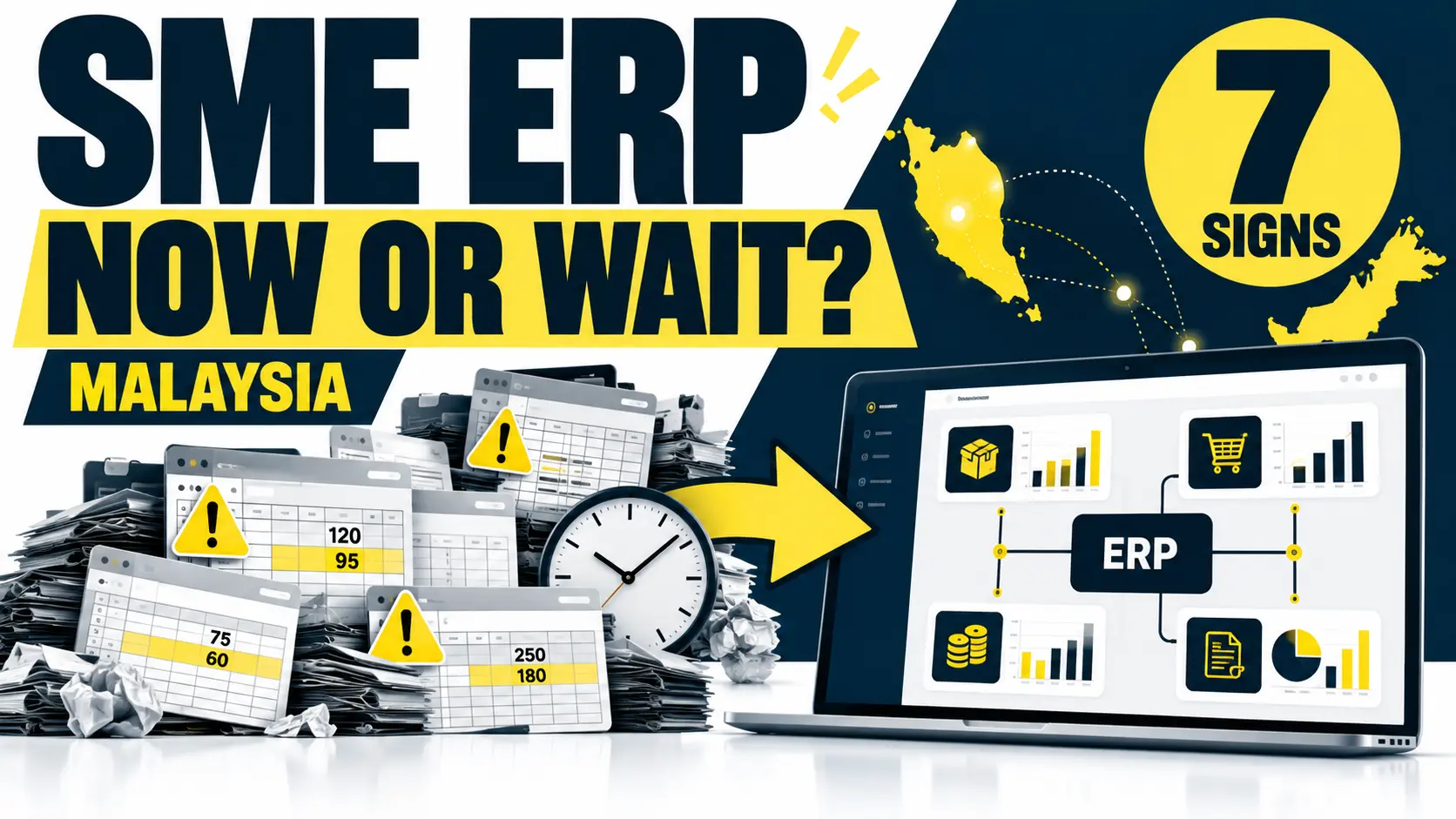
A Malaysian SME needs ERP when spreadsheets cause repeat errors and slow reports. Small teams with one sales channel and simple stock can wait. Four or more warning signs mean spreadsheets now cost more than a system.
Most Malaysian SMEs start on spreadsheets, and that is perfectly fine. The trouble starts when a second branch opens, or an auditor asks hard questions. GO-Globe builds business software for Malaysian companies. This guide shows exactly when ERP pays off and when waiting is smarter.
Contents
- 1 What Does Staying on Spreadsheets Really Cost?
- 2 Which Signs Show ERP for SME Malaysia Makes Sense?
- 3 When Is Small Business ERP Malaysia Too Early?
- 4 Do Malaysian Rules Change the Timing?
- 5 What Does ERP for SME Malaysia Include?
- 6 How Do You Choose Between Standard and Custom ERP?
- 7 How Do You Roll Out ERP Without Stopping Sales?
- 8 Not Sure Whether Your SME Is Ready for ERP?
- 9 Frequently Asked Questions
What Does Staying on Spreadsheets Really Cost?
Spreadsheets cost an SME three things: staff hours, data accuracy, and customer trust. None of these appears on an invoice. They show up as late nights, refund requests, and decisions based on last week's numbers. What did one real stock error cost you last quarter?
How Do Version Errors Reach Your Customers?
Version errors reach customers through quotes, stock counts, and delivery dates. Two staff members edit two copies of one file. Both copies look perfectly correct. Picture sales promising 40 units while the warehouse holds 12. The customer hears the promise first and the correction second.
A shared spreadsheet has no approval step for changes. Anyone with edit access can overwrite a price, a formula, or a supplier name. Nobody sees the change until a number looks wrong. By then, the invoice is out. Fixing it costs more than preventing it.
What Happens When One Person Holds the Spreadsheet Knowledge?
Key-person risk is the exposure created when only one employee understands a critical file. The formulas live in one head. The file lives in one folder. When that employee takes leave or resigns, month-end reporting stops for days. Nobody else can rebuild the logic quickly.
Picture the finance executive who built the stock tracker. She links twelve tabs by hand, and nobody else dares open the file. Her notice period becomes a countdown for the whole company. An ERP system stores the logic centrally, so the process survives staff changes.
How Do Stale Numbers Slow Decisions?
Stale numbers slow decisions because managers wait for someone to compile the latest figures. A report built by hand on Friday describes Monday's business. Reorder calls, credit approvals, and price changes all rely on that picture. How often do you decide first and check later?
Picture a manager approving a large order on Tuesday. The stock sheet updates on Thursday. The credit sheet updates monthly. She approves on instinct, and instinct has limits. Live ERP data replaces instinct with a current number. Every approval rests on the very same facts.
Where Does Month-End Time Go?
Month-end closing means reconciling sales, purchases, stock, and bank records into final accounts. On spreadsheets, staff copies data between files to finish the job. Each copy adds a chance for error. Each fix adds an hour or more. The close drags into the second week.
Purchasing shows the problem very clearly. Orders sit in one file, supplier invoices in another, and delivery notes in a third. Matching them by hand eats up whole afternoons. A dedicated procurement system keeps purchase orders, invoices, and receipts together. Matching then takes only minutes.
Add the three costs together. The total grows with every new customer, product, and branch. Effort on spreadsheets rises in a straight line, but errors rise faster. The question stops being whether you can afford ERP. It becomes how long you can afford to wait.
Which Signs Show ERP for SME Malaysia Makes Sense?
ERP makes sense for an SME when four or more of the seven signs below apply. This guide uses a simple count because one sign is a plain, passing nuisance. Four signs mean the business has clearly outgrown spreadsheets. The cost then compounds every single month.
- Stock counts differ between the spreadsheet and the shelf.
- Month-end closing takes more than five working days.
- Two or more people edit the same file every day.
- Customer, order, and invoice data sit in separate files.
- Managers wait for reports that staff build by hand.
- One employee holds the only working copy of a key formula.
- A second branch, warehouse, or online store adds new data sources.
Customer data deserves attention first. When inquiries, quotations, and orders live in separate files, nobody sees the full customer history. A CRM system holds the contact record, while ERP holds the order and the invoice. Together they answer one question: who bought what, and when?
Scoring takes ten minutes. Mark each sign true or false for the last 90 days. Zero to three marks mean the current setup still holds. Four to seven marks mean the cost of waiting exceeds the cost of change. Be honest, because nobody else checks.
Picture a Penang electronics distributor that scores itself. Stock counts differ, closing takes eight days, and three people edit the price list daily. That makes three marks already. A fourth, the new online store, tips the decision. One sign alone never would have done that.
When Is Small Business ERP Malaysia Too Early?
Small business ERP in Malaysia is too early when fewer than four warning signs apply. Daily processes stay simple at that point. A five-person trading firm with one sales channel and one stock location gains little. Tidy spreadsheets and basic accounting software handle that workload.
Which Businesses Can Wait Another Year?
Businesses can wait in three situations. They sell from one location. They hold stock in one place. They employ fewer than 10 people. Data volume stays small. One person still sees the whole operation. Daily conversations replace system reports. Nothing important slips through the cracks.
Waiting still needs a plan. Set a clear trigger in advance. Examples include a second sales channel, a fifth operations hire, or an e-Invoice requirement. A written trigger turns a vague worry into a decision date. Review it every quarter, and update the score honestly.
Accounting software covers invoices, ledgers, and tax reports. ERP adds stock, purchasing, and workflow control within one shared database. Many SMEs bridge the gap with basic accounting software at first. They move to ERP when stock or purchasing errors persist despite repeated careful manual checking.
What Should You Fix Before Buying ERP?
Fix the process before buying software. ERP copies your workflow into code, including its flaws. A broken approval chain stays broken after go-live. Map how an order moves from first inquiry to final payment. Remove duplicate steps. Then decide which steps the system must handle.
Clean data matters just as much. Duplicate customer names, inconsistent product codes, and outdated supplier records move into the new system. Data migration is the transfer of existing records into the ERP. Cleaning records before migration is much faster than cleaning them inside a live system.
Do Malaysian Rules Change the Timing?
Malaysian e-Invoice rules change the timing for many SMEs. LHDN rolls out MyInvois in phases by annual turnover. Phase 4 began on 1 January 2026 for turnover between RM1 million and RM5 million. Businesses below RM1 million are currently exempt. Check your own bracket first.
MyInvois validates each e-Invoice and returns a unique ID and QR code. The buyer's copy must carry both. Spreadsheet users can submit through the MyInvois portal, one invoice at a time. Bulk upload also works. Low invoice volumes suit that route. Higher volumes strain it.
ERP systems can connect to MyInvois directly through its API. Invoices are submitted as staff raise them. Staff never leave the invoicing screen. LHDN also allows submission through an appointed intermediary, such as an ERP vendor. Direct connection removes re-keying, a common source of invoice errors.
LHDN has also announced relaxation periods for some phases. Dates and thresholds have changed more than once. Check the current LHDN e-Invoice timeline before fixing a go-live date. Then confirm which phase your annual turnover places you in. Your accountant can help you confirm it.
What Does ERP for SME Malaysia Include?
ERP (Enterprise Resource Planning) is software that links finance, stock, sales, purchasing, and HR. Every department reads and writes the same database. Staff enter each fact once. One entry updates every report. That single source of truth replaces the file copies behind most spreadsheet errors.
Which Businesses Count as SMEs in Malaysia?
SME Corp Malaysia sets two limits per sector. Manufacturers qualify at up to RM50 million in sales turnover or 200 full-time employees. Services and other sectors qualify at up to RM20 million or 75 full-time employees. A firm meets the definition by satisfying either limit.
Micro, small, and medium enterprises formed 96.9% of Malaysian business establishments in 2023. The source is the official Department of Statistics Malaysia. That equals 1,101,725 firms across services, manufacturing, and construction. The question of when to adopt ERP therefore applies to almost every Malaysian business.
Which ERP Modules Does a Small Business Use First?
Small businesses usually adopt finance, inventory, and sales modules first. These three modules cover invoicing, stock levels, and customer orders. Spreadsheet errors cost the most there. Purchasing, HR, and payroll follow in later phases. A phased start limits disruption and spreads training across several months.
Inventory control is the module SMEs feel first. Reorder levels trigger alerts. Stock movements update every location. Sales orders reserve units at the moment of sale. Counts stay current without manual updates. Overselling drops because the warehouse and the sales team read the same number.
Reporting improves quickly because every module feeds the same database. A manager opens one dashboard and sees sales, stock, and cash for the same day. The full feature list sits on the ERP system page for Malaysian businesses. This guide stays focused on timing instead.
How Do You Choose Between Standard and Custom ERP?
Standard ERP suits SMEs with common workflows. Custom ERP suits SMEs with unusual processes. Standard systems install faster and follow known workflows. Custom systems fit the business exactly but take longer to build. Size matters less than process. Your daily operations decide the final answer.
When Does Standard ERP Fit?
Standard ERP fits when invoicing, purchasing, and stock control follow typical patterns. Trading, retail, and distribution firms fall here. The vendor has already solved the common problems. Staff adapt to the system instead of the system adapting to staff. Setup focuses on configuration and migration.
When Does Custom ERP Fit?
Custom ERP fits when a core process has no standard equivalent. Examples include project-based billing, multi-stage production, and unusual sales commission rules. Forcing those into a standard system creates workarounds, and workarounds recreate spreadsheets. Custom software development builds the exact workflow directly into the system.
What Should You Ask a Vendor Before Signing?
Ask whether the system connects to MyInvois. Ask who owns the data. Ask how long implementation takes. Request a written list covering data migration, integration, staff training, and support after launch. Those four items decide whether the system gets used. Vague answers signal early trouble.
Ask for a demo built on your own data, not sample data. Bring your busiest spreadsheet and your worst month-end. A vendor who can't reproduce your real process on screen won't reproduce it in production. Watch closely how the system handles each of your exceptions.
How Do You Roll Out ERP Without Stopping Sales?
A phased rollout moves one process at a time. Sales and delivery continue during the change. Start with the process that causes the most errors. Run the old spreadsheet and the new system side by side for one month-end. Compare totals before retiring the file.
Which Process Moves First?
Start with the process that hurts most and touches the fewest people. For many SMEs, that process is stock control or invoicing. A narrow first phase proves the system works. Staff see a real benefit very early, and trust builds before the larger modules arrive.
Connect sales channels in the second phase. If you sell online, link your e-commerce platform directly to ERP. Orders and stock levels then flow into ERP automatically. Nobody retypes a single order. The website and the warehouse show the same stock figure at all times.
How Do You Get Staff to Use It?
Staff adoption decides ERP success more than software features. Train each team on its own tasks, not the whole system. Name one owner per module. Collect questions during the first 30 days and answer them fast. People return to spreadsheets when the system feels slower.
Measure the change against the signs you scored earlier in this guide. Recount stock errors, count the days to close the month, and time the report cycle. Numbers show whether the project works. The same numbers justify the next phase to owners and finance teams.
Which Mistakes Delay an ERP Project?
Three mistakes commonly delay ERP projects. Teams skip data cleanup. They train only managers. They retire spreadsheets before the first reconciled month-end. Same root. The business treats ERP as a software purchase instead of a change in daily habits. Plan for the daily habits first.
Not Sure Whether Your SME Is Ready for ERP?
GO-Globe starts ERP projects with a business analysis of your current processes. The team builds custom ERP and connects it with your existing business tools. The services also include data migration and ongoing support. You leave knowing which of the seven signs apply to you.
Bring your busiest spreadsheet and your seven-sign score. Book a strategy session with GO-Globe to review both together. If the score says wait, you leave with a trigger point and a review date. If the score says move, you leave with a clear first phase.
Frequently Asked Questions
What is ERP for an SME in Malaysia?
ERP is software that links finance, stock, sales, and purchasing in one database, so a Malaysian SME enters data once and every report updates.
When does an SME need ERP?
When four or more warning signs appear, such as stock mismatches, slow month-end closing, duplicate data entry, and new branches or sales channels.
Can a small business keep using spreadsheets?
Yes, while it has one location, simple stock, and a small team. Problems start when several people edit the same shared files every single day.
Is ERP compulsory for e-Invoice in Malaysia?
No. LHDN allows submission through the free MyInvois portal. ERP can connect to MyInvois directly, which suits businesses with higher invoice volumes.
Does ERP replace accounting software?
ERP usually includes accounting and adds stock, purchasing, and HR, so many SMEs retire their separate accounting software after they adopt it.