


































...

Business Process Automation in Dallas

GO-Globe builds business process automation for companies in Dallas. We have delivered more than 800 projects for clients in over 25 countries since 2005.

Most automation programmes do not fail on technology. They fail because the wrong process was chosen first, or because nobody measured the process before changing it, so nobody could prove afterward whether it had actually improved.

This page is about the decisions that come before the build: where to start, how to work out the return, where the savings actually come from, and whether to buy software or build something.

  • Group 39441
    Group 41591
    Group 38992
    Group 38412
  • Group 39422
    Group 4170
    Group 4171
    Group 3943
  • Group4
    Group 41644
    Frame4
    Group 4172
    Group 41674
    Group 41664
    Frame4
    jar3OT.tif
    Frame
  • layer1
    Group 4174
    Group 4175
    Group 4176
    Group 4177
    Group 4178
    logo
    Frame
    Frame
    Group 4179
    Group 4169
About GO-Globe

Top quality, technology innovation, modern systems since 2005

GO-Globe leads in Corporate Web Apps, Custom Development, E-Commerce, ERP, AI Innovations, Branding, Hosting, and Business Advice.
Our expertise covers custom web design & development, mobile apps, e-commerce, VR/AR, AI ChatBots, and top consultancy. We serve various industries globally.
Founded in 2005 in Dubai, our clients include businesses, governments, royal families and charities. They all benefit from our profit-focused approach and fair policies.
Boost your profits with GO-Globe – your partner in innovation and growth!

What Business Process Automation Is

Business process automation is the use of software to run multi-step business processes with less manual handling. As a discipline, it covers more than the software itself. It covers how a business decides where to automate, in what order, and what it should reasonably expect back.

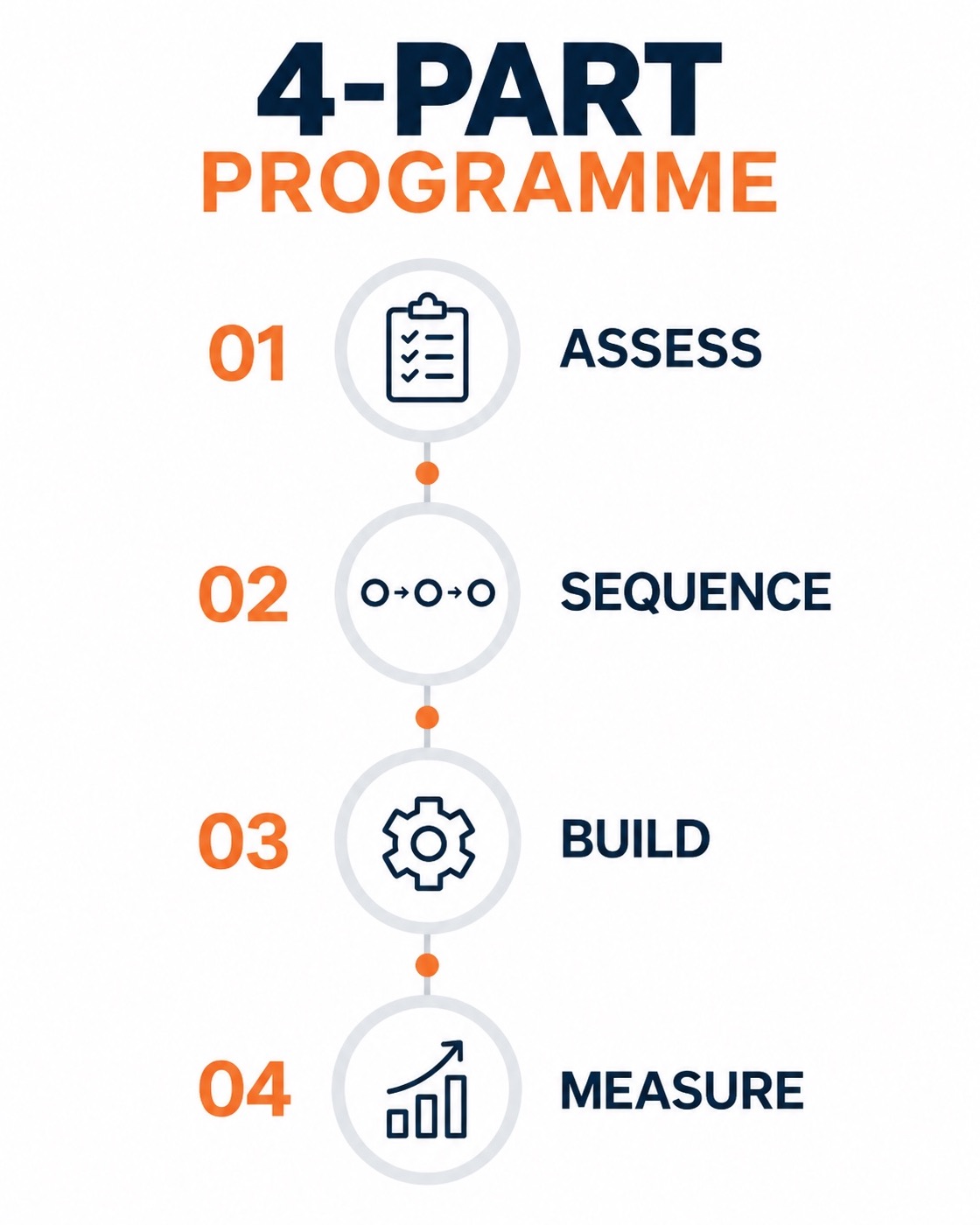
A real automation programme has four parts: an assessment of where manual effort concentrates, a decision on sequence, the build itself, and a measurement against numbers agreed before work started. Programmes that skip the first and last parts are the ones that disappoint.

Two things it is not.

It is not a single tool. No product automates a business on its own. Automation is a series of decisions about which work should stop being done by hand, made in an order that matches the business, not the software vendor's roadmap.

It is not a one-off project. The first process automated changes how the next one should be designed. Businesses that treat automation as an ongoing programme, with a sequence and an owner, get considerably more out of it than businesses that treat it as a single purchase.

Talk to an Automation Specialist

Where to Start: Finding the Right Process in a Dallas Business

This is the decision that determines whether the programme actually works, and it's usually made badly.

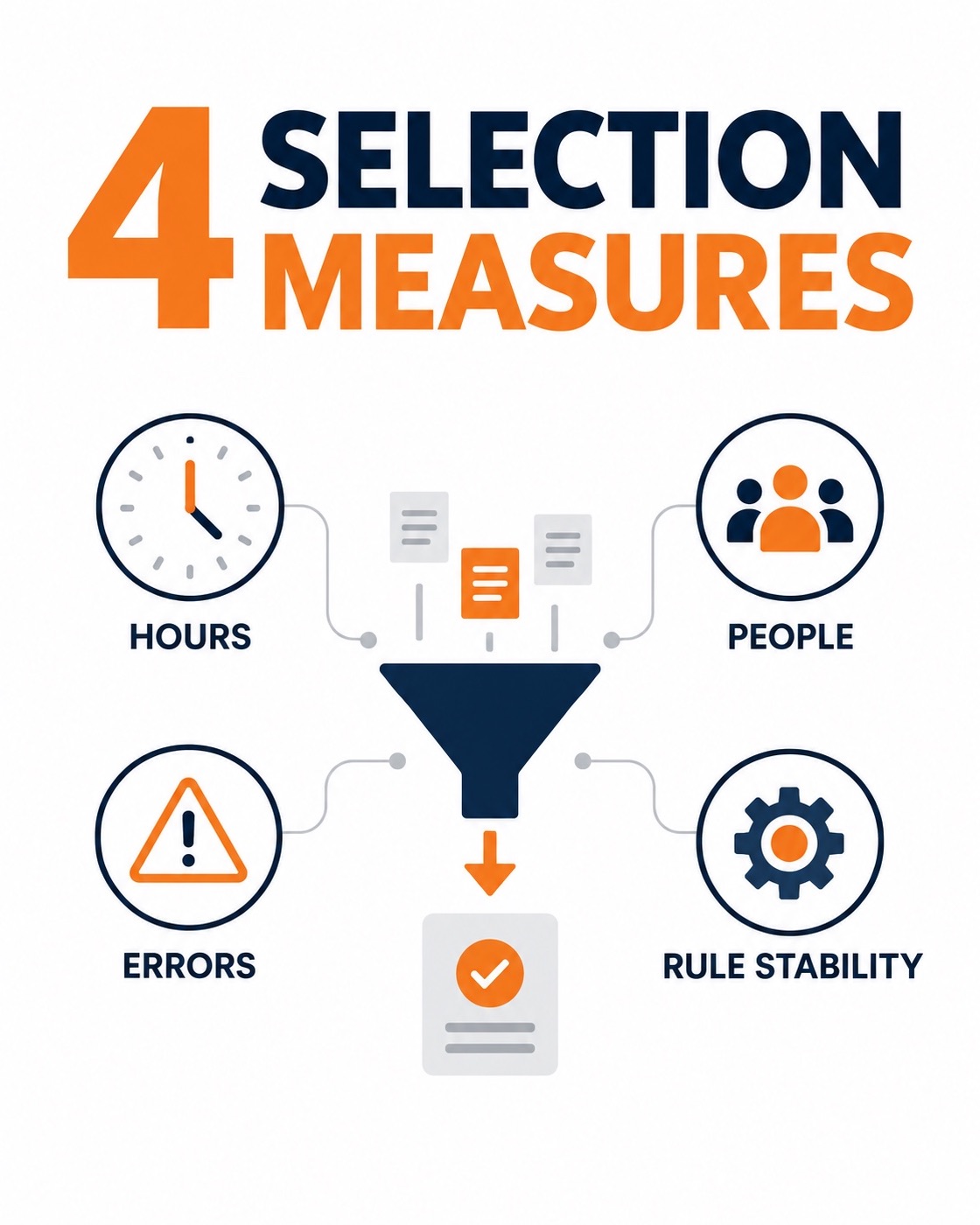
Score every candidate process on four measures: how many hours a month it consumes, how many people touch it, how often it produces errors or rework, and how stable its rules are. The right first process scores high on the first three and high on stability.

In Dallas specifically, those hours concentrate hard in a few places: finance, procurement and logistics coordination. Given the metro's real weight in freight, energy and manufacturing, that usually means invoice handling, purchase order approvals and shipment documentation, which is exactly why supplier portals and structured approval workflows are so often the first thing an automation programme touches here.

The three wrong ways to choose a first process:

  • The loudest complaint. The process people complain about most is often the one they find most tedious, not the one costing the most.
  • The most complex process. Starting with the hardest thing is how programmes stall before delivering anything at all.
  • Whatever the software happens to do well. If a vendor has already decided which process you should automate, they chose based on their product, not your actual costs.

Establish the baseline before anything gets built. Count the hours the process consumes now, the errors it produces now, and how long it takes end to end right now. Without those three numbers, there is no way to demonstrate a return later, and the programme gets judged on impressions instead of results.

Identify Your First Automation Opportunity

How to Calculate the Return

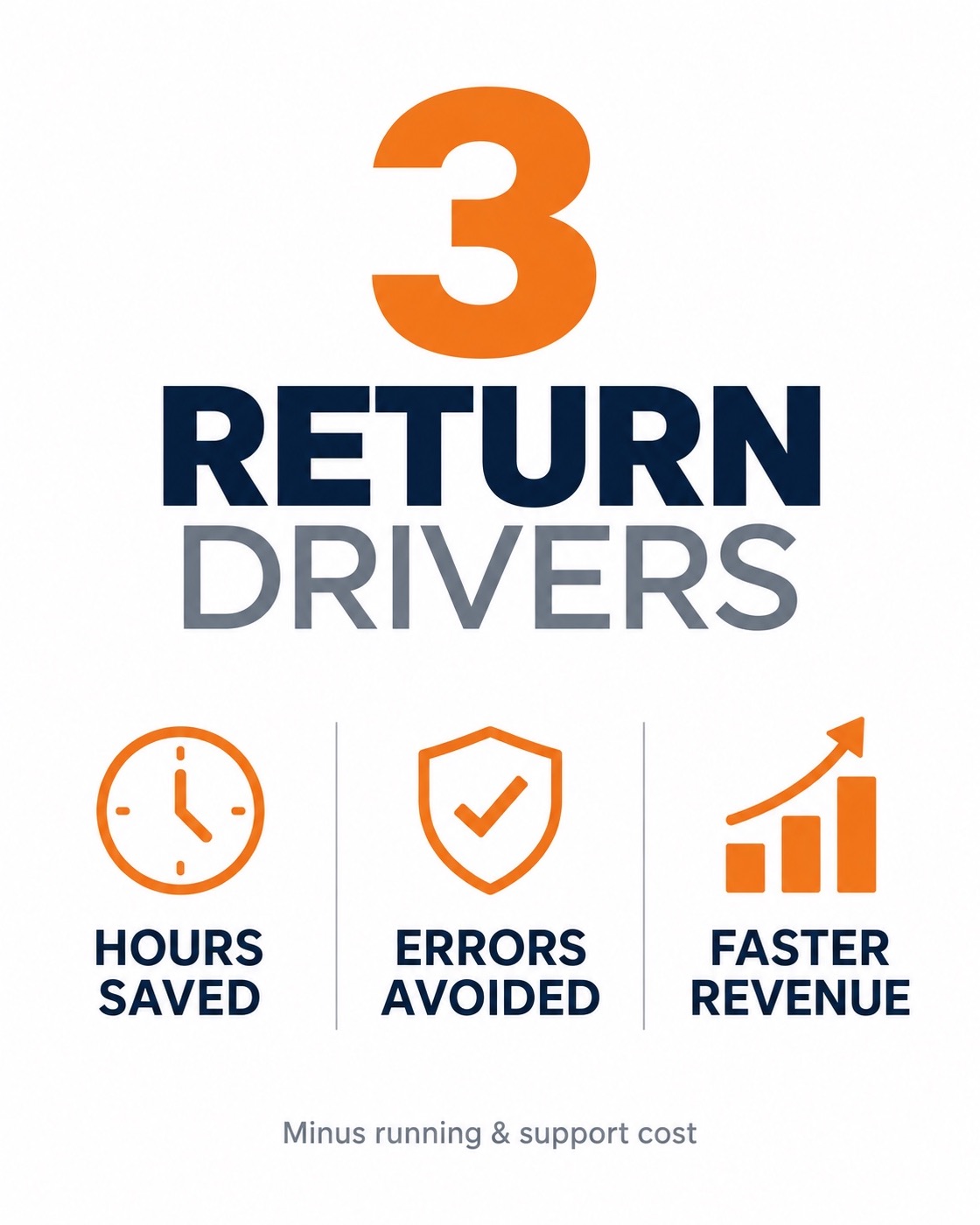
A realistic automation business case counts three things: staff hours removed, errors avoided, and revenue that arrives sooner because a step stopped waiting on someone's inbox. It then subtracts the running cost of the automation, which is never zero.

The working version:

Annual return = (hours saved per month × 12 × fully loaded hourly cost) + (annual cost of errors avoided) + (value of faster cycle time) − (annual running and support cost)

Fully loaded cost means salary plus employment costs plus overhead, not the hourly wage on its own. Leaving that out understates the case every time.

Three things that get counted wrongly:

Hours saved that are not actually saved. If automation removes six hours a week from a role and nothing changes about what that person does next, the business hasn't saved money, it's created capacity. Capacity is only worth money if it's redeployed to revenue-generating work or avoids a hire. Say which one it is in the business case.

Running cost treated as zero. Every automation carries hosting, support, monitoring and the occasional fix. A business case showing no ongoing cost has not been finished.

Errors ignored because they are hard to count. They are usually the largest number in the case. A duplicate payment, a missed renewal, a compliance finding, a shipment documented wrong. These carry real costs, and most businesses have never actually totalled them.

On payback period. Most single-process automations should pay back within twelve months. If a business case only works over a three-year horizon, the process chosen is probably the wrong one to start with.

Calculate Your Automation ROI

Where the Cost Savings Actually Come From

Automation is usually sold on labour cost. That is rarely where the largest saving actually sits.

Four sources of saving, roughly in order of size:

  • Errors and rework. The largest saving in most automation projects isn't the salary cost of the work removed, it's the cost of the errors that work produced. Manual data entry carries a well-established error rate, and every error carries a correction cost several times the cost of doing it right the first time.
  • Cycle time. When an approval that took four days takes four hours, invoices go out sooner and cash arrives sooner. For a business managing tight working capital, or a logistics operation where a delayed approval means a delayed shipment, this is often worth more than the staff hours themselves.
  • Avoided hiring. Growth normally requires more administrative headcount. Automation lets volume grow without that step, which matters directly for a Dallas-Fort Worth market where fast-growing companies, the metro raised roughly $1.6 billion in startup funding in 2025, are adding volume faster than most.
  • Staff hours. Real, but usually the smallest of the four, and the one most likely to be overstated.

A point worth being direct about. Automation rarely reduces headcount, and a programme sold internally on headcount reduction usually damages the trust it needs from the staff whose cooperation it depends on. What it reliably does is stop administrative work growing at the same rate as the business. That's a more defensible case, and an easier one to actually deliver.

Find Your Automation Savings

Build or Buy

Every automation programme reaches this decision, usually more than once.

Buy packaged software when Build custom when
The process is standard across your industry The process is part of why customers choose you
A mature product already fits most of it Fitting a product would need heavy customisation
You're willing to change your process to match the software Changing the process would damage something that works
Speed matters more than exact fit You already own systems that must be connected
Licence cost over five years is lower than a build Licence cost over five years exceeds a build

The question is not which approach is better. It's whether the process is one you want to be the same as everyone else's, or one that's part of why customers choose you. Standardise the first. Build the second.

Most Dallas businesses end up with both. A packaged ERP system or CRM system handles the standard work, and custom business applications handle the parts that make the business different. The integration between them is where most of the value gets created, and it's also where most programmes underestimate the work involved.

One caution on licence math. Compare over five years, not one. Per-user licensing looks inexpensive at twenty users and looks very different at two hundred, a real consideration for the fast-growing companies in Dallas's startup and mid-market scene. Model the cost at the headcount you expect to have, not the one you have now.

Choose the Right Automation Approach

Case Study: Al Dar Exchange

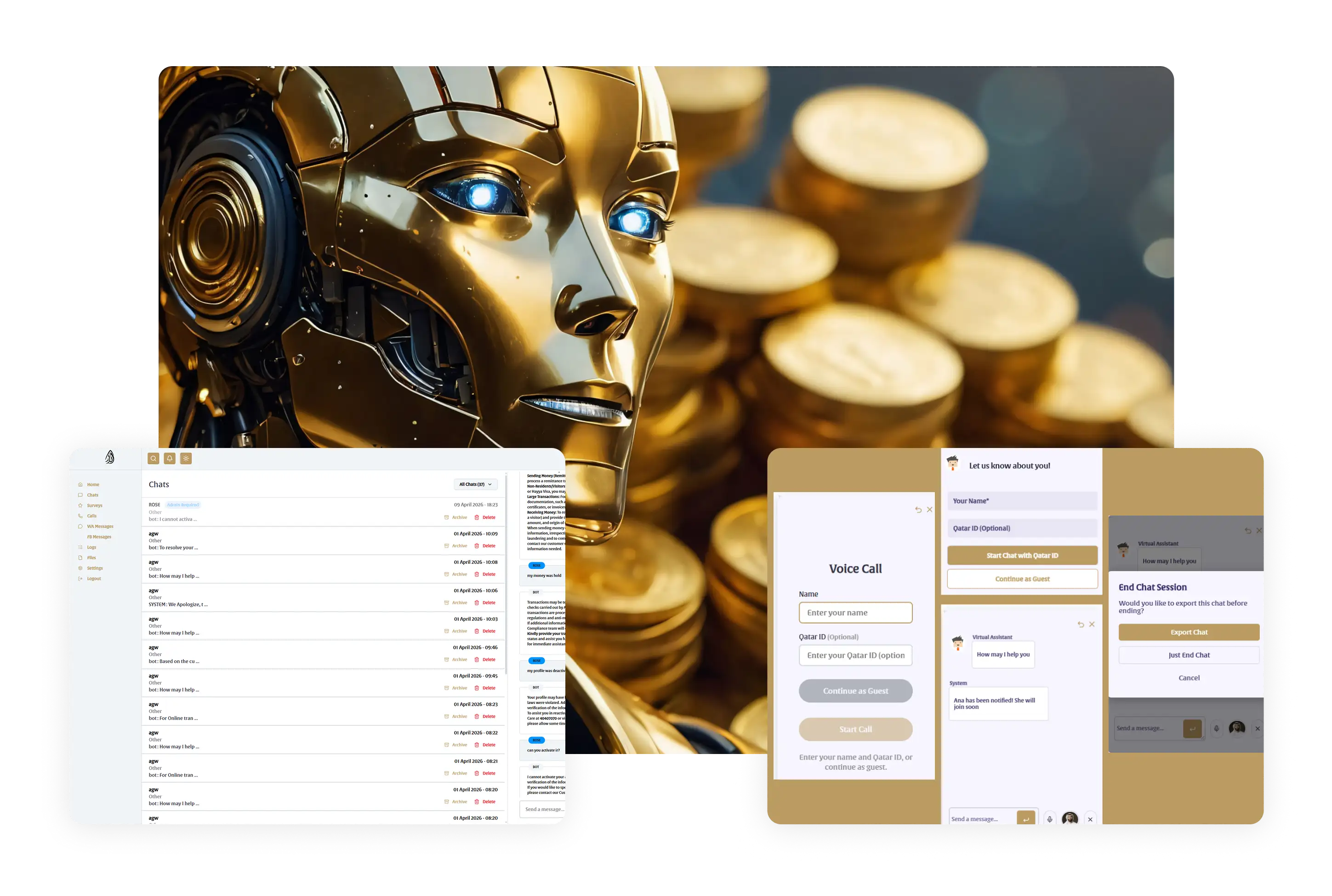
Al Dar Exchange handled customer enquiries across three separate channels, website chat, WhatsApp and telephone, and none of the three shared a record with the others. A customer who started a conversation in one channel and continued it in another had to start over, and the business had no single view of what had actually been asked or answered.

The consequences were the usual ones: high support cost, slow replies, and sales enquiries lost because nobody picked them up in time.

GO-Globe unified all three channels into a single platform, with a shared dashboard covering every conversation, an AI assistant handling first response in multiple languages, and a clean handover to a person when a question actually needed one.

Manual office workload fell by 70%. Three channels now run as one platform, with automated first response available 24 hours a day.

Mapped against the four sources of saving above, the largest share of that gain wasn't staff hours, it was the errors and delay that came from a fragmented process in the first place. That's the pattern worth noticing: the biggest automation win is rarely the one a business expected walking in.

Discuss a Similar Automation Project

Why Automation Programmes Fail

Five reasons, roughly in the order we see them.

  • The process was broken before it was automated. Automating a bad process just makes it produce bad output faster, and removes the human judgement that was quietly compensating for the flaws. Fix the process first, then automate it.
  • Nobody measured the baseline. The most common cause of a failed programme isn't technical, it's that nobody measured the process before automating it, so nobody can say afterward whether it actually improved. The programme then gets cut at the first budget review because it can't defend itself.
  • The hardest process went first. Ambitious first projects take longer, cost more and deliver later, exactly the profile that loses internal support before the second project even starts.
  • No owner after launch. Automations need someone whose job includes them. Rules change, systems update, edge cases appear. An automation with no owner degrades quietly until someone notices it's been producing wrong output for months.
  • It was run as an IT project. Automation changes how people work. The people doing the work need to be involved in designing the replacement, not informed once it's already built. Programmes run entirely out of IT hit resistance that has nothing to do with the technology itself.
Plan a Successful Automation Programme

Our Business Automation Services in Dallas

The automation work GO-Globe delivers in Dallas falls into three stages: working out what to automate, building it, and owning it once it's live.

Assessment and advisory

  • Process automation consulting: mapping how work currently moves, scoring each process, and recommending a sequence
  • Automation opportunity assessment across a department or the whole business
  • Business case and return modelling against a measured baseline
  • Build versus buy advisory, including licence cost modelled over five years, not one

Build

  • Custom business system development
  • ERP and CRM integration
  • AI agents for processes that need interpretation rather than fixed rules
  • Integration with platforms you already own, where they already fit

After launch

  • Ownership, monitoring and support
  • Sequencing the next process using what the first one taught us

Most engagements start with the assessment. A business that already knows which process it wants fixed can go straight to the build, though we'll still insist on measuring the baseline first, since without it, nobody can prove afterward that the work paid for itself.

All of these services are delivered remotely for Dallas clients, with a named point of contact and an agreed schedule of updates.

Explore Business Automation Services

Choosing a Business Automation Company in Dallas

Firms presenting themselves as a business automation company in Dallas fall into three groups. They are not interchangeable, and the difference matters more than price.

Connector specialists wire existing tools together. Fast and inexpensive when the tools are mainstream and the volume is modest, limited when they are not.

Software resellers implement a specific product. Strong on that one product, and structurally unable to tell you it's the wrong choice, since their revenue depends on the licence.

Custom builders develop systems to fit the process. More expensive up front, appropriate when the process is genuinely yours.

GO-Globe is in the third group, and integrates the first where it fits. We do not resell licences, which means there's no financial reason to recommend one platform over another.

Six questions that separate a business automation company quickly:

  • Will you tell me not to automate something? A firm that has never talked a client out of a project is selling, not advising.
  • Do you start with an assessment or with a solution? If a proposal arrives before anyone has watched the process being done, it's a product pitch.
  • Will you commit to a baseline measurement? Anyone confident in the outcome will agree to be measured against numbers taken before the work starts.
  • Who owns this after launch, and what does that cost? Get it in writing at the start.
  • Can you show me a business case rather than a feature list? Features describe what the software does. A business case says what changes, and what it's actually worth.
  • Do you earn commission on any software you recommend? Not disqualifying on its own, but worth knowing before weighing the advice.
Talk to a Business Automation Expert

Why Dallas Businesses Work With GO-Globe

Twenty years of building business systems. Founded in 2005, more than 800 projects delivered since.

International scale. Clients in over 25 countries across corporate, government and enterprise sectors.

Enterprise experience. Systems delivered for organisations including Shell, Nestlé, LG and Dubai Municipality.

No licence revenue. GO-Globe does not resell software, so the recommendation isn't decided by what pays us more.

Custom first, platform when it makes sense. We build where the process is genuinely yours, and integrate existing products where they already fit.

A named stack. Node.js, PHP (Laravel), React, .NET, REST APIs, PostgreSQL, MySQL, AWS and Azure. You always know what your systems are built in and who can maintain them.

Talk to us. Call +1 571 208 8604 or book a strategy session.

Discuss Your Automation Project

Frequently Asked Questions

Wondering what you’ll get, how we deliver, and what results to expect? This FAQ covers our process, tech stack, compliance approach, and post-launch support. GO-Globe helps unify systems into one intelligent hub — so employees, customers, and partners get what they need instantly.

Business process automation is the use of software to run multi-step business processes with less manual handling. For a Dallas business the benefit is usually threefold: administrative work stops growing at the same rate as the business, errors and the rework they cause fall, and processes that used to wait on someone's inbox complete in hours instead of days.

Score each candidate on four measures: hours consumed per month, number of people who touch it, frequency of errors or rework, and how stable the rules are. Start with a process that scores high on all four. Do not start with the most complex process, and do not start with whichever one a software vendor happens to be best at automating.

Follow the manual effort. The clearest indicators are work rekeyed from one system into another, decisions that wait in an inbox, spreadsheets used as a shared record between departments, and any process where someone maintains a personal checklist because the system doesn't. Each of those is a gap between two systems that should be talking to each other.

Cost depends on how many processes are in scope, how many systems must be connected and whether those systems have usable APIs, transaction volume, and what compliance requirements apply. GO-Globe quotes after an assessment, once the processes are mapped and prioritised, and prices any change to that scope before the work is done.

Add the staff hours removed, valued at fully loaded cost rather than hourly wage, the annual cost of errors avoided, and the value of faster cycle time. Subtract the annual running and support cost. Be honest about whether hours saved are redeployed or simply created as spare capacity, since only redeployed hours are actual money. Most single-process automations should pay back within twelve months.

In most implementations, no. What automation reliably removes is coordination work: rekeying, chasing, checking and routing. What it doesn't remove is judgement, relationships and exception handling. For most businesses, the realistic effect is that administrative headcount stops growing in step with volume, rather than existing roles disappearing.

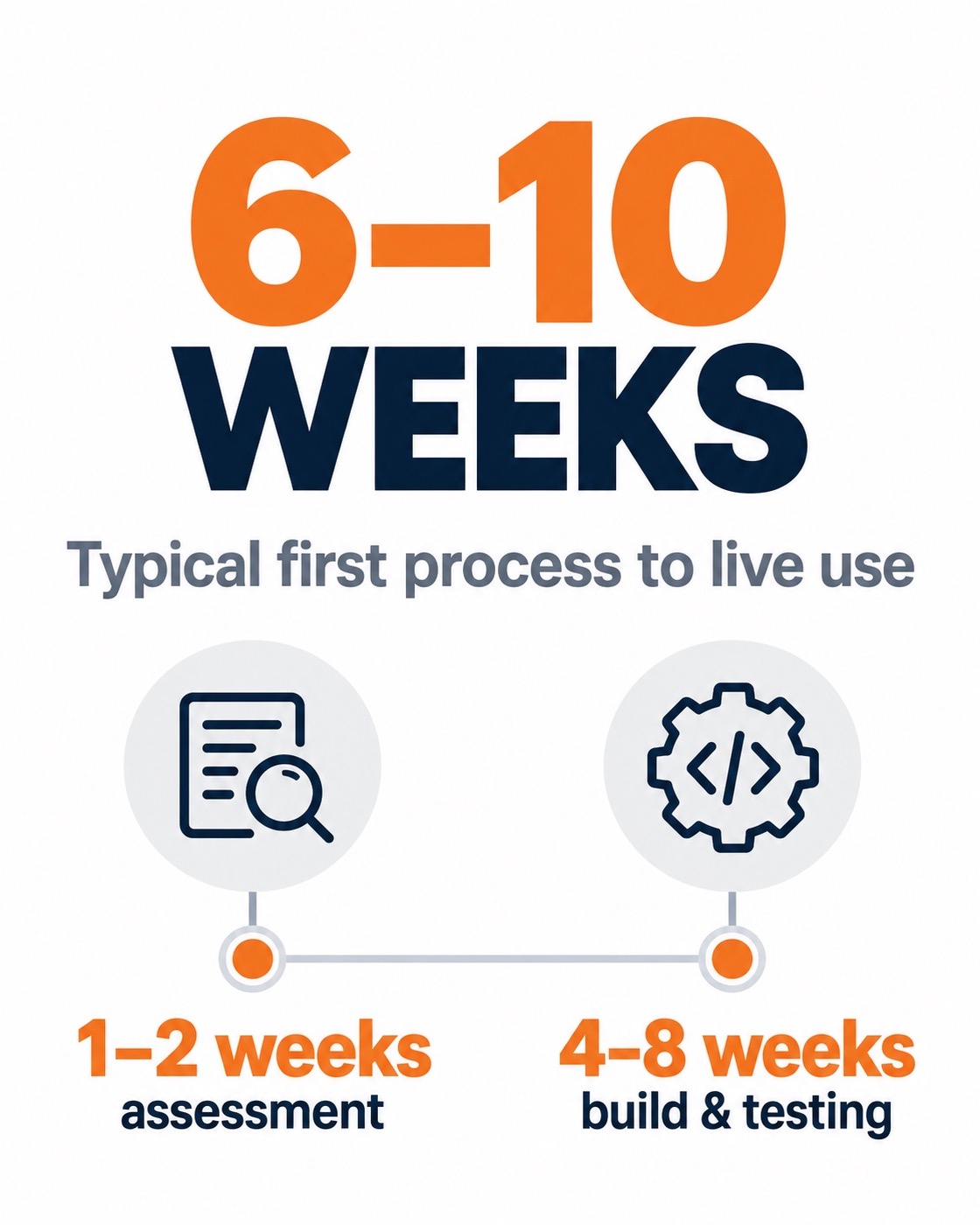
A first automated process typically reaches live use in six to ten weeks, one to two weeks of assessment and process mapping, four to eight weeks of build and testing. A full programme covering several processes runs longer and should be sequenced so each delivery funds and informs the next.

Buy when the process is standard for your industry, a mature product fits most of it, and you're willing to adapt your process to the software. Build when the process is part of what differentiates you, when fitting a product would require heavy customisation, or when licence costs over five years exceed the cost of building. Most businesses end up with both, and the integration between them is where the value gets created.

Get a Quick Call Back


    © 2005 - 2026 GO-Globe™ Driven by Your Success. Since 2005. All rights reserved.
    This site is protected by reCAPTCHA and the Google. Privacy Policy